
Mexico's Sargassum Crisis: Record Bloom Threatens Coast
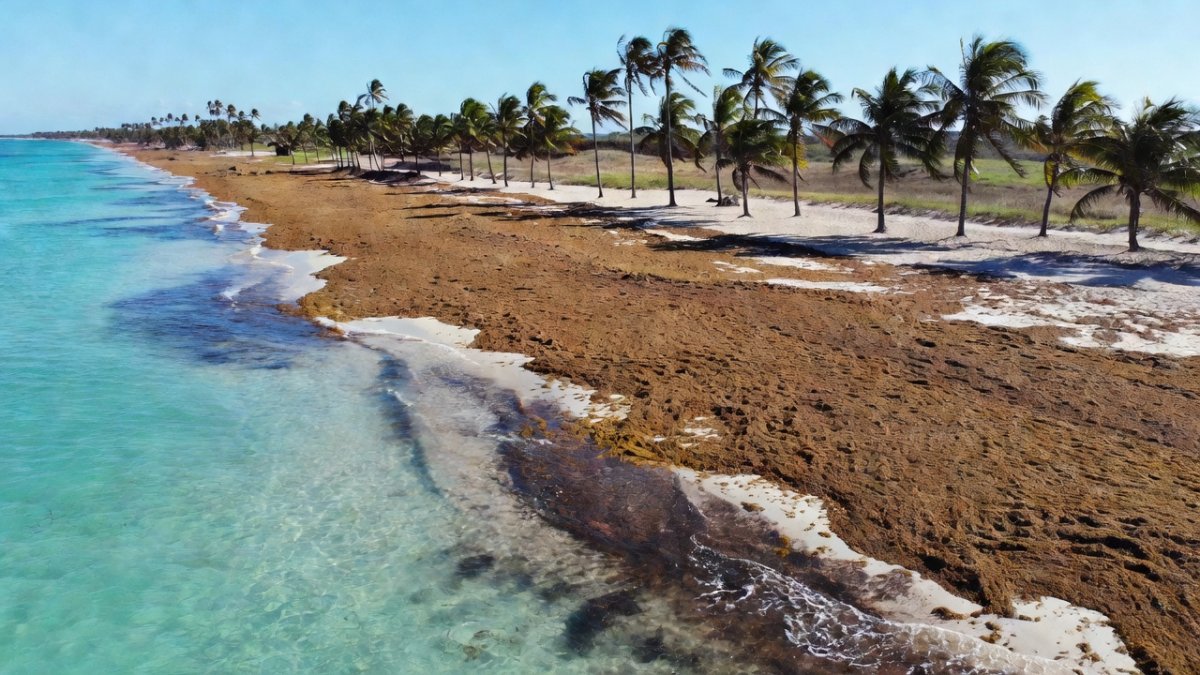
The stench hits you first — a rotten-egg sourness that clings to the back of the throat — and then the brown, tangled mass stretching along the shoreline like a wound.
The stench hits you first — a rotten-egg sourness that clings to the back of the throat — and then the brown, tangled mass stretching along the shoreline like a wound. On Playa Conchitas in Tulum, where sea turtles still nest against all odds, cleanup crews are working double shifts in late August 2026, shoveling sargassum into trucks that will haul away more than 96,000 metric tons of the stuff this year alone. This is not a new problem, but it is a worse one: the Great Atlantic Sargassum Belt is now a self-sustaining monster, and Mexico's Caribbean coast is its most visible victim.
Mexico's Caribbean Coast Battles Growing Sargassum Invasion as Record Bloom Threatens Marine Life and Tourism
Mexico City, Mexico - August 26, 2026 — The brown tide is rising again. Fresh video from Al Jazeera English, published August 25, 2026, shows large quantities of sargassum washing onto beaches across Mexico's Caribbean coast, threatening marine life and the tourism industry that sustains millions of livelihoods. The buildup is not an anomaly — it is the new normal, and the data proves it. Mexico has already collected 96,151 metric tons of sargassum in 2026, up from 92,783 tons in 2025, according to government figures cited by Reuters. The Cancun Post projects arrivals on Quintana Roo beaches could hit 100,000 tons by year's end. This is a health crisis, an economic emergency, and a Latin American climate story all rolled into one foul-smelling wave.
A New Wave Hits the Mexican Caribbean
The images from late August 2026 are stark: beaches that once advertised powder-white sand are now carpeted in thick, brown mats that stretch as far as the eye can see. Al Jazeera English's report, published August 25, 2026, documents "another major influx" of sargassum, with large quantities washing ashore and threatening both marine ecosystems and the tourism economy. This is not an isolated event. Le Monde reported on August 24, 2026, that Mexico's tourist beaches are grappling with a full-blown sargassum crisis, publishing a photograph taken August 6, 2026, of a municipal worker in Playa del Carmen removing the seaweed by hand — a Sisyphean task that repeats daily.
Travelers Today noted on August 17, 2026, that Tulum and Mahahual in southern Quintana Roo were still dealing with major accumulations in mid-August, with conditions capable of flipping within 48 hours. The Tulum Times reported on August 18, 2026, that Playa Conchitas — a critical nesting site for sea turtles — requires daily cleanup crews, even as the state logs its heaviest season on record. The Mexico Daily Post added on August 15, 2026, that oceanographic monitoring detected a large, dense patch drifting toward Riviera Maya shores. The message is clear: this is not a one-off event but a relentless assault on a coastline that generates billions in revenue.
The Science Behind the Record Bloom
To understand why 2026 is shaping up to be catastrophic, you have to look at the Atlantic Ocean as a whole. Before 2010, sargassum was largely confined to the Sargasso Sea, a calm, nutrient-poor region east of Florida. But strong winds around 2010 blew the seaweed into nutrient-rich tropical waters off West Africa, and everything changed. The Great Atlantic Sargassum Belt was born — a self-sustaining mass that now rides currents to northern Brazil, the Caribbean, the Riviera Maya, and the Gulf of Mexico, according to Reuters. It feeds on a cocktail of nutrients from the Amazon, Orinoco, and Congo rivers, deep-ocean upwellings, Saharan dust, and warming seas.
Brian Barnes, a research assistant professor at the University of South Florida College of Marine Science, has tracked this explosion with alarm. Sargassum went from 1 million metric tons in 2011 to 40 million tons last year — a figure that could double every five years. The USF Optical Oceanography Lab expects 2026 to be at least the second-largest year on record, driven by a large carry-over bloom from 2025 and elevated nutrient levels. Popular Science reports that over 9.3 million tons are already en route to Florida and the Caribbean. The Riviera Maya News noted on July 27 that the Mexican Navy alone collected 88,998 tons in Quintana Roo in 2026. The numbers are staggering, and they keep climbing.
The Hidden Health Toll on Cleanup Workers
While tourists complain about the smell, the people shoveling sargassum are paying a far heavier price. A peer-reviewed study published in the April 2026 issue of Harmful Algae is the first to directly measure hydrogen sulfide (H2S) in real time among sargassum cleanup workers. Researchers monitored 35 collectors in Puerto Morelos, Playa del Carmen, and Mahahual from June to August 2024, equipping them with chest-mounted portable sensors. The study, supported by UNAM, the University of São Paulo, and Canada's New Frontiers in Research Fund, was led by researcher Rosa Rodríguez. The findings are alarming: readings ranged from 1 to 50.8 parts per million (ppm), with 46.3% exceeding Mexico's 1 ppm eight-hour limit and 11.3% exceeding the 5 ppm short-term limit.
Some readings climbed past 50 ppm — potentially life-threatening. The health consequences are severe: 46.9% of workers reported itching or burning skin, 43.8% suffered headaches, 37.5% experienced dermatitis and fatigue, and 28.1% reported eye irritation and nausea. Dizziness affected 25%, while 21.9% suffered hives and nasal congestion. Throat irritation and difficulty breathing hit 18.8%, with additional reports of vomiting, anxiety, sleep disturbances, skin infections, hair loss on legs, and even loss of toenails. These workers do 8-hour shifts, 6 days a week, for up to 9 months a year. Rodríguez singled out El Recodo beach in Playa del Carmen, where sargassum became dark sludge removable only with machinery. Her recommendations: continuous H2S monitoring, personal alarm sensors, respirators, staff rotation, excluding asthmatics from decomposition zones, and medical surveillance.
Tourism: The Region's Economic Lifeline Under Siege
Quintana Roo's economy runs on sun, sand, and turquoise water — and sargassum is strangling all three. Hotels across the Caribbean are cutting rates and investing millions in cleanup efforts, according to Reuters. The state's tourism industry depends on Cancun, Tulum, Playa del Carmen, and Puerto Morelos, destinations that draw millions of visitors annually. When the seaweed hits, bookings drop, beachfront restaurants empty, and the ripple effect is felt across the entire service economy. Governor Mara Lezama of Quintana Roo has acknowledged the severity, stating: "Experience has taught us the best way to face sargassum is to intercept it in the sea before it hits our coasts."
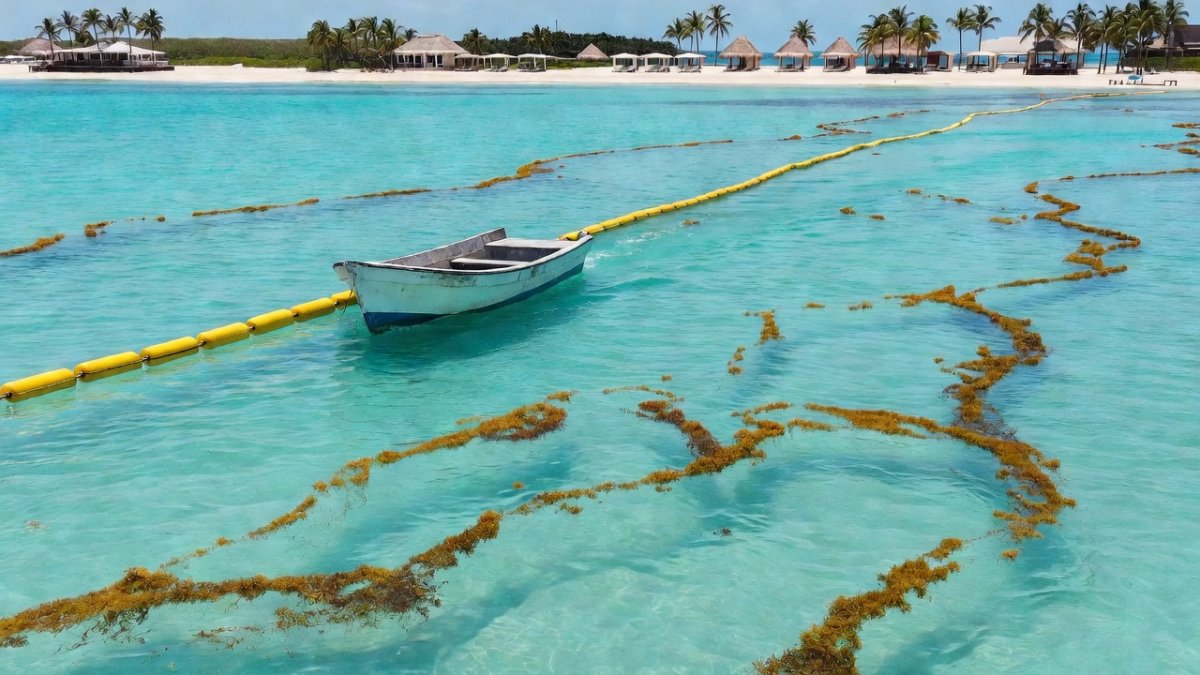
The government's response has been unprecedented. Mexico is deploying the Navy, 9,500 meters of offshore floating barriers, and thousands of beach cleanup workers — the earliest and largest response in history. The Navy has deployed 13 vessels and 191 personnel, with a new open-sea sargassum vessel expected within a month. Mexico is also sourcing more ships from Japan and supplying smaller Mexican-made vessels to the Dominican Republic. But the economic damage is already done. Travelers Today reported that conditions can flip within 48 hours, making it nearly impossible for hotels to guarantee the pristine beaches that justify premium rates. The tourism industry is fighting a war it cannot win with shovels and barriers alone.
Barriers, Boats and the Navy's Intercept Strategy
The strategy is simple in theory, brutal in practice: stop the sargassum before it reaches the shore. Mexico's Navy has deployed 9,500 meters of floating barriers offshore, designed to catch the seaweed in open water where it can be collected by specialized vessels. The Navy has 13 vessels and 191 personnel dedicated to this mission, with a new open-sea sargassum vessel expected within a month. Mexico is also sourcing additional ships from Japan, recognizing that domestic capacity is insufficient. The approach is based on lessons learned from previous years, when sargassum overwhelmed beaches and cleanup crews could not keep up with the volume.
Governor Lezama's statement reflects a strategic shift: intercepting sargassum at sea is more efficient and less damaging than removing it from beaches, where it mixes with sand and becomes toxic sludge. The barriers are designed to funnel the seaweed toward collection points, where vessels can scoop it up before it decomposes. But the system is not foolproof. Strong currents, storms, and the sheer volume of sargassum can overwhelm the barriers, allowing the seaweed to slip through. The Navy's efforts are supplemented by thousands of beach cleanup workers, but they are fighting a losing battle against a bloom that is growing every year. The question is whether technology and manpower can keep pace with nature.
When Seaweed Becomes an Industry
Amid the crisis, entrepreneurs see opportunity. Environment Minister Alicia Barcena reports that of close to 200 sargassum projects in Mexico, at least 11 have the potential to scale industrially, and 39 already produce marketable products: fuel, fertilizers, laminates, bioplastics, and even craft sandals. Carbonwave, led by executive Felix Navarrete, is already selling fertilizer abroad and has received regulatory approval from Mexico's sanitary watchdog, Cofepris. The company is expanding into cosmetics and textiles. Quintana Roo state plans to expand a biofuel plant in Cancun, while Secihti — Mexico's science council — is piloting its first industrial biorefinery to convert sargassum into biogas and bioplastics.
The Caribe Circular initiative, launched in April 2026, brings together eight business organizations, including CANIRAC and the Riviera Maya Hotel Association, to industrialize sargassum. The goal is to turn a liability into an asset, creating jobs and revenue from a problem that costs millions to manage. But there is a cautionary note. Some companies are seeking carbon credits by sinking sargassum bales to the seafloor, a practice that raises serious environmental concerns. Barnes warns that offshore sargassum is natural habitat for tons of turtles and fish, and sweeping the Caribbean clean causes collateral damage. The sargassum economy must be built on sustainable principles, not quick fixes that harm marine ecosystems.
What This Means for Latin America
Mexico's sargassum crisis is not an isolated problem — it is a hemispheric one. The same phenomenon is hitting the Dominican Republic, which is receiving Mexican-made vessels to help with cleanup. Caribbean island nations are struggling with the same brown tides, and northern Brazil is seeing sargassum accumulate on its beaches. The drivers are regional: warming seas, nutrient-rich river runoff, and changing ocean currents. The Great Atlantic Sargassum Belt is a regional crisis that demands regional solutions. Quintana Roo is the front line, but the entire Latin American coastline is vulnerable.
The implications are profound. For small island nations, sargassum can devastate fishing grounds, smother coral reefs, and destroy tourism infrastructure. For countries like Mexico, the economic stakes are enormous — tourism is a major source of foreign exchange and employment. The response must be coordinated, with shared technology, data, and resources. Mexico's decision to supply vessels to the Dominican Republic is a step in the right direction, but more is needed. Regional cooperation on monitoring, early warning systems, and cleanup strategies is essential. The sargassum belt does not respect national borders, and neither should the response.
The Bottom Line — What Comes Next
The sargassum crisis is not going away. The USF Optical Oceanography Lab expects 2026 to be at least the second-largest year on record, and the trend is upward. Mexico has collected 96,151 metric tons so far, and the projections suggest 100,000 tons by year's end. The health risks to cleanup workers are documented and severe, demanding immediate action on monitoring, protective equipment, and worker rotation. The tourism industry is bleeding revenue, and the government's intercept strategy is a necessary but insufficient response. The sargassum economy offers hope, but it must be built on sustainable practices that do not harm marine ecosystems.
The bottom line is that Latin America must adapt to a changing ocean. The Great Atlantic Sargassum Belt is a symptom of a warming planet, nutrient pollution, and shifting currents. Addressing it requires investment in science, technology, and regional cooperation. Mexico is leading the way with its Navy deployment, barrier systems, and industrial innovation, but the scale of the problem demands more. The sargassum will keep coming, and the region must be ready. The beaches of Quintana Roo are the front line, but the battle is for the entire Caribbean and beyond. The time to act is now, before the brown tide swallows the coast entirely.
By Elena Vasquez, Staff Writer
This article was produced with AI-assisted research and editorial support. Reporting is based on sources cited in the article.
What's Your Reaction?
 Like
0
Like
0
 Dislike
0
Dislike
0
 Love
0
Love
0
 Funny
0
Funny
0
 Wow
0
Wow
0
 Sad
0
Sad
0
 Angry
0
Angry
0

Latin America Correspondent at Global1.News. Based in Mexico City, covering politics, economics, energy, and culture across the region. Brings an on-the-ground perspective to stories spanning from the Rio Grande to Patagonia.















Comments (0)