
Lula Wins a Fourth Term, and Brazil's First Comeback From a First-Round Loss
Brazil's electoral authority declared Luiz Inacio Lula da Silva re-elected after a runoff in which he became the first candidate since 1988 to lose the first round and still win, beating Flávio Bolsonaro on a provisional count near 51.8 percent.
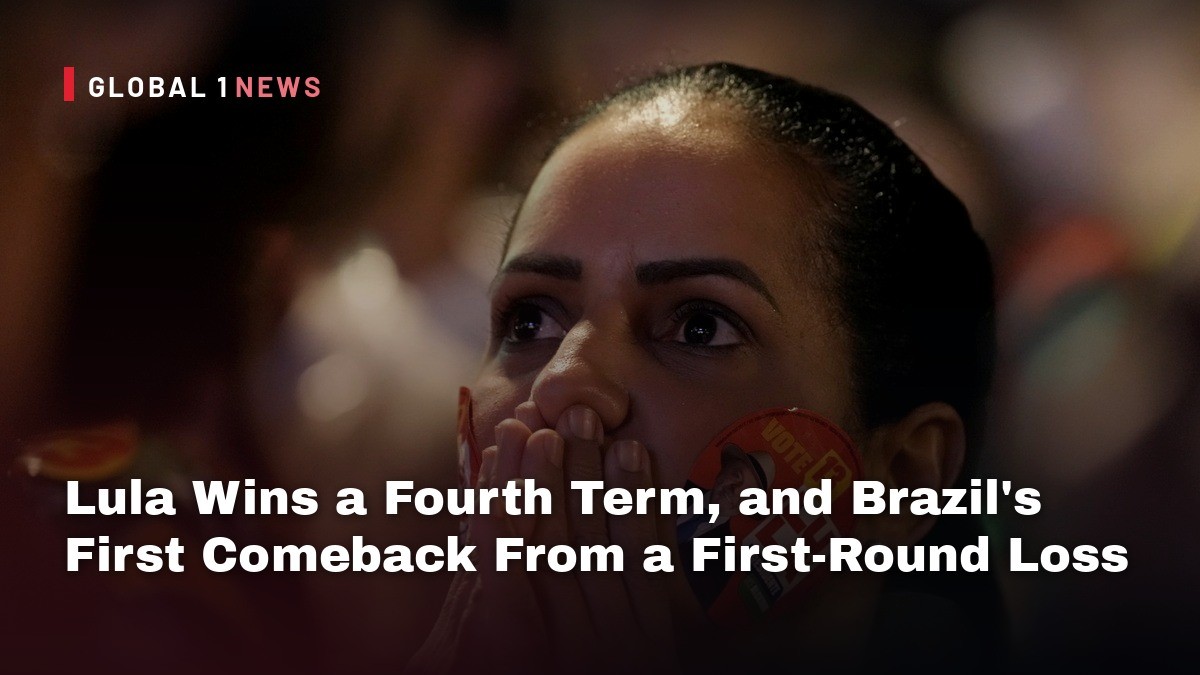
Brazil's electoral authority has declared Luiz Inacio Lula da Silva re-elected president, defeating Senator Flávio Bolsonaro in a runoff that broke a rule Brazilian democracy has kept since 1988. No candidate who lost the first round had ever come back to win. Lula, 80, now takes a fourth term into a Congress built against him, with no concession reported and the count still short of complete.
Lula Wins a Fourth Term, and Brazil's First Comeback From a First-Round Loss
Brasília, Brazil — The declaration came after a night of counting that stopped and restarted, and after a two-hour extension of voting ordered by a Supreme Federal Court justice at the request of the incumbent's campaign. Reuters logged the call at 20:11 EDT. The Guardian's running count, with 99.8% of districts in, had Lula on 51.76% to Flávio Bolsonaro's 48.24%, a gap of more than four million votes on that count.
The Count That Would Not Settle
The numbers moved all night, and they moved in one direction. The Rio Times automated feed, at 96.83% of polling stations counted at 8:09 p.m. ET, had Lula on 51.74% and Flávio on 48.26% — a gap of 4,176,278 votes. At 86.41% counted the lead was 3,096,041. The Rio Times noted the obvious: "so the lead has widened." Bloomberg Linea, citing TSE figures updated at 21h05 Brasília, had Lula on 51.62% with 91.95% of sections counted, blank votes at 1.11%. Datafolha projected a Lula win at the 80% mark, per Al Jazeera. The Guardian's latest graphic, sourced to the TSE, put Lula on 64,076,924 votes to Flávio's 59,727,910. Treat every one of those percentages as provisional. The count had not closed.
A First Round He Lost, and a Second He Won
On 4 October, Flávio Bolsonaro beat Lula outright. The TSE's final first-round result gave the senator 56,104,503 votes, 47.03% of valid votes, to Lula's 53,879,538, or 45.16% — a gap of 2,224,965 votes, 1.87 points. Neither cleared 50%, so the race went to a runoff, as every presidential election has since 2002. The BBC called it the tightest first round since 1989, the first direct presidential vote after the military dictatorship. Reporting carried by Tasnim put the first-round gap at under 2% of the vote, the narrowest ever recorded at that stage. The Inter-American Dialogue stated the stakes plainly: "Since 1989, no candidate who finished second in the first round has gone on to win the runoff." Abstention ran at 21.08%, about 33.4 million voters, the highest in a first round since 1998, per the Inter-American Dialogue and G1.
Two Hours That Changed the Night
Polls were due to close at 5pm Brasília time. Supreme Federal Court justice Cristiano Zanin ordered voting extended nationwide by two hours, to 7pm, granting a request from Lula's campaign, as reported by the Guardian and BBC. The TSE paused publication of results, then resumed after 7pm. A polling-station volunteer in São Paulo, Sofia Duarte, told the BBC the electronic machines had already been boxed when the order came: "No one told us anything... we connected the dots that maybe we would have to reopen the machines - but how?" She added: "No one knew how to act. This had never happened before and no one knew how to proceed." The BBC noted the machines were already in boxes when the extension was announced.
"Something Abominable Is Happening"
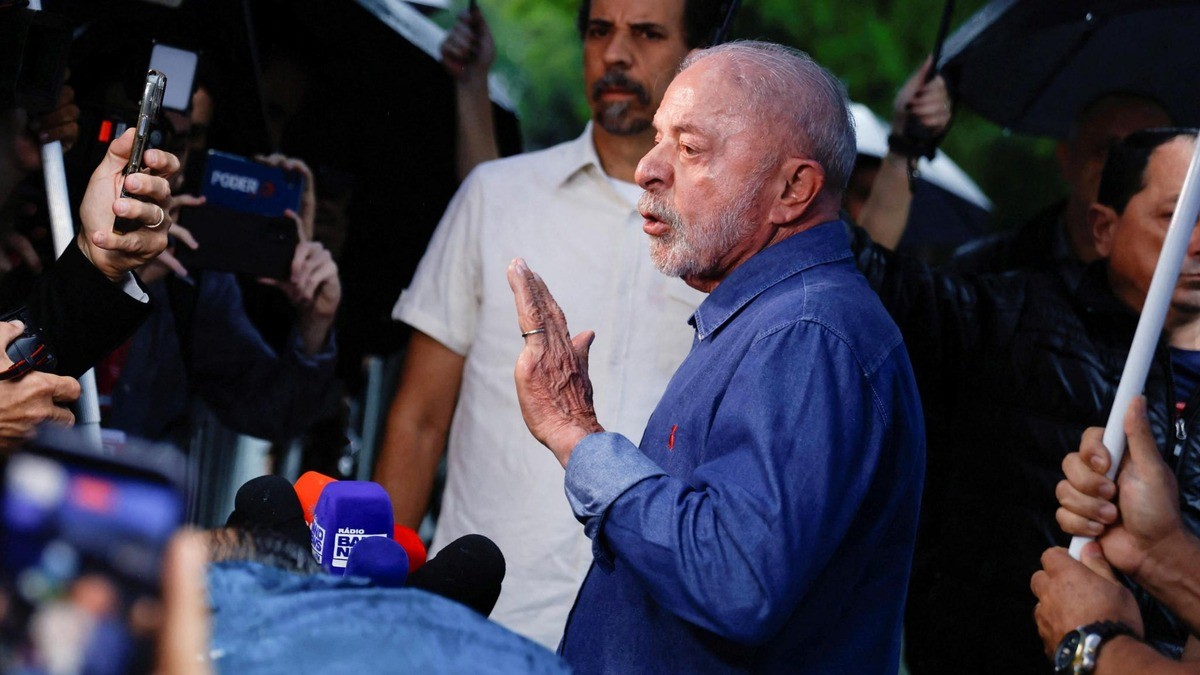
Lula's campaign alleged voter suppression, saying authorities in several cities were restricting access to public transport, per the Guardian, which reported allegations in at least 10 states. Lula told reporters: "Whether I won or lost, I'd just accept it and get ready for the next one. But this time, something abominable is happening." Flávio's camp called the extension "a disgrace," per AFP, though AFP also reports Flávio had requested an extension in some areas because of heavy rains. São Paulo governor Tarcísio de Freitas told SBT the extension was an attempt to disrupt the election: "They are disrupting an election out of certainty of defeat." He called the transport argument "fantasioso" and said the ruling came "one or two minutes" before polls closed. STF president Edson Fachin, after voting, said: "all authority and all power emanate from the people," and that respect for the result "is important, it is relevant and it is necessary."
Where the Votes Came From
Lula's margin was built in the places the maps have always favored him, and it held. With 1,094 of 1,351 overseas sections counted, Lula led abroad 56.33% to 43.67%, per the Rio Times. That reverses the first round among Brazilians in the United States, the largest bloc abroad, where Reuters had Lula on 31.6% and Flávio on 61.1%. The Rio Times found Lula ahead in all 12 states he carried in the first round, which were 98.5% counted, while Flávio led 14 of the 15 areas he won in round one, 95.8% counted. Minas Gerais, the second-largest state, was effectively level: Lula by 81,112 votes, 50.33% to 49.67%. In 2022 Lula took Minas Gerais with 50.2%. Turnout was the other battlefield. In the first round, 49.1% of voters aged 70 and over did not go to the polls, the highest rate of any age group, according to TSE data cited by the BBC — more than 8 million people, almost four times the 2,224,965-vote first-round gap.
The Map: Northeast Against the South
The regional split is the old one, sharpened. At 96.83% counted, the Rio Times had Lula leading all nine states of the Northeast, the country's poorer region, including Bahia at 71.2% and Pernambuco at 69.23%. Flávio led Paraná at 62.6% and Rio Grande do Sul at 57.82%. São Paulo, Minas Gerais and Rio de Janeiro hold about 40% of Brazil's 158.7 million registered voters, and Flávio was ahead in São Paulo at 54.05% and Rio at 53.45%. The BBC describes the shape of the race: Flávio stronger in the south, among wealthier voters and evangelical Christians; Lula stronger in the Northeast, among low-income voters, Catholics and women. The Guardian notes Lula won Minas Gerais in 2022 but lost it in this year's first round, 48.43% to 43.33%.
What Lula Inherits: A Congress Built Against Him
The win does not come with a friendly legislature. Reuters reports that Flávio's Liberal Party "emerged as the biggest winner in congressional elections," and that the next Congress "could make it difficult for him to govern if he wins a fourth non-consecutive term." O Globo puts numbers on it: the PL elected 121 deputies and 28 senators, the largest benches in both houses, holding 28 of 81 Senate seats and 121 of 513 in the lower house from next year. Flávio also drew declared support from almost all the Centrão parties in the runoff. The Inter-American Dialogue's assessment: "Even if Lula reverses the first-round result, a fourth term would require him to navigate a significantly more challenging Congress." O Globo reports Lula floated "a new form of governing" built on consultations with supporters.
The Bolsonaro Question
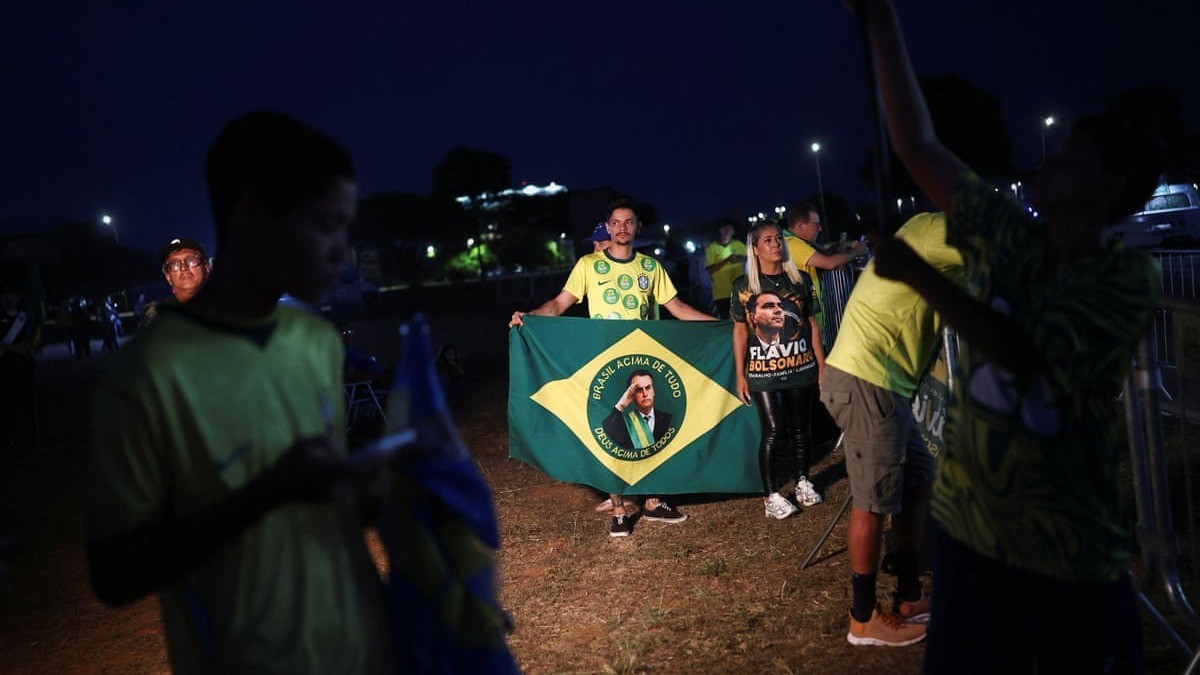
No concession from Flávio Bolsonaro had been reported at the time of writing. In an August interview on Globo, asked whether he would respect a loss, he did not answer directly: "I am not going to lose. And I will go further: I will win in the first round." He said then that he had never questioned the electoral process. His father, former president Jair Bolsonaro, is serving a 27-year sentence for plotting a coup after losing in 2022, and endorsed Flávio, who pledged amnesty for his father and for those jailed over the 8 January 2023 riots if elected, per the BBC. The BBC describes Flávio, 45, a lawyer and senator for Rio, as presenting himself as more moderate than his father. He has touted proximity to the White House and denies being helped by the US government, per AP.
What Is Still Unresolved
The count itself. The latest figures available remain short of 100%, and the certified totals are not in. No result is reported for the six governorship runoffs also held that day. Lula accused Washington of interference in the election; the United States denies it. The BBC reports that last year Donald Trump used Jair Bolsonaro's coup trial as justification for tariffs on Brazil and sanctions on top officials and judges, and AP reports the administration imposed high tariffs and classified drug-trafficking groups as foreign terrorist organizations. Asked about the election on Sunday, Trump said: "we are watching, yeah," and declined to endorse anyone, per AFP. Brazilian markets reopen at 9 a.m. ET on Monday 26 October. Prediction markets had already flipped: Kalshi priced Lula at 99.1% by 8:00 p.m. ET, per the Rio Times.
What Comes Next
Inauguration is 5 January 2027, per G1 and the Rio Times, under a 2021 constitutional amendment. Lula turns 81 on Tuesday 27 October. G1 notes that a win makes him the first Brazilian to preside over the country four times; CNN Brasil notes he could complete 16 years in office, two fewer than Getúlio Vargas. He was elected in 2002 and 2006 and returned in 2022. His campaign ran on sovereignty; at the UN General Assembly in September he said: "Brazil does not fit in anyone's backyard." After voting in Sao Bernardo do Campo he said he owed his election "only to the Brazilian people, who were an army of democracy." Folha de S.Paulo reads the result as opening "the way for the reorganisation of the right under a new leadership." The next Congress convenes against him either way.
By Jessica Ali, Staff Writer
This article was produced with AI-assisted research and editorial support. Sources: BBC News, The Guardian, Reuters, The Associated Press, Agence France-Presse, Al Jazeera, Bloomberg, Bloomberg Linea, Folha de S.Paulo, G1/Globo, O Globo, CNN Brasil, The Rio Times, RecortNews and the Inter-American Dialogue. Photographs: Natacha Pisarenko/AP via Al Jazeera (cover); Reuters via BBC News; Agustin Marcarian/Reuters via The Guardian.
What's Your Reaction?
 Like
0
 Dislike
0
 Love
0
 Funny
0
 Wow
0
 Sad
0
 Angry
0

Editor-in-Chief at Global1.News. Atlanta-based journalist who cuts through the BS and tells it like it is. Lead anchor, host, and the voice you hear when the spin stops and the truth starts.












Comments (0)