
KF-16s Lead Day-and-Night Operations as South Korea Steps Up in Pitch Black 2026
The KOREA NOW video released on August 5, 2026, captures Republic of Korea Air Force KF-16 fighters conducting continuous day-and-night sorties during the final phase of Exercise Pitch Black 2026 at RAAF Base Darwin. The footage shows the six deployed aircraft maintaining high-tempo operations alongside partners from fifteen other nations, underscoring the ROKAF’s integration into one of the Indo-Pacific’s largest air-combat training events. KF-16s Lead Day-and-Night Operatio
The KOREA NOW video released on August 5, 2026, captures Republic of Korea Air Force KF-16 fighters conducting continuous day-and-night sorties during the final phase of Exercise Pitch Black 2026 at RAAF Base Darwin. The footage shows the six deployed aircraft maintaining high-tempo operations alongside partners from fifteen other nations, underscoring the ROKAF’s integration into one of the Indo-Pacific’s largest air-combat training events.
KF-16s Lead Day-and-Night Operations as South Korea Steps Up in Pitch Black 2026
Seoul, South Korea – August 5, 2026 — The Republic of Korea Air Force has positioned itself at the center of Exercise Pitch Black 2026, with KF-16 fighter jets flying continuous day-and-night sorties at RAAF Base Darwin and a ROKAF officer serving as mission commander for allied pilots. The deployment of six KF-16s and approximately 100 personnel marks the ROKAF’s most substantial participation in the biennial exercise since it became a full participant in 2022, building on its observer role in 2016.
Captain Na Hyung-shin’s Mission-Commander Role
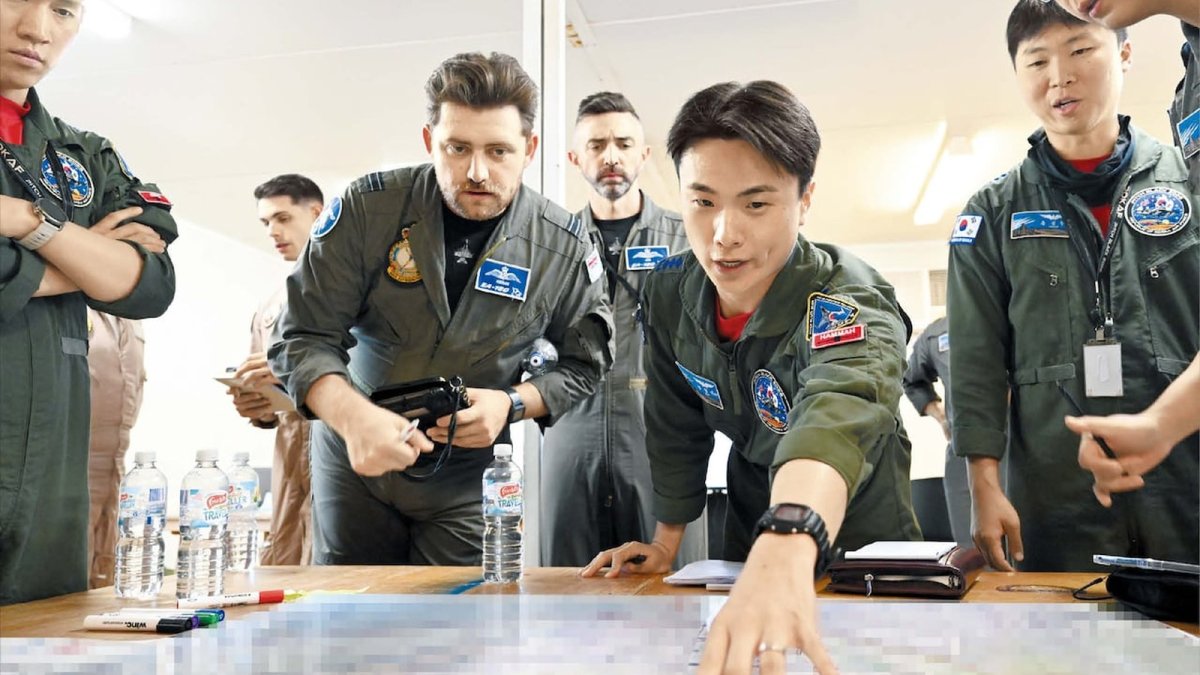
Chosun Ilbo English reported on August 5, 2026, that Captain Na Hyung-shin of the Republic of Korea Air Force served as mission commander for segments of the exercise. Captain Na conducted pre-mission briefings for pilots from multiple participating air forces, a responsibility that places a ROKAF officer at the center of combined planning at Darwin. This assignment reflects the ROKAF’s transition from observer status in 2016 to full participant since 2022.
The appointment of Capt. Na Hyung-shin as mission commander in Exercise Pitch Black 2026 underscores the Republic of Korea Air Force’s rising professional standing within multinational coalitions. By briefing pilots from allied nations during large-force employment missions, Capt. Na demonstrated ROKAF’s capacity to integrate seamlessly into complex combined operations hosted by the Royal Australian Air Force at Darwin.
Such leadership assignments signal Korea’s expanding contribution to regional air-power cooperation, moving beyond bilateral frameworks with the United States toward broader Indo-Pacific engagement where ROKAF assets and personnel operate on equal footing with long-standing allies.
Seventy-Five Years of Shared History in the Friendship Flight
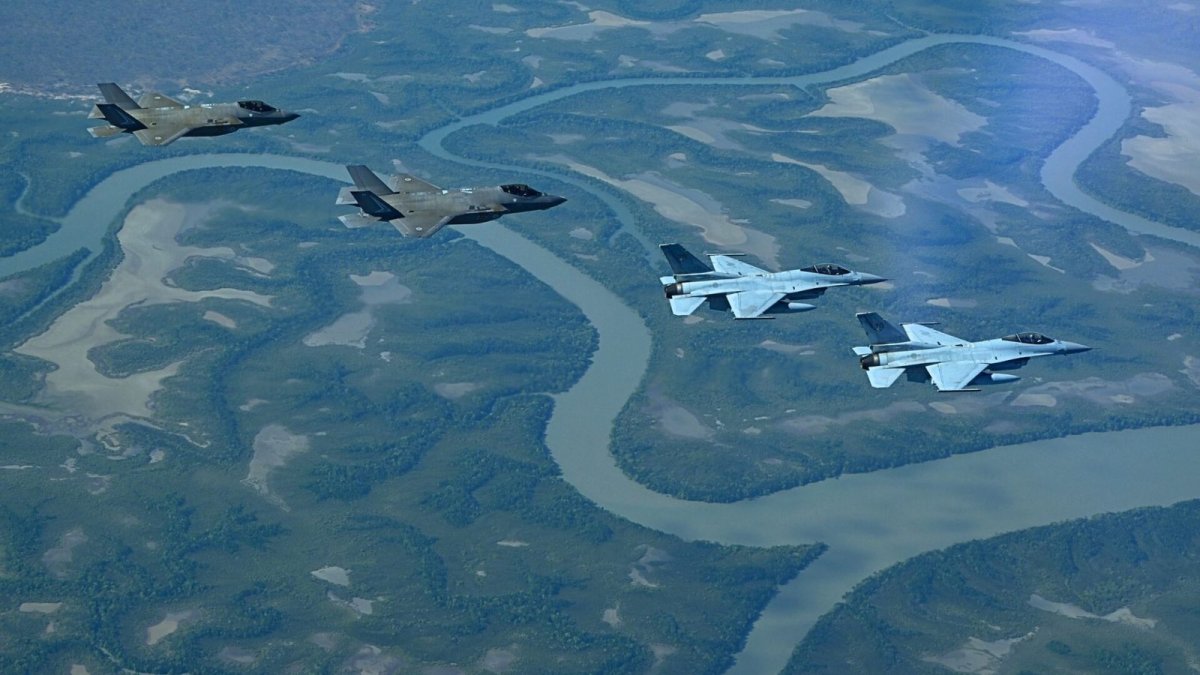
During the first week of the exercise, four RAAF F-35A Lightning II aircraft and four ROKAF KF-16 fighters conducted a formation flight over Australia’s Top End. AeroTime noted on July 23, 2026, that the sortie commemorated the seventy-fifth anniversary of the partnership that began when 77 Squadron, RAAF, flew P-51 Mustangs and later Gloster Meteor jets in support of United Nations forces during the Korean War. Wing Commander Benjamin Meares, commanding officer of 77 Squadron, stated that the flight honored shared history while demonstrating today’s operational partnership. ROKAF Captain Myungjing Song observed that the formation showed the alliance stands together every day.
The Friendship Flight conducted by four RAAF F-35As and four ROKAF KF-16s over Australia’s Top End commemorates the 75th anniversary of the Korean War and the specific combat record of 77 Squadron. That unit, the sole RAAF combat formation committed to the conflict, flew P-51 Mustangs before transitioning to Gloster Meteors while completing thousands of UN-support missions and additional humanitarian tasks.
Seventeen thousand Australian personnel served in Korea between 1950 and 1953, establishing an enduring historical bond now reinforced through contemporary air exercises. The flight therefore functions as living symbolism that links wartime sacrifice to present-day operational partnership between the two air forces.
By staging the sortie during the opening phase of Pitch Black 2026, both services highlight how shared history continues to underpin practical cooperation, including the deployment of ROKAF KF-16s and supporting KC-330 tankers to northern Australia.
Long-Range Deployment Validated by KC-330 Tankers
Prior Global1.News reporting from July 22, 2026, recorded that four KF-16s completed a nonstop 7,200-kilometre flight from Osan Air Base to Darwin on July 15, 2026, supported by two KC-330 multirole tankers. The deployment also included three KC-330 aircraft and approximately 100 personnel drawn from the 20th and 38th Fighter Wings. This reach demonstrates the ROKAF’s capacity to project fighter squadrons across the Indo-Pacific without intermediate basing, a capability directly relevant to extended deterrence planning on the Korean Peninsula.
Aerial refueling thereby emerges as a strategic enabler that extends the operational reach of ROKAF fighters, directly supporting extended deterrence objectives on the Korean Peninsula while simultaneously demonstrating expeditionary potential across the Indo-Pacific. The KC-330’s proven performance in this setting illustrates how tanker assets multiply the effectiveness of fighter deployments far from home bases.
This capability carries implications for future ROKAF participation in distant multinational exercises, allowing sustained presence without reliance on intermediate staging and reinforcing Korea’s ability to contribute to collective air operations at extended distances.
Exercise Architecture and Regional Security Framework
Exercise Pitch Black 2026 ran from July 20 to August 7 at RAAF Bases Darwin, Tindal, and Amberley. U.S. Indo-Pacific Command reported on August 2 that nineteen nations joined the United States in the largest iteration to date. Large-force employment missions integrated fighters, intelligence platforms, air-mobility assets, and command-and-control nodes. The concentration of activity in northern Australia places ROKAF assets inside a training environment that rehearses operations across vast maritime and archipelagic spaces, directly applicable to Northeast Asian contingencies.
Pitch Black 2026, conducted across RAAF Bases Darwin, Tindal, and Amberley from 20 July to 7 August, occupies a central position in the Indo-Pacific security architecture by exploiting northern Australia’s geographic advantages. The region’s vast training airspace and forward location help overcome the tyranny of distance that otherwise constrains large-scale air exercises in the southern hemisphere.
Participation by six ROKAF KF-16s and supporting personnel illustrates how these northern Australian facilities enable realistic rehearsal of distributed operations, logistics under pressure, and coalition coordination that directly inform regional contingency planning.
Defense-Industrial Linkages and Future Platforms
The ROK-Australia defense relationship extends beyond exercises. Australia has contracted Hanwha Defense for 129 AS-21 Redback infantry fighting vehicles valued at A$1.7 billion and 30 K9A1 Thunder howitzers valued at A$1.1 billion. These procurements create sustained industrial interdependence. Seoul’s ongoing KF-21 Boramae development now occurs against the backdrop of demonstrated ROKAF interoperability with RAAF F-35A fleets, offering potential pathways for future sensor and weapons integration discussions.
Ongoing development of the KF-21 Boramae offers a parallel avenue for air-domain cooperation. Potential future alignment between KF-21 and F-35A fleets could deepen both operational integration and industrial collaboration, building on the existing 2014 Defence Cooperation Agreement and the 2021 2+2 ministerial framework.
Such linkages position Korea and Australia to pursue joint capability development that complements their respective U.S. alliance commitments while expanding bilateral defense-industrial resilience across the Indo-Pacific.
Strategic Implications for ROK Defense Diplomacy
The 2021 ROK-Australia 2+2 Foreign and Defence Ministers’ Meeting and the 2014 Defence Cooperation Agreement provide the political foundation for the current deployment. Australian service during the Korean War, involving 17,000 personnel, supplies the historical legitimacy that enables contemporary operational trust. For Seoul, participation signals a maturing middle-power network that complements the U.S. alliance without replacing it, while offering additional training volume and geographic depth unavailable on the Korean Peninsula.
Korea’s middle-power defense diplomacy leverages multilateral exercises such as Pitch Black to advance foreign-policy objectives that complement its primary alliance with the United States. The 2021 2+2 meeting in Canberra on 2 September and the 2014 Defence Cooperation Agreement provide institutional scaffolding for these broader engagements.
By deploying six KF-16s and approximately 100 personnel to a 16- or 21-nation exercise hosted by Australia, Seoul demonstrates willingness to contribute to collective security beyond the Korean Peninsula. This approach diversifies partnerships while reinforcing interoperability standards already aligned with U.S. Indo-Pacific Command practices.
Multilateral air training thereby serves as a low-cost, high-visibility instrument of Korean statecraft, signaling strategic autonomy within a rules-based regional order and fostering habits of cooperation that can be scaled to future contingencies involving both U.S. allies and emerging partners.
Looking Ahead After August 7, 2026
With the exercise scheduled to conclude on August 7, 2026, ROKAF planners will assess sortie-generation data and command-and-control lessons. Future rotations are expected to incorporate additional platforms as the ROKAF receives F-35A aircraft and advances the KF-21 program. Continued engagement at Pitch Black will test whether the demonstrated long-range refueling and mission-commander roles can be sustained at higher tempos, shaping both ROK defense planning and the broader architecture of Indo-Pacific air-power cooperation.
By Prof. David Park, Staff Writer
This article was produced with AI-assisted research and editorial support. Reporting is based on sources cited in the article.
What's Your Reaction?
 Like
0
Like
0
 Dislike
0
Dislike
0
 Love
0
Love
0
 Funny
0
Funny
0
 Wow
0
Wow
0
 Sad
0
Sad
0
 Angry
0
Angry
0

East Asia/Technology Correspondent at Global1.News. Seoul-based voice covering Korean politics, technology, business, and culture. Analyzes how technology and geopolitics intersect across East Asia.















Comments (0)