
China Sea Launch Advances AI Hyperspectral Satellites for Global Partners
China's Smart Dragon-3 rocket lifted off from the Yellow Sea off Shandong on Aug 5, 2026, carrying AI-powered hyperspectral satellites Samarkand-2028 and Lampung-1. The twin Dongfang Huiyan craft bring in-orbit AI analysis to Earth observation for partners in Uzbekistan, Indonesia and across Asia.
China conducted a sea launch of two AI-powered hyperspectral satellites today using the Smart Dragon-3 rocket. The mission marks another step in the country's commercial sea-launch cadence while extending AI-equipped Earth observation capabilities to international partners. The satellites will support data applications across agriculture, water resources, and disaster response in Asia and beyond.
China Sea Launch Advances AI Hyperspectral Satellites for Global Partners
Tokyo, Japan - Aug 5, 2026. The Smart Dragon-3 carrier rocket lifted off at 10:38 a.m. Beijing Time from sea waters near Haiyang in Shandong Province. Taiyuan Satellite Launch Center conducted the offshore mission. The two satellites entered planned orbits and will join an existing high-resolution satellite to form an integrated system.
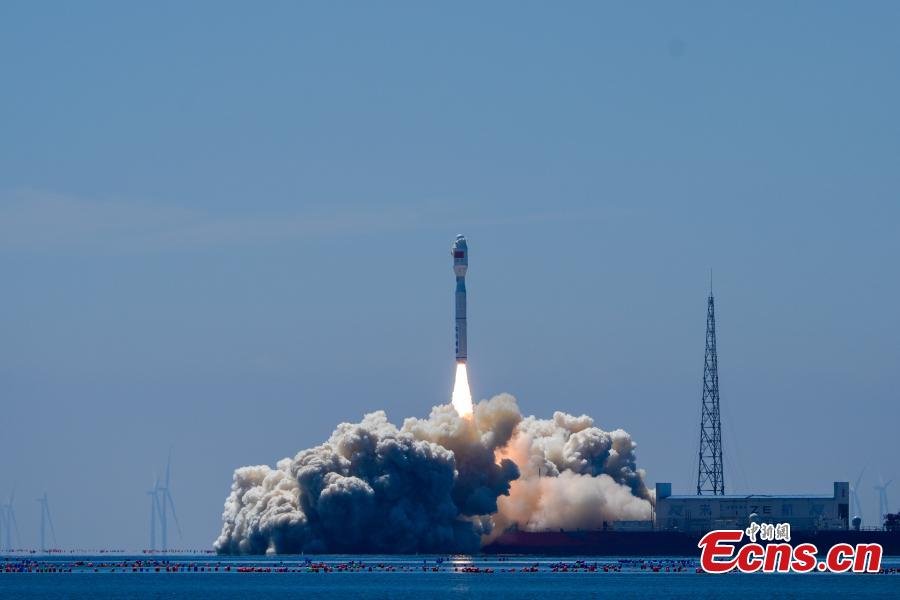
Sea Launch Puts Twin Hyperspectral Satellites in Orbit
The Smart Dragon-3 completed its 12th flight and its fourth launch this year. The developer CALT reported improvements in pre-launch testing reliability and launch communications. The team advanced mission-independent general assembly and testing along with pulsating assembly methods. These steps shortened the delivery cycle through standardized design. Wednesday's mission was the second orbital launch from the sea by a Chinese rocket within two weeks. Gravity-1 launched from the East China Sea on July 22 and sent nine satellites into preset orbits. That flight marked the first far-sea launch of a private commercial rocket. The Smart Dragon-3 mission placed the two hyperspectral satellites into orbit from waters near Haiyang. Taiyuan Satellite Launch Center oversaw the operation. The satellites will operate as part of the Dongfang Huiyan constellation project.
From 'Seeing the Earth' to 'Understanding the Earth'
The twin satellites carry 22 hyperspectral channels and onboard AI inference capabilities. Real-time in-orbit analysis reduces response times from several days to the minute level. Star Vision Aerospace Group Ltd based in Hangzhou supplied the AI capabilities. The company is described as a work of international collaboration under the Dongfang Huiyan constellation project. The satellites were developed by Wuhan University under the guidance of STAR.AI Spatio-temporal Intelligence Technology Co Ltd. They will form a collaborative network with the already in-orbit Dongfang Huiyan high resolution 01 satellite. This setup builds an integrated general survey plus detailed survey system. The combination validates a model that merges hyperspectral remote sensing with AI. The approach moves operations from simply seeing the Earth to understanding the Earth through faster data processing.
The twin satellites feature 22 hyperspectral channels paired with onboard AI inference engines that perform real-time analysis during each pass. This capability shortens data turnaround from several days of ground processing to the minute level. Star Vision Aerospace Group Ltd supplied the AI modules while Wuhan University built the spacecraft under STAR.AI guidance. The pair joins the existing Dongfang Huiyan high-resolution satellite to create an integrated general-survey and detailed-survey network. The combination supports agriculture water-resource monitoring and disaster-response tasks across Asia by delivering processed outputs directly from orbit.
Uzbekistan and Indonesia Come Aboard
The satellites received the names Samarkand-2028 and Lampung-1. Samarkand-2028 reflects cooperation with the Uzbekistan Space Agency. Lampung-1 honors Indonesia's Lampung Province. Partners serve as joint developers of the onboard AI algorithms and core users of future data. Uzbekistan President Shavkat Mirziyoyev watched the live broadcast and extended congratulations. Indonesian guests attended the launch. Samarkand-2028 carries an AI module developed by Uzcosmos specialists. This module enables hyperspectral data processing directly in orbit. Data will support agriculture ecology and natural resource monitoring. Joint mission plans were announced in November 2025 when Uzcosmos signed a strategic memorandum with Star Vision. The name commemorates Uzbekistan hosting the International Astronautical Congress in Samarkand in 2028. Lampung-1 is owned by the Lampung provincial administration. It targets coastal and marine monitoring precision agriculture environmental surveillance and disaster mitigation. The partnership began with a strategic cooperation agreement signed May 28 2025 in Haiyang China.
Samarkand-2028 carries an AI module built by Uzcosmos specialists that processes hyperspectral data while still in orbit for agriculture ecology and natural-resource tasks. Lampung-1 focuses on coastal marine monitoring precision agriculture environmental surveillance and disaster mitigation for the Lampung provincial administration. Uzbekistan and Indonesia act as joint algorithm developers and primary data users. The May 28 2025 agreement signed in Haiyang formalized the Lampung partnership while the November 2025 memorandum with Star Vision outlined Uzbekistan cooperation tied to hosting the International Astronautical Congress in Samarkand in 2028.
What Hyperspectral Imaging Offers Asia's Economies
Hyperspectral sensing monitors water quality suspended solids in water bodies vegetation and crops and mineral deposits. These capabilities serve agriculture forestry grassland water resources and mining sectors. Asian economies that rely on precise resource management stand to benefit from the data. Countries facing challenges in coastal zones agriculture output and disaster preparedness can apply the information for decision making. The onboard AI processes data in orbit to deliver results at the minute level. This speed supports timely responses in dynamic environments such as changing crop conditions or water contamination events. The Dongfang Huiyan constellation project extends these tools to partners in Central Asia and Southeast Asia. The integrated survey system combines broad coverage with detailed analysis. Regional users gain access to processed outputs without lengthy ground delays. The technology addresses practical needs in economies where resource monitoring directly affects food security and environmental protection.
Japan's Earth Observation and Launch Ambitions
Japan's flagship spaceborne hyperspectral imager HISUI developed by METI has operated on the ISS Kibo module since 2019. Japan lacks a dedicated commercial hyperspectral satellite of its own. The private small-satellite launcher Space One Kairos has faced setbacks in all three flights. The first attempt in March 2024 ended seconds after liftoff. The second flight occurred in December 2024. The third attempt on March 5 2026 was terminated about 69 seconds into flight from Spaceport Kii in Wakayama Prefecture. In contrast the Chinese commercial sea-launch cadence continues with repeated missions this year. Japan's Space Basic Plan emphasizes Earth observation yet progress on dedicated hyperspectral platforms remains limited. METI-supported efforts like HISUI provide valuable data from the ISS but do not match the dedicated orbital assets now entering service from other regional players. The gap highlights differences in commercial launch reliability and satellite deployment speed.
Implications for the Asia-Pacific Space Race
Regional Earth-observation demand continues to rise across agriculture maritime zones and disaster management. Data sovereignty concerns push countries to seek independent or partnered access to satellite resources. The involvement of Uzbekistan and Indonesia in the Dongfang Huiyan project illustrates both cooperation and competition in the sector. Economic security considerations tie space capabilities to national development goals. Partners gain onboard AI processing and direct data rights through the agreements. This model contrasts with traditional data purchase arrangements. Japan maintains strong technical foundations through METI programs yet faces repeated launcher challenges. The Asia-Pacific dynamics now include faster commercial cycles from Chinese operators. Countries weigh options between established partnerships and emerging commercial offerings. The outcome affects how quickly regional economies can integrate advanced sensing into daily operations.
Countries seek independent or partnered access to maintain data sovereignty while clarifying rights over AI-processed outputs. Japan maintains METI-supported HISUI operations on the ISS Kibo module since 2019 yet lacks a dedicated commercial hyperspectral satellite. Its private launcher Space One recorded three unsuccessful flights through March 2026. In contrast China's repeated sea launches this year have placed operational assets into orbit faster highlighting differences in commercial deployment speed and reliability across the Asia-Pacific region.
What to Watch For
Next constellation launches will expand the Dongfang Huiyan network. Uzbekistan plans a first 6U scientific CubeSat in 2028 named after scholar-astronomer Mirzo Ulugbek. The country is also exploring options for its first national cosmonaut. Space One will attempt a fourth Kairos flight after the prior terminations. Japan continues to evaluate hyperspectral options under METI guidance and the Space Basic Plan. Observers will track whether commercial sea-launch reliability sustains the current pace. International Astronautical Congress preparations in Samarkand in 2028 may highlight further joint projects. Regional governments will assess data access models from the new satellites. Forward momentum in AI-integrated sensing points to tighter integration of space assets with economic planning across Asia Pacific.
Observers will track the next Dongfang Huiyan constellation launches that expand the integrated survey system. Uzbekistan plans tied to the 2028 International Astronautical Congress in Samarkand remain on the calendar. Space One is expected to attempt a fourth flight after three prior setbacks from Spaceport Kii. Regional partners will also watch how the Samarkand-2028 and Lampung-1 satellites perform once their onboard AI modules begin delivering minute-level outputs for agriculture and coastal applications.
The August 5 launch underscores how commercial sea operations and AI processing are reshaping Earth observation timelines. Japan and other regional actors face choices on how to match or complement these developments to secure data advantages for their economies.
By Kenji Tanaka, Staff Writer
This article was produced with AI-assisted research and editorial support. Reporting is based on sources cited in the article.
What's Your Reaction?
 Like
0
Like
0
 Dislike
0
Dislike
0
 Love
0
Love
0
 Funny
0
Funny
0
 Wow
0
Wow
0
 Sad
0
Sad
0
 Angry
0
Angry
0

Japan Correspondent at Global1.News. Tokyo-based voice covering Japanese politics, technology, economy, and culture. Tracks the intersection of tradition and innovation in one of the world's most dynamic societies.















Comments (0)