
Kenyan Designer Weaves a Cultural Revival, One Thread at a Time
In the heart of Kibera, Nairobi, a quiet revolution is taking place — one thread at a time. While global fashion giants churn out millions of identical garments daily, young Kenyan designer Hillary Mukabwa of Mukabwa Studio is turning back to the traditional handloom, weaving clothes and fabrics that carry the weight of history.
In the heart of Kibera, Nairobi, a quiet revolution is taking place — one thread at a time. While global fashion giants churn out millions of identical garments daily, young Kenyan designer Hillary Mukabwa of Mukabwa Studio is turning back to the traditional handloom, weaving clothes and fabrics that carry the weight of history. In an era where fast fashion dominates wardrobes and landfills alike, this 20-something finance and design graduate is proving that the old ways still hold profound meaning for Africa's cultural future.
Kenyan Designer Weaves a Cultural Revival, One Thread at a Time
Nairobi, Kenya — The rhythmic clack of a wooden shuttle passing through taut cotton threads is not a sound you expect to hear in the 21st century, especially not from a young man in his twenties. Yet inside a modest studio in Kibera, one of Africa's largest informal settlements, Hillary Mukabwa is making that ancient music daily, pushing back against the relentless tide of disposable fashion. His mission is simple but radical: prove that the handloom, a technology thousands of years old, still has a vital place in modern Africa.
A Return to the Loom in an Age of Fast Fashion
Mass production is quickly changing the fashion industry, with environmentalists warning about the industry's devastating impact on the planet. The United Nations Environment Programme has long flagged fashion as one of the most polluting sectors globally, responsible for up to 10 percent of global carbon emissions and vast quantities of textile waste. Fast fashion's model — producing cheap, trendy clothing at breakneck speed — has created a culture of disposability, where garments are worn a handful of times before being discarded, often ending up in African markets as secondhand waste.
Against this backdrop of environmental crisis and cultural erosion, Mukabwa's decision to go back to hand looms feels almost defiant. He is not just making clothes; he is making a statement about what African fashion could be. The contrast between the sterile efficiency of a factory floor and the organic, human-paced rhythm of his studio could not be starker. Where machines produce thousands of identical pieces an hour, Mukabwa's hands produce a handful of unique textiles a day.
As a young person, Mukabwa admits he feels like "an anomaly" in an industry that celebrates speed and scale. His peers are chasing digital marketing careers or corporate jobs, not sitting at wooden looms inherited from a bygone era. Yet he embraces this outsider status, believing that the path less travelled holds the deepest rewards. "Modernisation kills the aspect of traditional craftsmen and ways of doing work," he says, his voice carrying the weight of conviction. "So, being a young guy, it is a bit not normal to go back. But I just wanted to be that person who kind of tries to revive the old practices, because this is where culture lives."
His words resonate far beyond Nairobi. Across the continent, from the weavers of Thiès in Senegal to the Kente cloth makers of Ghana, a generation is rediscovering that heritage is not a relic but a resource. Mukabwa's studio, Mukabwa Studio, is part of a growing movement of young Africans who see traditional craft not as nostalgia but as innovation — a way to create beauty, jobs and identity in a globalised world.
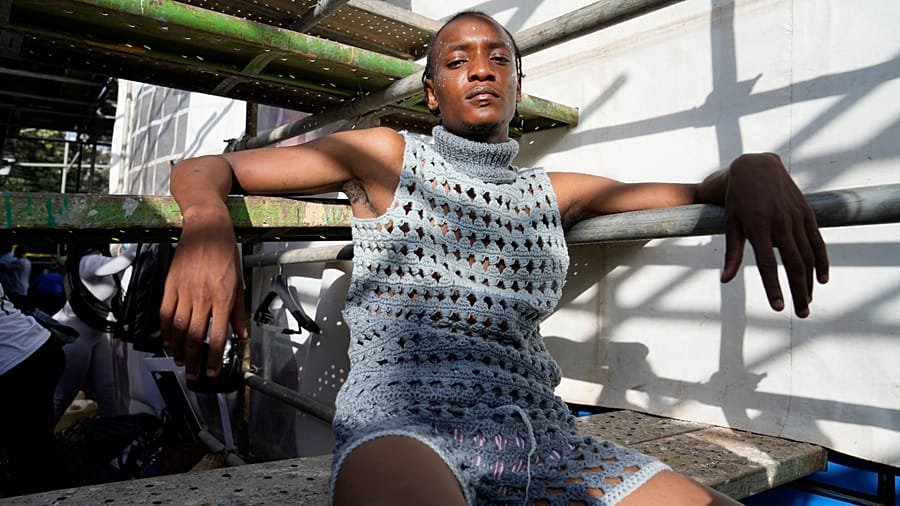
The Craft: How the Handloom Works
To understand what Mukabwa is doing, you must understand the machine itself. The traditional handloom he operates uses a counter-balance mechanism, a system of pulleys and heddles that opens different types of thread in precise patterns. As the weaver presses foot pedals, the warp threads separate, creating a shed through which a shuttle passes, carrying the weft thread across. This single pass of the shuttle creates one line of fabric; repeat it thousands of times, and you have a cloth.
The machine is operated entirely manually — no electricity, no motors, no digital interfaces. Every movement is deliberate, every thread placed by human intention. This is the antithesis of the automated looms that dominate textile factories in Asia and beyond, which can produce metres of fabric in minutes. Mukabwa's loom produces centimetres in the same time, but what it lacks in speed, it makes up for in soul.
"The difference between the hand looms and the electric machines is that these hand looms, first of all, they are traditional," Mukabwa explains. "So, you find that they carry a story. It's a piece of art, you know. Rather than producing masses, they produce with meaning." Each piece that comes off his loom is not just fabric; it is a narrative woven into cotton, a testament to patience and skill that no factory can replicate.
The main raw material is locally sourced cotton, supporting Kenyan farmers and reducing the carbon footprint of imported synthetic fibres. From this humble starting point, Mukabwa creates a range of products that includes clothes, bags, table mats and towels. Each item is a canvas for his craft, transforming everyday objects into carriers of cultural memory. The texture of handwoven cotton is distinct — slightly irregular, breathable, and imbued with a warmth that machine-made fabric simply cannot match.
'This Is Where Culture Lives': A Designer's Mission
Mukabwa's journey to the loom was not a straight line. A finance and design graduate from Kibera, he initially followed the conventional path, studying subjects that promised stability and success. But something pulled him back to his roots. In 2024, he began experimenting with weaving, initially as a curiosity, then as a passion that would consume him. The more he learned, the more he realised how much had been lost.
"I realised there was a gap where people like me are not conversant with and are unable to learn about this process because it looks tiresome, bulky and unachievable," he says. This observation struck him deeply — a whole generation had been alienated from its own craft traditions, not because the crafts were worthless, but because they had been made to seem obsolete. The colonial and post-colonial emphasis on Western-style education and industrial production had pushed handloom weaving to the margins, and young Kenyans had no way to access this knowledge.
His mission became clear: keep Kenya's cultural heritage alive by making it relevant again. This is not about museum preservation but about living tradition. Mukabwa wants to show that the handloom is not a relic but a tool for the future — one that can provide sustainable livelihoods, create unique products, and connect young Africans to their heritage. He sees himself as a bridge between generations, carrying forward the knowledge of elders and translating it for a contemporary audience.
The ambition does not stop at Kenya's borders. Mukabwa hopes to take the stories woven on his looms beyond Kenya while keeping the looms as part of the process. He envisions a day when Mukabwa Studio's fabrics are worn in Dakar, Lagos, London and New York — not as exotic curiosities but as recognised works of art. The loom, he insists, will remain central to this expansion, because the story is in the making, not just the product.
Clients and the Appeal of the Unique
In a world of identical high-street garments, Mukabwa's clients are drawn to something rare: uniqueness. Maylone Ginnette, a satisfied customer, puts it plainly: "I like the clothes because one, of their quality because they are pure organic cotton and they are unique. Most of them, you can see they are unique pieces, so I think I will still choose the weaving, how they are made because of the efforts you can see people do to get the product, the end result of the product."
Her words capture the essence of the appeal. In an age of mass production, where a designer dress can be knocked off and sold for a fraction of the price within weeks, handwoven pieces offer something counterfeit-proof: authenticity. No two handwoven fabrics are identical; the slight variations in thread tension, colour and texture are not flaws but signatures. Each piece tells the story of its making, and clients are willing to pay for that narrative.
The business model is built on custom orders, a deliberate choice that reinforces the value of the craft. Clients do not pick from a rack; they sit with Mukabwa and choose the colour, fabric and design together, becoming co-creators of their garments. This collaborative process transforms shopping from a transaction into an experience, deepening the connection between maker and wearer. It also ensures that nothing is wasted — every piece is made to order, eliminating the overproduction that plagues the fast fashion industry.
Mukabwa sells his items online through his social media pages, using platforms like Instagram and WhatsApp to reach clients in Nairobi and beyond. The digital storefront is a clever fusion of old and new — ancient craft meeting modern marketing. His growing following is a testament to the appetite for Kenyan-made apparel, a market that has long been dominated by imported secondhand clothes and cheap Asian imports. As more Kenyans discover the quality and story behind handwoven fabrics, the demand for local production is rising.

A Kibera Story: Community, Cotton and Custom Orders
Kibera is often described in terms of its challenges — poverty, overcrowding, lack of infrastructure. But Mukabwa sees something else: potential. His business relies on custom orders, a model that allows him to plan production carefully and avoid waste. But the deeper goal is community transformation. His long-term vision is to empower young people and mothers in Kibera who never had the chance to pursue education, offering them training and employment in the weaving trade.
This is not charity; it is economic empowerment. By teaching others to weave, Mukabwa is creating a skilled workforce that can earn dignified incomes from their craft. The handloom, once seen as a symbol of backwardness, becomes a tool of liberation. For mothers who cannot leave their homes for formal employment, weaving offers flexible work that can be done alongside childcare. For young people with few prospects, it offers a path to skill and income.
The connection between traditional craft and community development is profound. When a community controls its own production, it controls its own destiny. Mukabwa's studio is not just a business; it is a hub of knowledge transfer, where elders' wisdom meets youthful energy. The looms are not just machines; they are instruments of social change, weaving together threads of heritage, opportunity and hope.
Mukabwa's plans to create employment opportunities and contribute to economic empowerment in the community are still in their early stages, but the vision is clear. He dreams of a Kibera where the clack of looms is as common as the sound of music, where young people see weaving not as a last resort but as a first choice. The custom-order model ensures that growth is sustainable, tied to real demand rather than speculative production.
Africa's Slow-Fashion Movement
Mukabwa's work is not happening in isolation. Across the continent, a slow-fashion movement is gaining momentum, challenging the dominance of fast fashion and celebrating Africa's rich textile traditions. From the handwoven fabrics of Senegalese weavers in Thiès to the iconic Kente cloth of Ghana, from the vibrant Ankara prints of West Africa to the Kitenge of East Africa, the continent has a deep well of textile heritage to draw from.
The tension between preserving this heritage and competing with global fast fashion is real. Cheap imports flood African markets, undercutting local producers and eroding traditional skills. Yet there is also a counter-movement, driven by designers like Mukabwa who see heritage as a competitive advantage. In a global market saturated with identical products, African handcrafted textiles offer something no factory can replicate: authenticity, story and cultural depth.
The environmental argument for slow fashion is compelling. Handwoven cotton, produced locally and made to order, has a fraction of the carbon footprint of mass-produced synthetic garments shipped across the world. As consumers become more conscious of the climate crisis, the demand for sustainable, ethical fashion is growing. African designers who combine traditional techniques with modern aesthetics are well-positioned to capture this market.
The economic opportunity is equally significant. The African Continental Free Trade Area, which aims to create a single market for goods and services across 54 countries, could boost intra-African trade in textiles and apparel. If African designers can scale their production while maintaining quality and authenticity, they could capture a larger share of the global fashion market, which is valued in the trillions of dollars. The revival of traditional techniques is not just cultural preservation; it is economic strategy.
What to Watch For
Mukabwa's plans to take his handwoven stories beyond Kenya are ambitious but grounded. He speaks of exhibitions, collaborations with other African designers, and perhaps one day, a flagship store in a major fashion capital. The growing market for unique sustainable African fashion suggests that his timing is right. International buyers, weary of mass-produced goods, are increasingly seeking out pieces with provenance and purpose.
Upcoming opportunities for African designers are multiplying. Fashion weeks in Dakar, Lagos, Accra and Johannesburg are showcasing the continent's creative talent to global audiences. Digital platforms are making it easier for small producers to reach international customers. The story of Mukabwa Studio — a young man from Kibera reviving an ancient craft — is exactly the kind of narrative that resonates in this moment.
Why does this matter for Africa's cultural identity? Because what we wear is who we are. When young Africans embrace traditional craft, they are not just making a fashion statement; they are asserting their identity in a globalised world. They are saying that African culture is not a relic of the past but a living, breathing force that can shape the future. The handloom, in Mukabwa's hands, becomes a symbol of this assertion.
For readers who want to support African makers, the path is clear: buy directly from artisans, share their stories, and value the work behind the product. Every handwoven piece purchased is a vote for a different kind of economy — one that values people and planet over profit and waste. As Mukabwa weaves his threads, he is also weaving a future where African creativity is celebrated, not exploited.
The story of Mukabwa Studio, reported by Africanews in late August 2026, is still unfolding. But its message is already clear: the old ways are not obsolete; they are essential. In the rhythm of the loom, there is a heartbeat of a continent refusing to forget itself. And in the hands of a young designer from Kibera, that heartbeat is growing louder.
By Amara Diop, Staff Writer
This article was produced with AI-assisted research and editorial support. Reporting is based on sources cited in the article.
What's Your Reaction?
 Like
0
Like
0
 Dislike
0
Dislike
0
 Love
0
Love
0
 Funny
0
Funny
0
 Wow
0
Wow
0
 Sad
0
Sad
0
 Angry
0
Angry
0

West Africa/Sahel Correspondent at Global1.News. Dakar-based journalist covering politics, security, climate, and development across Francophone and Anglophone West Africa. Tells the stories of a region undergoing profound transformation.













Comments (0)