
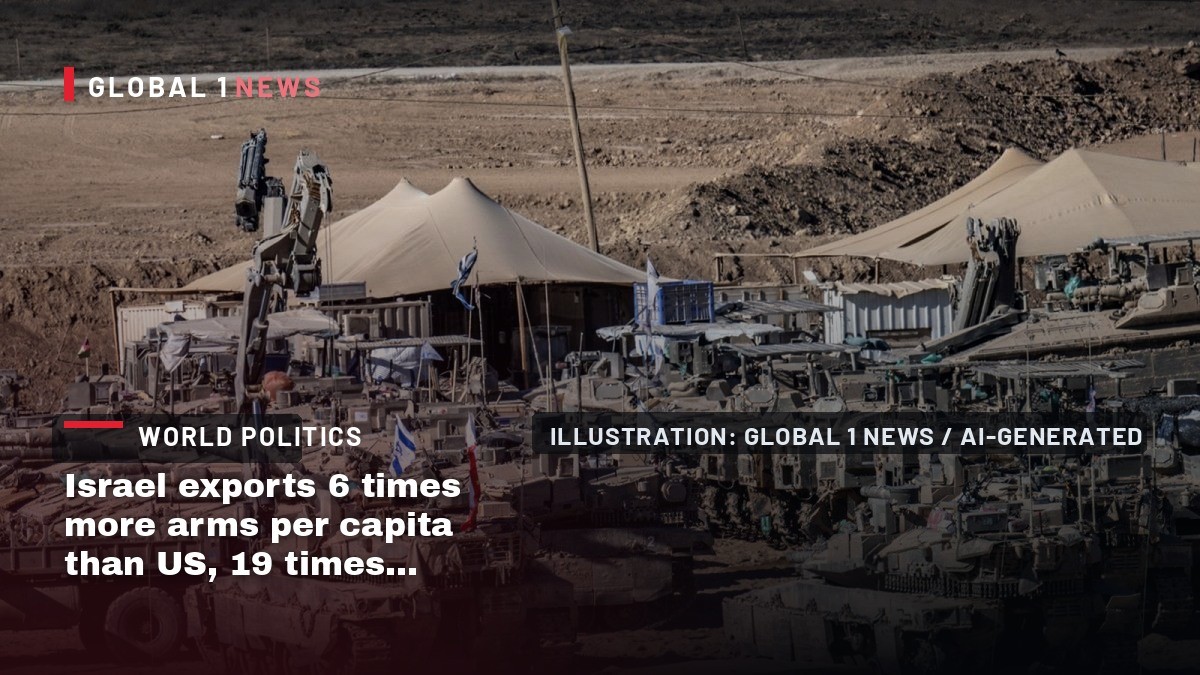
Israel exports 6 times more arms per capita than US, 19 times more than Russia
Israel exported arms at a rate equivalent to roughly $263 per citizen in 2025, a figure nearly six times greater than the United States and 19 times higher than Russia, according to a new study released this week.
Study: Israel’s Arms Exports Per Capita Outpace US and Russia by Wide Margins
Israel exported arms at a rate equivalent to roughly $263 per citizen in 2025, a figure nearly six times greater than the United States and 19 times higher than Russia, according to a new study released this week. The analysis, authored by Palestinian-American writer Susan Abulhawa, draws on data from the Stockholm International Peace Research Institute (SIPRI) Arms Transfers Database to reveal the extraordinary scale of Israel’s weapons industry when measured against its population. The findings come as regional tensions remain elevated and as international scrutiny of arms sales to Israel continues to grow.
The study’s calculations place Israel far ahead of every major weapons-exporting country on a per-capita basis. When measured against Israel’s Jewish population alone, the figure rises to $340 per person — roughly eight times the US rate and 25 times Russia’s. The numbers, Abulhawa argues, show that Israel’s arms trade is not a marginal sector but a defining feature of its economic and strategic posture.
Per-Capita Comparison: A Dramatically Different Picture
While the United States remains by far the largest weapons exporter in absolute terms, Abulhawa’s study finds that adjusting for population produces a starkly different ranking. Israel ranked seventh in total arms exports between 2020 and 2025, trailing the US, France, Russia, Germany, China and Italy. But once the same SIPRI data is divided by population, Israel moves decisively to the top.
Israel’s per-capita arms exports were roughly 2.5 times those of Norway, the nearest competitor, and more than three times those of the United States. The study emphasizes that this is not the result of a single exceptional year. Israel has been either the world’s largest arms exporter per capita — usually by a considerable margin — or close to the top in every year of the past quarter-century.
Looking across the entire 1960–2025 period covered by the SIPRI database, Israel recorded the highest average arms exports per capita of any country, at the equivalent of $56 per person every year over 65 years. The study found that Israel’s lead over competing arms exporters has widened particularly sharply during the past decade.
SIPRI Data: What It Counts and What It Misses
The study relies primarily on SIPRI’s Arms Transfers Database, which tracks major conventional weapons such as fighter jets, tanks, missiles and naval vessels. These figures are widely used by researchers and policymakers as a baseline for measuring the global arms trade. However, Abulhawa notes that SIPRI’s methodology does not capture much of Israel’s lucrative trade in drones, ammunition, small arms, cyber technology, surveillance equipment, services and training.
This gap is significant. Israel has become a leading exporter of armed drones and surveillance systems, sectors that have grown rapidly over the past two decades. The study points out that when governments’ own wider figures for defence contracts are used instead, Israel reported $13 billion in arms-export agreements in 2023 — a figure that includes the broader range of military goods and services. That amount is equivalent to around 2.5 per cent of Israel’s GDP, according to the study.
Economic Embeddedness: Arms Trade as a Core Sector
The study also examines arms exports against the size of national economies, showing how deeply the weapons trade is embedded in Israel’s economic model. Using SIPRI figures, Israeli arms exports amounted to around 0.25 per cent of GDP in 2023 — more than three times the equivalent proportion in France and more than six times that of the United States.
But when the broader defence-contract figures are applied, the picture becomes even more pronounced. Proportionally, Israel’s arms-export economy is around eight and a half times larger than that of the US and almost nine times larger than France’s, according to the study. These figures suggest that while larger powers make more money from weapons in absolute terms, no comparable country derives as much arms-export business relative to the size of its population and economy as Israel.
This economic embeddedness has domestic implications. The arms industry is a major employer and a driver of technological innovation in Israel, with close ties to the military establishment and to academic institutions. It also shapes foreign policy, as arms sales are often used to build diplomatic and security relationships with client states across Asia, Africa, Latin America and Europe.
Human Impact: What the Numbers Mean for Palestinians
For Palestinians, the scale of Israel’s arms exports is not an abstract statistic. The same industry that supplies weapons to foreign governments also produces the military equipment used in the occupied territories. Drones, surveillance systems, crowd-control munitions and other hardware developed for export are frequently tested and refined in Palestinian communities, human-rights organisations have documented over the years.
The study does not directly address the human cost of these weapons, but its findings provide context for ongoing debates about accountability and international law. Palestinian civil-society groups have long called for arms embargoes and for greater transparency in weapons transfers to Israel. The per-capita figures, Abulhawa argues, underscore how central the arms trade is to Israel’s self-conception as a regional military power — and how difficult it may be to shift that posture through diplomatic pressure alone.
The economic weight of the sector also means that any future peace agreement or security arrangement would need to reckon with the industry’s role in Israel’s economy. That is a factor rarely discussed in mainstream coverage of the conflict, but one that the study brings into sharper focus.
Regional Context: Arms Sales and Middle East Dynamics
The findings arrive at a moment of heightened military spending across the Middle East. Several Arab states have expanded their own defence budgets and arms imports in recent years, often citing regional threats. Israel’s arms-export dominance per capita, however, is unique in its scale and persistence.
The study’s long-term data — covering 65 years — shows that Israel’s position at the top of the per-capita rankings is not a recent development. It reflects a sustained national commitment to military production that predates the current government and has continued across successive administrations. This continuity suggests that the arms trade is not a policy choice of any single leader but a structural feature of the Israeli state.
For neighbouring countries, the implications are twofold. On one hand, Israeli weapons are present in markets across the region, sometimes in countries that do not have formal diplomatic relations with Israel. On the other hand, the scale of Israeli arms exports relative to its population raises questions about the long-term sustainability of a regional security architecture built on such asymmetries.
Why This Matters Now
The study’s release comes as several European governments face domestic legal challenges over arms-export licences to Israel. Courts in the United Kingdom, the Netherlands and Spain have all heard cases in recent months arguing that such sales may violate international humanitarian law. While the study does not take a position on those cases, its data provides a factual foundation for the broader debate.
It also comes as the global arms trade faces increased scrutiny over its role in conflicts beyond the Middle East. The war in Ukraine has driven a surge in weapons production and procurement across Europe, and several countries are expanding their own defence industries. In that context, the study’s per-capita comparisons offer a reminder that Israel’s arms sector is not merely a regional player but a global one — and that its scale relative to population is unmatched.
Abulhawa’s study does not offer policy prescriptions. But its numbers are likely to be cited in parliamentary debates, court proceedings and advocacy campaigns in the months ahead. For journalists and researchers, it provides a useful corrective to the tendency to measure the arms trade only in absolute terms, which can obscure the outsized role that smaller states can play.
Methodology and Limitations
The study is based primarily on SIPRI’s Arms Transfers Database, which is widely regarded as the most comprehensive public source on major conventional weapons transfers. SIPRI uses a standardised unit system to compare the volume of arms transfers across countries and over time, which allows for consistent per-capita calculations.
However, as the study itself notes, SIPRI’s data does not capture the full range of military exports. Drones, small arms, ammunition, cyber capabilities, surveillance equipment, training and maintenance services are largely excluded. This means that the per-capita figures based on SIPRI data likely understate Israel’s true arms-export activity. The study’s use of government-reported defence-contract figures for 2023 — the $13 billion figure — is an attempt to address this gap, though such figures are not always directly comparable across countries.
Figures for some countries were not immediately available in the study’s published tables, and the authors note that data limitations remain a challenge for any cross-national comparison of the arms trade. Despite these caveats, the study’s central finding — that Israel leads the world in per-capita arms exports by a wide margin — is consistent across multiple data sources and time periods.
By Fatima Al-Rashid, Staff Writer
This article was produced with AI-assisted research and editorial support. Sources: Middle East Monitor, Anadolu Agency, SIPRI Arms Transfers Database.
What's Your Reaction?
 Like
0
Like
0
 Dislike
0
Dislike
0
 Love
0
Love
0
 Funny
0
Funny
0
 Wow
0
Wow
0
 Sad
0
Sad
0
 Angry
0
Angry
0

Gulf/MENA Correspondent at Global1.News. Based in Doha, covering Gulf politics, energy markets, diplomacy, and development across the Middle East and North Africa. Tracks the economic transformation of the Gulf states.













Comments (0)