
Hitler's Eagle's Nest Burned Almost to the Ground. Bavaria Says It Won't Leave a Ruin.
The Kehlsteinhaus, the Nazi-era mountain retreat known as Hitler's Eagle's Nest, was largely destroyed by fire overnight in Bavaria. Police suspect arson, a 33-year-old man is in psychiatric care, and officials say they will not leave a ruin on the peak.
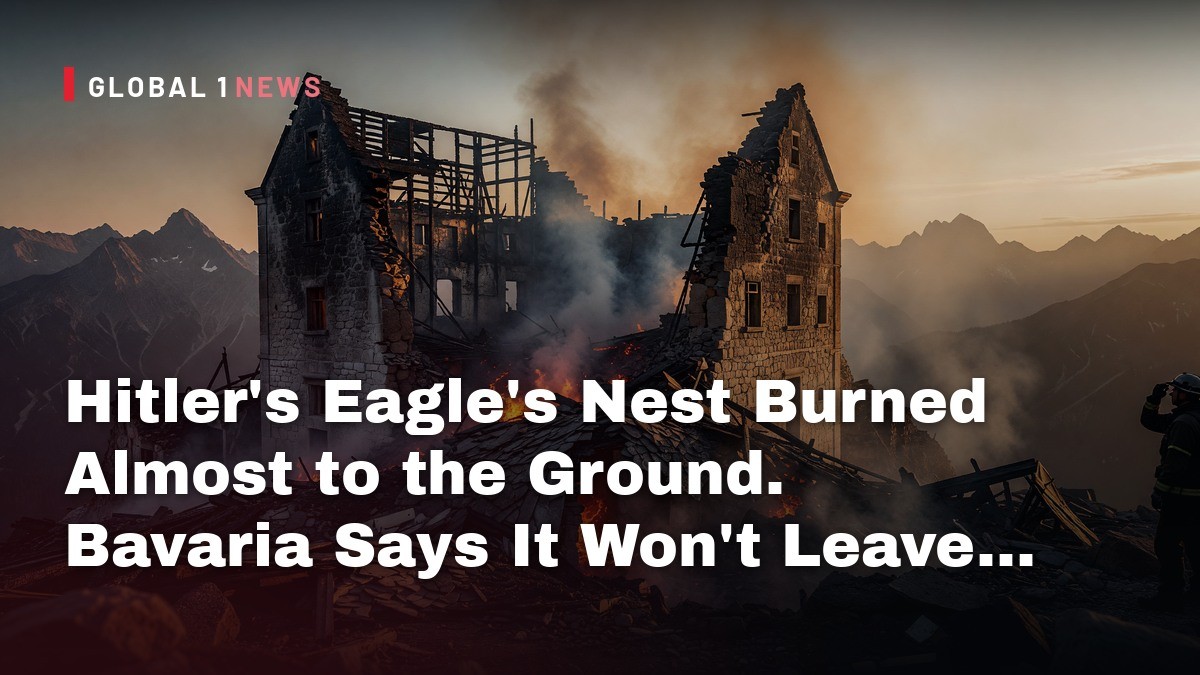
A fire broke out at the Kehlsteinhaus, the mountaintop building above Berchtesgaden known to the world as Hitler's Eagle's Nest, on the evening of Friday 23 October 2026. The building burned through the night and into Saturday. No one was hurt. A 33-year-old German man was arrested, and Bavaria's interior minister says the state will not leave a ruin on the peak.
Hitler's Eagle's Nest Burned Almost to the Ground. Bavaria Says It Won't Leave a Ruin.
Berchtesgaden, Germany — The fire alarm came in on a Friday night, and by the time the crews reached the top, the building was in full blaze.
What Burned on the Kehlstein
The Kehlsteinhaus sits at 1,834 metres above sea level on the Kehlstein peak, above the Obersalzberg, near Berchtesgaden in Bavaria's southeastern corner, close to the Austrian border. One regional report gives the altitude as 1,838 metres; the standard figure used by the Associated Press, The Guardian, Al Jazeera, t-online and tagesschau is 1,834.
Police say a fire alarm from the building reached the Integrierte Leitstelle Traunstein at about 21:15 on Friday. Several outlets, among them t-online, Al Jazeera and ingenieur.de, report that the building's smoke detector triggered the alarm at about 21:50.
Fire brigades called out could already see clearly visible flames on the approach. First emergency crews arrived at 21:52 and found the building in full blaze. Flames were visible from kilometres away at times. The fire was still burning at 7 a.m. Saturday. Around midday, Bayerischer Rundfunk reported it was largely under control, with no open flames visible on webcam images.
A Motorcycle With No Number Plate
Shortly after the fire broke out, a suspicious person came into the focus of investigators near the scene. He was taken into temporary custody at about 21:45 on Friday.
The man was a motorcyclist who came towards the emergency crews on the narrow and steep Kehlsteinstraße as they drove up. Police operations chief Gerhard Holzinger said the motorcycle had no number plate. "As luck would have it" the biker came towards them, Holzinger said, and because arson was already suspected, he was arrested.
According to dpa, the 33-year-old is alleged to have tried to escape arrest on the motorcycle. Bavarian Interior Minister Joachim Herrmann said it was not easy for officers to stop him. He was injured during the operation and was first taken to hospital. How he was injured has not been explained.
He is a German citizen. His registered residence is in Berlin. He was born in the Berchtesgadener Land region, Herrmann said, and has ties to the Berchtesgaden area but does not currently live there.
What the Prosecutor Said, and What He Would Not
On Saturday the man was brought before an investigating judge in Rosenheim. A psychiatric expert produced a short assessment and diagnosed a mental illness. The Traunstein public prosecutor's office applied for his provisional placement in a psychiatric hospital. The judge issued a placement warrant for an arson offence, and criminal police took him directly to a psychiatric hospital.
Public prosecutor Rainer Vietze, at a press conference in Berchtesgaden on Saturday afternoon, said there were "konkrete Anhaltspunkte für mögliche psychische Erkrankungen des Beschuldigten" — concrete indications of possible mental illness in the accused — and that at least diminished culpability must be assumed. A political motive is also being examined, Vietze said, but investigators are, in his words, "ganz am Anfang," right at the beginning of that line.
The suspicion of deliberately causing an arson offence hardened during Saturday. Police speak of "dringender Tatverdacht," urgent suspicion, against him. From investigator circles, dpa reports "deutliche Hinweise," clear indications, that the motorcyclist set the fire. Police said there were no current indications that anyone else was involved. He is the only suspect. No motive has been established, and no cause has been officially confirmed beyond the arson suspicion.
Two Hundred People on a Mountain
Around 200 rescue and emergency personnel were deployed: fire brigades from six municipalities, among them Berchtesgaden, Marktschellenberg, Königssee and Schönau, with Ramsau and Bischofswiesen called in later, plus the Kreisbrandinspektion, the Bavarian Red Cross, the Bergwacht mountain rescue and police. At one point around 150 were reported; later roughly 200.
Access was the core problem. The building sits at the end of a narrow, steep mountain road that winds up through a series of tunnels. Fire engines had to climb roughly 700 vertical metres. Sufficient firefighting water was a problem, and crews had to establish a second supply. A firefighting helicopter could not be deployed. Strong wind, rain that turned into the year's first snow, and toxic smoke hampered the operation.
The building and its immediate surroundings could only be entered with heavy breathing apparatus. Police spokesperson Lisa Maier put it plainly: "You can only get into the building with heavy breathing apparatus." She cited the retreat's altitude above 1,800 metres as what complicated the operation. At times emergency personnel were cut off from the outside world and waited for hours in self-built shelters. The operation had to be interrupted around 02:50 and resumed in the morning.
Bavaria Says It Cannot Leave a Ruin
The Free State of Bavaria owns the building. It falls under the responsibility of the Interior Ministry, which Herrmann heads. The Berchtesgadener Landesstiftung holds the usufruct, and the Zweckverband Bergerlebnis Berchtesgaden operates the mountain restaurant.
Herrmann, speaking to dpa on the sidelines of the CSU party conference in Munich and at the Berchtesgaden press conference, said: "Wir werden da kaum eine Ruine stehen lassen können" — we're not going to leave a ruin there. "I think we will be able to find a sensible solution," he said. He said the historically significant house, visited by tens of thousands of people every year, should be rebuilt. He said the house was well insured and possible insurance claims were already being examined. Rebuilding will take some time. Because of the building's difficult historical significance, historians are to be included in the process. He stressed "it is important that we continue to do the work of remembrance," and thanked police for their intervention.
There is no concrete timetable and no binding cost estimate. No authority has given a euro figure. Bartl Wimmer, chairman of the Zweckverband Bergerlebnis Berchtesgaden, said: "Der Schaden geht sicher in die Millionen" — the damage certainly runs into the millions.
A Tea House Built to Impress
The house was built in 1937 and 1938 on the initiative of the Nazi official Martin Bormann, as part of the cordoned-off leadership and residential area on the Obersalzberg, sealed off from the public. It was intended as the so-called Teehaus, a political representation venue away from public view, meant to impress foreign diplomats and state guests.
Hitler received diplomats and other foreign guests there occasionally, but the building's actual political importance remained small. The Zweckverband's own description is candid: "Erbaut 1937/38, sollte in der NS-Zeit das damals sogenannte Teehaus als politischer Repräsentationsort abseits der Öffentlichkeit dienen. Tatsächlich blieb die Bedeutung des Kehlsteinhauses gering." Hitler himself rarely used it; his actual residence on the Obersalzberg was the Berghof, at a different spot. WELT notes that, in contrast to his later wife Eva Braun, Hitler was seldom at the Kehlsteinhaus. The Nazi leadership gathered at Obersalzberg used the house mainly for rest and private celebrations.
Construction was a huge engineering effort under enormous time pressure: a 6.5 km mountain road, five road tunnels, and an elevator carved inside the rock, with thousands of workers, around 3,800 cited. It was completed in 1938.
The One Building the Bombs Missed
Large parts of the Nazi restricted area were destroyed by Allied bombing in April 1945. The Kehlsteinhaus remained almost undamaged. It also escaped being blown up after the war. The Berghof ruins were blown up in 1952.
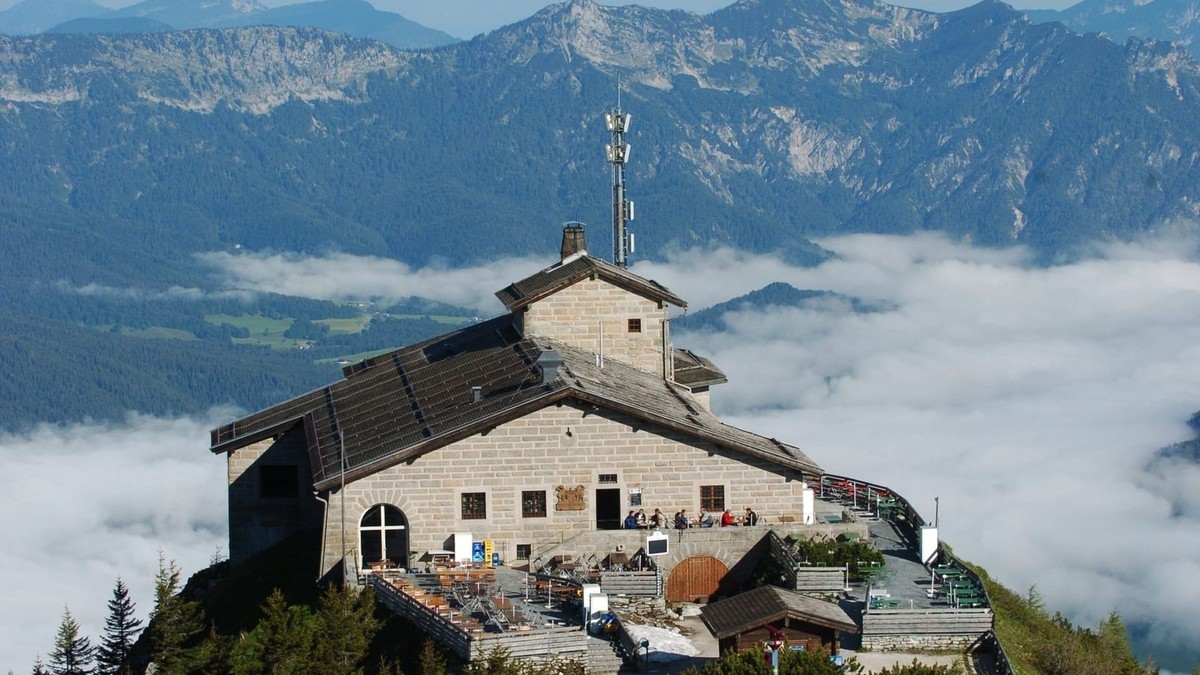
Since 1952 it has operated as an alpine mountain restaurant. An exhibition there, run by the Institut für Zeitgeschichte, told visitors about the building's history and its role in the Nazi dictatorship. The Obersalzberg Documentation Center further down the mountain, home to the area's main historical exhibition, was unaffected by the fire.
Its own website says it is "one of the few undamaged monuments of the Hitler era" and that it "stands for the insanity of the regime." The website also says post-war American war films gave the building a prominence it perhaps did not deserve, probably also because it is among the few undamaged monuments of the Hitler years. The Allies coined the name Eagle's Nest.
The house was due to stay open for the regular season until Sunday 8 November 2026, an abrupt end to the season.
Three Hundred Thousand, or Four Hundred Thousand
How many people came up that mountain each year is a number the outlets do not agree on.
Bild says the site counts about 300,000 visitors a year. Süddeutsche Zeitung says up to 400,000 guests visit the historic viewpoint each year. tagesschau and WELT say only "tens of thousands" each year. Those figures sit a long way apart, and no single authority has settled them.
What is not in dispute is the pull of the place. The district administrator of Berchtesgadener Land, Michael Koller, drove up to the Obersalzberg when he heard. "Ich kann es gar nicht fassen," he said — I can't grasp it. "For our region it is indisputably one of the most important flagships. And it is the most famous." The Regionalverkehr Oberbayern bus operation is also affected, alongside the restaurant operator.
What Investigators Still Cannot Do
Investigators have not been able to enter the destroyed building, for reasons of self-protection and safety. In the coming days an expert from the Bavarian State Criminal Police Office will support the investigation. A fire-detection dog was also to be used.
The investigation into the cause and the background is being led by the Traunstein criminal police under the direction of the Traunstein public prosecutor's office. Police published photographs of the nearly completely destroyed Kehlsteinhaus. Police told Bild the building was so badly damaged it "could probably not be saved," and Reuters reports police describing it as unlikely to be salvageable. There was a danger of collapse on Saturday.
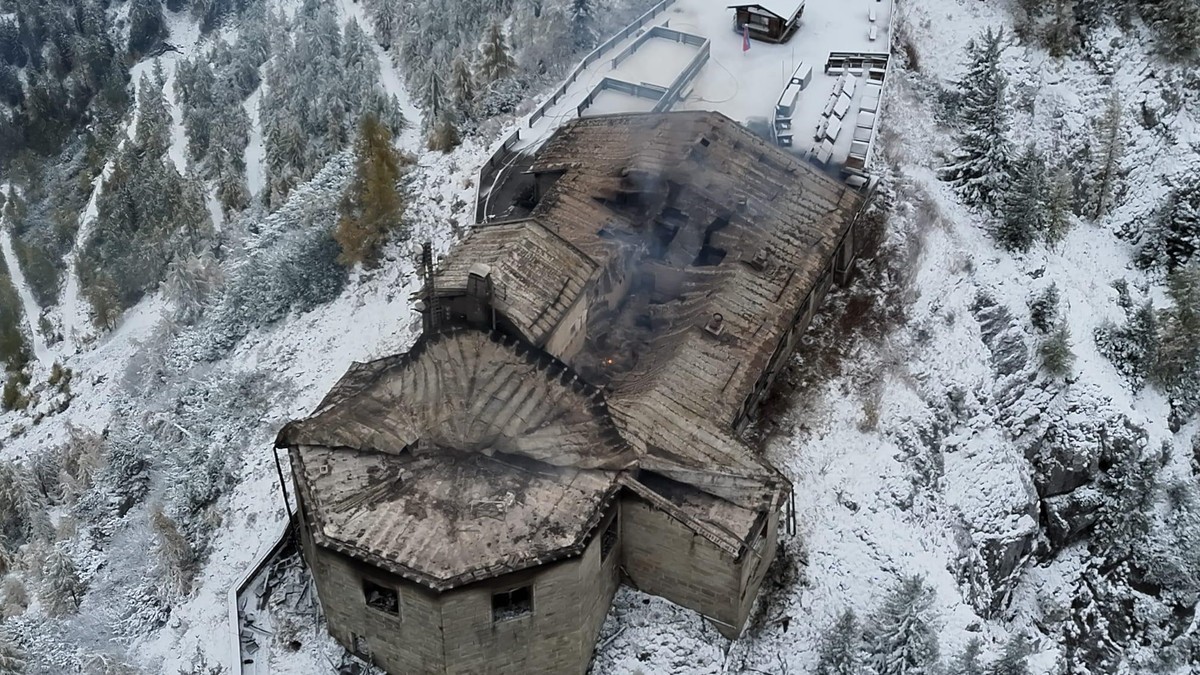
Herrmann said the damage is not yet quantified; fire damage experts must establish the exact extent. Overnight into Sunday, smaller ember nests re-ignited in the burned-out ruin. They were discovered by the alpine task force around 02:30 and brought under control quickly. Firefighting work ended around 04:30. The area around the site remains cordoned off, and authorities declared a no-fly zone for drones.
The Ruin Bavaria Will Not Leave Standing
Police say the building was probably not salvageable. The interior minister expects a rebuild. Those are two positions, not one decision. No rebuild has been approved, funded or scheduled. What a rebuild requires depends on how much of the historic fabric survived, in particular the load-bearing structure, the natural stone facade and the historic interiors. The building is a protected monument; the underground access tunnel and the elevator system are part of the protected ensemble. Damage there is not yet known. No confirmed statement exists on whether the house will reopen in 2027.
No one was hurt. According to findings so far, nobody was in the building. The restaurant had not opened on Friday, a scheduled closure, which is why no visitors or staff were present. The man in custody is a suspect. The fire's cause is a suspicion under investigation. The motive is not established. That is what is known, and what is not.
By Jessica Ali, Staff Writer
This article was produced with AI-assisted research and editorial support. Sources: Associated Press, Reuters, The Guardian, Al Jazeera, CBS News, Euronews, tagesschau, Sueddeutsche Zeitung, Bild, Passauer Neue Presse, Berliner Zeitung, WELT, ORF, ingenieur.de. Photographs: fire at the Kehlsteinhaus, Bayerisches Rotes Kreuz/Florian Scherer via Reuters and t-online; fire-damaged building, Polizeipraesidium Oberbayern Sued via OVB; the building before the fire, Peter Kneffel/dpa via t-online.
What's Your Reaction?
 Like
0
 Dislike
0
 Love
0
 Funny
0
 Wow
0
 Sad
0
 Angry
0

Editor-in-Chief at Global1.News. Atlanta-based journalist who cuts through the BS and tells it like it is. Lead anchor, host, and the voice you hear when the spin stops and the truth starts.















Comments (0)