
Spain's First General Strike in 14 Years Puts Housing at the Center of an Election
Spain held its first general strike in 14 years as millions walked out over housing costs and wages, eighteen days before a snap election. Unions claimed four million participants; employers called the stoppage a failure.

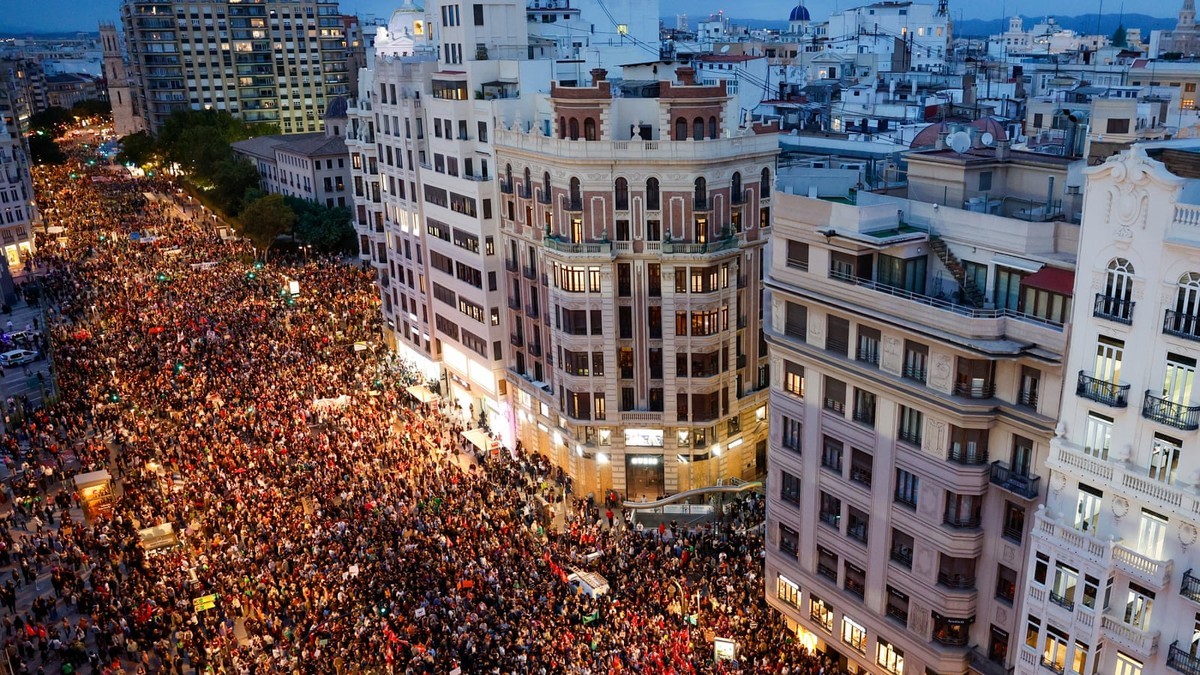
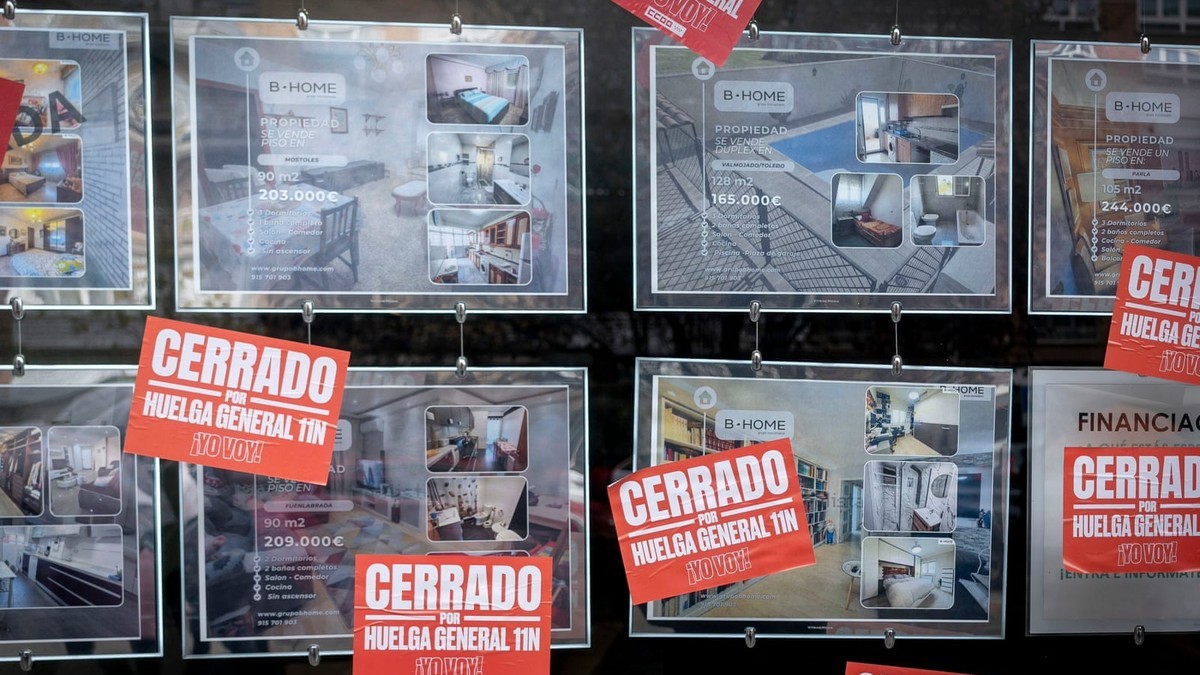
Spain's unions called the first general strike in fourteen years, and by Wednesday night the country had the pictures to prove it: shuttered storefronts on Madrid's Gran Vía, house keys jangling above the crowd, a Barcelona shopping boulevard packed end to end under the rain, and later, rubbish bins burning in the street. What began as a tenants' revolt over rent became a national stoppage over pay and the cost of living, landing a little more than two weeks before a snap election that could end the Spanish left's run in power.
Spain's First General Strike in 14 Years Puts Housing at the Center of an Election
MADRID, Spain — The 24-hour stoppage ran from midnight under a three-word slogan: "Salaries. Housing. Prices."
Spain Stops: The First General Strike Since 2012
The walkout was called by Spain's two largest unions, the General Union of Workers and the Workers' Commissions, joined by the smaller CGT and CNT and by tenants' associations that had been organising rent protests for months. It was the first general strike jointly backed by the big two since 2012, when Spanish workers downed tools against austerity during the eurozone debt crisis under the conservative government of Mariano Rajoy. Euronews counts it as the eighth general strike since Spain returned to democracy in the late 1970s.
This one did not begin as a labour dispute. The Associated Press notes it was the first general strike in Spain whose principal push came from housing unrest — a distinction that shaped the day, including the fact that the Socialist prime minister encouraged it rather than trying to defuse it.
Workers set up picket lines through stormy weather, blocking factory gates, markets and transport depots from early morning. The Interior Ministry said dozens of arrests were made over a range of incidents, and Spanish reports described attacks on estate agents' offices.
A Strike That Began With One Eviction
The spark was a flat in Madrid and an 87-year-old woman named Maricarmen Abascal. She was evicted from the home she had lived in for more than seven decades at the end of September, facing what the BBC reported was a tripling of her rent under new landlords. She died in hospital weeks later. As protests and encampments spread across the country, Maricarmen became the face of a generation shut out of the property market.
Housing campaigners used the uproar to call the strike, and the unions soon climbed aboard. Gonzalo Álvarez, a 27-year-old sales worker volunteering for a housing union in Madrid, told the BBC the eviction "was the little fire" that started it. He knew her, and said he was deeply upset by how she was treated.
The movement's own temperature ran hotter than the union leadership's. Before the strike, the tenants' union in Granada descended on the city's most tourist-heavy streets and disabled about 300 lockboxes used for short-term rentals.
The Numbers That Explain the Anger
The Bank of Spain puts the country's housing deficit at roughly 750,000 homes, a gap projected to widen past one million by 2028. With fewer people able to buy, the rental market has absorbed the pressure, and the arithmetic has turned brutal for anyone under forty.
Spain's Youth Council calculates the average rent of €1,176 a month at about 98.7 percent of a young person's average monthly salary. In Madrid, the property portal Idealista put the average rent for a 50-square-metre flat at €1,170 in October, against an average gross monthly salary of about €2,460 — close to half a pay packet, well above the 30 percent ceiling that housing experts and public institutions generally treat as affordable.
Rents have climbed roughly 80 percent over the past decade, with the cost of buying up about 63 percent, while wages failed to keep pace.
Two Counts of the Same Crowd
Nobody disputes that the crowds were large. Nobody agrees on how large, and the gap is a story in itself.
In Madrid, the central government's office in the city counted 120,000 people marching through the rain. The Tenants' Union put attendance above half a million. In Barcelona, city police recorded 55,000 behind a banner reading "Live. Not just survive." The organisers said 400,000. Bilbao's municipal police counted around 50,000. In Girona, police said 18,000 and organisers said more than 50,000; in Lleida, municipal police said 4,000 and organisers said 14,000.
Nationally, the unions said four million workers took part — roughly one in five of Spain's 23 million-strong workforce, according to the national statistics institute. The Tenants' Union said it expected five million by the end of the day.
What Shut Down, and What Did Not
Union figures put participation at 90 percent in the ports, naming Valencia and Algeciras, and in the automotive sector, with complete stoppages reported at Volkswagen's plant in Navarre and at SEAT in Barcelona. The unions counted 85 percent in the meat industry, 82 percent in waste collection and 75 percent in energy, but only 38 percent in healthcare and social services and 35 percent in the postal service.
The employers' confederation, CEOE, called the strike a failure. Its vice-president, Miguel Garrido, argued the dispute had little to do with labour at all. "This is not a strike for labour-related reasons, but rather for political ones, and it is closely linked to the early calling of elections," he said.
The energy data splits the same way depending on what is measured and when. Grid operator Red Eléctrica recorded a 7.5 percent fall in power use in the early hours, against more than 15 percent in 2012, and a drop of as much as 15.5 percent between 10 and 11 a.m. Employers pointed to about five percent overall and a 25.6 percent fall in industrial demand.
The Night the Bins Burned
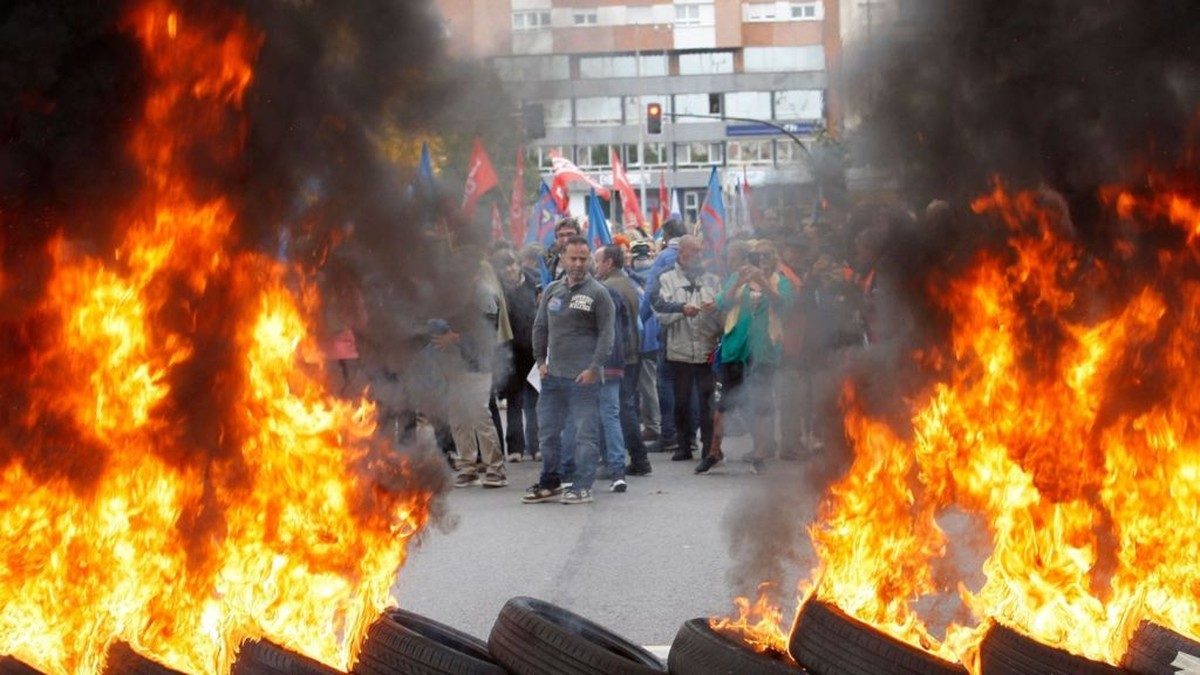
The marches were overwhelmingly peaceful, and then they were not. After the main demonstrations ended, groups of masked and hooded protesters threw fireworks and flares at police, set rubbish containers alight and smashed shop windows on Barcelona's Passeig de Gràcia, near Plaça de Catalunya. Local media reported looting, including at a Lego shop. Police in helmets and riot shields fired tear gas and rubber rounds.
In Madrid, riot police used foam bullets, tear gas and pepper spray to clear the area around Plaza de España. In Gijón, in the north, tyres burned across the road.
The arrest and injury figures do not agree. Reuters reported at least 73 arrests nationwide by 9 p.m. GMT from more than 1,000 incidents; Euronews reported more than 70 arrests and 1,500 incidents; government officials put the total above 50. The UGT said at least eight people were hurt when police charged a picket outside Madrid's bus depots, and Reuters reported unions preparing a criminal complaint over an operation they said injured 20.
Sánchez's Gamble
Prime Minister Pedro Sánchez kept a low profile on the day itself, but he had already picked his side. Earlier in the week he posted a video praising the labour movement's historic wins — the eight-hour day, the state pension, public healthcare. "Your eight-hour day. Your pension. Your public healthcare… These were collective conquests," he said. "It wasn't easy, but they changed Spain."
That is an unusual posture for a Spanish prime minister facing a general strike, and the calculation is easy to read. Sánchez called the snap election for 29 November in the middle of a housing revolt, and since then the campaign has drifted toward two disasters — a deadly migration incident in Ceuta and a high-speed train collision in late October that killed 69 people, Spain's second fatal rail disaster of the year. The Socialists still trail in the polls.
Oriol Bartomeus, a political science professor at the Autonomous University of Barcelona, told the AP what the left needs from all this. "The Socialists need for the strike to be a success and for there not to be any violence so that the election campaign can swing back to being about housing," he said.
The Right Calls It a Gift
The conservative People's Party and the far-right Vox saw a staged election stunt. PP spokesman Miguel Tellado called it "a gift by the unions to their political parties during the buildup to a campaign where it is clear the left needs all the help it can get."
Party leader Alberto Núñez Feijóo, whose party leads the polling and who is tipped to be Spain's next prime minister, called the strike "nonsense" and described the unions as "mafia" and "trash." He also warned they may have made a "historic mistake." Sánchez fired back on Spanish television: "What is nonsense is to question the rights of workers to strike."
Isabel Díaz Ayuso, the right-wing leader of the Madrid region, accused strikers of "holding citizens hostage" and complained of a "mafia of union representatives," telling Spanish television she had asked Feijóo to promise her "this garbage will end."
Vox leader Santiago Abascal held his own event in Barcelona as the marchers filled the streets; regional police cordoned off the area around the venue.
The Decrees Parliament Would Not Pass
The underlying dispute is legislative, and that is why it has become an election. The government's package sought to curb evictions and cap rent pressure. It failed. Right-wing parties blocked it in parliament last month, and Sánchez responded by calling the snap vote and sending the argument to the country.
The strikers' demands go further than the decrees did. Tenants' organisations want automatic renewal of leases, a crackdown on housing speculation, the elimination of tourist lets in pressured areas and stronger protections for renters. The unions want a large expansion of public housing and a new minimum wage agreement.
Their anger is not reserved for the right. "This is a strike against rentierism, against landlords, against employers and against all governments," said Valeria Racu, a spokesperson for the Tenants' Union. "That includes the central government, this progressive government that has been very disappointing and whose housing policy has been disastrous and has brought us to this point, just as the policies of the Partido Popular did before."
The Vote That Will Judge It
Spain votes on 29 November, eighteen days after the walkout. Polls point to a right-wing coalition between the People's Party and Vox as the most likely outcome — putting the People's Party, whose leader called the unions a mafia, into government.
Pepe Álvarez, the UGT's general secretary, called the walkout a success with "massive" participation and said whoever ends up governing "will have to listen to the people."
The head of the Workers' Commissions, Unai Sordo, put the stakes more plainly on Cadena Ser. "There is one issue that is fracturing the country, and that is the difficulty many people face in accessing housing," he said. BBVA Research's chief economist, Miguel Cardoso, estimated the stoppage could shave 0.1 to 0.2 percent off Spain's annual output — a small number for an economy, and an enormous one for a generation that cannot afford a roof.
By Jessica Ali, Staff Writer
This article was produced with AI-assisted research and editorial support. Cover: Global 1 News editorial image. Photographs: Ana Escobar/EPA; Angel Perez/ZUMA Press Wire/Shutterstock; EPA. Sources: The Associated Press, BBC News, Reuters, The Guardian, Euronews, Agence France-Presse, Catalan News, and the Bank of Spain.
What's Your Reaction?
 Like
0
 Dislike
0
 Love
0
 Funny
0
 Wow
0
 Sad
0
 Angry
0

Editor-in-Chief at Global1.News. Atlanta-based journalist who cuts through the BS and tells it like it is. Lead anchor, host, and the voice you hear when the spin stops and the truth starts.













Comments (0)