
Danube Drought Exposes Nazi Warships While Crippling Nuclear Plants Across Europe
Record-low Danube waters have exposed sunken Nazi warships from World War II near Serbia's Prahovo port, while the same drought has cut Hungary's Paks nuclear plant to 10 percent capacity and driven the Rhine to levels unseen since 1880.
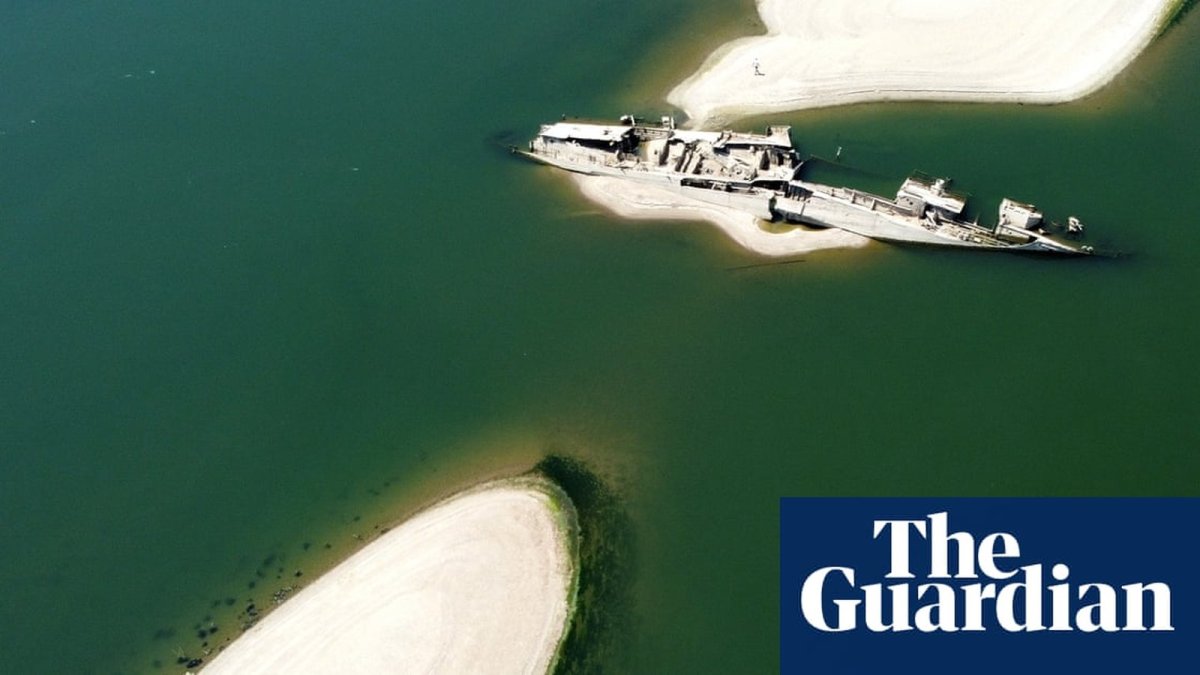
The record-low waters of the Danube have laid bare dozens of sunken Nazi German warships from World War II near Serbia's port of Prahovo, while the same drought has pushed Hungary's Paks nuclear plant to operate at just 10 percent capacity and forced Romania's navy to blast riverbed rock with explosives.
WWII Relics Emerge from the Danube Riverbed
Dozens of German warships from Adolf Hitler's Black Sea fleet now sit exposed on sandbanks along the Serbian-Romanian border. Historians note that up to 200 vessels were deliberately scuttled in September 1944 near Prahovo to block the Soviet advance, months before Nazi Germany's May 1945 surrender.
At least 20 wrecks of various sizes stand visible to the naked eye from the banks of Prahovo. Some hulls remain partly submerged and may still carry unexploded ordnance, complicating removal efforts that Serbian authorities have pursued with EU funding for years.
Lifelong resident Ivica Gavrilovic observed that people still lack safe access to the ships themselves. Fellow Prahovo resident Krsta Brandic added that large vessels can no longer pass the narrowed channel created by the exposed wrecks.
Similar exposures occurred in 2022 and again in 2024, when ships still bearing explosives surfaced. Communist Yugoslav authorities removed some earlier, yet most remain due to the hazards they pose.
The pattern of exposure across 2022, 2024 and again this year signals that Europe's hydrological extremes are no longer isolated events but part of a worsening sequence — one that threatens both heritage preservation and practical river use. The same low waters that reveal the fleet also constrain commercial traffic and force authorities to confront long-deferred cleanup challenges, with the persistent danger of unexploded ordnance still embedded in many hulls at the center of the standoff between preservation and safety.
Hungary's Nuclear Plant Struggles with Cooling Water
Hungary's Paks nuclear power plant, which normally supplies nearly half the country's electricity, has been forced to run at roughly 10 percent capacity. Low Danube levels have taken all but one reactor offline, raising fears of a complete shutdown.
Prime Minister Péter Magyar publicly thanked households and industry for cutting consumption during peak evening hours to ease pressure on the grid. The plant relies on Danube water for reactor cooling, a system now severely constrained.
The situation at Paks demonstrates how record-low flows amplify vulnerabilities in nuclear operations across the region, with similar curtailments already reported at facilities in Romania and France. A complete shutdown would intensify pressure on the grid during peak summer demand, forcing greater dependence on imports and highlighting how upstream drought conditions propagate downstream through the ten countries the Danube traverses from its German source to the Black Sea.
Water levels in Budapest reached just 4 inches on Monday, shattering the previous record low of 13 inches set in 2018. Earlier reports noted levels at 9 inches, already below the 2013 mark.
The Danube winds through ten countries on its journey to the Black Sea, making upstream drought conditions felt far downstream in Hungary's energy sector.
Romania Deploys Explosives to Protect Cernavodă Reactor
Romanian naval forces detonated explosives in the riverbed near Izvoarele village to redirect Danube water toward the sole operating reactor at the Cernavodă nuclear plant. State water managers now plan to sink two rock-filled barges to form a temporary dike for additional flow.
The measure underscores how critically low river levels threaten cooling systems at one of Romania's key power facilities. Without intervention, the plant risked further curtailment during peak summer demand.
Similar pressures have affected hydropower stations in Serbia, where reduced turbine output compounds regional electricity shortfalls. Liz Saccoccia of the World Resources Institute noted that nuclear plants in Hungary, Romania, and France have already scaled back generation due to insufficient cooling water.
Rhine River Hits Lowest Levels Since 1880
At the Kaub chokepoint near Koblenz, the Rhine fell to 9 inches on Wednesday, breaking the prior record of 9.3 inches from 2018. ETH Zurich data placed the level at 24 centimeters on Monday and Tuesday, the lowest since records began in 1880.
The critical navigation threshold stands at 78 centimeters. Below that mark, barges must lighten loads sharply, driving freight costs higher and forcing rerouting to rail and road where possible.
Lanxess reported that barge shipments are severely restricted, with some loading points unreachable. Commercial vessels on the Rhine have cut cargo by as much as 80 percent to avoid grounding.
Record lows were also logged at Cologne and at Lobith on the German-Dutch border. The Po in Italy and Loire in France show comparable stress in multiple stretches.
Germany Faces Potential GDP Hit from Disrupted Shipping
Stefan Kooths of the Kiel Institute for the World Economy estimated that Rhine low levels could trim German GDP by up to 0.2 percent in the third quarter, equating to a loss in value added of roughly 1 to 2 billion euros.
Felix Schmidt at Berenberg noted freight rates have gone through the roof. Germany posted 0.2 percent growth in the second quarter after a revised 0.4 percent in the first.
The combination of 80 percent load cuts and forced modal shifts reveals a structural vulnerability that could persist if drought patterns continue, pressuring both short-term output and longer-term logistics resilience. The ripple effects extend beyond immediate transport costs, as commercial vessels operating at severely reduced capacity compound delays and elevate expenses across southern European trade corridors already strained by chronic water stress.
Around 30 percent of southern Europe's population already lives in areas of permanent water stress, where demand chronically exceeds supply. The current drought amplifies that structural vulnerability.
Ancient Mammoth Bones and Other Historical Finds Surface
Receding waters near Ruse, Bulgaria, revealed bone fragments believed to belong to a woolly mammoth from the Ice Age. Nikolay Nenov, director of the Regional Historical Museum, identified a jawbone, tusk fragments, part of a shoulder blade, and a femur with articular head.
The animal appears to have been young, with dark bone coloration suggesting a marshy burial environment. The well-preserved remains lay concentrated in one spot, indicating they came from a single individual. Woolly mammoths died out about 4,000 years ago.
In Croatia, the skeleton of the 1937 coal-carrying cargo ship Fulton emerged on the exposed riverbed. In Slovakia, police safely detonated a 1,543-pound unexploded British bomb recovered from the river after RAF mining operations in 1944.
A German military motorcycle was also recovered in Budapest. A cruise ship ran aground on a Danube sandbank in Bulgaria, while Lake Brenets on the Switzerland-France border nearly dried up, stranding boats on the exposed bed.
Record Heat Waves Intensify the Hydrological Crisis
Slovakia, Austria, and Hungary logged record temperatures this week. The Slovak hydrometeorological agency reported a new national high of 42 degrees Celsius in the village of Dolné Plachtince on Thursday.
Europe remains the planet's fastest-warming continent. Successive heat waves have drawn moisture from soils and waterways, shrinking rivers that serve as critical trade corridors and industrial water sources.
Satellite images from Sentinel-2 show dramatically reduced waterways compared with 2023. The visual evidence confirms the scale of the current contraction across the Rhine and Danube basins.
Scientists Warn of Worsening Extremes Without Emission Cuts
Richard Allan, climate science professor at the University of Reading, stated that continued warming will make current hydrological extremes only the beginning. Managing water resources will grow progressively harder without rapid cuts in greenhouse gases across all sectors.
Hannah Cloke, Regius professor of meteorology and climate science at the University of Reading, described the simultaneous drying of soils, emptying of rivers, and spike in water demand as the clear fingerprint of a changing climate. Summers like this are entering the ordinary range and will intensify as long as fossil fuels are burned.
The human-caused climate crisis is supercharging these extremes, turning what were once rare events into recurring threats to energy security, navigation, and historical preservation along Europe's major waterways.
The physics-driven escalation now confronting Europe demands long-term policy responses rather than repeated short-term firefighting. Managing water resources will become progressively more challenging as the climate warms, affecting energy generation, navigation, and industrial operations along the continent's major rivers — with the wreck-strewn Danube standing as both museum and warning.
By Jessica Ali, Staff Writer This article was produced with AI-assisted research and editorial support. Sources: CNN, The Guardian, CBS News, CNBC.What's Your Reaction?
 Like
0
Like
0
 Dislike
0
Dislike
0
 Love
0
Love
0
 Funny
0
Funny
0
 Wow
0
Wow
0
 Sad
0
Sad
0
 Angry
0
Angry
0

Editor-in-Chief at Global1.News. Atlanta-based journalist who cuts through the BS and tells it like it is. Lead anchor, host, and the voice you hear when the spin stops and the truth starts.














Comments (0)