
China Deploys World's First Bamboo-Built Floating Solar Farm Off Shandong
China has launched the world's first 100kW floating solar farm built with bamboo frames off the coast of Yantai in Shandong. The Jilin-2 platform, developed by CIMC Raffles with Beijing Forestry University, will power a hydrogen, ammonia and methanol project and test bamboo composites for offshor...
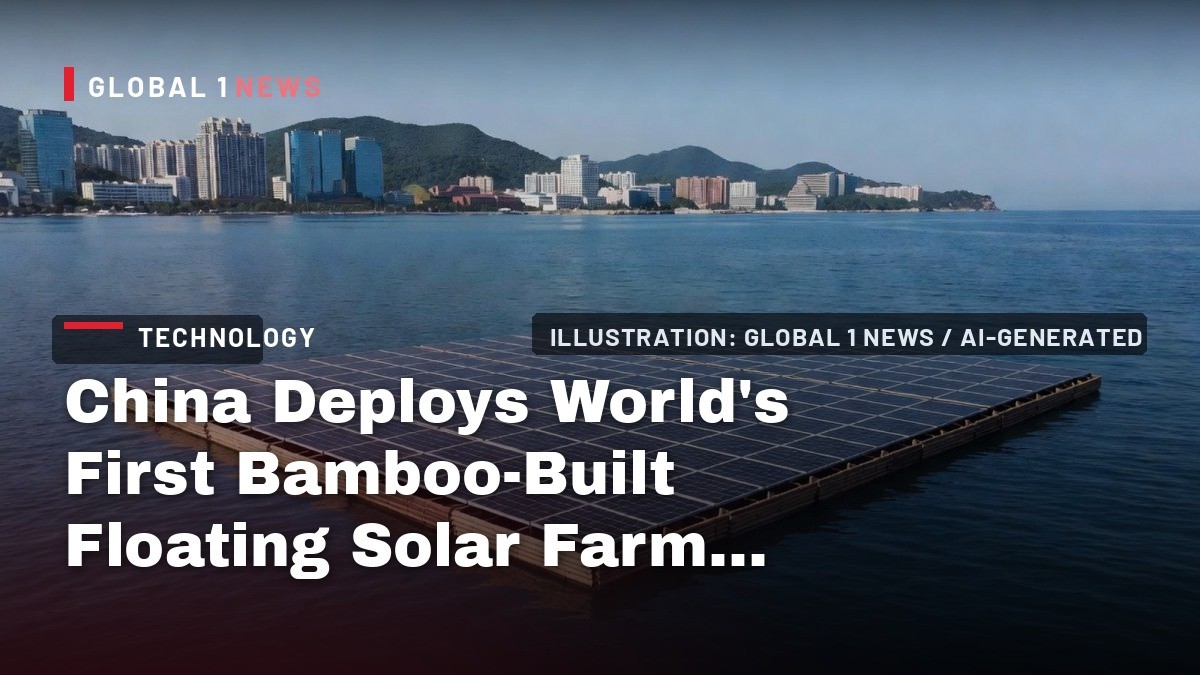
A Bamboo Innovation Rides the Waves Off Yantai
China has put a floating solar farm on the water that is built out of bamboo, not steel or plastic. The 100-kilowatt (kW) platform, named Jilin-2, is the first of its kind in the world, and it has been deployed at a demonstration base off the coast of Yantai in the eastern province of Shandong, developer Yantai CIMC Raffles Ocean Technology Group announced. The platform is made of composite bamboo tubes and pipes, and it will supply power to an integrated hydrogen, ammonia and methanol production project nearby.
"Compared to conventional steel or high-density polythene structures, the bamboo-based design significantly reduces marine environmental impact," CIMC Raffles said in announcing the deployment.
From a 10kW Prototype to a World First
Jilin-2 builds on an earlier 10kW prototype called Jilin-1, which was completed in 2023. The new platform was developed by the CIMC Offshore Engineering Research Institute, the company's research arm, together with China Forestry Group Corporation and Beijing Forestry University. CIMC Raffles said its next step is a megawatt-level bamboo-based project, with the goal of promoting the global adoption of green marine materials.
The timing matters. China has committed to peaking carbon emissions by 2030 and reaching carbon neutrality by 2060, and offshore solar is one of the fastest-growing tools in that effort. In December, a one-gigawatt (GW) offshore solar farm, the world's largest, was brought online off the coast of Dongying, also in Shandong, according to state-owned developer CHN Energy. The HG14 project spans roughly 1,223 hectares of shallow coastal waters about 8 kilometres from shore, and combines solar generation with energy storage and aquaculture.
Why Bamboo: Material Science Meets Marine Engineering
Conventional offshore solar farms rest on sturdy steel or plastic frames with buoyant floats. The Jilin-2 design replaces those with bamboo-wound pipes as a core support, plus "sea bamboo pipes", fibre-reinforced wood-bamboo composite pipes developed by Beijing Forestry University that provide buoyancy and load-bearing support.
Qi Chusheng, a professor at the university, told the official forestry trade newspaper China Green Times that the wood and bamboo materials were modified to withstand high humidity, corrosion, salt spray and ultraviolet radiation. He said the renewable materials could be processed into high-value, durable engineering products, offering a way to reduce reliance on conventional high-energy-consuming materials, according to a report published on August 12.
Bamboo is a fast-growing, giant woody grass found naturally across Asia, Africa and Central and South America. It is lightweight, flexible, durable and strong, which is why China's 2023 action plan to replace plastic with bamboo, formally the Bamboo for Plastic Global Action Plan 2023-2030, has made the material a centrepiece of its latest forest and grassland conservation plan released in July.
China's Offshore Solar Surge Is Only Getting Bigger
The bamboo platform is a pilot, but it sits inside a much larger build-out. Across China's vast coastline, offshore solar farms are multiplying to serve the dual carbon goals, and Shandong has become the proving ground. The 1GW HG14 plant near Dongying is now in commercial operation as the world's largest open-sea solar project, and developers are pushing into deeper, more exposed waters where materials and mooring systems face harsher conditions.
That is where bamboo's durability claims will be tested. The Jilin-2 platform will be monitored for long-term durability, environmental adaptability and fatigue performance, according to CIMC Raffles. The data will provide technical support for using wood-bamboo composites in offshore power plants, marine energy islands and marine ranches, the managed underwater farming zones China has been developing to cultivate marine life while restoring ecosystems.
The economics are also shifting. Steel frames corrode in salt water and require expensive protective coatings, while high-density polythene floats have a limited service life and are difficult to recycle at sea. If bamboo composites can match their structural performance at a comparable cost, the maintenance and replacement cycle of offshore arrays could fall sharply, a consideration that matters as China plans gigawatt-scale floating capacity rather than single demonstration platforms. Beijing's industrial policy has repeatedly favoured domestically abundant raw materials, and bamboo is one of the few such inputs with a dedicated national promotion plan behind it.
A Cautionary Tale From Japan's Floating PV Pioneers
Japan knows both the promise and the peril of floating solar. The country was an early adopter, and its largest floating photovoltaic plant, a 13.7MW project built by Kyocera at the Yamakura Dam in Chiba, was considered a flagship of the technology. In September 2019, Typhoon Faxai brought 120mph winds to the region, and the plant was devastated, with two-thirds of the array destroyed and panels stacked atop one another in a fire that followed. The disaster put wind resistance and mooring engineering at the centre of floating PV design worldwide.
China's bamboo-based approach is an implicit answer to that lesson: the platform is designed for the open sea rather than sheltered reservoirs, and the composite pipes are engineered to resist corrosion, salt spray and UV radiation, the exact failure modes that plague steel and plastic in marine environments. For Japanese utilities and engineering firms watching China's offshore build-out, the Jilin-2 experiment is a reminder that the technology frontier has moved well beyond the calm waters where Japan's floating solar boom began.
Japan's Own Bamboo Problem Points to a Shared Opportunity
There is a second, closer connection for Tokyo. Japan has an abundance of bamboo, much of it abandoned and overgrown as traditional bamboo forests have lost their economic uses. Revitalising those forests has become a policy goal, and the Forestry Agency announced plans this week to support the revitalisation of Japan's forestry and lumber industries through public-private cooperation, including forest consolidation and ICT adoption.
Bamboo composites like the ones powering Jilin-2 represent exactly the kind of high-value downstream use that could make Japanese bamboo groves worth managing again. If China proves that wood-bamboo materials can survive years of salt spray and wave fatigue, Japanese companies with expertise in materials science and precision manufacturing have a natural opening to apply the same techniques to their own offshore projects and coastal infrastructure.
What to Watch For
Three signals are worth tracking. First, CIMC Raffles' move to a megawatt-level bamboo platform: if the demonstration data supports it, the jump from 100kW to 1MW-plus would mark the transition from novelty to commercial contender. Second, how the sea bamboo pipes perform through their first typhoon season, the real-world stress test that Japan's Yamakura Dam project failed in 2019. Third, whether China's Bamboo for Plastic push, now embedded in the forest and grassland conservation plan, starts steering procurement standards for offshore energy infrastructure.
For the Asia-Pacific region, the stakes are practical. Floating solar is one of the few renewable technologies that can be deployed on reservoirs, coastal waters and degraded marine zones without competing for land, and the choice of materials will determine how cheaply and how safely it scales. If bamboo composites hold up where steel and plastic have struggled, the world's first bamboo-built solar farm off the coast of Shandong will not be a curiosity, it will be a blueprint.
By Kenji Tanaka, Staff Writer
This article was produced with AI-assisted research and editorial support. Sources: South China Morning Post, CIMC Raffles, China Green Times, PV Magazine, The Japan Times.
What's Your Reaction?
 Like
0
Like
0
 Dislike
0
Dislike
0
 Love
0
Love
0
 Funny
0
Funny
0
 Wow
0
Wow
0
 Sad
0
Sad
0
 Angry
0
Angry
0

Japan Correspondent at Global1.News. Tokyo-based voice covering Japanese politics, technology, economy, and culture. Tracks the intersection of tradition and innovation in one of the world's most dynamic societies.















Comments (0)