
Brazil Relaxes Belo Monte Water Rule as El Niño Drought Looms
Brazilian regulators approved a temporary cut in Belo Monte dam's minimum water flow on the Xingu River, from 300 to 100 cubic meters per second, as El Niño drought looms. Scientists warn the dam was built on outdated river data, with climate change and deforestation threatening its future.
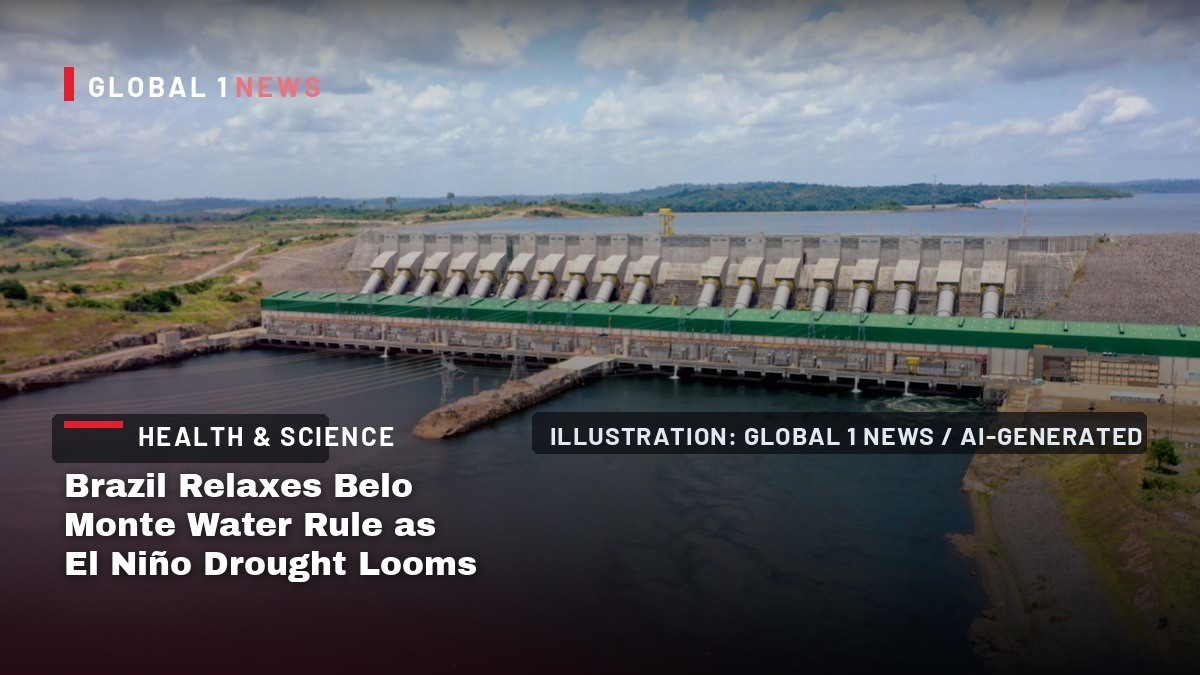
Brazilian environmental authorities have approved a temporary relaxation of water-flow rules at the Belo Monte hydropower plant on the Xingu River, a decision that underscores the mounting pressure climate change is placing on Amazonian energy infrastructure. The measure, granted to operator Norte Energia, permits a reduction in the reservoir's minimum outflow from 300 cubic meters per second to 100 cubic meters per second, a move designed to preserve electricity generation while anticipating another potentially severe El Niño-fueled dry season. The decision has drawn sharp criticism from scientists who argue the plant was never designed to withstand the compounding effects of deforestation and intensifying drought.
Altamira, Pará, Brazil — The Xingu River, a clear-water tributary of the Amazon that has sustained Indigenous and riverine communities for millennia, is once again at the center of a high-stakes trade-off between energy security and environmental integrity. This week, federal regulators granted Norte Energia permission to slash the minimum water flow through the Belo Monte dam's intermediate reservoir from 300 to 100 cubic meters per second, a temporary measure that will remain in effect until Nov. 30. The company has already begun the gradual reductions, according to regulatory officials who spoke with Mongabay.
A Calculated Gamble on the Volta Grande do Xingu
The decision directly affects the Volta Grande do Xingu, a sweeping bend in the river where the dam's reduced flow has historically devastated local fishing, transportation, and daily subsistence patterns. Regulators insist the change will allow the plant to maintain both electricity output and water flows through this critical stretch, but the math is unforgiving: a two-thirds reduction in minimum flow carries inherent risks to water quality and aquatic ecosystems.
André Oliveira Sawakuchi, a geoscientist at the University of São Paulo, offered a blunt assessment of the trade-off. "Between a worse option and a bad one, they chose the bad one," he told Mongabay by phone. The comment captures the grim calculus facing Brazilian energy planners as they navigate a future where the hydrological assumptions underpinning the country's largest Amazonian dam no longer hold.
Norte Energia, for its part, maintains that the measure will keep the required flow through the Volta Grande unchanged, and the company says it will monitor water quality and fish movements, reporting back to regulatory agencies. IBAMA, Brazil's federal environment agency, echoed this confidence, telling Mongabay that "significant social and environmental impacts are not expected." The agency framed the decision as a necessary evil: without the relaxation, it argued, the alternative would be a significant drawdown of Belo Monte's reservoirs to maintain the established flow regime.
Three Years of Drought, Three Years of Requests
This is not a novel request. Norte Energia has sought permission to reduce flows during every dry season for the past three years, a pattern that reveals the chronic nature of the problem. In 2024, regulators approved the request for the first time, framing it as a drought emergency measure. In 2025, the company submitted the same request again, but federal regulators rejected it, citing environmental risks. Now, with another El Niño projected to bring extreme drought conditions, the measure has been approved once again.
The back-and-forth illustrates a broader institutional struggle to reconcile short-term energy demands with long-term environmental stewardship. Each approval chips away at the regulatory framework that was supposed to protect the Xingu's unique ecosystems and the communities that depend on them. Each rejection, meanwhile, risks blackouts and economic disruption in a country where hydropower supplies roughly 60% of electricity.
The stopgap nature of these decisions underscores a larger, more troubling reality: a recent government report warned that hydropower plants in the region could lose up to 40% of their generation capacity over the coming decades. That projection, if accurate, would represent a seismic shift for Brazil's energy matrix, forcing the country to confront the uncomfortable possibility that its reliance on Amazonian dams is fundamentally unsustainable.
A Dam Designed for a River That No Longer Exists
Sawakuchi's critique goes to the heart of the problem. The Belo Monte project, the largest hydropower plant in the Amazon, was designed using historical river flows dating back to the 1950s. Those records captured a world before the Amazon's deforestation crisis accelerated, before climate change began altering rainfall patterns across the basin, and before El Niño events became more frequent and intense.
"There are two factors that reduce water availability in the Xingu," Sawakuchi said. "One is deforestation in the basin over the past few decades. The other is longer-lasting and more intense droughts, which may be associated with climate change. The project wasn't designed with this in mind, so the likelihood is that this situation will get worse."
The implications are stark. Belo Monte was conceived as a monument to Brazilian engineering prowess, a project that would harness the power of the Xingu to fuel the nation's development. But the river that flows through the dam today is not the river that engineers studied in the 1970s and 1980s. Deforestation in the Xingu basin has reduced rainfall and altered the timing and volume of river flows. Climate change is compounding these effects, creating a feedback loop that threatens to turn the dam into a monument to miscalculation.
Communities on the Frontline of a Shrinking River
For the Indigenous and riverine communities of the Volta Grande do Xingu, the stakes are existential. The river is not merely a resource; it is the foundation of their livelihoods, their cultures, and their identities. Fishing, transport, and daily life all depend on the river's flow. When the water drops, fish populations decline, navigation becomes treacherous, and the social fabric begins to fray.
The communities have long argued that Belo Monte was built at their expense, a sacrifice made for the benefit of distant cities and industries. The temporary flow reductions, they say, are not temporary at all — they are a creeping normalization of a degraded river. Each approval makes the next one easier, each concession makes the previous one seem less significant.
IBAMA's assurance that "significant social and environmental impacts are not expected" rings hollow to those who have watched the river shrink year after year. The agency's own logic, however, reveals the bind: if the measure were not adopted, the alternative would be an even more drastic drawdown of the reservoirs, which could cause catastrophic damage to the Volta Grande ecosystem. The choice, as Sawakuchi put it, is between a bad option and a worse one.
The Future of Amazonian Hydropower
The Belo Monte saga is a cautionary tale for the entire Amazon region, where dozens of dams have been built or proposed under the assumption that the region's water resources are abundant and reliable. That assumption is now demonstrably false. Climate models project more frequent and severe droughts, deforestation continues to erode the hydrological cycle, and the region's energy infrastructure is increasingly vulnerable.
The government report warning of a 40% loss in generation capacity is a wake-up call, but it remains unclear whether policymakers are listening. The approval of this latest flow reduction suggests a reactive approach, one that prioritizes immediate energy needs over long-term planning. The result is a series of stopgap measures that paper over the underlying crisis without addressing it.
Brazil is not alone in this predicament. Across South America, countries that have built their energy systems around hydropower are grappling with the same reality. Colombia, Peru, and Ecuador have all faced energy shortages in recent years as droughts have reduced reservoir levels. The Amazon, once seen as an inexhaustible source of clean energy, is proving to be far more fragile than anyone imagined.
For Belo Monte, the coming months will be a test. If the El Niño materializes as projected, the reduced flow will help keep the turbines spinning, but at a cost to the river and its people. If the drought is milder than expected, the measure will have been unnecessary, and the environmental damage will have been incurred for nothing. Either way, the fundamental question remains unanswered: how long can Brazil continue to rely on a dam that was designed for a river that no longer exists?
The answer, Sawakuchi suggests, is not long. "The likelihood is that this situation will get worse," he said. The temporary measure approved this week is a bandage on a wound that requires surgery. Until Brazil confronts the structural flaws in its Amazonian energy strategy, the Xingu will continue to pay the price.
This article was produced with AI-assisted research and editorial support. Sources: Mongabay.
By Elena Vasquez, Staff Writer
What's Your Reaction?
 Like
0
Like
0
 Dislike
0
Dislike
0
 Love
0
Love
0
 Funny
0
Funny
0
 Wow
0
Wow
0
 Sad
0
Sad
0
 Angry
0
Angry
0

Latin America Correspondent at Global1.News. Based in Mexico City, covering politics, economics, energy, and culture across the region. Brings an on-the-ground perspective to stories spanning from the Rio Grande to Patagonia.













Comments (0)