
China Bets Quantum Tech Can Banish Power Grid Blackouts
China is rolling quantum sensing, communication and computing across its national power grid after an 18-month Hefei trial, aiming to prevent blackouts while a new MIIT standards body and 5 trillion yuan grid investment sharpen its global quantum edge.
China Bets Quantum Tech Can Banish Power Grid Blackouts
Beijing — China is preparing to expand quantum technologies across its national power grid after an 18-month trial proved they can rapidly detect and diagnose equipment faults, in a push that marries two of Beijing's most strategic priorities: grid reliability and quantum supremacy.
Tags: quantum technology, power grid, blackouts, quantum sensing, quantum computing, State Grid, MIIT, China technology
Hefei Trial: Quantum Moves From Lab to Live Substation
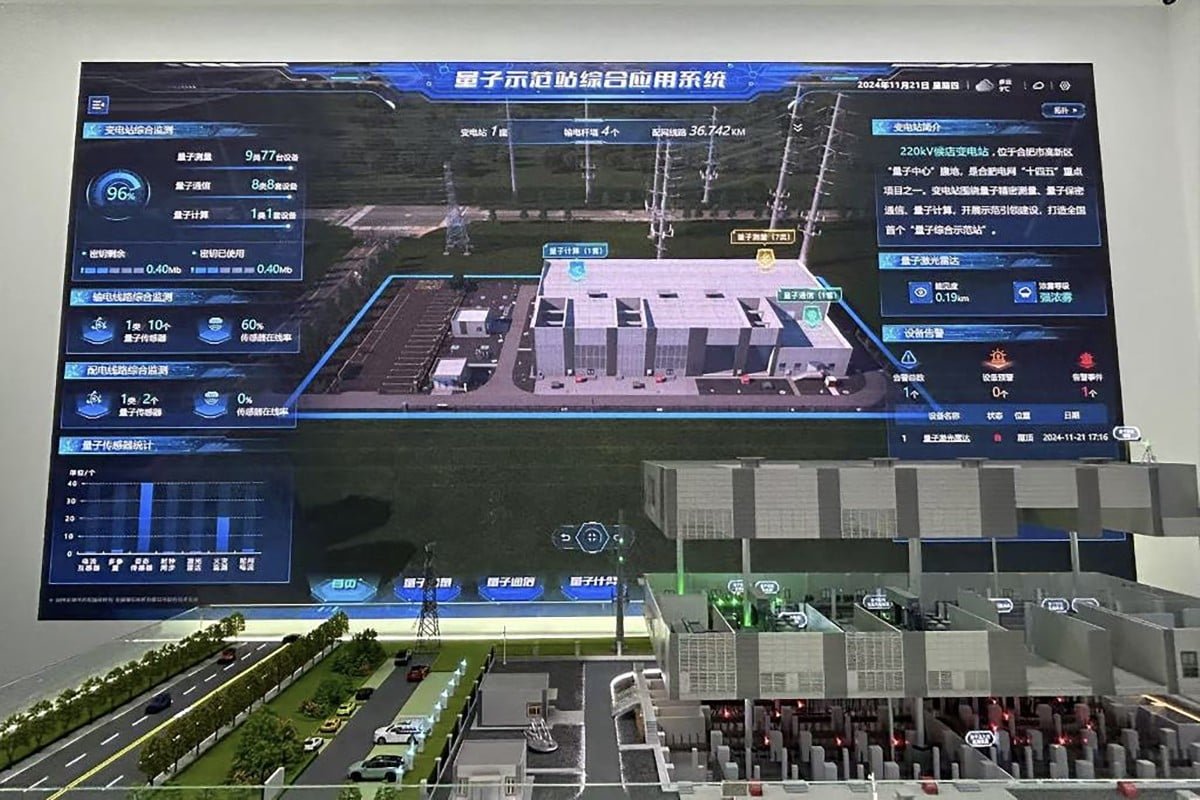
During the 18-month trial at the Houdian Quantum Application Demonstration Substation in Hefei, capital of eastern Anhui province, quantum technology was used to quickly detect and diagnose defects and faults in power system equipment, according to a report published Wednesday by People's Daily. The facility, officially commissioned in November 2024, is the first of its kind anywhere in the world, and has developed and applied dozens of quantum solutions spanning three domains: measurement, communication and computing.
"The operation has proved that quantum technology is not a 'showpiece', but a 'hard support' for guaranteeing the power supply and promoting development," Tian Teng, a researcher with Anhui Electric Power Company, was quoted by the report as saying. State media described the project as a "landmark integration of the new-type power grid with cutting-edge quantum technology" — the first systematic application of quantum tech to power grid engineering.
What Quantum Tech Actually Does on a Power Grid
Quantum technology harnesses the physics governing individual atoms, in which they exist in multiple states simultaneously until measured — a phenomenon known as "superposition." That allows quantum systems to measure, compute and communicate data with precision and speed that classical systems cannot match, which is precisely why grid operators are interested.
The Hefei deployment builds on earlier work. In May 2025, researchers at the University of Science and Technology of China, in collaboration with State Grid Corporation, unveiled a doughnut-shaped "diamond ring" device embedding nitrogen-vacancy quantum sensors that acts as a high-precision sentinel for power lines, detecting grid instability in real time. China has also claimed smart-grid technology capable of cutting blackout recovery time to a tenth of a second, according to state media.
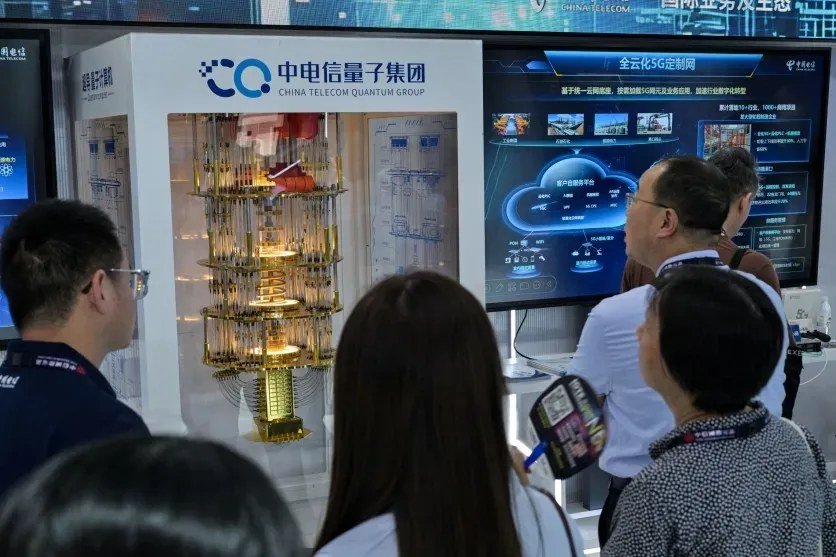
The applications fall into three buckets: quantum precision measurement for sensing current, voltage and equipment stress with far greater sensitivity; quantum communication for secure, tamper-evident control signals; and quantum computing simulations to model grid behaviour and predict failures before they cascade into blackouts.
Policy Push: MIIT Stands Up Quantum Standards Body
Beijing's institutional machinery is moving in step. On July 30, the Ministry of Industry and Information Technology formally established a national technical committee on quantum information standardization, holding its inaugural meeting in Beijing. The committee's secretariat is anchored at the China Academy of Information and Communications Technology — the same MIIT-affiliated think tank that ran China's 5G standards playbook.
That precedent matters. CAICT ran the technical trials through which 5G equipment was certified against domestic standards, and those domestic benchmarks became the baseline China carried into 3GPP and International Telecommunication Union negotiations. The result: Chinese companies now hold approximately 12.42% of declared global 5G standard-essential patents, second only to Qualcomm. MIIT has said it intends to "participate actively in the formulation of international standards and rules" for quantum technologies, a phrase Beijing has used before in telecoms, AI and cybersecurity.
The new committee's mandate covers the full quantum stack — basic frameworks, quantum computing, quantum communication and quantum precision measurement — and explicitly includes quantum communication and sensing, scope beyond the existing national standards committee TC578. It arrives as ISO/IEC's Joint Technical Committee 3, the emerging international forum for quantum standards, converts its ad hoc groups into formal working groups, creating a venue where China and Western nations will compete to shape the rulebook.
The Money: Quantum First Among 'Future Industries'
Quantum technology was named first among seven designated future industries in China's 15th Five-Year Plan, published in October 2025 and covering 2026-2030 — a designation that unlocks prioritized resource allocation and cross-sector coordination. The grid investment behind it is staggering: state-linked projections call for more than 5 trillion yuan in new-type power grid investment over the plan period, driving a 10 trillion yuan market and more than a million jobs, with 15 new ultra-high-voltage direct current lines, upgraded urban distribution grids and smart microgrids in the pipeline.
The research pipeline feeding the commercial push is accelerating. In February 2026, Origin Quantum made its Origin Pilot quantum operating system available for public download. In May 2026, a team led by the University of Science and Technology of China published results in Nature for Jiuzhang 4.0, a programmable photonic quantum computing prototype that manipulated quantum states of up to 3,050 photons simultaneously — more than twelve times the scale of its predecessor — completing a Gaussian boson sampling benchmark estimated at more than 10^54 times faster than the world's most powerful classical supercomputer. CAICT also runs the Quantum Information Industry Alliance, which counts 104 member organizations.
The Global Race: Washington's Uneven Response
China's grid deployment lands as the United States accelerates its own quantum response, but with a governance gap. On June 22, President Donald Trump signed two executive orders: one directing the Department of Energy, Commerce and the Intelligence Community to deliver a research-grade quantum computer to a DOE facility by 2028 under the QC-ADDS program; the other setting binding 2030 and 2031 deadlines for federal agencies and contractors to migrate to quantum-resistant encryption. The Commerce Department separately distributed $2.013 billion in CHIPS Act incentives across nine quantum computing companies, with IBM as anchor recipient for its proposed Anderon quantum chip foundry.
NIST completed the cryptography side in August 2024, finalizing three post-quantum encryption standards — ML-KEM, ML-DSA and SLH-DSA — and selecting a fourth algorithm, HQC, in March 2025. What Washington has not done is create an institution equivalent to the MIIT quantum committee: a single body whose job is to align domestic quantum companies behind a coherent standards strategy and carry that alignment into ITU and ISO forums.
What This Means for Asia-Pacific Readers
For Japan and the wider Asia-Pacific, the stakes are concrete. Quantum communication networks built to Chinese QKD standards will not natively interoperate with networks built to European ETSI or ISO/IEC JTC 3 specifications — and once embedded in physical infrastructure, that incompatibility persists for the infrastructure's operational lifetime. Analysts at the IISS have documented how China has conditioned access to Belt and Road Initiative funding on adoption of its quantum standards in Southeast Asian partner countries, a dynamic that could fragment the region into overlapping, non-interoperable technological systems.
Tokyo has been building its own counterweights, including a quantum technology cooperation pact with Australia signed in late July and government-backed research at institutions such as the RIKEN and the University of Tokyo. For Japanese manufacturers of precision instruments and grid equipment, the Hefei model is a signal that quantum sensing is moving from the laboratory into operational infrastructure faster than many market forecasts assumed — and that China intends to define the technical rules of that transition.
What to Watch For
Three developments will test whether the Hefei trial scales. First, how quickly State Grid and its provincial affiliates roll quantum sensing hardware beyond Anhui — a nationwide rollout would be the first industrial-scale deployment of its kind. Second, what standards the new MIIT committee files first with ITU and ISO/IEC JTC 3, and whether those drafts carry Chinese domestic specifications into international rulemaking. Third, whether the 5 trillion yuan grid investment program funds quantum upgrades as a line item, which would give Chinese quantum vendors a captive domestic market of a scale no Western competitor can match.
The trial at one substation in Hefei may prove to be the moment quantum technology stopped being a physics demonstration and started being infrastructure. For grid operators, equipment makers and standards bodies across Asia-Pacific, the question is no longer whether quantum technology will reach the power grid — it is whose standards will be running on it when it does.
By Kenji Tanaka, Staff Writer
This article was produced with AI-assisted research and editorial support. Reporting is based on sources cited in the article.
What's Your Reaction?
 Like
1
Like
1
 Dislike
0
Dislike
0
 Love
0
Love
0
 Funny
0
Funny
0
 Wow
0
Wow
0
 Sad
0
Sad
0
 Angry
0
Angry
0

Japan Correspondent at Global1.News. Tokyo-based voice covering Japanese politics, technology, economy, and culture. Tracks the intersection of tradition and innovation in one of the world's most dynamic societies.














Comments (0)