
China Grapples with AI-Driven Misinformation During Typhoon Noul and Recent Floods
As Typhoon Noul made landfall over the weekend, China confronts not only the physical destruction of powerful storms and flooding but also a rapidly spreading wave of AI-generated fake videos that distort rescue operations, exaggerate damage, and incite panic buying.
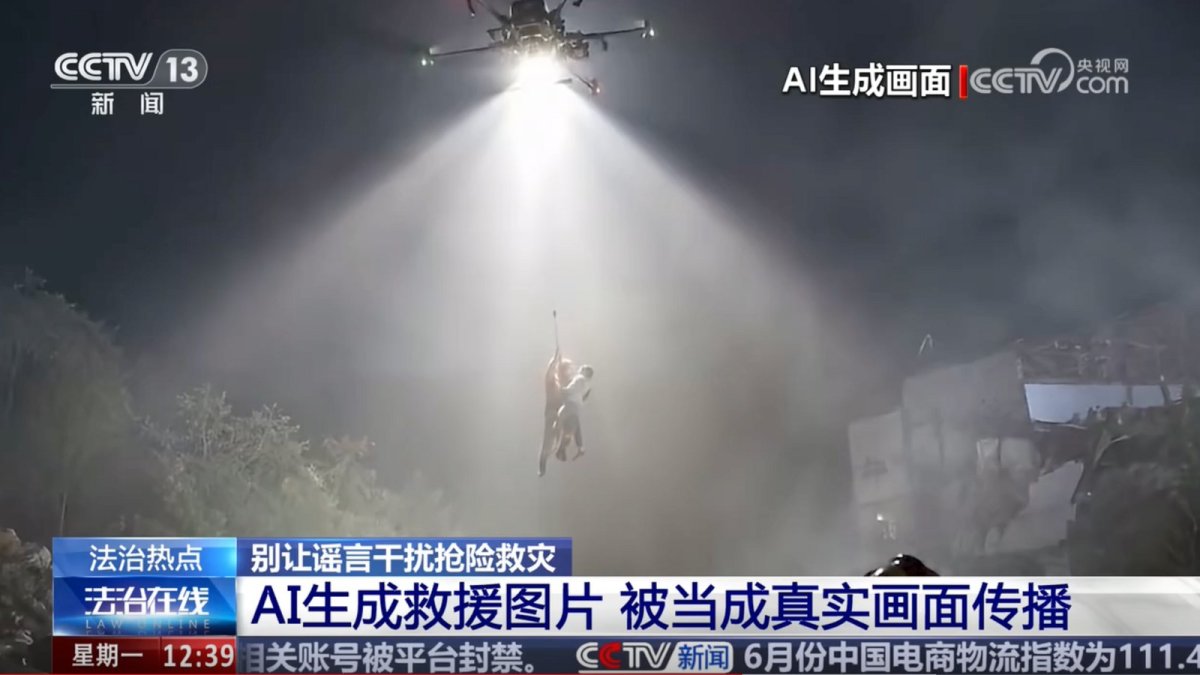
As Typhoon Noul made landfall over the weekend, China confronts not only the physical destruction of powerful storms and flooding but also a rapidly spreading wave of AI-generated fake videos that distort rescue operations, exaggerate damage, and incite panic buying. These fabricated clips have inundated social media platforms, compounding the challenges for authorities already managing mass evacuations and complex emergency responses. The convergence of natural disaster and digital deception now tests the limits of official information control in ways that previous crises did not.
AI Flood of Fake Disaster Videos Tests China's Information Defenses
Beijing, China — As rescue operations continue in the wake of Typhoon Noul, authorities face an unprecedented secondary crisis of AI-fabricated videos that threaten to undermine public safety and erode trust in official communications.
Typhoon Noul Landfall and the Surge of AI Misinformation
Typhoon Noul made landfall over the weekend, adding to a series of powerful storms and flooding incidents that have struck China in recent months. As rescue operations continue and evacuations unfold, authorities now confront an additional layer of difficulty: a wave of AI-generated fake videos flooding social media platforms. These fabricated clips spread claims of dead bodies in floodwaters, severe inundation in unaffected areas, and distorted accounts of emergency responses. The combination of real disaster impacts and digital deception has complicated efforts to maintain public order and deliver accurate information.
Specific Instances of Fabricated Disaster Content
Particular examples illustrate the scale of the problem. Videos falsely depicting power outages triggered panic buying of emergency supplies in multiple locations. In Hengzhou city, Guangxi, real flooding in early July caused hundreds of snakes to escape from a breeding farm; this incident was quickly followed by fake images showing crocodiles being released into a river. Other clips purported to show rescue teams prioritising pigs over people, further inflaming tensions during already dangerous mass evacuations.
Official Responses and Enforcement Actions
Chinese authorities have moved to counter the spread of such material through arrests, detentions pending criminal prosecution, and fines. Huang Zhihua, Deputy Chief in charge of online public security for the Zhejiang Police Department, stated that many content creators exploit disaster news to gain followers by producing sensational or exaggerated material. These measures aim to deter deliberate fabrication designed to attract attention and views, yet enforcement remains reactive amid rapidly evolving digital tools.
The pattern of penalties illustrates a broader regulatory emphasis on accountability for content that disturbs public order during emergencies. Officials have highlighted how accessible AI tools lower the threshold for producing convincing falsehoods, prompting police departments to publicize cases as a deterrent. While the source material does not detail new platform obligations, the combination of post-publication punishment and expert commentary on labeling indicates an ongoing effort to raise the cost of creating and distributing misleading material. This approach seeks to preserve stability without addressing the underlying ease with which generative tools can be repurposed.
Expert Analysis on AI's Role in Misinformation
Professor Chen Bin, writing in the newspaper of the Communist Party's Central Party School, noted that AI dramatically lowers the technical barriers to producing false information. Individuals can now generate convincing text, images, audio and video simply by prompting AI tools, enabling large-scale fabrication without advanced skills. Professor Gao Fuping of the East China University of Political Science and Law explained that motivations range from amusement without regard for consequences to deliberate attempts to generate traffic or cause panic and social unrest. Professor Xu Xiaoke from Beijing Normal University added that detection technology continues to lag behind generation capabilities, describing the situation as a constant cat-and-mouse game where technical fixes alone cannot reliably identify manipulated content.
Proposals for trusted information infrastructure, including official early-warning systems and disaster interfaces accessible to news organizations, aim to provide verified geographic and timestamp data that platforms and citizens can consult. Such systems would supplement existing enforcement by offering authoritative reference points during events like Typhoon Noul. However, the source material underscores that technical solutions alone cannot reliably identify manipulated content once it has been re-edited or stripped of markers.
China's Ambitious AI Development Strategy
China's 2017 announcement positioned artificial intelligence as the central engine of national advancement, directing substantial state resources toward domestic firms and research programs. State-controlled wire service Xinhua reports more than 6,000 AI companies now operating inside the country, supported by ongoing capital inflows that intensify competition among developers. This scale of investment has produced rapid gains in generative capabilities, yet the same tools are being deployed to fabricate disaster imagery and emergency-response footage during Typhoon Noul and earlier floods. The resulting paradox places authorities in the position of simultaneously accelerating AI development and confronting its immediate misuse for spreading panic-buying rumors and false rescue scenes.
The dual-use character of generative systems means that techniques refined under national priority programs can be accessed by individuals seeking attention or profit with minimal technical skill. Professor Chen Bin observed that AI removes earlier barriers, allowing large-scale production of realistic but invented content simply through prompting. Government statements continue to emphasize technological leadership, yet enforcement actions against fabricators reveal an implicit recognition that unchecked domestic application of these tools undermines crisis communication. This tension leaves policy makers balancing promotion of AI self-sufficiency against the need to constrain its harmful domestic effects without slowing the broader innovation drive.
Erosion of Public Trust from Past Official Handling
Earlier in July, local journalists were instructed to describe a major breach at the Liulan Dam near Nanning using softer terms such as "opening" or "gap," even as the resulting flood caused at least 26 deaths downstream. Similar patterns appeared in 2021 when officials in Henan province were arrested for concealing or underreporting 139 deaths. These episodes have created documented public skepticism toward official channels, making audiences more receptive to alternative narratives circulated on social media during subsequent storms. When authorities later face AI-generated videos claiming exaggerated flooding or mismanaged rescues, the prior credibility deficit reduces the immediate persuasive power of corrective statements.
The trust vacuum amplifies the impact of fabricated clips because citizens already question whether state sources are minimizing risks. Mass evacuations and rescue operations therefore unfold against a backdrop in which both genuine updates and false content compete for attention. Experts note that this environment rewards sensational material, as viewers turn to unofficial videos when they doubt institutional reporting. Addressing the spread of AI misinformation therefore requires more than technical detection; it also depends on narrowing the gap between official language and observable outcomes in past disasters.
Broader Implications for Governance and Credibility
The current situation highlights challenges for information governance during natural disasters. Calls for mandatory stamping of AI-generated content face limitations, as users can remove markings through re-editing. Experts advocate stronger geographic and timestamp verification alongside official early-warning systems accessible to news organisations. Yet the lag in detection tools suggests that reliance on technology alone will prove insufficient. For disaster response credibility, authorities must address both the technical proliferation of AI tools and the underlying trust deficits to limit the spread of misinformation in future events.
Similar challenges appear in other jurisdictions where transparency obligations and platform-labeling requirements are under discussion. The EU AI Act and US debates over labeling AI-generated media reflect parallel efforts to raise visibility of synthetic content without assuming detection tools will keep pace. Because disaster-related falsehoods can cross borders rapidly through global platforms, the effectiveness of any single country's measures depends partly on coordinated standards for verification and labeling. China’s experience during recent floods therefore illustrates a wider problem: building resilient information ecosystems requires combining enforcement, infrastructure, and realistic assessments of technological limits.
By Prof. Marcus Chen, Staff Writer
This article was produced with AI-assisted research and editorial support. Reporting is based on sources cited in the article.
What's Your Reaction?
 Like
0
Like
0
 Dislike
0
Dislike
0
 Love
0
Love
0
 Funny
0
Funny
0
 Wow
0
Wow
0
 Sad
0
Sad
0
 Angry
0
Angry
0

World Politics Analyst at Global1.News. Based in Beijing, covering US-China relations, global trade, and geopolitical strategy. Brings deep analytical perspective to the power dynamics shaping international affairs.















Comments (0)