
Xi Jinping’s Paradox of Political Control
The Fifth Plenum of the Chinese Communist Party, convened from 26 to 29 October, offered a rare glimpse into the evolving architecture of political control under General Secretary Xi Jinping.
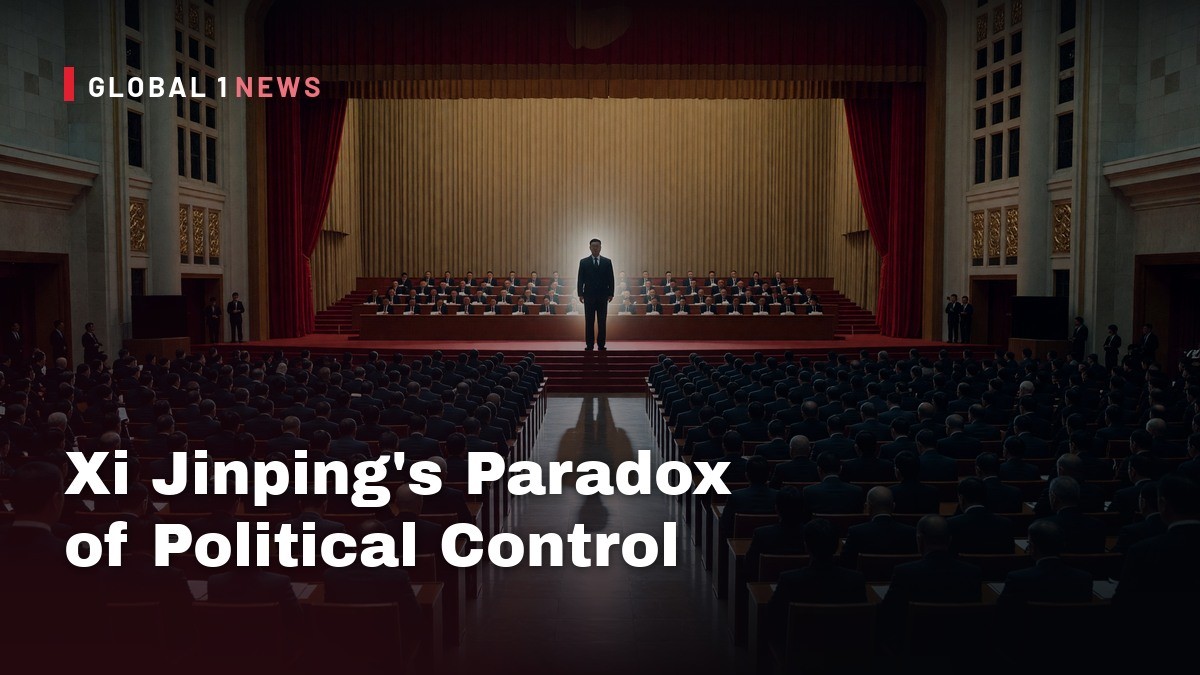
The Fifth Plenum of the Chinese Communist Party, convened from 26 to 29 October, offered a rare glimpse into the evolving architecture of political control under General Secretary Xi Jinping. By codifying “comprehensive and strict party governance” and elevating “Xi Jinping Thought on Party Building” (XJTPB) to a doctrinal cornerstone, the plenum signaled both an intensification of internal rectification mechanisms and a lingering paradox: the party’s expanding capacity to punish dissent coexists with persistent shortcomings in political reliability, information accuracy, and delegated authority. This tension, evident in the recent purges of senior People’s Liberation Army (PLA) officers, underscores a fundamental principal‑agent dilemma that could shape China’s governance trajectory for years to come.
Institutionalising “Self‑Revolution”
The plenum’s communiqué framed XJTPB as an essential component of “Xi Jinping Thought on Socialism with Chinese Characteristics for a New Era.” Its central premise is that the party’s long‑term survival hinges on the “political construction” of its members—strengthening ideals, forging loyalty, and ensuring that cadres are “loyal, clean, and responsible.” In practice, this translates into a requirement that political reliability become the decisive qualification for career advancement and authority.
Beyond loyalty, the doctrine demands a continuous “self‑revolution,” a process of identifying and correcting political, ideological, organizational, and disciplinary weaknesses. The language echoes Mao Zedong’s Yan’an rectification campaigns, yet Xi seeks to embed rectification as a permanent feature of party governance rather than an episodic campaign. The communique explicitly calls for the party to “turn the blade inward” on a continual basis, positioning self‑purification as a safeguard against the decay that, in Xi’s view, doomed past dynasties and the Soviet Union.
From Ideology to Institutional Practice
To translate the ideological thrust of XJTPB into concrete governance, the plenum outlined three priorities: tighter management and supervision of officials, stronger party organisations throughout the hierarchy, and the integration of disciplinary enforcement with behavioural correction and anti‑corruption measures. This “integrated” formula is described as preventing corruption in three dimensions—“not daring to be corrupt, not being able to corrupt, not wanting to corrupt.”
In effect, the party aims to reshape the institutional environment in which officials operate. By fostering a climate of fear of punishment, limiting opportunities for deviance through monitoring, and cultivating ideological conviction through “self‑revolution,” the CCP hopes to produce cadres who internalise discipline and therefore require less external coercion.
The Principal‑Agent Dilemma at the Core
Despite the logic of this model, the plenum’s own language acknowledges a core contradiction. Centralised leadership must delegate authority to subordinates whose actions and motivations cannot be fully observed—a classic principal‑agent problem. While tighter supervision can deter misconduct, it does not automatically resolve information asymmetries or guarantee political reliability. The source material notes that heightened scrutiny has already encouraged “bureaucratic caution, excessive conformity, and the concealment of politically inconvenient information.”
This paradox is not merely academic. Effective governance requires accurate reporting from the field, initiative in problem‑solving, and adaptability to local conditions. Over‑monitoring can suppress these qualities, leading to a governance style that is rigid, risk‑averse, and detached from on‑the‑ground realities. The Fifth Plenum, by institutionalising continuous rectification, deepens this tension between control and functional governance.
Military Purges: A Microcosm of the Tension
The recent purges within the PLA illustrate the paradox in stark terms. Senior officers have been investigated for corruption, procurement manipulation, and breaches of party discipline. The source material highlights that these investigations occur despite a dense web of political supervision—party committees, political commissars, disciplinary inspection, and centralized personnel management. The fact that such violations persist suggests that existing supervisory mechanisms are insufficient to prevent misconduct before it arises.
At the same time, the willingness to sanction high‑ranking military figures demonstrates Xi’s capacity to enforce discipline at the highest levels. Yet the recurrence of these cases raises doubts about the preventive effectiveness of the party’s control apparatus. The purges thus reveal both the coercive strength of the system and its limitations in ensuring reliable compliance in advance.
Implications for Domestic Governance
If the principal‑agent dilemma remains unresolved, the CCP may face a trade‑off between maintaining strict political discipline and fostering the initiative needed for effective policy implementation. The source material warns that excessive conformity can lead to “the concealment of politically inconvenient information,” which in turn hampers the party’s ability to respond to emerging challenges. This risk is amplified in sectors where rapid technological change and complex economic dynamics demand flexible, informed decision‑making.
Moreover, the emphasis on ideological rectification may divert attention and resources from substantive governance reforms. By prioritising “self‑revolution” and ideological conformity, the party could inadvertently weaken the very institutional capacities it seeks to protect, as cadres focus on meeting doctrinal expectations rather than addressing practical governance problems.
Strategic Outlook: Balancing Control and Effectiveness
Looking ahead, the CCP’s challenge will be to calibrate its control mechanisms so that they reinforce, rather than undermine, governance effectiveness. The Fifth Plenum’s articulation of “integrated” governance offers a blueprint, but its implementation will require nuanced adjustments. For instance, enhancing upward feedback channels while maintaining disciplinary oversight could mitigate information distortion without eroding political reliability.
In the military sphere, a similar balance is needed. Strengthening internal audit functions and transparent procurement processes may reduce the incidence of corruption, while preserving the party’s ability to intervene decisively when necessary. Such reforms would align the PLA’s operational efficiency with the broader objectives of XJTPB, reducing the need for disruptive purges.
Conclusion: The Enduring Paradox of Xi’s Political Control
The Fifth Plenum has cemented Xi Jinping’s vision of a party that constantly self‑examines, self‑purifies, and self‑renews. By institutionalising “self‑revolution,” the CCP seeks to create a cadre of officials who are ideologically aligned, disciplined, and incapable of corruption. Yet the very mechanisms designed to guarantee loyalty and purity also generate a principal‑agent dilemma that threatens the quality of governance. The recent PLA purges underscore the limits of punitive control when preventive oversight remains imperfect.
As China navigates an increasingly complex domestic and international environment, the tension between strict political discipline and the need for accurate information, initiative, and adaptability will shape the party’s capacity to govern effectively. Whether Xi’s model can reconcile these competing demands will determine not only the future of the CCP’s internal dynamics but also the broader trajectory of China’s political and economic development.
This article was produced with AI-assisted research and editorial support. Reporting is based on the source material cited below. Sources: The Diplomat; thediplomat.com; Global1.News (12 November 2026).
By Kenji Tanaka, Staff Writer
What's Your Reaction?
 Like
0
 Dislike
0
 Love
0
 Funny
0
 Wow
0
 Sad
0
 Angry
0

Japan Correspondent at Global1.News. Tokyo-based voice covering Japanese politics, technology, economy, and culture. Tracks the intersection of tradition and innovation in one of the world's most dynamic societies.













Comments (0)