
Brazil's Lula Hails Oil Discovery Near Amazon River Mouth
Brazil's Petrobras confirms oil discovery in the Foz do Amazonas basin, hailed by President Lula as a national triumph. Environmentalists and Indigenous groups sue to halt drilling, while commercial viability and field size remain unknown.
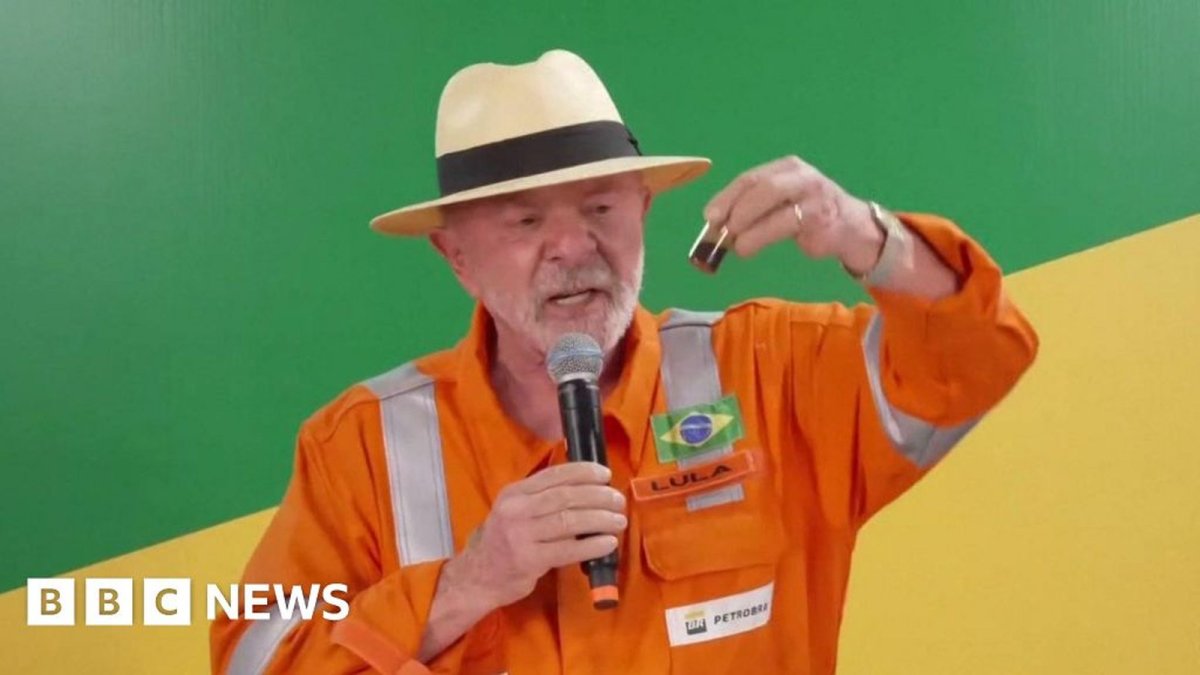
The Brazilian government is celebrating what it calls a historic breakthrough in the country’s quest for energy independence, as state-run oil giant Petrobras confirmed the discovery of oil in the ultra-deep waters of the Foz do Amazonas basin, a region long at the center of a bitter tug-of-war between economic ambition and environmental preservation. President Luiz Inácio Lula da Silva, standing on a drilling vessel roughly 175 kilometers off the coast of Amapá state, hailed the find as “a passport to the country’s future,” framing it as a matter of national sovereignty and a financial lifeline for his administration’s ambitious energy transition agenda. The announcement, made this week, injects a volatile new variable into Brazil’s presidential race, with Lula seeking another four-year term in elections scheduled for October. Yet, the jubilation is tempered by stark uncertainty: the size of the reservoir remains unknown, its commercial viability is unproven, and a coalition of environmental and Indigenous groups has vowed to fight the project in the courts.
Rio de Janeiro, Brazil — Article continues...
A Discovery in the Deep: The Morpho Well
The discovery was made at the Morpho exploration well, designated 1-BRSA-1405-APS, located in the FZA-M-59 block of the Foz do Amazonas basin. Drilling operations, which began in October 2025, reached a total depth of 2,886 meters (9,469 feet) in ultra-deep water, a technically challenging environment that demands some of the most advanced engineering in the industry. The block itself was acquired by Petrobras during the 11th bidding round of Brazil’s National Petroleum Agency (ANP) in 2013 under a concession regime, with Petrobras serving as the operator holding a 100% interest in the area.
Petrobras CEO Magda Chambriard, visibly buoyant while displaying a sample of the extracted oil to reporters, said the find confirmed the company’s long-held “optimism” about the Brazilian Equatorial Margin. “There is oil; we don’t know how much. We are extremely optimistic,” Chambriard stated, emphasizing the company’s commitment to “ensuring the country’s energy security” and rebuilding Brazil’s oil reserves, which have been in decline in recent years. The company has already invested approximately $300 million in drilling the Morpho well, with corporate affairs director Clarice Coppeti noting that roughly half of that sum was dedicated to environmental protection measures. Drilling costs run about $1 million per day, underscoring the financial stakes involved in this high-risk, high-reward venture.
The Equatorial Margin: A $720 Billion Gamble
The Foz do Amazonas basin is part of the Equatorial Margin, a roughly 2,200-kilometer stretch along Brazil’s northern and northeastern coastline that geologists believe could hold vast untapped reserves. Analysts have estimated the region could contain around 10 billion barrels of oil, with a potential market value of approximately $720 billion—a figure that would transform Brazil’s position in the global energy market and dramatically expand its proven reserves. For Petrobras, which has seen its production capacity stretched and its exploration portfolio thin, the Equatorial Margin represents the most promising frontier for reversing a projected decline in output.
But the scale of the prize is matched by the scale of the challenge. Petrobras has three additional wells to drill in the FZA-M-59 block and another six in other areas of the region, all of which are still awaiting licenses from Brazil’s environmental protection agency, IBAMA. The path to this week’s announcement was anything but smooth: IBAMA initially denied Petrobras a license to drill in the basin in May 2023, a decision that sparked a fierce political battle. The agency eventually granted a license in 2025 after the company appealed and submitted revised environmental plans, which included heavy investment in environmental studies, advanced spill-response systems, and a large-scale emergency simulation involving hundreds of personnel, vessels, and aircraft. The licensing process, however, has done little to mollify critics who view the project as an unacceptable risk to one of the planet’s most biodiverse marine environments.
Environmentalists and Indigenous Groups Push Back
Conservationists have long warned that the area is ecologically fragile, home to coral reefs, mangroves, and coastal wetlands that teem with wildlife. The primary concern is that any accident—a blowout, a pipeline rupture, or a tanker spill—could have catastrophic consequences, with ocean currents potentially carrying spilled oil to sensitive coastal ecosystems that serve as nurseries for countless marine species. Since drilling began, environmental and Indigenous groups have filed lawsuits against the Brazilian government and Petrobras to halt exploration, according to The Associated Press. Their legal challenges argue that the licensing process failed to consult traditional communities, underestimated spill risks, and did not adequately assess the climate impact of extracting and burning the oil.
The timing of the announcement has added fuel to the fire. Lula gave Petrobras the green light for exploratory drilling just weeks before Brazil hosted the COP30 climate conference last November, a decision that left environmentalists aghast and drew sharp criticism from European leaders. Lula, however, has been unapologetic, singling out foreign opposition in his public remarks. “Many people didn’t want me to announce that Petrobras had won the licence because they said that the Europeans would be annoyed,” he said. “I took the decision to announce that people wanted to do exploratory drilling there before COP because the interests of our country and our company were at stake.” On Monday, he went further, dismissing conservationist criticism as “meddling” and asserting: “This means national sovereignty. Any country which has oil of this quality won’t allow anyone to butt in.”
Lula’s Balancing Act: Oil Revenue to Fund the Green Transition
Lula’s defense of the project rests on a central argument: that oil revenues are essential to fund Brazil’s transition away from fossil fuels. “I’m not denying my commitment to the fight for a day when we no longer need fossil fuels, because Brazil will continue to be the king of biofuel innovation and will remain a major player in renewable energy,” he said, attempting to reconcile his environmental credentials with his government’s aggressive push for oil exploration. It is a delicate balancing act, one that reflects the broader tension facing many developing nations that seek to grow their economies while addressing climate change.
For Lula, the political calculus is equally delicate. With less than two months to go before the presidential election, he is trying to attract voters hoping for economic development in Brazil’s remote northern regions without alienating the urban, environmentally conscious electorate that forms a key part of his base. Reuters reported that the discovery has handed Lula a fresh boost for his reelection campaign, but the returns are far from certain. The oil is not yet flowing, and the timeline for any potential production remains years away, if it happens at all. The commercial viability of the field is still unknown, and the legal challenges from environmental groups could delay or even derail the project entirely.
Oiapoque: A Town Transformed by Hope
In the meantime, the mere prospect of oil has already begun to reshape the human geography of the region. In Oiapoque, the nearest town to the discovery site in Amapá state, the hope of jobs and opportunities has triggered an influx of people, according to local housing authorities. The town, historically a quiet border outpost, is now bracing for a potential economic boom, with newcomers arriving in search of work in the oil industry or in the support services that would accompany it. The influx has strained local infrastructure, but for many residents, the promise of prosperity outweighs the risks.
Petrobras, for its part, maintains that drilling operations are continuing “with the aim of continuing the exploratory assessment in a safe manner and with respect for the environment and people.” The company has pointed to its investment in environmental protection and its emergency preparedness as evidence of its commitment to responsible exploration. But for the environmental and Indigenous groups that have taken the government to court, the company’s assurances ring hollow. They argue that the licensing process was flawed from the start, that the risks to the Amazon’s coastal ecosystems are unacceptable, and that Brazil should be investing in its renewable energy potential rather than doubling down on fossil fuels.
The discovery at the Morpho well is, without question, a significant moment for Brazil. It has the potential to reshape the country’s energy future, bolster its economy, and cement Lula’s legacy as a leader who delivered prosperity to his nation. But it also represents a profound gamble—one that pits the immediate promise of wealth against the long-term health of a fragile ecosystem and the global imperative to reduce carbon emissions. As the drilling continues and the legal battles rage on, the world will be watching to see whether Brazil’s “passport to the future” leads to a destination of sustainable prosperity or a cautionary tale of environmental recklessness. For now, the only certainty is uncertainty, and the only clear fact is that the oil is there—how much, and at what cost, remains to be seen.
This article was produced with AI-assisted research and editorial support. Sources: BBC News, Mining.com, Agência Brasil, Reuters, The Associated Press.
By Elena Vasquez, Staff Writer
What's Your Reaction?
 Like
0
Like
0
 Dislike
0
Dislike
0
 Love
0
Love
0
 Funny
0
Funny
0
 Wow
0
Wow
0
 Sad
0
Sad
0
 Angry
0
Angry
0

Latin America Correspondent at Global1.News. Based in Mexico City, covering politics, economics, energy, and culture across the region. Brings an on-the-ground perspective to stories spanning from the Rio Grande to Patagonia.














Comments (0)