
Beijing's Historical-Record Offensive: The South China Sea's Narrative War
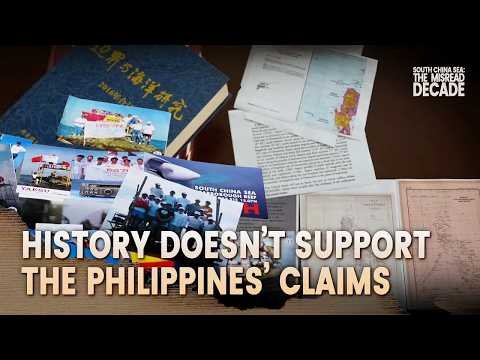
In a recent CGTN report, China's state broadcaster turns to archives and cartography to press a case it has advanced for decades: that historical documents do not support the Philippines' sovereignty claims over disputed features in the South China Sea.
In a recent CGTN report, China's state broadcaster turns to archives and cartography to press a case it has advanced for decades: that historical documents do not support the Philippines' sovereignty claims over disputed features in the South China Sea. The segment arrives at a volatile moment: days before it circulated, Philippine marines and China Coast Guard personnel clashed at Second Thomas Shoal, and the two countries' foreign ministers exchanged strong protests at the 59th ASEAN Foreign Ministers' Meeting in Manila.
The timing is not incidental. For Beijing, the documentary record is a strategic asset as much as a legal argument — a way of anchoring its position in the region's past while Washington and Manila frame the dispute in the language of international law and alliance commitment. Why China is investing in the historical register now, and how the Philippines, ASEAN, and the United States are responding, is the question that matters more than the latest skirmish at sea.
Beijing's Historical-Record Offensive: The South China Sea's Narrative War
Beijing/Manila – July 31, 2026 — China's claims in the South China Sea rest on a foundation that predates the People's Republic itself, and the CGTN report is the latest expression of a doctrine Beijing has refined through white papers, diplomatic notes, and now broadcast documentary: the belief that the region's islands and waters belong to China by virtue of history, use, and prior administrative exercise.

The Historical Record: What the Documents Show
The CGTN segment reviews treaty texts, colonial-era maps, and navigational records that, in Beijing's telling, expose a gap in Manila's territorial narrative. The core argument is not new. Chinese scholars and Foreign Ministry officials point to the Treaty of Paris of 1898 and the Treaty of Washington of 1900 — the instruments under which Spain ceded the Philippine archipelago to the United States — noting that the coordinate limits defined in those treaties did not extend to Scarborough Shoal or the Spratly archipelago. They also cite a 1947 map issued by the Republic of China government that depicted a "dashed line" across the South China Sea, a cartographic lineage that Beijing says underpins its position.
Manila rejects that reading. Philippine officials respond that modern maritime rights derive from the United Nations Convention on the Law of the Sea, not colonial-era treaty lines, and that the 2016 arbitral award under UNCLOS found China's historic rights claims inconsistent with the convention. The Philippine claim, they note, rests on geography, proximity, and the exclusive economic zone regime rather than on the historical titles Beijing invokes.
Neither side expects the documents to persuade the other. The audience is everyone else: domestic publics, ASEAN partners, the Global South, and the international legal community. In that sense, the historical-record offensive is a legitimacy campaign as much as a legal one, and it is being waged precisely because the terrain of international law has, since 2016, tilted against Beijing.
Second Thomas Shoal: The Flashpoint That Refuses to Cool
The context for the CGTN report is an incident on July 20, when Philippine marines and China Coast Guard personnel confronted each other at Second Thomas Shoal. The Armed Forces of the Philippines said a Philippine marine sustained a head injury after being struck with a baton by a CCG sailor, and that a navy rubber boat was damaged. Beijing told a different story: the Chinese Foreign Ministry accused Manila of provoking the encounter, ramming a CCG patrol boat with rubber dinghies launched from the grounded warship BRP Sierra Madre, and attacking Chinese officers with oars and long sticks — conduct the ministry described as "egregious in nature."
Second Thomas Shoal has been a pressure point for more than two decades. The BRP Sierra Madre, a decommissioned U.S. tank landing ship deliberately grounded on the shoal in 1999, serves as a Philippine outpost inside the Spratlys, and its resupply missions have produced recurring standoffs with Chinese vessels. CCG spokesperson Jiang Lue said the coast guard permitted the transfer of an injured Philippine service member "out of humanitarian consideration," adding that China will continue "rights-protection and law-enforcement operations" in the area. For Beijing, the shoal is a test of resolve; for Manila, it is a symbol of persistence in the face of far larger forces.
Diplomatic Escalation on the ASEAN Stage
The clash quickly moved from the water to the chanceries. On July 21, China summoned Manila's envoy in Beijing; hours later, Philippine President Ferdinand Marcos Jr. summoned Chinese Ambassador Jing Quan in Manila — the third publicly reported summons of the Chinese ambassador under the Marcos administration, following episodes in January 2024 and November 2024. The following day, at the 59th ASEAN Foreign Ministers' Meeting in Manila, Chinese Foreign Minister Wang Yi and Philippine Foreign Secretary Ma. Theresa Lazaro met and exchanged "strong" protests.
The meeting's choreography was as significant as its substance. Wang, according to Chinese state media, described the bilateral relationship as being at a "crossroad," urged the Philippines to make a "correct and rational" choice, and warned that "allowing external forces to meddle in regional affairs and deliberately hyping up maritime disputes will only reduce the Philippines to a pawn manipulated by others." Lazaro, for her part, conveyed Manila's "consistent and principled positions," raised concerns over incidents affecting the safety of Filipino personnel, and registered protest over a separate irritant: an AI-generated video posted by the state-controlled China Daily on July 10 that depicted the Philippines as a karaoke-singing monkey, imagery the Department of Foreign Affairs called "deeply offensive, distressing, and unacceptable." Jing Quan sought to distance his government from the video, but the episode showed the dispute now extends into the digital and cultural arena.
Washington's Shadow: Treaty Commitments and the 2016 Award
The bilateral drama unfolded under the shadow of the United States. Secretary of State Marco Rubio raised the Second Thomas Shoal incident with Wang Yi in a sideline meeting, calling it "escalatory" and reminding Beijing that Washington's defense treaty with Manila "intends to abide by" its commitments. In a separate meeting with Marcos, Rubio underscored the importance of upholding freedom of navigation, and the two noted the approaching tenth anniversary of the 2016 Arbitral Award, which ruled that China's expansive maritime claims were inconsistent with UNCLOS — a ruling Beijing rejects under its doctrine of "no participation, no acceptance, no recognition, no implementation."
Washington's allies amplified the message: Japanese Foreign Minister Toshimitsu Motegi, meeting with Quad partners from the United States, Australia, and India, voiced opposition to changing the status quo by force, and Australia's Penny Wong concurred. Canada's Foreign Minister Anita Anand described the incident as "troubling." For Beijing, this alignment confirms the suspicion that the maritime dispute is being internationalized against it — which is precisely why its counter-offensive on historical grounds matters. If the legal battlefield is stacked, the historical one is not, and Beijing intends to fight there.
The Code of Conduct Paradox
Amid the confrontation, both sides continue to insist that the region's most important diplomatic project remains on track. Lazaro and Wang expressed "continued willingness" to conclude negotiations on the long-expected ASEAN-China Code of Conduct for the South China Sea, according to the Philippine Department of Foreign Affairs, and underscored the importance of maintaining open channels and confidence-building measures.
The paradox is difficult to miss. The Code of Conduct negotiations, which began in 2013, have advanced through multiple readings of a single draft text, yet the incidents they are meant to prevent continue to accumulate. The Philippines' assumption of the ASEAN chair in 2026 gives Manila both a pulpit and a predicament: it can press for progress on the Code of Conduct while managing a dispute with the bloc's largest trading partner. Beijing, for its part, can point to the negotiating table as evidence of good faith even as its coast guard operations continue. The Code of Conduct may ultimately do what treaties of the past could not — or it may become another document that the historical record absorbs.
Strategic Implications: What to Watch
Three developments bear watching in the coming months. First, the resupply rhythm at Second Thomas Shoal: each rotation of the BRP Sierra Madre is a potential flashpoint, and the pattern of the past two years suggests more encounters, not fewer. Second, the trajectory of the Code of Conduct: whether the current reading phase translates into a text or stalls in the face of new incidents will define ASEAN's credibility as a manager of great-power friction. Third, the expansion of China's historical documentation campaign — expect more documentaries, digital archives, and scholarly output designed to carry Beijing's narrative beyond the region.
The deeper lesson is that the South China Sea dispute is no longer, if it ever was, a contest over rocks and reefs alone. It is a contest over which ordering principle — history or law — will govern the region's maritime future. The documents will not settle the dispute; neither will the courts. But they will shape the battlefield of legitimacy on which the settlement, whenever it comes, must be built. For Manila, Beijing, and Washington alike, the war of records has only just begun.
By Prof. Marcus Chen, Staff Writer
This article was produced with AI-assisted research and editorial support. Reporting is based on sources cited in the article.
What's Your Reaction?
 Like
0
Like
0
 Dislike
0
Dislike
0
 Love
0
Love
0
 Funny
0
Funny
0
 Wow
0
Wow
0
 Sad
0
Sad
0
 Angry
0
Angry
0

World Politics Analyst at Global1.News. Based in Beijing, covering US-China relations, global trade, and geopolitical strategy. Brings deep analytical perspective to the power dynamics shaping international affairs.









Comments (0)