
Justice for Wang Wang: A Stray Dog's Killing and the Limits of Chinese Censorship
The death of a stray dog in a mid-sized city in Guangdong province would ordinarily merit little more than a local news brief. That the killing of a dog named Wang Wang has instead triggered a cross-border campaign — a digital screen in New York's Times Square, a billboard beside Taipei 101, and the inboxes of an animal-welfare organisation in Italy — speaks to something far larger than animal cruelty.
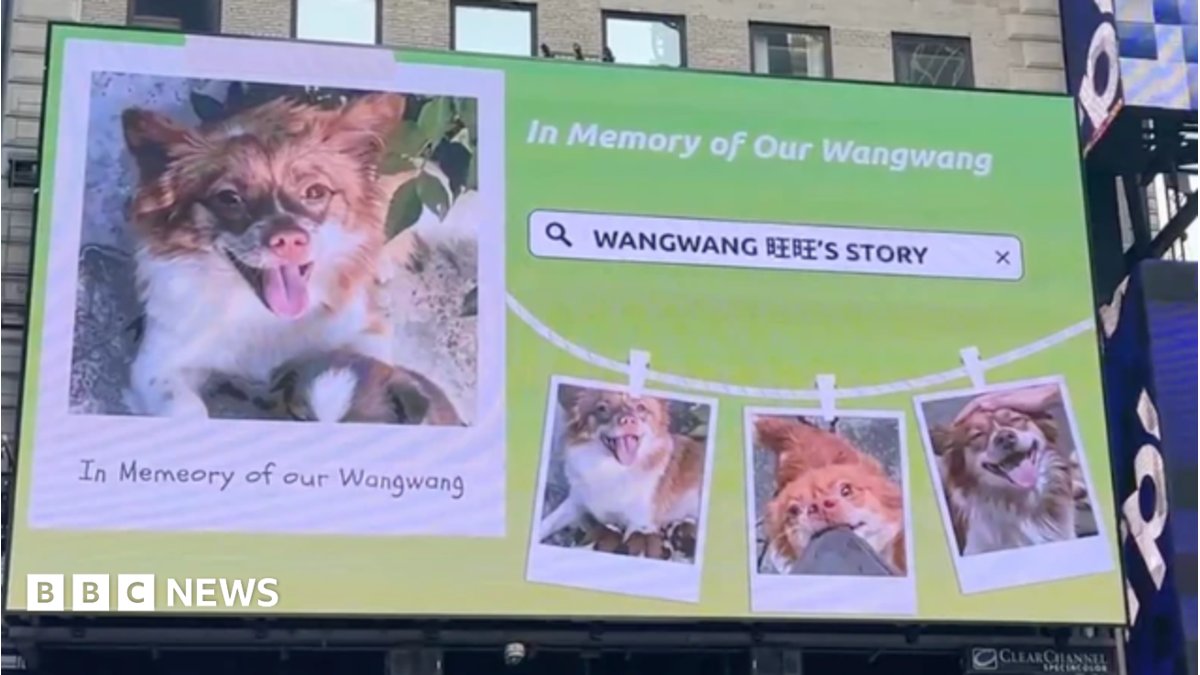
The death of a stray dog in a mid-sized city in Guangdong province would ordinarily merit little more than a local news brief. That the killing of a dog named Wang Wang has instead triggered a cross-border campaign — a digital screen in New York's Times Square, a billboard beside Taipei 101, and the inboxes of an animal-welfare organisation in Italy — speaks to something far larger than animal cruelty. It is a case study in how China's censorship apparatus manages public emotion, and what happens when that apparatus collides with an issue that resonates far beyond the mainland's borders.
At the centre of the storm is a graphic video that emerged at the end of June. It shows four boys in Jieyang, Guangdong province, beating three puppies with sticks before setting their mother on fire. The boys, all younger than 14, are seen laughing as the dog burns. The footage ignited nationwide outrage — and then censorship moved to suppress the discussion. Unusually, the suppression did not work. Three weeks later, posts were still drawing thousands of comments, and activists had carried the fight onto some of the most visible advertising spaces on the planet.
The Killings in Jieyang: Facts and Gaps
The available facts are thin, and deliberately so. Jieyang authorities have not revealed the boys' identities, nor have they commented on reports that the boys filmed themselves. What is known is the sequence shown in the footage: the beating of the puppies, the immolation of Wang Wang, and the laughter of the boys.
Last month, Jieyang authorities said the boys would be sent to a "specialised school" — a phrase not elaborated upon. The vagueness is significant. Under Chinese law, minors under 16 do not face criminal liability except in major crimes such as murder and rape. The boys' age places them beyond the reach of the criminal justice system, whatever the public might demand.
A Legal Vacuum for Animal Protection
China currently does not have a law against animal cruelty, and cruelty to animals is not punishable by law. The Wang Wang case has revived demands for protective legislation — demands that recur after each high-profile abuse case but have yet to produce a national statute. The legal vacuum leaves authorities with few instruments beyond administrative measures, and citizens with no formal channel for seeking justice on behalf of an animal.

This is not merely a domestic detail. For a government that has invested heavily in projecting an image of rule of law and humane governance, the absence of animal-welfare legislation is an exposed flank — one that international organisations and overseas activists are now exploiting with considerable effectiveness.
Censorship Framed as Child Protection
The official response was twofold: administrative action against the boys, and censorship of the public conversation. Authorities cited the boys' age as the reason for urging restraint. "We urge the public not to disseminate related information, to reject cyberbullying, and to work together to create a good environment for the growth of minors," read the official statement cited in the BBC's report.
Censors moved to block the video to protect the boys' identities. Keywords such as "Wang Wang" and "animal protection" trended as search terms, but posts related to them began to disappear towards the end of the week. Some users reported that their ability to share posts had been restricted. Even celebrity commentary was affected: posts by Chinese actor Du Jiang and Taiwanese actress Joe Chen, who had called for stronger animal protection, also disappeared, though it is unclear whether they were removed by the celebrities themselves or by the platforms.
The child-protection rationale is not without merit. Snippets of the video with the boys' faces visible continue to circulate, and unverified close-up posts raise the real risk that other children will be wrongly identified. Countries around the world restrict information about child offenders for precisely these reasons. But in China, the censorship cut deeper: it suppressed the broader conversation about animal cruelty, including the demand for legal reform.
Why This Case Would Not Die
It is hard to say why this particular case, among the many sensitive issues censored in China, galvanised such sustained pushback. The BBC report offers two plausible explanations: the killing was the latest in a string of animal abuse cases that had made headlines, and the footage had a visceral impact that abstract reports rarely achieve.
One animal lover in eastern China, identified only as PL, told BBC Chinese she found the video "affecting in a particularly severe way." Her words capture the dynamic: "We can't make our voices heard, so many people [outside China] are actively helping us to share this message." The censorship did not extinguish the anger; it redirected it — outward, across borders, into channels that Chinese authorities do not control.
Taking the Fight Offline and Overseas
The overseas campaign has been remarkably concrete. The International Organisation for Animal Protection, based in Italy, says it has received more than 100 reports from people around the world calling for intervention and has sought more information from Chinese authorities. In New York's Times Square, photographs of Wang Wang appear on a digital screen every 35 minutes, with the caption: "She was loved. She wanted to live. She should still be here."
Similar billboards have been erected near Taipei 101, including a picture of Wang Wang nursing her puppies, with the words: "This planet is their home too. Justice for Wang Wang." The campaign was funded by private individuals — CK, a Taiwanese woman, spent NT$30,000 ($930; £692) — rather than by organised political actors. This grassroots character makes it harder to dismiss as foreign interference.
The Taiwan Dimension: Soft Power and a Cross-Strait Contrast
The placement of the second billboard adds a delicate geopolitical layer. Taiwan is a territory Beijing claims as part of China, and cross-strait relations are already strained. The billboard is not a political statement per se; it is an animal-welfare message funded by a private Taiwanese citizen. Yet its presence on the island, broadcasting a mainland atrocity, subtly reframes the cross-strait narrative: Taiwanese civil society can express solidarity with mainland citizens' anger in public space, while mainland citizens are denied the same opportunity at home.
That asymmetry is diplomatically awkward. Beijing has long projected itself as the defender of Chinese interests and the guardian of social stability. The Wang Wang case shows a Taiwanese citizen spending her own money to amplify a story that mainland platforms are suppressing. Whatever the intent, the effect is a quiet but visible challenge to Beijing's management of information.
Civil Society Under Constraint
For students of Chinese civil society, the episode illustrates how activism adapts to censorship. When domestic digital channels are restricted, movements migrate to offline spaces, to foreign platforms, and to physical billboards abroad. They partner with international organisations and use the visibility of Western capitals to create pressure that Beijing cannot easily ignore.
The limits of that strategy are equally clear. The censorship has not been lifted; it has been modulated. Authorities have not completely banned the discussion, but they have restricted its reach. The boys' identities remain protected, and the legal framework remains unchanged. For every billboard in Times Square, there are thousands of deleted posts on Chinese platforms. The question is whether international campaigning can convert moral outrage into institutional change — a tall order when the target is a political system whose priority is stability rather than responsiveness.
Strategic Implications: What Wang Wang Reveals
The episode exposes three tensions at the heart of China's governance model. The first is between censorship and public opinion: the attempt to suppress the Wang Wang story appears to have amplified it, converting a local incident into an international cause célèbre. The second is between legal development and social demand: without an animal-cruelty statute, authorities are left with improvised measures — a vaguely defined "specialised school," a censorship campaign, an appeal to protect minors — none of which answers the public's demand for accountability.
The third tension is between international image and domestic control. Beijing has invested heavily in soft power, from the Global South to Western capitals. A campaign that places images of Wang Wang in Times Square — with the implicit message that Chinese citizens cannot speak freely at home — cuts directly against that investment. The affair will not change China's political system, and it may not produce an animal-welfare law soon. But it has demonstrated that Chinese citizens can, under the right conditions, route around censorship and make themselves heard on the world stage. That is a lesson Beijing will study carefully — and one that activists are already learning to use.
By Prof. Marcus Chen, Staff WriterThis article was produced with AI-assisted research and editorial support. Reporting is based on sources cited in the article.
What's Your Reaction?
 Like
0
Like
0
 Dislike
0
Dislike
0
 Love
0
Love
0
 Funny
0
Funny
0
 Wow
0
Wow
0
 Sad
0
Sad
0
 Angry
0
Angry
0

World Politics Analyst at Global1.News. Based in Beijing, covering US-China relations, global trade, and geopolitical strategy. Brings deep analytical perspective to the power dynamics shaping international affairs.










Comments (0)