
Beijing Bans Even Owning a Drone as It Locks Down the Capital's Skies
Beijing will make owning, storing or carrying a drone illegal in the capital from Nov 15, the tightest UAV rule in China, after a light aircraft hit the Citic Tower in June. Owners are offered buybacks, recycling subsidies or free postage out, even as Beijing promotes a drone economy worth 1.5 tr...
Citic Tower Crash Turns the Capital Into a Drone-Free Zone
Beijing has done what no other capital has attempted. From November 15, it will be illegal not merely to fly a drone in the Chinese capital but to own one, store one, or carry one through the city gates.
The revised regulation was published on the municipal government website on Sunday, and its language leaves little room for interpretation. The entire administrative area of Beijing is designated controlled airspace for unmanned aerial vehicles. Flight is prohibited except where otherwise permitted by law. So is possession, storage and transport of drones and their core components, along with bringing them into the city at all.
"In Beijing, drones are now being regulated like firearms," one commenter wrote on Chinese social media, according to the South China Morning Post. Another, a media professional, noted the practical consequence for his trade: aerial photography in the capital, he said, will be "entirely out of the question."
What the New Rules Actually Prohibit
The revised regulation was adopted by the Standing Committee of the Beijing Municipal People's Congress and builds on an earlier framework approved in March that took effect on May 1. That version required owners to register their devices under their real names and identities, and let them keep registered drones under strict conditions. Sales had already been banned in the city from April.
The new text closes the remaining loopholes and, by the assessment of Chinese commentators, is the strictest drone regime in the country. Notably, it removes the option of storage. The earlier rules had permitted storage facilities for drones and their core components outside Beijing's sixth ring road; from November 15, no organisation or individual may establish a warehouse, temporary storage site or similar facility anywhere inside the municipality.
Authorities will also establish a no-fly zone covering the capital and its surrounding areas from September 20, primarily restricting non-essential flights. Commercial aviation and emergency rescue operations are exempt, and exceptions are contemplated for designated special-purpose flights such as counter-terrorism, agriculture, disaster relief and research. Enforcement is not symbolic: officials may confiscate non-compliant devices and fine individuals and companies.
A Crash in June, Then Nine Months of Tightening
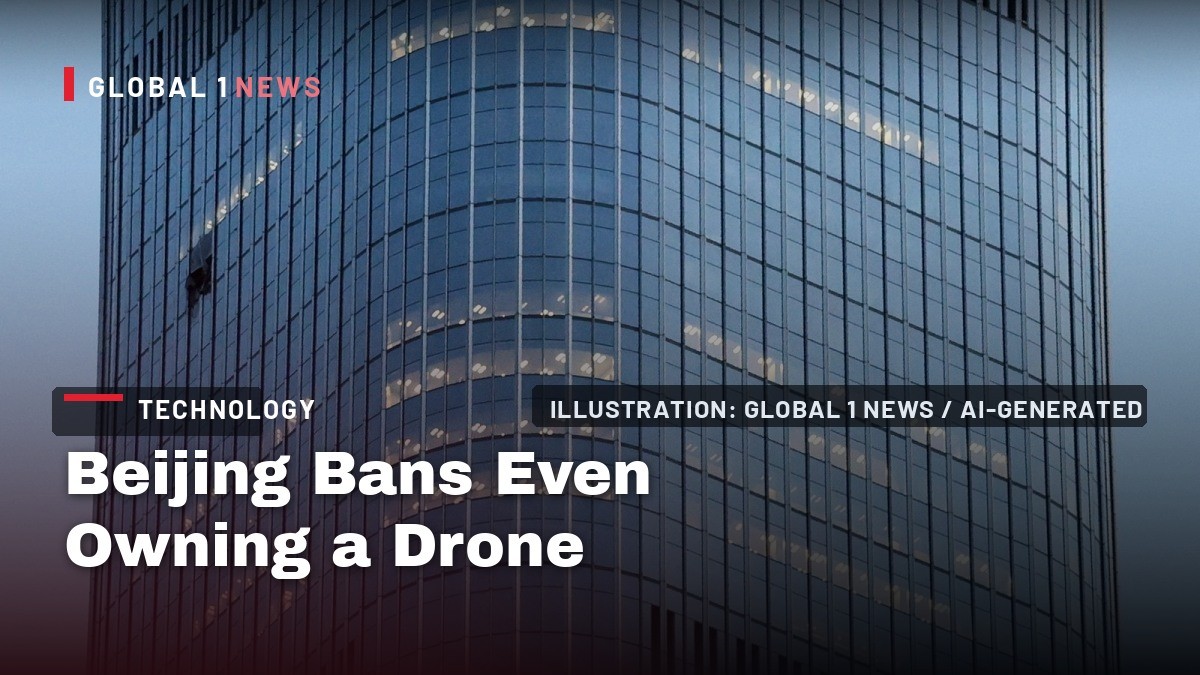
The trigger was an incident that China's censors moved quickly to scrub from the internet. On the afternoon of June 26, a single-engine, two-seat light aircraft crashed into the CITIC Tower, the 528-metre, 108-floor skyscraper known locally as China Zun that anchors the capital's central business district and can accommodate 12,000 office workers.
The pilot, the only person on board, was killed. Thirteen people on the ground were injured, and debris was scattered at the base of the tower while fire crews worked small blazes below the impact point. The Chaoyang district government confirmed the basic facts in a statement on WeChat the following day without elaborating on the cause, and police blocked bystanders from photographing the scene as images and posts were rapidly deleted online.
What followed was a tightening ladder that ran across the whole regulatory system, not just the capital. The Civil Aviation Administration of China's interim regulations on unmanned aircraft flight management had already mandated real-name registration. A revised Public Security Administration Punishment Law took effect on January 1, classifying illegal drone flights as endangering public safety, with detention of five to ten days available alongside fines.
On May 1, two mandatory national standards took effect, governing real-name registration and activation and real-time operational identification, with unregistered aircraft physically locked and older devices given until 2027 to comply. On July 1, China's revised Civil Aviation Law came into force, the first top-to-bottom rewrite since 1995. Its 16 chapters and 262 articles put unmanned aircraft on the same legal footing as airliners, requiring airworthiness certification, and write the low-altitude economy into national aviation law for the first time.
Buybacks, Scrapping and Free Postage
Beijing has also built an exit ramp, and it is unusually generous for a security measure. According to the state-owned Beijing Daily, owners can sell their devices at designated buyback locations with a subsidy, hand them over for scrapping and recycling for a smaller payment, or mail them out of the capital with postage waived.
The state postal operator's EMS service is accepting drones for shipment to addresses outside Beijing between September 12 and November 14, with the delivery fee waived once the equipment is verified. Owners who prefer to move the devices themselves must do so by November 15, using civil aviation, rail or road services.
The bureaucracy is the tell. A capital that treats an estimated 3.29 million registered aircraft nationwide as a strategic industry is simultaneously paying citizens to make its own city a hole in the national map.
The Contradiction: A Capital Ban Inside a Drone Boom
That tension is the real story. China's registered unmanned aircraft fleet reached nearly 3.29 million units by the end of 2025, a 51 per cent jump in a single year, while flight hours surged 69.9 per cent to 45.3 million, according to the CAAC's 2025 statistical bulletin. The regulator estimates the low-altitude economy, the commercial ecosystem below roughly 1,000 metres spanning drones, electric vertical take-off aircraft and helicopters, reached 1.5 trillion yuan (about US$211 billion) in 2025 and will exceed 3.5 trillion yuan by 2035.
Beijing is not opting out of that boom. It is hardening the perimeter around its political core while pushing the market outward. Provincial governments have folded the low-altitude economy into their development plans, with Wuhan aiming to build 1,000 drone hangars and an integrated management system by 2030.
Nor is the capital unique in its instincts, only in its thoroughness. The South China Morning Post has reported that nearly 20 of China's largest cities have imposed blanket bans on civilian drone flights over central areas, some without any public policy announcement.
Japan Is Tightening by Distance, Not Prohibition
Tokyo has taken the opposite approach, and the contrast is instructive. Japan does not ban ownership. It widens the forbidden zone.
Japan's Drone Act, enacted in 2016 after a drone carrying radioactive material landed on the roof of the prime minister's office, created red zones above designated key facilities and yellow zones extending about 300 metres around them. Designated facilities, a list that now runs to several hundred and includes the Diet, the Imperial Palace, Self-Defence Force bases, United States Forces Japan installations, airports and nuclear sites, had not changed in a decade even as drone performance improved dramatically.
That changed this year. On March 24, the cabinet of Prime Minister Sanae Takaichi approved a draft revision expanding yellow zones from roughly 300 metres to about one kilometre, citing the need for sufficient distance to guard key facilities against faster aircraft. The Diet enacted the amendment on June 17, and it took effect on July 14. Flying in a yellow zone now carries an immediate penalty of up to six months in prison or a fine of up to 500,000 yen, closing a gap that previously required operators to ignore a police warning first. The National Police Agency commissioner-general can also designate venues hosting the emperor, the prime minister or foreign dignitaries, and international conference sites from the preparation stage.
The government's own data shows why. According to a National Police Agency report, drones that flew at about 50 kilometres per hour when the law was enacted can now reach 70 to 80 kilometres per hour, with some foreign-made models hitting 150. Transmission range has grown from 200 to 300 metres to as much as 10 kilometres, and payload capacity from between 80 grams and 5 kilograms to as much as 30 kilograms.
Japan's Ministry of Defence went further still in July, expanding flight restriction zones around designated defence-related facilities from about 300 metres to about one kilometre. The ruling Liberal Democratic Party has separately called for interceptor drones and long-term combat capability, and Tokyo's police have run counter-drone drills using interceptor aircraft since 2016.
What to Watch For
The first question is contagion. If Beijing can outlaw possession outright and absorb the political cost through buybacks and free postage, the roughly 20 cities that already restrict central-area flights have a template, and the commercial drone operators who rely on urban airspace have a problem. Watch whether Shenzhen, Shanghai or Guangzhou copy the possession ban, and whether China's drone manufacturers, whose export dominance rests on civilian scale, quietly lobby against the precedent.
The second is enforcement. A registry that locks unregistered aircraft is only as strong as its screening. Postal channels are the obvious gap: Beijing is waiving fees to push devices out of the city, which means every parcel leaving the capital is now a compliance question, and the second-hand market is about to be flooded by a forced sell-off.
The third is Japan's next move. Extending yellow zones to one kilometre in central Tokyo redraws the map over Chiyoda and Minato wards, exactly where commercial drone delivery pilots and aerial survey work concentrate. Japan has chosen graduated restriction over prohibition, but each expansion narrows the space where the country's own low-altitude ambitions can operate, and the LDP's push for interceptor drones suggests Tokyo now reads the sky as a security domain first.
For Asia's two largest aviation markets, the lesson of this September is that the same technology can be a strategic industry and a security liability in the same sentence. China is betting it can have both, just not in the capital.
By Kenji Tanaka, Staff Writer
This article was produced with AI-assisted research and editorial support. Sources: South China Morning Post, Associated Press, China Daily, Reuters, Agence France-Presse, The Japan Times, Kyodo News, Mainichi Shimbun, Japan Ministry of Defense, Japan National Police Agency, Xinhua, Civil Aviation Administration of China, Library of Congress.
What's Your Reaction?
 Like
0
Like
0
 Dislike
0
Dislike
0
 Love
0
Love
0
 Funny
0
Funny
0
 Wow
0
Wow
0
 Sad
0
Sad
0
 Angry
0
Angry
0

Japan Correspondent at Global1.News. Tokyo-based voice covering Japanese politics, technology, economy, and culture. Tracks the intersection of tradition and innovation in one of the world's most dynamic societies.














Comments (0)