
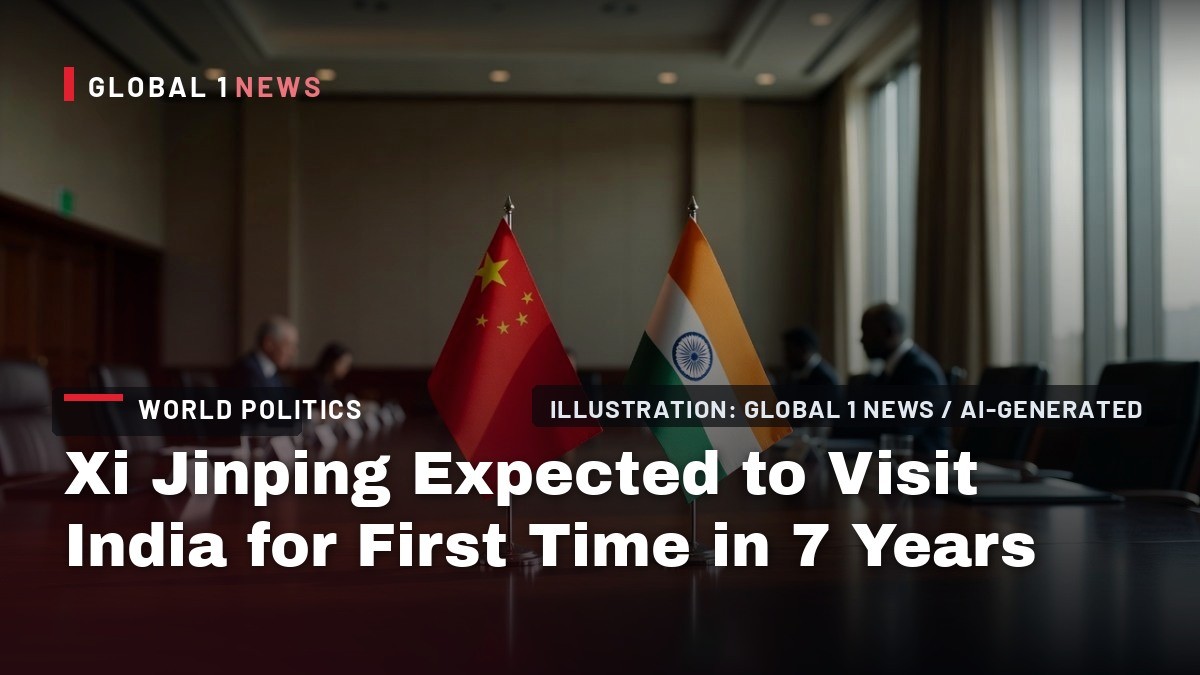
Xi Jinping Expected to Visit India for First Time in 7 Years
Xi Jinping is expected to visit India in September for the first time in seven years, with the BRICS summit in New Delhi and the SCO meeting in Bishkek setting the stage for a cautious thaw in China-India ties.
China and India Move Toward a Pivotal Summit Season
After two years of a cautious thaw, China and India are heading toward a pivotal test of whether their relationship can move beyond managed optics to meaningful engagement. President Xi Jinping and Prime Minister Narendra Modi are expected to cross paths next week at the Shanghai Cooperation Organisation (SCO) summit in Bishkek, Kyrgyzstan, with a fuller sit-down planned for New Delhi in mid-September when Xi is expected to attend the BRICS summit - his first visit to India in seven years.
The Chinese Foreign Ministry confirmed on Wednesday that Xi would attend the SCO summit on August 31 and September 1, while Modi is also expected to participate. Sources cited by the South China Morning Post expect a short, tightly managed encounter on the sidelines of the Bishkek meeting that would set the stage for the main event in India. Beijing has not officially confirmed the India visit, saying only that it attaches importance to BRICS cooperation and supports India in hosting the summit.
Bishkek First: The SCO Encounter That Sets the Stage
The Bishkek summit, held under Kyrgyzstan's chairmanship, brings together the SCO's member states at a moment when the bloc is expanding its footprint. India and China sit on opposite sides of the organization's internal debate over connectivity and security, yet the leaders' expected encounter matters less for what it produces than for what it signals: that both capitals consider the relationship worth managing at the highest level.
The timing is deliberate. A year ago, Modi met Xi on the sidelines of the SCO summit in Tianjin - the Indian leader's first visit to China in seven years - where the two agreed that China and India were development partners rather than rivals and that the boundary issue should not define the broader relationship. That meeting followed the Kazan BRICS summit in October 2024, where the two leaders gave what India's national security adviser Ajit Doval later described as "clear and positive direction" to the relationship.
For Japan and other Asia-Pacific capitals, the pattern is significant: the China-India channel is being rebuilt through multilateral summitry rather than standalone bilateral visits, a structure that gives both governments cover to engage while keeping domestic political costs low.
The Main Event: New Delhi BRICS and a Seven-Year Gap
The fuller encounter is planned for New Delhi on September 12-13, when Xi is expected to attend the 18th BRICS Leaders' Summit with a reported delegation of around 400 people. It would mark the Chinese leader's first visit to India since 2019, a seven-year gap that tracks the worst stretch of China-India relations since the 1962 border war.
Both sides are working hard to churn out deliverables, according to people familiar with the negotiations. The disputed Himalayan border is expected to be high on the agenda when Xi meets Modi in the Indian capital, alongside trade, investment and people-to-people ties, including visas. Indian media, including Hindustan Times, have confirmed the expectation of a large Chinese delegation, while analysts note that Beijing has deliberately left room to adjust if the ground shifts before September.
Border First: Delimitation Talks After the 25th Round
The diplomatic runway was cleared on Tuesday, when Chinese Foreign Minister Wang Yi, Beijing's special representative on the boundary question, co-chaired the 25th round of talks on the Himalayan border dispute with Doval, Modi's principal security adviser. The Indian foreign ministry described the talks as "candid and in-depth," with both sides agreeing to keep seeking a political settlement "in the context of their overall and long-term interests."
Beijing's readout quoted Wang as urging both sides to "place the border issue in its proper place within bilateral relations" and to "maintain forward momentum without pausing, regressing, or veering off course." Notably, both the Indian embassy in Beijing and the Chinese foreign ministry used the term "delimitation" - agreeing on paper where the boundary runs, rather than simply managing troops along the Line of Actual Control.
Missing from this week's readouts was "early harvest," last year's strategy of prioritising the less contentious stretches while putting off Ladakh and Arunachal Pradesh - which Beijing calls Zangnan, or "south Tibet" - for later. That omission signals that the harder questions are now on the table, even if a grand settlement remains distant.
Beyond the Border: Trade, Investment and Visas
The economic track could offer more tangible wins than the border file. Under newly relaxed Indian rules, investors from countries sharing a land border with India - including China - can acquire non-controlling stakes of up to 10 per cent without government approval, barring specific restricted sectors. A Xi-Modi summit could deliver political momentum to efforts to boost trade and investment and address India's glaring trade deficit with China.
On the people-to-people front, tourist visas and direct flights have resumed, but the return of Chinese journalists to India remains the last major piece on the negotiating table. New Delhi has moved more slowly than Beijing on visa restoration, and sources said any restoration was expected to be tightly controlled and reciprocal, not a blanket move.
Sober Realism: What Analysts Expect
Analysts counsel against expecting a breakthrough. Zhu Yongbiao, dean of the school of politics and international relations at Lanzhou University, described the Wang-Doval talks as a "positive signal" but said concrete actions from India mattered far more than rhetoric, predicting the border situation would at best "freeze or revert to the prior status quo."
Manoj Kewalramani of the New Delhi-based Takshashila Institution said anyone looking for a breakthrough on the boundary "is likely to be disappointed," noting that the last two Modi-Xi meetings produced no joint statement. He suggested a new formal mechanism for trade, investment and green energy technologies might be useful, while ruling out grand bargains: "This is not the moment for grand bargains for either side."
Antara Ghosal Singh of the Observer Research Foundation said a successful meeting for India would mean a stable border, secure upstream manufacturing supply chains, greater leverage with Washington and more room to advance "Make in India." For China, she said, high-level contact with India could weaken US efforts to check and balance Beijing. "Overall, the conditions are ripe in both New Delhi and Beijing for a deep reset in bilateral ties," she said, "but both sides will be seeking to maximise their gains while reducing concessions."
What to Watch For: Japan and the Asia-Pacific
For Tokyo, the stakes are indirect but real. India is a pillar of Japan's Indo-Pacific strategy and the Quad, and a sustained China-India thaw could change the geometry of regional diplomacy in ways that touch everything from maritime security to supply chains. Japan will watch closely whether New Delhi's engagement with Beijing shifts India's calculus in the Quad, in the East China Sea debates, and in the competition over infrastructure and connectivity across the Indo-Pacific.
The immediate test comes in two stages: the Bishkek encounter on August 31-September 1, where body language and readouts will signal the temperature of the relationship, and the New Delhi summit on September 12-13, where deliverables on border management, trade and visas will show whether the thaw has substance. Asia-Pacific readers should expect incremental progress, not drama - and should watch whether the "delimitation" language survives into the final readouts, because that will tell them whether the two giants are serious about converting managed calm into something more durable.
By Kenji Tanaka, Staff Writer
This article was produced with AI-assisted research and editorial support. Sources: South China Morning Post, Hindustan Times, Firstpost, BusinessWorld, China-Global South Project, Tribune Online.
What's Your Reaction?
 Like
0
Like
0
 Dislike
0
Dislike
0
 Love
0
Love
0
 Funny
0
Funny
0
 Wow
0
Wow
0
 Sad
0
Sad
0
 Angry
0
Angry
0

Japan Correspondent at Global1.News. Tokyo-based voice covering Japanese politics, technology, economy, and culture. Tracks the intersection of tradition and innovation in one of the world's most dynamic societies.















Comments (0)