
West Bank Stabbing Near Jericho Sparks Massive IDF Manhunt
In a recent i24NEWS English report, the focus was on a dramatic manhunt unfolding across the Jordan Valley after a terror stabbing attack on Sunday morning. The incident, which left a 24-year-old Israeli man moderately wounded, has triggered a large-scale military and police operation involving elite units and aerial support. West Bank Stabbing Near Jericho Sparks Massive Manhunt; IDF Deploys Elite Units in Jordan Valley Jerusalem, Israel — Sunday — A 24-year-old Israeli man
West Bank Stabbing Near Jericho Sparks Massive Manhunt; IDF Deploys Elite Units in Jordan Valley
Jerusalem, Israel — Sunday — A 24-year-old Israeli man was stabbed multiple times in a terror attack on Sunday morning near the Palestinian village of Al-Auja, located on Route 90 just north of Jericho, the IDF confirmed. The victim, identified by Israeli media as an ultra-Orthodox soldier from Betar Illit, was evacuated to Shaare Zedek Medical Center in Jerusalem in moderate condition, according to Magen David Adom. The attacker, reported to be a 16-year-old Palestinian, fled the scene immediately, prompting a sweeping manhunt that has sealed off entire villages and mobilized some of the IDF’s most elite counter-terror units.
The Attack
The stabbing occurred at a shopping complex along Route 90, a major north-south artery in the West Bank that serves both Israeli civilians and Palestinian residents. According to the victim’s brother, Shlomo Hanaya, who spoke to KAN Reshet Bet, the victim is an active IDF soldier who was vacationing in the area with his family. He had stopped at the complex to buy cigarettes when the terrorist, who had been waiting near the vehicle, rushed him from behind and stabbed him multiple times.
Shlomo Hanaya described the outcome as a "great miracle," noting that his brother sustained only moderate wounds despite the ferocity of the attack. Security footage published by KAN News, blurred to protect identities, shows the assailant lurking near the man’s car before lunging at him as he returned from the store. The video captures the brief but violent struggle before the attacker flees on foot, leaving the wounded soldier bleeding on the ground.
Magen David Adom paramedics treated the man at the scene and transported him to Shaare Zedek Medical Center in Jerusalem, where medical staff were evaluating stab wounds concentrated on his upper back.
The Manhunt
The IDF immediately launched a large-scale manhunt, deploying military aircraft, soldiers from the Duvdevan undercover counter-terror unit, the Nitzan 636 Unit, and the Jordan Valley Division. The Civil Administration and the Shin Bet (Israel Security Agency) joined the search, conducting house-to-house sweeps in Al-Auja and the nearby village of Fasayil. A security source told KAN News that the IDF has blocked all entrances to both villages, as well as several access points into Jericho, effectively trapping the suspected terrorist in a tightening cordon.
Police from the Jordan Valley Station and criminal investigators from the Judea and Samaria District Police have begun collecting forensic evidence at the scene, including the knife used in the attack and surveillance footage from nearby businesses. The manhunt has since expanded into the city of Jericho itself, where forces are interrogating suspects and conducting intelligence-gathering operations. The army confirmed it is in ongoing contact with residents and security officials in the area, urging cooperation while warning that the terrorist remains at large.
The use of Duvdevan, a unit specializing in undercover operations in Palestinian urban areas, underscores the seriousness with which the IDF views this incident. The unit’s operators are trained for close-quarters combat and rapid apprehension, and their deployment signals that the military expects the suspect to attempt to blend into the local population. The Nitzan 636 Unit, a mixed reconnaissance unit, is providing real-time intelligence from the ground, while aircraft circle overhead to track any movement in the open terrain of the Jordan Valley.
On the Ground
The closure of Al-Auja and Fasayil has had an immediate impact on daily life for Palestinian residents. Hani Najoum, head of the Al-Auja village council, told the Palestinian Authority’s Wafa news agency that Israeli forces raided the village and sealed it off, trapping residents inside and forcing shops to close. Soldiers searched homes and collected surveillance footage from private residences and businesses, a standard procedure in manhunts but one that Najoum described as a collective punishment.
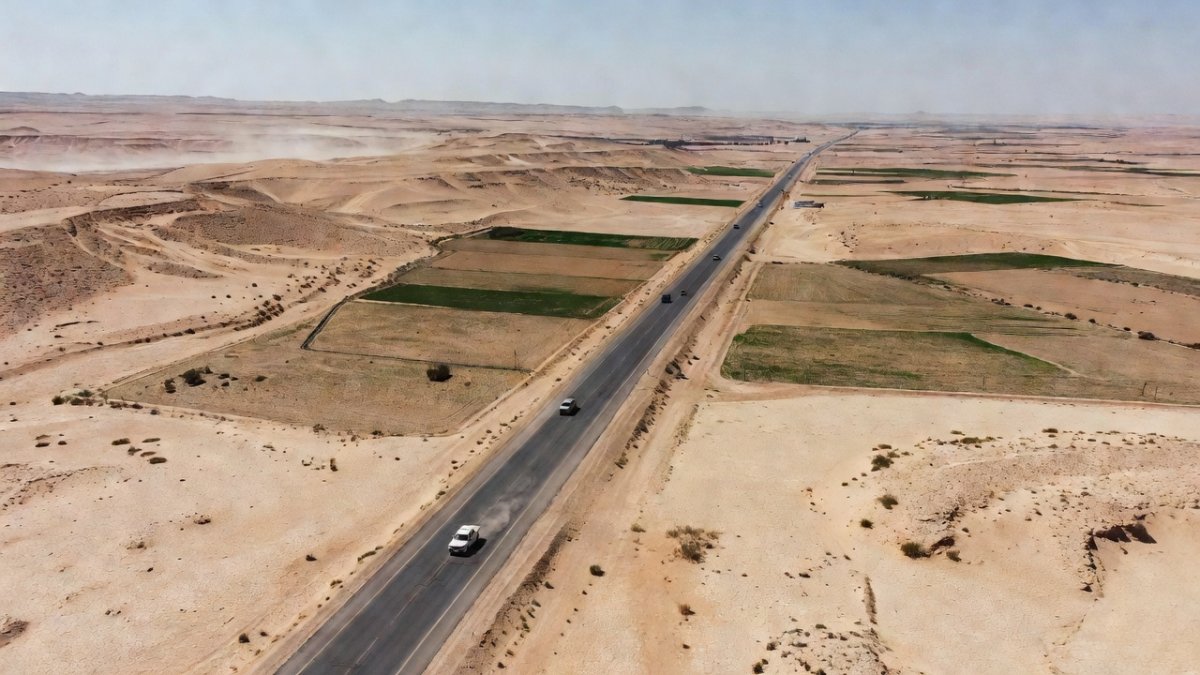
The village of Al-Auja sits along Route 90, a highway that is heavily used by Israeli settlers traveling between the Jordan Valley settlements and Jerusalem, as well as by Palestinians commuting to Jericho and other West Bank cities. The attack site is approximately eight kilometers (five miles) north of Jericho, a city that has seen periodic violence but has largely remained quiet since the Gaza war began in October 2023. The choice of this location—a busy commercial area frequented by both Israelis and Palestinians—suggests the attacker deliberately sought a target in a mixed-traffic zone.
For Israeli residents of the Jordan Valley, the attack is a stark reminder of the region’s volatility. The valley is home to dozens of small agricultural settlements, many of which are connected by Route 90. Security officials have long warned that the highway’s length and relative isolation make it vulnerable to hit-and-run attacks. Sunday’s stabbing, carried out by a teenager with a knife, is precisely the kind of low-tech assault that is difficult to prevent despite extensive surveillance and patrols.
Regional Context
The attack comes amid a significant rise in Israeli settler violence against Palestinians across the West Bank since the Gaza war began in October 2023. UN OCHA data tracks a sharp spike in both settler attacks and Palestinian displacement, with entire communities in the northern West Bank being forced to abandon their homes due to repeated raids and intimidation. The Hamas statement praising Sunday’s stabbing explicitly framed it as a response to "settler violence" and the "escalating desecration" of the Al-Aqsa Mosque compound in Jerusalem.
Hamas said in a statement: "This operation demonstrates that our people are determined to resist the occupation in every part of Palestine." The terror group’s endorsement of the attack is likely to escalate tensions further, particularly in the sensitive Jordan Valley, which holds strategic significance for Israel’s security doctrine. The valley, which runs along Israel’s eastern border with Jordan, is considered a critical buffer zone, and successive Israeli governments have insisted on maintaining a military presence there as part of any future peace agreement.
The timing of the attack is also notable. It comes amid heightened security alerts across the West Bank, a period when security forces are typically on high alert for copycat attacks inspired by the ongoing war in Gaza. The fact that the attacker was a 16-year-old from a village near Jericho, rather than a known operative, highlights the challenge of preventing spontaneous acts of violence inspired by broader regional dynamics. Israeli security officials have repeatedly warned that the West Bank is a powder keg, with a young Palestinian population increasingly radicalized by the ongoing war in Gaza and the daily frictions of occupation.
Diplomatic and International Reactions
The attack has drawn swift condemnation from Israeli officials, though no formal statements from the Prime Minister’s Office or the Foreign Ministry had been issued by late Sunday afternoon. The IDF’s operational response, however, speaks to the seriousness with which the military views the incident. The deployment of Duvdevan and the Shin Bet to a stabbing attack—rather than just local police—indicates that the security establishment is treating this as a potential escalation point, not a one-off incident.
Internationally, the attack is likely to be cited by both sides in the ongoing debate over West Bank security. Israeli officials will point to the stabbing as evidence of continued Palestinian terrorism, while Palestinian representatives will highlight the IDF’s closure of Al-Auja and Fasayil as collective punishment. The United Nations and European Union have repeatedly called for restraint on both sides, but such statements have had little effect on the ground. Washington, which has been pressing for a ceasefire in Gaza and broader regional de-escalation, is expected to issue a statement condemning the attack while urging Israel to exercise restraint in its response.
The attack also comes at a delicate moment for Israeli-Palestinian security coordination. The Palestinian Authority’s security forces, which operate in parts of the West Bank including Jericho, have been under increasing pressure from both Israeli raids and Hamas influence. The IDF’s decision to coordinate with local security officials in the manhunt suggests that the military is seeking to maintain working relationships with PA forces even as it conducts unilateral operations. Whether that coordination holds in the coming days will be a key indicator of the stability of the broader security framework.
Analysis and What This Means
Sunday’s stabbing attack near Jericho is a stark reminder that the West Bank remains a flashpoint even as international attention focuses on Gaza and Lebanon. The choice of a teenage attacker, the location on a major highway, and the immediate praise from Hamas all point to a strategy of low-cost, high-impact attacks designed to destabilize daily life and provoke an Israeli overreaction. The IDF’s response—sealing villages, deploying elite units, and conducting house-to-house searches—is predictable but also risks inflaming local resentment and fueling the next attack.
For Israeli residents of the Jordan Valley and the broader West Bank, the attack underscores the fragility of their security. The victim, an off-duty soldier on a family vacation, was targeted not because of his military role but simply because he was an Israeli in the wrong place at the wrong time. The fact that he survived with moderate wounds is, as his brother said, a miracle—but it is a miracle that could easily have been a tragedy.
Looking ahead, the manhunt’s outcome will shape the immediate security picture. If the terrorist is captured quickly, the IDF may be able to contain the fallout. If he evades capture for days, the operation could expand, leading to more closures and arrests, and potentially triggering a new cycle of violence. The broader question, however, is whether the Israeli government will address the root causes of such attacks—the ongoing occupation, the settler violence, and the lack of a political horizon—or continue to rely solely on military responses. For now, the security establishment is focused on one thing: finding the 16-year-old who stabbed a soldier in the back and vanished into the alleys of Al-Auja.
The coming days will test both the IDF’s operational capabilities and the resilience of the local population, Israeli and Palestinian alike. The Jordan Valley, often described as Israel’s eastern security belt, is now the scene of a manhunt that could define the next phase of the conflict. As the sun sets over Jericho, the search continues, and the region holds its breath.
By Hannah Berg, Staff WriterThis article was produced with AI-assisted research and editorial support. Reporting is based on sources cited in the article.
What's Your Reaction?
 Like
0
Like
0
 Dislike
0
Dislike
0
 Love
0
Love
0
 Funny
0
Funny
0
 Wow
0
Wow
0
 Sad
0
Sad
0
 Angry
0
Angry
0

Israel Correspondent at Global1.News. Based in Tel Aviv, covering Israeli politics, security, technology, and society. Provides balanced, deeply-sourced reporting on one of the most closely-watched regions in the world.














Comments (0)