
USS George Washington’s Danang Port Call Highlights US-Vietnam Strategic Convergence
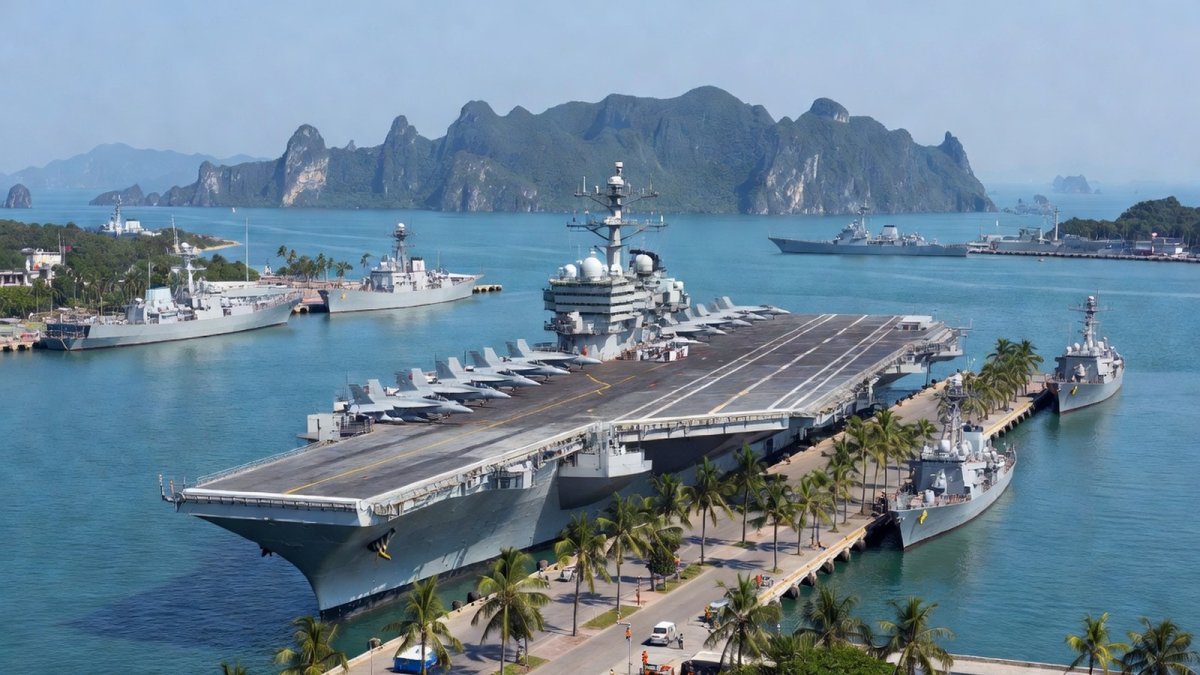
The USS George Washington, a Nimitz-class nuclear-powered aircraft carrier, arrived in Danang, Vietnam, on July 30, 2026, for a five-day scheduled port visit. More than 5,000 sailors were aboard the vessel, which was accompanied by the guided-missile cruiser USS Robert Smalls and the guided-missile destroyer USS Shoup.
The Carrier’s Arrival and Immediate Context
The USS George Washington, a Nimitz-class nuclear-powered aircraft carrier, arrived in Danang, Vietnam, on July 30, 2026, for a five-day scheduled port visit. More than 5,000 sailors were aboard the vessel, which was accompanied by the guided-missile cruiser USS Robert Smalls and the guided-missile destroyer USS Shoup. Vietnamese Naval Region 3 Command personnel, representatives from the ministries of National Defense and Foreign Affairs, and senior US embassy officials greeted the ships upon arrival.
This marks the fourth US aircraft carrier visit to Vietnam since the USS Carl Vinson’s historic call in March 2018. Previous visits included the USS Theodore Roosevelt in March 2020 and the USS Ronald Reagan in 2023. The George Washington is forward-deployed to Yokosuka, Japan, as part of Carrier Strike Group 5 within the US 7th Fleet.
Historical Trajectory of US-Vietnam Defense Ties
Diplomatic normalization between Washington and Hanoi occurred in 1995. The 2018 Carl Vinson visit represented the first carrier deployment after that milestone. Subsequent calls have coincided with the elevation of bilateral ties, culminating in the Comprehensive Strategic Partnership signed in 2023. That framework built upon the Comprehensive Partnership established in 2013 and the strategic partnership declared in 2007.
Vietnam’s Ministry of Defense described the George Washington visit as one that “contributes to maintaining and developing Vietnam-U.S. relations.” US Ambassador Jennifer Wicks characterized the port call as “yet another testament” to the healthy state of defense cooperation and people-to-people ties under the 2023 partnership. She added that the United States is proud to mark 250 years of American independence alongside its friends in Vietnam.
The 2018 arrival of the USS Carl Vinson established a precedent for high-visibility naval engagement that subsequent visits have built upon through measured escalation in scope and frequency. This initial post-normalization carrier call demonstrated that both sides could manage historical sensitivities while advancing practical military-to-military contacts, setting expectations for reciprocal gestures that reinforce mutual confidence without formal alliance structures. Analysts note that such milestones reflect a deliberate pacing in which each step tests the durability of political will on both sides before proceeding to more ambitious forms of cooperation.
The elevation of bilateral frameworks has created institutional channels that facilitate these port calls as routine rather than exceptional events. By embedding defense dialogue within progressively deeper partnership architectures, Hanoi and Washington have normalized the presence of major US naval assets in Vietnamese waters, transforming what once appeared extraordinary into a predictable element of regional diplomacy. This trajectory underscores how sustained diplomatic investment can convert episodic contacts into a stable pattern of engagement that withstands shifts in the broader geopolitical environment.
Strategic Significance for the Indo-Pacific
Captain Nicholas DeLeo, commanding officer of the George Washington, stated that the visit supports a relationship growing stronger across a broad range of subjects and reflects shared interest in a free and open Indo-Pacific. The carrier’s presence in the Western Pacific functions as a visible demonstration of US commitment to regional stability.
Overlapping concerns regarding China’s growing power have driven steady strategic convergence between the two countries over two decades. Vietnam maintains its distinctive “bamboo diplomacy,” balancing relations with China, the United States, Russia, and Japan. Carrier visits serve as practical confidence-building measures within this calibrated approach.
Vietnam’s bamboo diplomacy operates through flexible adaptation rather than rigid alignment, allowing Hanoi to absorb external pressures while preserving core autonomy in its foreign policy choices. In the South China Sea, this manifests as firm assertion of exclusive economic zone rights alongside pragmatic management of incidents with Chinese vessels, avoiding escalation that could disrupt broader economic interdependence. The approach enables selective cooperation with external powers on maritime awareness and capacity building without crossing thresholds that Beijing might interpret as containment.
This calibration reflects a calculated assessment that over-reliance on any single partner risks reducing maneuverability in a contested maritime domain. By engaging US naval visits as confidence-building measures rather than security guarantees, Vietnam signals openness to balancing influences while maintaining its longstanding preference for strategic autonomy. Such positioning allows Hanoi to extract tangible benefits from multiple relationships without locking into exclusive alignments that could constrain future options amid evolving power dynamics.
Separating Trade Tensions from Security Cooperation
The Trump administration recently imposed a new 12.5 percent tariff on Vietnamese goods following an investigation that identified sixty nations as having breached US laws against the use of forced labor. The tariff took effect after the expiry of a previous blanket 10 percent measure. Vietnam recorded a $178.2 billion trade surplus with the United States in 2025, according to the Office of the US Trade Representative.
Washington has raised concerns that Vietnam has been used as a transshipment point for Chinese goods seeking to avoid US tariffs. Vietnamese authorities responded by passing a new law tightening restrictions on the import and export of goods produced with forced labor. They also permitted US customs officials to conduct spot checks at Chinese-owned factories in northern Vietnam. No significant evidence of illicit transshipment was identified during those inspections.
The imposition of the 12.5 percent tariff after the prior blanket measure expired illustrates Washington’s willingness to apply targeted economic pressure even as defense channels remain open. Vietnam’s $178.2 billion trade surplus with the United States amplifies the stakes of these measures, yet Hanoi has responded by enacting domestic legislation and permitting limited inspections rather than retaliating in ways that could jeopardize security dialogue. This pattern reveals a deliberate strategy of absorbing economic friction without allowing it to contaminate parallel defense cooperation.
The security-trade nexus therefore rests on mutual recognition that compartmentalization serves both capitals’ interests. Vietnamese authorities’ cooperation on spot checks at Chinese-owned facilities demonstrates an effort to address US concerns over transshipment while protecting the broader relationship from spillover effects. Such measures allow defense engagement to advance on its own terms, insulated from the cyclical disputes that characterize economic interdependence between the two countries.
Hanoi has consistently sought to insulate security cooperation from economic friction, pursuing a form of de-risking without full decoupling. This separation allows defense engagement to proceed even as trade disputes remain active.
Relevance for South Korea and Northeast Asian Allies
South Korea observes these developments through the lens of its own alliance with the United States and the evolving ROK-US-Japan trilateral security framework. US carrier presence in the Western Pacific provides a common good that supports extended deterrence commitments to Seoul. Korean policymakers view such deployments as tangible demonstrations of American resolve in a region where North Korean threats and Chinese maritime activities intersect.
Vietnam’s hedging posture differs markedly from Seoul’s formal alliance model. While Hanoi maintains strategic autonomy and avoids binding security commitments, South Korea integrates US carrier operations into joint exercises and contingency planning. Both capitals nevertheless benefit from the same underlying US naval posture that underwrites freedom of navigation and regional stability.
South Korean observers interpret sustained US carrier deployments in the Western Pacific as reinforcing the credibility of extended deterrence commitments that underpin Seoul’s security calculations. Within the ROK-US-Japan trilateral framework, these assets contribute to shared situational awareness and interoperability that enhance collective responses to both North Korean provocations and Chinese maritime assertiveness. Policymakers in Seoul therefore track such movements as indicators of American willingness to maintain forward presence despite competing global demands.
The contrast with Vietnam’s hedging model highlights differing risk tolerances in alliance management. Where Seoul integrates carrier operations into joint planning and exercises under formal treaty obligations, Hanoi preserves distance from binding arrangements to avoid provoking its northern neighbor, illustrating how a single US naval posture can accommodate varied partnership intensities across the Indo-Pacific.
Forward-Looking Implications for Regional Order
The George Washington visit reinforces the pattern of incremental but sustained US-Vietnam defense engagement. As the carrier operates from its Japanese homeport, its movements contribute to the broader architecture of US alliances and partnerships stretching from Northeast to Southeast Asia. South Korea, as a treaty ally, monitors these interactions for signals about the durability of American forward presence.
Over time, the ability of Hanoi and Washington to compartmentalize trade disputes while advancing security dialogue will test the resilience of their Comprehensive Strategic Partnership. For Seoul, the contrast between Vietnam’s transactional approach and its own alliance commitments underscores the value of institutionalized extended deterrence arrangements. Continued carrier visits of this kind will remain important indicators of whether overlapping strategic interests can sustain cooperation amid persistent economic frictions.
Repeated carrier visits function as visible markers of an incrementally institutionalized partnership that contributes to a rules-based maritime order without requiring ASEAN members to choose sides. By normalizing high-end US naval presence in Southeast Asian ports, these engagements reinforce the principle that freedom of navigation remains a shared interest rather than a unilateral imposition, thereby supporting ASEAN centrality amid great-power competition.
Future indicators to monitor include the cadence of additional port calls and the evolution of trade negotiations that test whether economic disputes can continue to be ring-fenced from security cooperation. The durability of this separation will determine whether the Comprehensive Strategic Partnership can serve as a durable template for other regional actors navigating similar tensions between commercial interests and strategic alignment.
By Prof. David Park, Staff WriterThis article was produced with AI-assisted research and editorial support. Reporting is based on sources cited in the article.
What's Your Reaction?
 Like
0
Like
0
 Dislike
0
Dislike
0
 Love
0
Love
0
 Funny
0
Funny
0
 Wow
0
Wow
0
 Sad
0
Sad
0
 Angry
0
Angry
0

East Asia/Technology Correspondent at Global1.News. Seoul-based voice covering Korean politics, technology, business, and culture. Analyzes how technology and geopolitics intersect across East Asia.











Comments (0)