
US Approves $4.5 Billion KC-46 Tanker Sale to Qatar, Bypassing Israeli Defense Embargo
Washington has approved a possible $4.5 billion sale of four Boeing KC-46A refueling tankers to Qatar despite Israel's defense export embargo, as the Israeli Air Force takes delivery of its second Gidon tanker. The deal could extend Doha's reach toward Iran - and toward Israel.
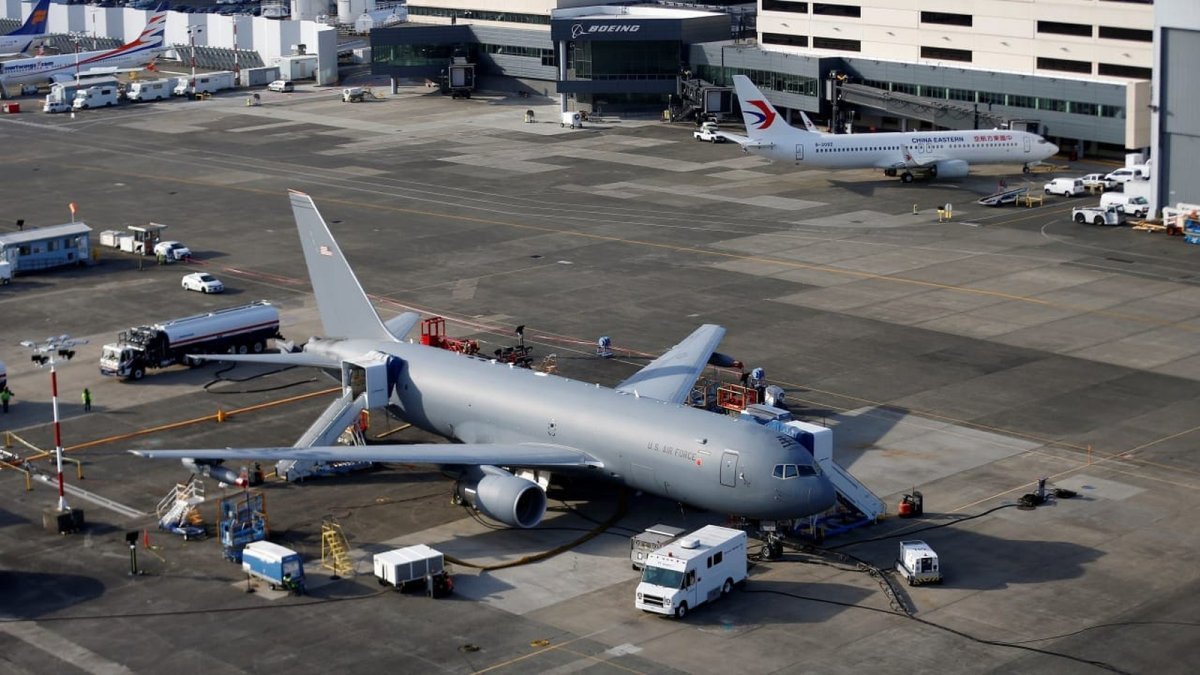
Washington’s Green Light Amid a Jerusalem Veto
The US State Department has approved a possible $4.5 billion Foreign Military Sale of four Boeing KC-46A aerial refueling aircraft to Qatar, according to an official notification to Congress published on August 20. The deal, which includes spare parts, maintenance, and long-term training support, moves forward despite the Israeli defense establishment’s strict embargo on defense exports to Qatar—a policy rooted in the complex security calculus that defines Jerusalem’s relationship with Doha.
For Israeli defense officials, the approval lands with particular weight this week. The Israeli Air Force (IAF) just took delivery of its second KC-46 tanker at Nevatim Airbase, part of a six-aircraft order placed by the Defense Ministry. The parallel timelines underscore a strategic paradox: while Israel expands its own aerial refueling fleet, Washington is simultaneously enabling Qatar to acquire the same capability—one that could extend Doha’s reach in ways that cut both toward Tehran and, theoretically, toward Israel.
What Qatar Is Buying
The proposed package includes up to four KC-46A aircraft and eight Pratt & Whitney PW4062 engines—four installed and four spares—according to the State Department’s transmittal. The comprehensive deal also features 10 AN/ALR-69A radar warning receivers, Guardian Laser Transmitter Assemblies for Large Aircraft Infrared Countermeasure systems, missile-warning sensors, secure communications equipment, identification systems, training devices, and logistical support.
The $4.5 billion figure represents the maximum estimated value of the package. Qatar has not yet signed a contract, and the final value could be lower depending on the equipment and services included in any eventual agreement. The principal contractors would be Boeing, Pratt & Whitney, RTX, and Northrop Grumman.
If finalized, Qatar would become just the fourth country to operate the KC-46A, joining the United States, Japan, and Israel. The aircraft, a militarized version of the Boeing 767-200 airframe, can carry roughly 212,000 pounds of fuel and refuel aircraft using either a fly-by-wire boom or hose-and-drogue systems—a critical detail for a customer whose fighter fleet mixes US-standard and European types.
Operational Significance: A Tanker for a Mixed Fleet
To date, Qatar has lacked a dedicated tanker fleet. The Qatar Emiri Air Force operates a growing combat fleet of Boeing F-15QAs, Dassault Rafales, and Eurofighter Typhoons—none of which can refuel themselves. The acquisition will, for the first time, allow Qatari fighters to conduct long-range strike missions far beyond the country’s borders, marking a dramatic shift in its operational reach.
The F-15QA receives fuel through a boom, while the Rafale and Typhoon use probes designed for hose-and-drogue refueling. The KC-46A’s dual-system capability makes it uniquely suited to Qatar’s mixed inventory. Beyond refueling, the aircraft can carry passengers, cargo, and aeromedical patients, giving Qatar an additional long-range transport capability alongside its existing Boeing C-17 and Lockheed Martin C-130J fleets.
Qatar previously considered acquiring the Airbus A330 Multi Role Tanker Transport but never completed an order. The KC-46A now fills that gap, and four tankers will allow Doha to keep its own fighters airborne longer and contribute more directly to coalition air patrols instead of relying entirely on partner nations for fuel.
The Israel Angle: Embargo and the Parallel Gidon Program
The Israeli defense establishment maintains a strict embargo on defense exports to Qatar, a policy that has been in place for years and reflects deep concerns about Doha’s regional behavior and its relationships with actors hostile to Israel. The US approval of this sale does not change that Israeli policy, but it does create a notable tension: Jerusalem’s closest ally is arming a country that Israel itself refuses to supply.
Meanwhile, the IAF’s Gidon tanker program continues to advance. A second Gidon touched down at Nevatim Airbase last week, marking a milestone for the IDF’s aerial refueling and cargo capabilities. The Gidon, converted from a Boeing KC-46 airframe through a joint program between the US Air Force and the IAF, is described by the officer who oversees its operation as the most advanced aerial refueling aircraft in the world.
Israel has ordered six of the aircraft to date, with the possibility of expanding the fleet further. The Gidon first entered IAF service earlier this year, becoming the flagship of a new refueling squadron that will only continue to grow. The IAF commander emphasized the aircraft’s strategic importance: “First and foremost, it is a tanker aircraft, and its capabilities are extensive and very important for the State of Israel.”
The Iran Paradox: Deterrent or Long-Range Threat?
The timing of the Qatari sale is significant. Recent conflicts involving Iran have underscored the vital strategic role of aerial tankers, which extend the range and loiter time of fighter jets, transport planes, and intelligence platforms. Roughly 70 US tankers are currently deployed in the region, and Qatar itself faced Iranian attacks during the war, suggesting the procurement may serve as a deterrent against Tehran.
But the deal simultaneously hands Doha a long-range force-projection capability toward Israel that it previously did not possess. This is the central paradox for Israeli defense planners: the same aircraft that could help Qatar defend against Iranian missiles could, in a different scenario, extend Qatari fighter range toward Israeli airspace.
The IAF commander’s words about the Gidon apply equally to Qatar’s new capability: “Our goal is to get the Air Force as far as it needs to go, to all the points it needs to reach, and to bring all of its capabilities across the Middle East, or even farther if necessary.” For Israel, the question is whether Qatar’s version of that goal remains aligned with Jerusalem’s interests.
Washington’s Rationale: A Major Non-NATO Ally
The State Department said the proposed sale would support US foreign-policy and national-security objectives by strengthening the security of a major non-NATO ally. “The proposed sale will improve Qatar’s capability to meet current and future threats by providing timely aerial refueling capabilities for its fighter aircraft fleet,” the department said in its notification.
The State Department added that Qatar would have no difficulty absorbing the aircraft into its armed forces and said the sale would not alter the basic military balance in the region. That assessment is likely to face scrutiny in Jerusalem, where defense officials may view the deal differently—particularly given the Israeli embargo and the potential for Qatari long-range capabilities.
Washington’s relationship with Doha is anchored in strategic interests that go beyond the tanker sale. Qatar hosts Al Udeid Air Base, the largest US military installation in the Middle East, and has spent the past decade building a mixed fighter fleet with American, French, and British equipment. The US has a direct interest in ensuring that Qatari aircraft can operate effectively in coalition operations.
Timeline and Caveats: Congressional Review and 2030 Delivery
The approval represents a preliminary stage ahead of a formal contract, and no firm delivery schedule has been set. The proposed deal must still clear the congressional review process before the US and Qatar can negotiate a final agreement. Congressional notification does not guarantee that a sale will be completed or that all four aircraft will be purchased.
Given existing production backlogs and heavy global demand, Qatar is unlikely to receive the aircraft before 2030. The US remains the primary operator of the KC-46, with roughly 105 in service and plans to procure 283 in total, while Japan operates six and has approval for nine more. Israel’s six-aircraft order places it in a queue that is already stretched thin.
For Israeli readers, the timeline matters. The IAF’s Gidon program is already delivering operational capability at Nevatim, while Qatar’s tanker fleet remains years away. That gap provides Jerusalem with a window—but not a permanent one.
Regional Context: Gulf States Under Iranian Attack
The request comes as Gulf states weather sustained Iranian missile and drone attacks tied to the wider US and Israeli conflict with Iran, and as disruptions in the Strait of Hormuz squeeze regional energy shipments. Aerial tankers have proven essential in this environment, extending the range and loiter time of fighter jets, transport planes, and intelligence platforms across the region.
For Qatar, the tanker acquisition is part of a broader military buildup that has accelerated in recent years. The country has invested heavily in advanced fighters, air defense systems, and now aerial refueling. The KC-46A purchase would give Doha a capability that most Gulf states lack, positioning it as a more significant military player in the region.
Four tankers will not shift the regional balance of power on their own, as the State Department noted. But they represent a meaningful step for a country that has traditionally relied on coalition partners for air operations. The question for Israel is whether that step moves Qatar closer to being a stabilizing force or a potential challenge.
Bottom Line for Israeli Readers
The US approval of the Qatari KC-46A sale is a reminder that Washington’s interests in the Gulf do not always align with Jerusalem’s preferences. The Israeli defense establishment’s embargo on defense exports to Qatar remains in place, but it does not extend to American decisions about arming Doha.
For the IAF, the parallel Gidon program offers a measure of reassurance. Israel’s tanker fleet is arriving now, with six aircraft on order and the possibility of expansion. The Gidon is described by its operators as the most advanced aerial refueling aircraft in the world, capable of carrying significantly more fuel, cargo, and passengers than its predecessors, with greater precision and in more complex environments.
The strategic calculus is clear: Israel is building its long-range capabilities while Qatar acquires the means to extend its own. The two programs will operate in the same region, with the same aircraft type, and potentially with different objectives. For Israeli defense planners, the KC-46A is no longer just an Israeli asset—it is becoming a regional one.
This article was produced with AI-assisted research and editorial support. Sources: Jerusalem Post, AeroTime, AeroCorner, Breaking Defense, US State Department.
By Hannah Berg, Staff Writer
What's Your Reaction?
 Like
0
Like
0
 Dislike
0
Dislike
0
 Love
0
Love
0
 Funny
0
Funny
0
 Wow
0
Wow
0
 Sad
0
Sad
0
 Angry
0
Angry
0

Israel Correspondent at Global1.News. Based in Tel Aviv, covering Israeli politics, security, technology, and society. Provides balanced, deeply-sourced reporting on one of the most closely-watched regions in the world.















Comments (0)