
Ukraine's Prosecutor General Charges the Anti-Graft Chief — Then Leaves the Country
Ukraine's Prosecutor General Ruslan Kravchenko signed a notice of suspicion against NABU chief Semen Kryvonos, then left the country as Zelensky demanded his dismissal, with a parliamentary vote set for September 15.
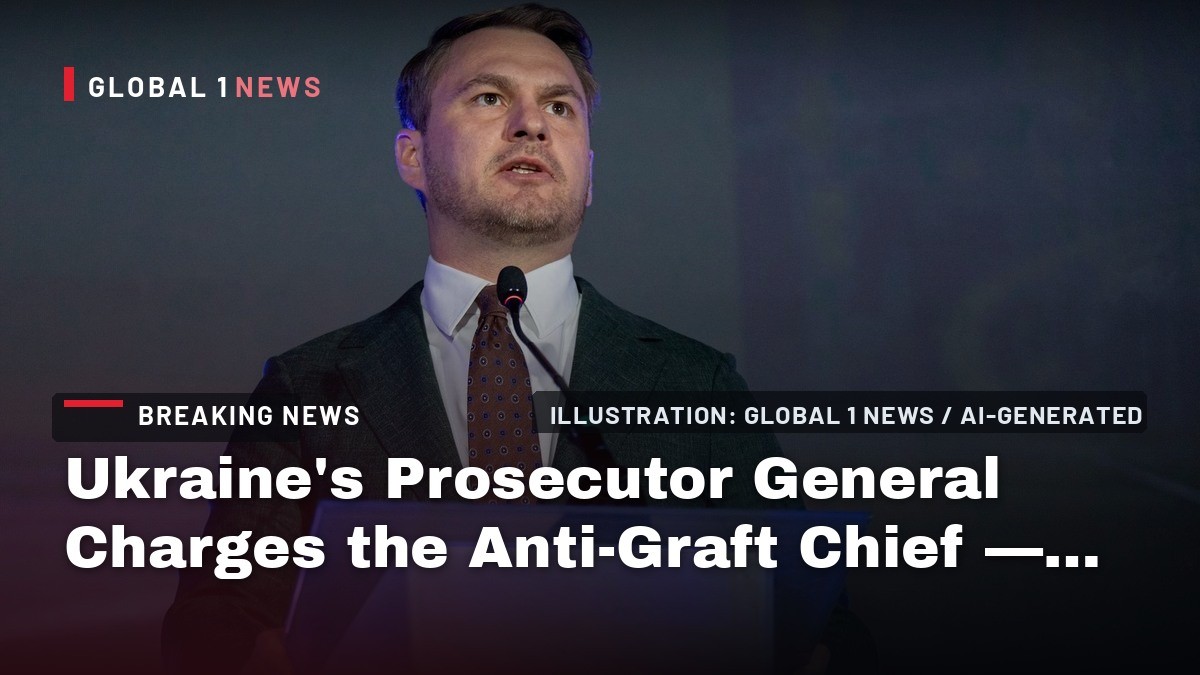
Folks, Ukraine's prosecutor general signed a notice of suspicion against the head of the country's own anti-corruption bureau — and then got into a government car at 2:30 in the morning and left the country. The man who once helped gut the agency investigating him is now accusing that agency of a political hit job. The president's answer was four words: dismissal from office.
Ukraine's Prosecutor General Charges the Anti-Graft Chief — Then Leaves the Country
Kyiv, Ukraine — Ruslan Kravchenko went on camera on September 14, 2026, with a caption that told Ukraine exactly where he stood: "I should have done this a long time ago." In a video address posted at 08:35 local time, the Prosecutor General announced he had signed a notice of suspicion against Semen Kryvonos, the head of the National Anti-Corruption Bureau of Ukraine — the agency that had spent the previous ten days investigating his own office.
Two Notices of Suspicion and a Departure
Kravchenko framed the move as the exposure of an operation aimed at him. "Operation Carthage was aimed not only at me," he said. "Its real purpose was to gain access to materials from the criminal proceedings concerning NABU and SAPO officials and employees and then remove the prosecutor general and halt the adoption of procedural decisions in these cases."
He said his office was providing procedural oversight in dozens of criminal proceedings into serious and particularly serious crimes committed by NABU and SAPO employees. On that basis, he said, he signed the suspicion against Kryvonos.
He suspects Kryvonos of falsifying official documents to obtain an unlawful benefit on an especially large scale, and of arranging a sham adoption intended to create artificial grounds to avoid liability in court.
A second notice of suspicion concerns a person close to SAPO head Oleksandr Klymenko: influencing a judge of the High Anti-Corruption Court, offering the judge an unlawful benefit, and facilitating evasion of military mobilisation. Kravchenko called that case "the trigger and the true reason for the nighttime assault on the Prosecutor General's Office."
He called on both men to resign, and claimed Zelensky had previously sought to prevent him from approving the charges against the NABU chief.
An Empty Chair and a 2:30 A.M. Drive
By the time Ukrainians woke to that video, Kravchenko was already gone.
He left the country overnight, at about 02:30 local time on September 14, in an official government car, according to Ukrainska Pravda, citing law-enforcement sources. The Anti-Corruption Action Centre, known as ANTAC, also reported the departure.
Kravchenko confirmed he was abroad on what he called a business trip — Ukrainska Pravda reported it was planned for Lithuania. His stated reason was a series of scheduled meetings with international partners, at which he intended to describe "the real state of affairs in the system of anti-corruption authorities, signs of their concentration of uncontrolled influence and the risks that such practices pose to state sovereignty, the rule of law and democratic institutions of Ukraine."
ANTAC said he could have left only with Zelensky's consent and permission, and alleged he was authorised to travel in exchange for signing the suspicion against Kryvonos. The group described the allegations against NABU and SAPO as retaliation and a bid to divert attention from Carthage. Kyiv Post noted there is currently no publicly established evidence that Zelensky authorised the trip in exchange for the suspicion.
Zelensky's One-Path Answer
The president's response was blunt. "This prosecutor general has only one path: dismissal from office. That is exactly what I told him," Zelensky said on social media. "Ukraine has seen all the reasons. If he considers this political pressure, then let him call it that."
Zelensky submitted a motion to parliament seeking Kravchenko's dismissal and urged lawmakers to approve it without delay.
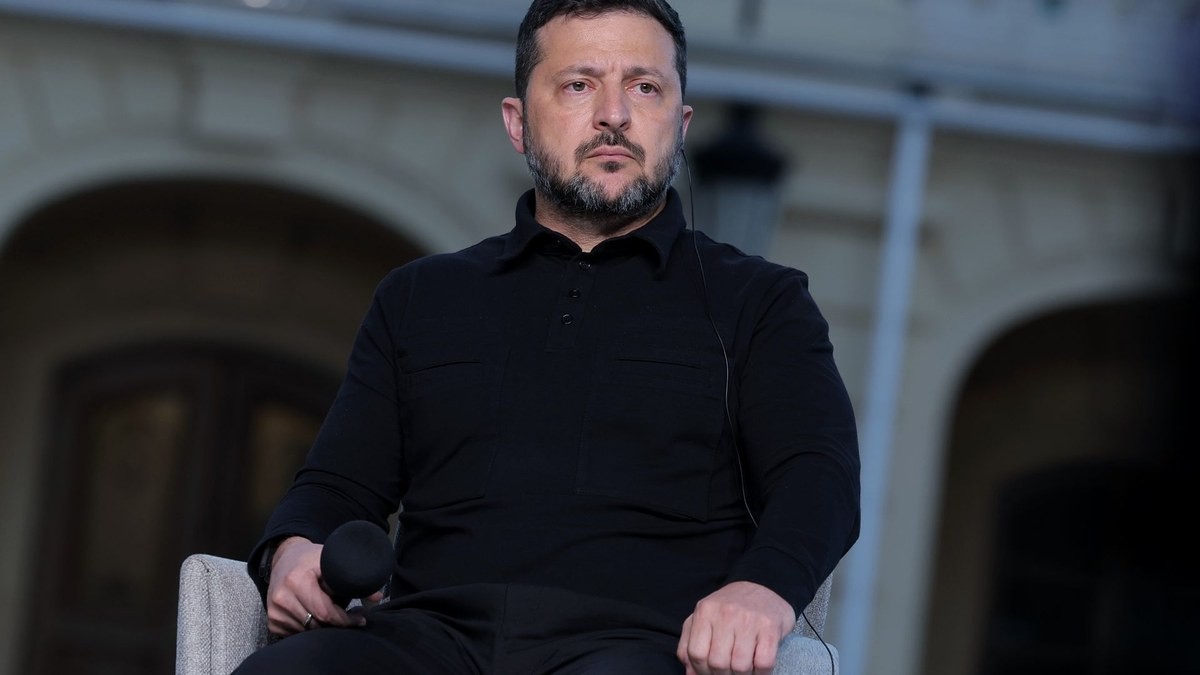 Davyd Arakhamia, leader of the ruling Servant of the People faction, announced the Verkhovna Rada would vote on September 15.
Ukrainian media reported, citing sources close to the president, that the move against Kryvonos was Kravchenko's own and had not been coordinated with the Presidential Office. One account of the office's reaction was headlined "He's gone mad." Ukrainska Pravda, citing sources, reported that MP Hetmantsev is being considered as his replacement.
On his resignation, Kravchenko said: "This deliberate political decision does not constitute an admission of any wrongdoing, result from any deal or mean that I am giving up the ongoing fight to defend my reputation and integrity." He said he would not let it be used to halt criminal proceedings, conceal or destroy evidence, or let "those whose actions it has been investigating" establish control over the prosecution service.
Where It Started: Operation Carthage
The raid that set all of this in motion began late on September 4. NABU and SAPO announced the exposure of a criminal organisation the following day.
The codename was Carthage — an apparent nod to the Roman refrain that "Carthage must be destroyed," applied here to corruption said to have taken root in the Prosecutor General's Office.
The main figure is Serhii Kropyva, deputy head of the office's International Legal Cooperation Department and, according to an anti-corruption prosecutor speaking in court, a confidant of Kravchenko. In NABU recordings he appears under the nickname "Chancellor."
Kropyva is suspected of protecting illegal call centres and laundering more than 89 million hryvnias, about $2 million, in assets. The High Anti-Corruption Court ordered him held in custody until November 2 with bail set at 120 million hryvnias, about $2.7 million. Prosecutors had asked for 200 million; his lawyers objected that the sum far exceeded his means, and said they would appeal. If bail is posted he must surrender his foreign passports and cut contact with Kravchenko and the prosecutor general's deputy, Mariia Vdovychenko.
Two others are in custody with him: Yelyzaveta Ivakhnenko, alias "Muza," described as Kropyva's partner, held on bail of 20 million hryvnias, about $450,000, and Serhii Kutsyi, Kropyva's driver, held until November 3 on 3 million hryvnias, about $68,000. NABU and SAPO said five participants in the criminal organisation had been exposed.
Investigators say the group took systematic monthly payments to let fraudulent call centres operate untouched, laundering the proceeds into real estate, luxury cars and jewellery. Ukrainska Pravda, citing law-enforcement sources, reported each call centre paid representatives of the Prosecutor General's Office about $7,000 a month; Kyiv Post put the "black cash" at tens if not hundreds of thousands of dollars monthly.
Illegal call centres employ roughly 60,000 people across Ukraine, the Guardian reported, citing the Swiss-based Global Initiative Against Transnational Crime. Their scams reach pensioners and people living alone, often with callers posing as bank security staff or debt collectors.
The "Boss" in the Recordings
NABU's recordings refer to a "boss" allegedly protecting the group — a figure addressed as Andriiovych whose prior job as head of the State Tax Service matches Kravchenko. An earlier Telegram post by the Prosecutor General's Office confirms that investigators read the term "boss" as referring to him.
According to those recordings, Kropyva arranged repair work at Kravchenko's house in Kozyn, an elite settlement south of Kyiv. Investigators found a newly built 300-square-metre residence there, about 3,229 square feet.
Kravchenko said he chose the house last winter and had been living in it since May. It does not appear in his latest asset declaration; he said he would declare it in his 2026 disclosure. He would have been required to declare the rental had the expense exceeded 166,400 hryvnias, about $3,748 — there is no information on whether it did.
Searches on September 4 also covered Kravchenko's own office, that of his senior deputy Vdovychenko, and premises linked to Oleh Kiper, the governor of Odesa Oblast. None of them has been charged. Vdovychenko resigned on September 8. The Prosecutor General's Office initially denied that Kravchenko's personal office had been searched, then admitted it the next day.
A Denial, a Polygraph Order and Seven Prosecutors
Kravchenko stayed out of public view until September 6, when he denied any role in the scheme. "I have absolutely no connection with the cover-up of illegal call centres," he said. "I did not issue any instructions to facilitate such activities, nor did I use the powers of the Prosecutor General for this purpose."
He said the employee implicated in the investigation had been suspended and a dismissal was being prepared. He cited 147 criminal cases under investigation, more than 183 people served with notices of suspicion, and indictments against 93 individuals already sent to court.
At a press conference on September 7, he said seven prosecutors would be referred to the Prosecutors' Qualification and Disciplinary Commission, which decides dismissals, and that the office had ordered mass polygraph testing of staff. "For civil servants there's a simpler dismissal procedure," he said. "Prosecutors can only be removed from their post by a decision of the Prosecutors' Qualification and Disciplinary Commission, so we're now preparing a submission to the commission. We're talking about seven prosecutors."
How a Loyalist Rose
Kravchenko was born in 1990 in Sievierodonetsk, in the Luhansk region now under Russian occupation. He took a law degree specialising in military law in 2012 and became a career prosecutor in 2014, rising to deputy military prosecutor of the Central Region and then to head of the Bucha District Prosecutor's Office. He was one of the prosecutors in the case against fugitive former president Viktor Yanukovych.
In April 2023 Zelensky appointed him head of the Kyiv Regional State Administration. On December 31, 2024, he took over the State Tax Service, a post that had been vacant for about three and a half years; he said budget revenues rose by 50 billion hryvnias during his tenure. On June 17, 2025, parliament approved him as Prosecutor General with 273 votes — at 35, the youngest person ever to hold the post. He replaced Andriy Kostin, who resigned in October 2024 after media revealed at least 50 prosecutors had allegedly obtained disability status fraudulently to boost their pensions.
July 2025 defined his tenure. Zelensky moved to place NABU and SAPO under the prosecutor general's control; parliament passed the bill and Zelensky signed it into law, with opposition lawmakers shouting "shame!" as the result was read. The following day Kyiv saw its largest anti-government protest since Russia's full-scale invasion in 2022, and independence was eventually restored amid the protests and Western pressure.
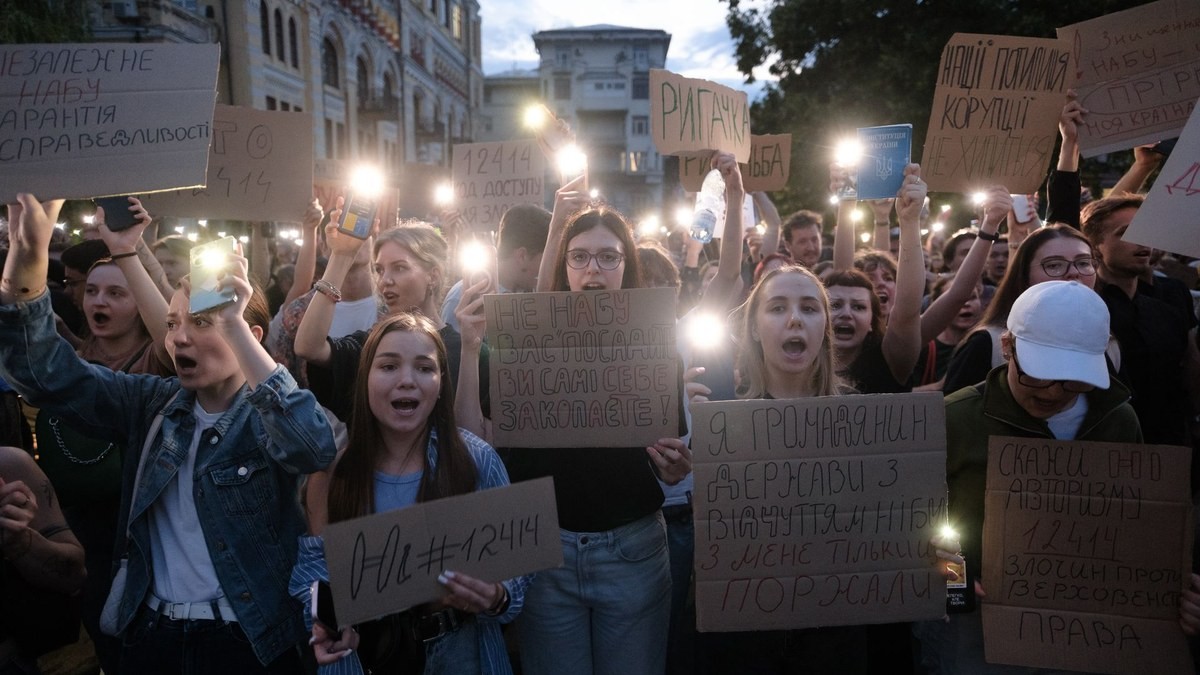
European Commissioner Marta Kos called the "dismantling of key safeguards protecting NABU's independence a serious step back," adding that "the rule of law remains central to Ukraine's EU bid." Commission spokesman Guillaume Mercier called the agencies "crucial" for fighting corruption and maintaining public trust. Then-MP Anastasia Radina warned the law would turn them into "purely decorative institutions ... completely dependent on the will of the prosecutor-general."
That same July, the Prosecutor General's Office, the Security Service of Ukraine and the State Investigation Bureau carried out at least 70 searches at NABU. Two NABU detectives were arrested and charged with high treason and aiding Russia. In November 2025, Zelensky's powerful chief of staff, Andriy Yermak, resigned after NABU searched his premises; the next month NABU charged five lawmakers from Arakhamia's party with taking cash in exchange for parliamentary votes. From late 2025, Ukrainska Pravda reported, Kravchenko began refusing certain orders from the President's Office and clashed with the deputy chief of staff overseeing law enforcement, Oleh Tatarov.
What NABU Says Back
The anti-corruption agencies did not wait to respond. They said Kryvonos had not officially been served with any notice of suspicion as of September 14, and that Kravchenko's statements "remain public rather than procedural at this stage."
They called his actions "a continuation of the systematic attack on the independence of anti-corruption agencies," and denied his claim that NABU had seized case materials referenced in his statement. Kryvonos told the outlet NV he had not been formally served.
The procedural dispute is the point. A suspicion signed and announced is not the same as one formally served, and the two agencies are drawing that line in public.
A Vote on Tuesday and a Fight Over the Next Prosecutor
The Verkhovna Rada votes on the dismissal on September 15. RBC-Ukraine reported that Zelensky still had no candidate to replace Kravchenko and that the resignation had "caused confusion among members of parliament."
Lawmakers were said to fear that the next head of the Prosecutor General's Office could sign off "without even looking" on notices of suspicion against them submitted by SAPO.
Anti-corruption activists argue the only answer is a transparent contest, with international experts taking part, to choose the next prosecutor. One said: "The problem with the Prosecutor General's Office lies with the prosecutor general, who essentially trades his political loyalty to the president for control over the law enforcement system and the financial benefits he derives from it. There is no other solution but to hold a transparent competition for the post."
The stakes run straight into Ukraine's EU accession path. NABU and SAPO were created in 2015 under Western guidance as a condition of that path and of international lending; the United States, Britain and the European Union supplied technical and equipment support.
The Case That Outlived Its Target
Political analyst Ihor Reiterovich told the Kyiv Independent that Kravchenko's handling of the raid's fallout was "a complete failure — very amateurish and deeply unprofessional. His explanations only raised more questions."
A former senior official of the Prosecutor General's Office put it more simply: "There's no way something like this could be going on behind the prosecutor general's back. No prosecutor general would allow it. He would either put a stop to it — or take charge of (the scheme) himself."
Analyst Volodymyr Fesenko said Zelensky's trust in Kravchenko had been gone for a year, and that the balance of power has shifted. "NABU does not see itself as weak," he said. "Zelensky, on the other hand, is significantly weakened. (The authorities) are on the defensive now; they are not in a position to attack."
One commentator, Shevchuk, said the case had exposed "the lack of proper vetting and selection of prosecutors, the absence of prosecutorial independence in handling cases, continued top-down micromanagement, and the lack of effective internal oversight — all things the reform was supposed to ensure."
Reuters called the affair "the latest sign of disunity in the senior ranks of the Ukrainian ruling elite." What the vote in the Rada on Tuesday settles is who holds the office. It does not settle who holds the evidence.
By Jessica Ali, Staff Writer
This article was produced with AI-assisted research and editorial support. Sources: Ukrainska Pravda, Kyiv Independent, Kyiv Post, Reuters, BBC, Radio Free Europe/Radio Liberty, NV, Liga.net, EWN, Daily Investor, Quartz, the Guardian, ANTAC and the Office of the Prosecutor General of Ukraine.
What's Your Reaction?
 Like
0
Like
0
 Dislike
0
Dislike
0
 Love
0
Love
0
 Funny
0
Funny
0
 Wow
0
Wow
0
 Sad
0
Sad
0
 Angry
0
Angry
0

Editor-in-Chief at Global1.News. Atlanta-based journalist who cuts through the BS and tells it like it is. Lead anchor, host, and the voice you hear when the spin stops and the truth starts.










Comments (0)