
Ukraine's Drone War Reaches Deep Into Russia: Krasnodar Strike Kills 3 as Kyiv Hits Refineries
Ukrainian drones struck port terminals in Russia's Krasnodar region, killing three, as Kyiv hit oil refineries and logistics hubs deep inside Russia. The strikes came after Russian drones killed 15 at a mall in Zelenskyy's hometown of Kryvyi Rih - a dangerous new cycle of escalation.
Folks, let’s cut straight to it. This week, the war in Ukraine stopped being a distant, grainy drone video on your feed and became a brutal, visceral reality check. On Friday, Russian drones slammed into a crowded shopping mall in Kryvyi Rih—President Volodymyr Zelenskyy’s own hometown—killing at least 15 people, a number that climbed to 16 as rescuers pulled bodies from the rubble. More than 130 men, women, and children were wounded. This wasn’t a military target. This was a Friday afternoon errand run turned into a charnel house. And while the world’s attention flickered, Moscow didn’t stop. By Saturday, Russian drones and missiles had killed at least seven more people across Ukraine, according to the Associated Press. But here’s the part the talking heads won’t tell you: Ukraine is not just taking these punches. They’re swinging back—hard. On the same day, Ukrainian drones hit port facilities in Russia’s Krasnodar region, killing three people and setting fuel terminals ablaze. And overnight, Kyiv’s forces struck a major oil refinery deep inside Russian territory, torching a logistics hub that feeds Moscow’s war machine. This is no longer a one-sided siege. This is a reciprocal escalation, folks, and it’s rewriting the rules of this conflict in real time. Let’s break it down, piece by piece, because you deserve the facts without the spin.
The Krasnodar Port Strike: Russia Feels the Fire at Home
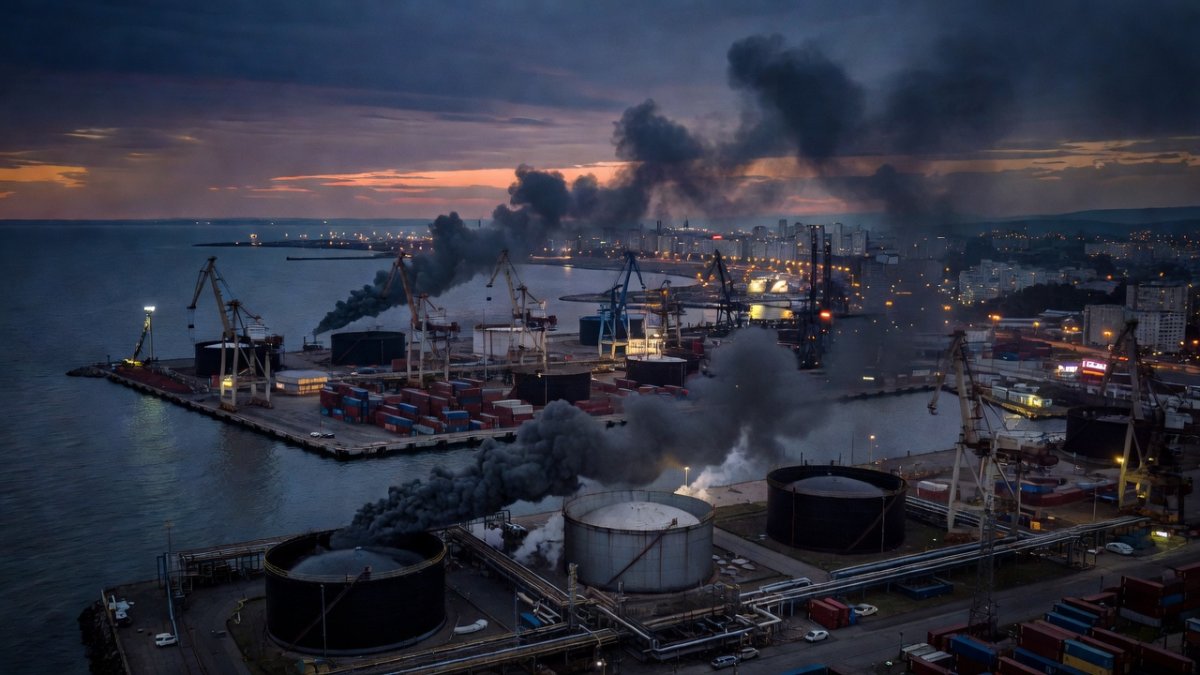
Let’s start with the strike that Moscow would rather you forget. On Saturday, Ukrainian drones hit port terminals in the village of Volna, in Russia’s Krasnodar region. Krasnodar Governor Veniamin Kondratyev confirmed the attack on Telegram, stating that the strike targeted port infrastructure in the Temryuk district and sparked a fire at the port. The human cost? Three people dead. Three lives ended not on a battlefield in Donetsk, but on Russian soil, in a facility that helps move the fuel that powers Putin’s invasion. The New York Post, citing the AP, framed it bluntly: “10 killed in Russian and Ukrainian attacks a day after fatal shopping mall drone strike.” That’s seven dead in Ukraine and three in Russia—a grim symmetry that underscores how the front lines have blurred. For months, the Kremlin sold its people a sanitized war fought by “volunteers” in a distant land. Now, the explosions are in their backyard. And the fires in Krasnodar didn’t stop on Saturday. Overnight into Sunday, reports of explosions and fires continued to emerge from the region, according to Ukrainian Air Force statements. This isn’t a one-off raid, folks. This is a campaign.
Kryvyi Rih: The Mall Attack and the Human Toll
Now, let’s talk about the horror that started this spiral. On Friday, Russian drones struck a shopping mall in Kryvyi Rih, a city that holds symbolic weight as Zelenskyy’s birthplace. The president didn’t mince words, calling the attack “cynical and despicable.” And he’s right. This was a deliberate strike on a civilian gathering place, not a military depot. The death toll stood at 15 on Friday, then rose to 16 as emergency crews sifted through the debris. Over 130 people were wounded—many of them likely shoppers, teenagers, families grabbing a meal or buying school supplies. The AP and Al Jazeera both confirmed the scale of the carnage. This is the kind of attack that should galvanize the free world, yet we’re seeing the usual diplomatic hand-wringing. But here’s the thing, folks: Zelenskyy’s “cynical and despicable” isn’t just rhetoric. It’s a factual description of a military doctrine that treats civilian infrastructure as legitimate targets. And it’s a direct provocation—one that Ukraine answered not with tears, but with steel.
Russia’s Overnight Barrage: 271 Drones and Counting
If you think the mall strike was a one-off, think again. The Institute for the Study of War (ISW) reported that Russian forces launched a staggering arsenal overnight on August 21-22: ballistic and quasi-ballistic missiles, three cruise missiles, and a jaw-dropping 271 drones against Ukraine. Then, overnight into Sunday, Ukraine’s Air Force reported that Russia launched another 127 strike drones. Let me put that number in perspective for you, folks. That’s nearly 400 drones in a 48-hour window. These aren’t precision weapons—they’re cheap, mass-produced munitions designed to overwhelm air defenses, exhaust Ukrainian resources, and terrorize civilians. The Kyiv Independent and CBS News have both documented this pattern: Moscow is throwing everything it has at the grid, at the cities, at the psyche of the Ukrainian people. And while the world focuses on the death toll—which is tragic and real—we have to acknowledge the strategic intent. Russia is trying to break Ukraine’s will by making daily life unbearable. But here’s the counterpoint: every drone that gets shot down, every missile that’s intercepted, is a testament to Ukrainian resilience. And more importantly, Ukraine is no longer just defending. They’re retaliating.
Ukraine Strikes Back: Oil Refineries, Warehouses, and Air Defenses
This is where the story gets interesting, folks. Ukraine’s General Staff confirmed striking the Novokuybyshevsk Oil Refinery in Russia’s Samara region overnight on Saturday, after reports of a massive fire at the facility. This isn’t a symbolic pinprick—this is a refinery that processes crude oil into jet fuel, diesel, and gasoline for the Russian military. And it’s not alone. The Kyiv Independent reported that a Ukrainian attack also set ablaze a major logistics center—an Ozon warehouse in Chapayevsk, Samara region. That’s not just a warehouse; it’s a distribution hub for one of Russia’s largest e-commerce giants, a rival to Wildberries. Hitting it sends a message: no part of the Russian economy is off-limits if it supports the war effort. But the most jaw-dropping claims come from Commander Robert “Magyar” Brovdi, head of Ukraine’s Unmanned Systems Forces. According to the Kyiv Independent, Brovdi stated that Ukrainian drones struck two Russian fighter jets, a large missile-carrying drone, high-value radars, and other air defense assets in Krasnodar Krai. Two fighter jets, folks. On the ground. Destroyed. That’s not a nuisance raid—that’s a surgical decapitation of Russian air power in the region. Ukraine is systematically dismantling the very systems that launch those 271-drone barrages.
The Fuel-Shortage Strategy: Choking Russia’s War Machine
Let’s zoom out for a second, because this isn’t random chaos—it’s strategy. Ukraine has increasingly targeted Russian oil infrastructure as part of a deliberate campaign to disrupt Moscow’s fuel supply. The Kyiv Independent has reported that strikes on refineries have forced some facilities to reduce or halt production entirely, contributing directly to Russia’s fuel shortages. Think about that, folks. Russia is the world’s second-largest oil exporter, yet its domestic market is facing shortages because Ukrainian drones keep setting its refineries on fire. That’s not just an inconvenience—it’s a strategic hemorrhage. If Russian tanks, jets, and supply trucks can’t get fuel, they can’t fight. If Russian civilians can’t get gasoline, the social contract starts to fray. This is economic warfare at its most precise, and it’s working. The Novokuybyshevsk refinery strike is a prime example: it’s located deep in Samara, hundreds of miles from the front lines, yet Ukraine reached it. The message to Moscow is clear: your rear is no longer safe. Every barrel of oil you use to fund this war is a target. Every logistics hub that moves supplies to the front is a target. Ukraine is fighting a total war, and they’re using Russia’s own infrastructure as the battlefield.
The Escalation Cycle: What Comes Next?
So, where does this leave us, folks? We’re in a dangerous escalation cycle, and both sides are feeding it. Russia responds to Ukrainian deep strikes with massive drone barrages on cities. Ukraine responds to those barrages with more strikes on Russian oil and logistics. The ISW’s assessment of 271 drones in a single night shows that Moscow has no intention of de-escalating—they’re doubling down on terror tactics. But here’s the analytical reality: this cycle favors Ukraine in the long run. Russia’s economy is already strained by sanctions, and now it’s bleeding fuel and hardware at home. Ukraine, meanwhile, is proving it can project power deep into Russian territory, which is a psychological blow that Moscow cannot hide from its own population. The question is whether the West will step up support or continue to dither. We’ve seen the hand-wringing over long-range missiles, the delays in aid packages, the fear of “escalation.” But folks, the escalation is already here. It’s happening in Kryvyi Rih, in Krasnodar, in Samara. The only way to stop the cycle is to give Ukraine the tools to end it decisively—air defense systems to protect civilians, and long-range strike capabilities to keep dismantling Russia’s war economy. Every day we hesitate, more shopping malls become targets, and more refineries burn.
The Bigger Picture: Why This Matters to You
Now, let’s bring this home, because I know you’re sitting there thinking, “Jessica, why should I care about a warehouse in Samara or a mall in Kryvyi Rih?” Here’s why, folks: this war is a test of whether the rules-based international order means anything. When Russia strikes a shopping mall, they’re not just killing Ukrainians—they’re attacking the very concept of civilian safety. And when Ukraine strikes back at Russian oil infrastructure, they’re showing that aggression has consequences. This matters to you because the price of gas, the stability of global markets, and the credibility of alliances all hinge on this conflict. If Russia wins, every autocrat with a grudge gets a green light. If Ukraine wins, we prove that democracy and sovereignty aren’t just words on a charter. The numbers this week—16 dead in a mall, 130 wounded, 271 drones, 3 dead in a Russian port—are not abstract statistics. They’re the price of freedom, paid by ordinary people who just wanted to shop, to work, to live. And they’re paying it so that we don’t have to.
So, what can you do, folks? First, stay informed. Don’t let the 24-hour news cycle bury this story. Share the facts, push back on propaganda, and demand that your leaders take a clear stance. Second, support humanitarian efforts for Ukrainian civilians—organizations like the Red Cross and local relief funds are on the ground, and they need resources. Third, if you’re in a position to influence policy, call your representatives. Ask them why we’re still debating aid packages while Russia launches 271 drones in a single night. Ask them what the endgame is if we let Ukraine fight with one hand tied behind its back. And finally, remember the human cost. The 16 people in that mall weren’t soldiers. They were someone’s mother, someone’s child, someone’s friend. Their lives mattered, and their deaths demand more than performative outrage. We have a choice, folks: we can watch from the sidelines, or we can be part of the force that stops this madness. The drones are flying, the refineries are burning, and the world is watching. Let’s make sure we’re on the right side of history.
By Jessica Ali, Staff Writer
This article was produced with AI-assisted research and editorial support. Sources: AP, Al Jazeera, Kyiv Independent, Institute for the Study of War, CBS News.
What's Your Reaction?
 Like
0
Like
0
 Dislike
0
Dislike
0
 Love
0
Love
0
 Funny
0
Funny
0
 Wow
0
Wow
0
 Sad
0
Sad
0
 Angry
0
Angry
0

Editor-in-Chief at Global1.News. Atlanta-based journalist who cuts through the BS and tells it like it is. Lead anchor, host, and the voice you hear when the spin stops and the truth starts.















Comments (0)