
Trump Suddenly Wants a Summit With Kim Jong Un. Why Now?
The image appeared on Truth Social on the morning of August 16: a grainy, unsmiling photograph of President Donald Trump and North Korean leader Kim Jong Un, taken during their impromptu meeting at the Demilitarized Zone in 2019.
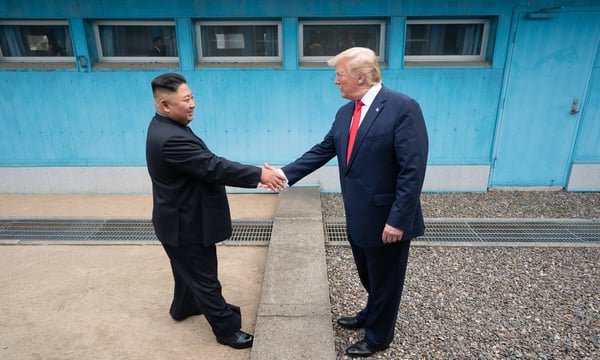
The image appeared on Truth Social on the morning of August 16: a grainy, unsmiling photograph of President Donald Trump and North Korean leader Kim Jong Un, taken during their impromptu meeting at the Demilitarized Zone in 2019. For a president who prizes visual spectacle, the choice of a dour, frozen frame was curious. Hours later, the message became clearer. Trump ordered the Pentagon to scale back joint military exercises with South Korea, citing his "very good relationship" with Kim as a primary reason. Two days after that, the Wall Street Journal reported that Trump was actively pushing aides to arrange a face-to-face meeting with Kim as early as November, on the sidelines of the Asia-Pacific Economic Cooperation (APEC) summit in Shenzhen, China.
The flurry of activity marks a dramatic reversal for a relationship that went cold after the failed Hanoi summit in February 2019 and remained frozen through the first eighteen months of Trump’s second term. To understand the sudden pivot, one must look beyond the Korean Peninsula and toward the White House’s mounting domestic and foreign policy crises. The most direct answer to "why now" is not geopolitics; it is political survival.
The Iran War and the Midterm Calculus
The war Trump launched against Iran remains unresolved and deeply unpopular, with no clear victory on the horizon. The conflict has dragged on longer than anticipated, consuming administration bandwidth and public attention. A summit with Kim Jong Un would serve as a dramatic distraction, allowing Trump to reclaim the mantle of global statesman and pivot the news cycle away from the stalemate in the Middle East. The timing is particularly telling. A summit on the sidelines of the Shenzhen APEC gathering would land roughly two weeks after the November 3 midterm elections. This sequencing allows Trump to announce a foreign policy win in the making without voters having the chance to judge the results at the ballot box. It is a classic political maneuver: dangle the prospect of a historic breakthrough, let the headlines roll, and defer the actual substance until after the electoral dust settles. However, this calculus assumes that Kim Jong Un is willing to play the role of political savior. There is little evidence to suggest he is inclined to rescue Trump from sliding approval numbers tied to the Iran war. Pyongyang has watched Washington’s entanglement in the Middle East with a mixture of relief and opportunism, and it has little incentive to provide a distraction that would benefit a president who has offered nothing new in return.The Seoul Problem: A $350 Billion Frustration
Beyond the Iran quagmire, Trump’s summit push is also a pointed message to Seoul. South Korea pledged $350 billion in investment as part of a tariff deal reached last year, and the rollout has lagged badly. Trump is reportedly frustrated with the slow pace; South Korea has been described as the slowest negotiating partner the administration has dealt with. Commercial disputes involving American companies and what Trump views as insufficient South Korean support for U.S. priorities have added to the irritation. The exercise drawdown was framed by Trump as both a favor to Kim and a jab at Seoul over its refusal to help with the Iran war. He called the joint exercises "costly" and said they "send a signal that is totally inappropriate and hostile" toward North Korea, which he described as "unthreatening and respectful" during his time in office. The language was deliberately provocative, designed to humiliate an ally that has failed to deliver on its financial commitments. The summit push sends an even clearer message: Trump can bypass Seoul entirely and deal with North Korea directly. This is a strategic nightmare for South Korean President Lee Jae-myung, who has staked his presidency on the role of "peacemaker." Lee has shown a positive attitude toward the potential summit, saying he will remain fully dedicated to facilitating Trump’s peacemaking endeavors. But the reality is that Washington’s unilateral moves have left Seoul scrambling. South Korea’s Foreign Affairs and Defense Ministries said on August 19 that Washington had not explained or given advance notice regarding Trump’s decision to scale down the exercises. The Ulchi Freedom Shield exercises, which were supposed to last until August 27, ended on August 21, according to local media reports.Pyongyang’s Cool Response and the Nuclear Precondition
The answer from Pyongyang came a day later and was far cooler than Trump’s overture. Kim Yo Jong, the powerful sister of Kim Jong Un, said the reduced drills changed nothing and called their provocative character unaltered by a shorter schedule. She also denied that any direct communication between the two leaders had taken place. "As for the news from Washington that shortly ago, there was a communication between the leaders of the DPRK and the U.S., I am not aware of it at all," she said in a statement published by KCNA on August 19. The following day, North Korea fired about 10 short-range ballistic missiles toward the ocean off its east coast, according to the South’s Joint Chiefs of Staff. The missiles flew around 300 kilometers and were launched from the Pyongyang area around 5 p.m. KST. The South Korean National Security Council convened an emergency meeting and condemned the launches. These signals are not a full rejection of dialogue. Rather, North Korea is attempting to raise the price of reengagement. Unlike the 2018-19 summits, Pyongyang has a new precondition: its nuclear weapons are not up for negotiation. In 2023, North Korea amended its constitution to make its nuclear arsenal a permanent basic law of the state, closing off denuclearization as a negotiating outcome. Kim said last September that he saw no reason to avoid dialogue with Washington if it dropped its denuclearization demand, but that he would never trade away the arsenal to escape sanctions.The Master-Servant Dynamic and Alliance Strain
Kim Yo Jong’s statements have been particularly cutting toward Seoul. In a separate statement on August 20, she mocked South Korea’s "poor plight": "The ROK cannot let out a single word of protest at the GIs leaving without any mutual coordination at the U.S. chief executive's unilateral order... This is the inevitable fate of the puppet army." She compared the South Korea-U.S. alliance to "the relation between master and servant." The rhetoric is designed to exploit the growing rift between Washington and Seoul. North Korea would likely prefer engaging Washington and Tokyo while bypassing Seoul entirely—a strategy that would divide the allies and isolate South Korea much as Seoul once isolated Pyongyang by establishing ties with Moscow and Beijing at the end of the Cold War. The historical parallel is not lost on South Korean strategists, who fear a return to the "skipping over" dynamic that characterized U.S.-North Korea engagement in the 1990s. Despite the missile launches and the dismissive tone, Kim Yo Jong confirmed again that the relationship between Trump and Kim Jong Un is "still excellent." This mixed messaging is deliberate. Pyongyang wants to keep the door open for a summit while signaling that it will not come cheap. Kim stands to gain plenty from a meeting: a peace declaration would let him claim legitimacy as a responsible nuclear state, a status he has sought since the constitutional amendment.Trump’s Response and the Numbers Game
Trump, for his part, has doubled down. On August 18, he told reporters at the Oval Office that Kim had in fact responded to his request for a conversation. "Kim Jong Un has always treated me with great respect," Trump said, adding, "I understand him. He understands me." Following Kim Yo Jong’s denial of any direct communication, Trump insisted that North Korea possesses "57 very powerful nuclear weapons" and emphasized that he gets along with Kim Jong Un well, and that he expects to meet with the North Korean leader later this year. The numbers are a point of contention. South Korean Defense Minister Ahn Gyu-back told lawmakers at the National Assembly on August 21 that North Korea may have around 80 to 120 nuclear weapons, and that he could not share Seoul’s exact estimate. The discrepancy between Trump’s figure and Seoul’s estimate highlights the intelligence-sharing gaps that have emerged between the allies.China’s Calculated Silence
Chinese Foreign Minister Wang Yi visited Seoul amid the furor. In an August 19 meeting with South Korean Foreign Minister Cho Hyun, Wang said China will play a constructive role for peace on the Korean Peninsula, but declined to comment on China’s role in a potential summit, saying it is a matter for the U.S. and North Korea. Beijing’s calculated silence is telling. China benefits from a divided U.S.-South Korea alliance and has little interest in facilitating a summit that could stabilize the region without Chinese involvement. At the same time, Beijing does not want to be seen as an obstacle to peace, so it maintains a posture of constructive ambiguity.Strategic Implications and the Road Ahead
The summit push represents a fundamental shift in Trump’s approach to the Korean Peninsula. By sidelining Seoul and accepting Pyongyang’s nuclear precondition, the administration is effectively abandoning decades of U.S. policy that tied engagement to denuclearization. The constitutional amendment of 2023 has closed off that outcome, and Trump appears willing to deal with North Korea as a nuclear state in exchange for a photo opportunity and a political win. For South Korea, the implications are profound. The alliance, already strained over money and the Iran war, is facing its most serious test in decades. President Lee’s "peacemaker" posture may prove untenable if Washington continues to act unilaterally. The South Korean public, which has grown accustomed to being treated as an equal partner, may not tolerate being cast as the "puppet army" in Kim Yo Jong’s narrative. The road to Shenzhen is fraught with obstacles. Pyongyang has not confirmed any summit, and the missile launches suggest that Kim Jong Un is in no hurry to accommodate Trump’s timeline. The North Korean leader has little incentive to help a weakened president, and he may calculate that waiting until after the midterms—or even until a new administration—would yield better terms. What is clear is that the status quo is unsustainable. The U.S.-South Korea alliance is being tested in ways not seen since the 1970s, and North Korea is exploiting the rift with characteristic skill. Whether a summit materializes in November or not, the dynamics of the Korean Peninsula have already shifted. The question now is whether Seoul can adapt to a new reality in which its closest ally is willing to bypass it entirely for the sake of a headline. This article was produced with AI-assisted research and editorial support. Sources: The Diplomat, Reuters, KCNA. By Prof. David Park, Staff WriterWhat's Your Reaction?
 Like
0
Like
0
 Dislike
0
Dislike
0
 Love
0
Love
0
 Funny
0
Funny
0
 Wow
0
Wow
0
 Sad
0
Sad
0
 Angry
0
Angry
0

Prof. David Park
East Asia/Technology Correspondent at Global1.News. Seoul-based voice covering Korean politics, technology, business, and culture. Analyzes how technology and geopolitics intersect across East Asia.














Comments (0)