
Trump and Xi exchange warm words at state dinner but little progress on key issues
While both leaders exchanged warm remarks and emphasized a shared desire for “responsible major countries” to cooperate, the underlying tensions over Taiwan, trade, technology and artificial intelligence (AI) remained conspicuously unaddressed.
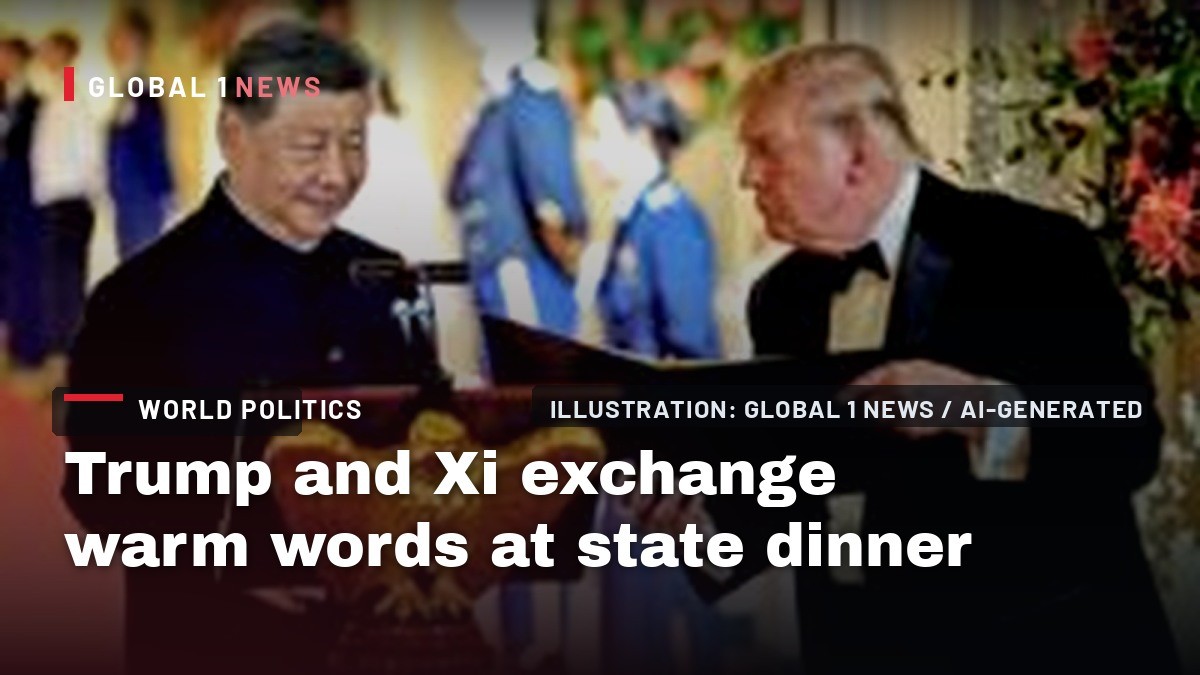
US President Donald Trump and Chinese President Xi Jinping met for a state dinner at the White House on Thursday, an encounter marked by diplomatic courtesy and a parade of high‑profile business leaders, but offering little substantive movement on the core issues that dominate US‑China relations. While both leaders exchanged warm remarks and emphasized a shared desire for “responsible major countries” to cooperate, the underlying tensions over Taiwan, trade, technology and artificial intelligence (AI) remained conspicuously unaddressed.
Symbolic gestures and the tone of the encounter
From the outset, the evening was staged as a celebration of bilateral goodwill. Trump greeted Xi with a red‑carpet welcome and presented him with a sculpture of a bald eagle, a symbol he described as embodying “the free and soaring spirit of America.” The First Lady, Melania Trump, contributed to the symbolism by helping design the sculpture and by selecting a menu that combined American ingredients with subtle Chinese influences. The choice of red tablecloths and a wine from the same vineyard used in President Nixon’s 1972 “Toast to Peace” with Premier Zhou Enlai reinforced the historical resonance of the event.
In his remarks, Trump highlighted the differences between the two nations’ systems but insisted that “we have never gotten along better.” Xi, for his part, framed the meeting as a “historic juncture” and suggested that the ambitions of both countries could be “mutually reinforcing.” Both leaders invoked the notion of acting as “responsible major countries,” a phrase that appears to be a diplomatic shorthand for managing competition without escalation.
AI and the rhetoric of control
Artificial intelligence featured prominently in Xi’s speech, where he urged that AI remain “under human control” and that major powers act responsibly in its development. Trump, who has repeatedly positioned China as the United States’ chief rival in the AI race, echoed a similar concern for maintaining a competitive edge. However, beyond these broad statements, the source material provides no concrete details on any agreements or joint initiatives. The absence of specific commitments suggests that the AI discussion, while rhetorically significant, did not translate into measurable progress during the talks.
The presence of leading AI and tech executives—Tim Cook of Apple, Jensen Huang of Nvidia, Sam Altman of OpenAI, Sundar Pichai of Google, and Jeff Bezos of Amazon—underscored the importance both governments place on the sector. Yet the notable absence of Anthropic, one of the world’s largest AI firms, hints at possible gaps in the outreach or selective invitations, though the source does not clarify the reason.
Taiwan: The unresolved flashpoint
Taiwan remained the most palpable source of friction. Earlier in the day, Xi urged Trump to adopt the “correct position” on the self‑governing island, a request that aligns with Beijing’s longstanding claim over Taiwan. The source notes that a $14 billion arms package for Taiwan, delayed by Trump, was framed by the President as a “very good negotiating chip” for Beijing. This delay followed a May warning from Xi that mishandling the Taiwan issue could lead to “collision or even conflict.”
While Chinese state media reported that Xi privately advised Washington to handle Taiwan “with prudence,” the United States has not publicly responded to those remarks. The continuation of the arms package delay, coupled with the diplomatic language used at the dinner, indicates that the Taiwan question remains a strategic lever rather than a settled matter.
Trade and economic expectations
Trade expectations were a recurring undercurrent. Trump arrived in Washington with the anticipation of securing deals that would lower Chinese tariffs on American goods, increase imports of Chinese rare earth minerals, and boost exports of US agricultural products. The source material, however, does not record any concrete outcomes on these fronts. The emphasis on “different systems” but “never gotten along better” may be an attempt to soften the competitive narrative without committing to specific trade concessions.
Furthermore, the presence of senior executives from General Motors, Visa, Paramount Skydance, ExxonMobil and other major corporations suggests that the US business community is eager to capitalize on any potential opening. Yet the lack of reported agreements at the dinner implies that any substantive trade negotiations are likely to continue behind closed doors, separate from the ceremonial aspects of the visit.
The tech elite’s role in diplomatic theatre
The guest list read like a roll call of America’s tech elite. In addition to the CEOs mentioned earlier, the dinner hosted a range of influential figures from the banking and entertainment sectors. Trump’s comment that “everybody wanted to be there” reflects the perception that access to high‑level diplomatic events is a valuable networking opportunity for industry leaders. The convergence of tech and political power at the White House underscores how intertwined economic interests are with foreign policy in the contemporary US‑China relationship.
While the presence of these executives adds a layer of prestige to the event, it also raises questions about the extent to which corporate interests may influence or be leveraged in diplomatic negotiations. The source material does not detail any policy announcements or commitments emerging from these interactions, leaving the impact of the tech community’s participation largely symbolic.
Public dissent and the optics of protest
Outside the White House gates, protesters shouted as the delegation arrived, and several were arrested. Their presence highlighted domestic opposition to the rapprochement, reflecting a segment of American public opinion that remains skeptical of any perceived softening toward Beijing. The source does not elaborate on the protesters’ specific demands, but their visibility serves as a reminder that diplomatic overtures are contested within both societies.
The contrast between the lavish, controlled environment of the state dinner and the unrest just beyond its doors illustrates the delicate balancing act the Trump administration faces: projecting a narrative of cooperation while managing domestic political pressures that demand a tougher stance on China.
Looking ahead: The limited substance of a symbolic summit
Following the dinner, the itinerary includes a tea ceremony in the White House’s Red Room and a tour of the National Archives, where Xi and his wife will view foundational American documents. These cultural and historical gestures reinforce the ceremonial nature of the visit. However, the source material makes clear that substantive progress on the most contentious issues—Taiwan, AI governance, trade imbalances, and technology transfer—remains elusive.
In sum, the state dinner served as a high‑profile showcase of diplomatic courtesy and elite networking, yet it delivered little in the way of concrete policy shifts. As both nations continue to vie for influence in the AI race and as Taiwan remains a flashpoint, the next steps will likely unfold in less public, more technical negotiations. The world will be watching whether the warm words exchanged over sesame‑crusted sea bass translate into measurable actions, or whether the evening will be remembered as a well‑staged display of soft power without substantive outcomes.
This article was produced with AI-assisted research and editorial support. Reporting is based on the source material cited below. Sources: BBC News Asia; bbc.co.uk; Global1.News (25 September 2026).
By Kenji Tanaka, Staff Writer
What's Your Reaction?
 Like
0
Like
0
 Dislike
0
Dislike
0
 Love
0
Love
0
 Funny
0
Funny
0
 Wow
0
Wow
0
 Sad
0
Sad
0
 Angry
0
Angry
0
Japan Correspondent at Global1.News. Tokyo-based voice covering Japanese politics, technology, economy, and culture. Tracks the intersection of tradition and innovation in one of the world's most dynamic societies.












Comments (0)