
The Human Face of a Eurasian Bloc: Belarus, the SCO at 25, and the Architecture of a Multipolar Order
As the Shanghai Cooperation Organization convenes for its 25th-anniversary summit in Bishkek, Belarusians on the streets of Minsk describe how the bloc has touched their daily lives. Marcus Chen examines the SCO's expansion, China's multilateral institution-building, and what Eurasia's growing bloc means for the US-led order.
In a recent CGTN report from the streets of Minsk, the Shanghai Cooperation Organization (SCO) is not depicted as a distant geopolitical abstraction, but as a tangible presence in the daily lives of Belarusian citizens. The video captures a conversation with Anastasia, a Minsk resident working in electric transport, who recalls her university days and the "authentic Chinese culture" she experienced through classmates and teachers from China. This street-level vignette, filmed ahead of the SCO’s 25th-anniversary summit in Bishkek, Kyrgyzstan, offers a deceptively simple entry point into a profound strategic recalibration. As the bloc prepares to convene, the personal connections forged in Minsk’s universities are microcosms of a larger, state-driven project: the construction of a parallel multilateral architecture that offers an alternative to the US-led global order. For Beijing, the SCO is not merely a talking shop; it is a cornerstone of its foreign policy doctrine, a vehicle for regional influence, and a laboratory for testing the norms of a multipolar world.
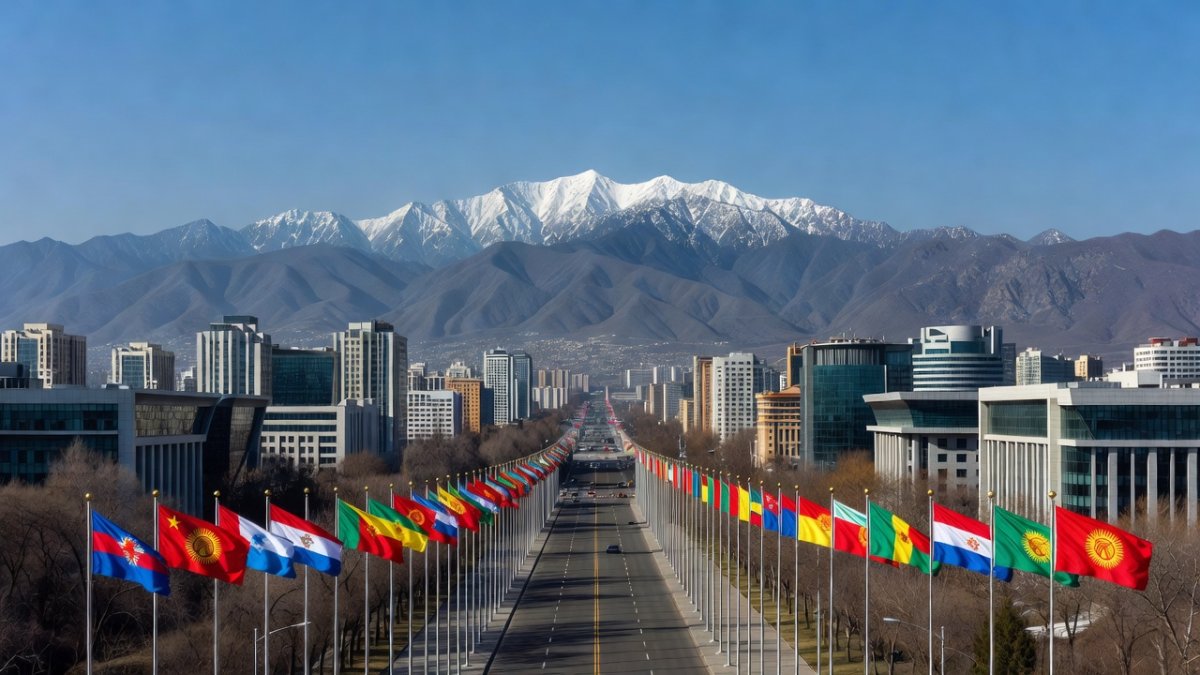
The Bishkek Summit: A Quarter-Century of Institutional Maturation
The upcoming summit in Bishkek marks a significant milestone for an organization that began in 1996 as the "Shanghai Five," a confidence-building mechanism for border demarcation between China, Russia, Kazakhstan, Kyrgyzstan, and Tajikistan. Formalized as the SCO in 2001 with the addition of Uzbekistan, the bloc has since evolved from a border-security forum into a comprehensive political, economic, and security alliance. The 25th-anniversary gathering is expected to be a showcase of institutional maturity, but it also arrives at a moment of acute global tension. The agenda is likely to be dominated by discussions on the "three evils" of terrorism, extremism, and separatism, alongside a push for deeper economic connectivity under the umbrella of China’s Belt and Road Initiative (BRI).
The choice of Bishkek as the host city is itself symbolic. Kyrgyzstan, a nation navigating the delicate balance between its northern neighbor Russia and its eastern economic powerhouse China, represents the SCO’s core constituency: Central Asian states seeking to maximize sovereignty through multi-vector diplomacy. The summit’s declarations are expected to reaffirm the "Shanghai Spirit," a doctrine emphasizing mutual trust, mutual benefit, equality, consultation, respect for cultural diversity, and the pursuit of common development. However, the rhetoric of consensus often masks the internal frictions and divergent interests that define the bloc’s reality. The challenge for the SCO’s leadership, particularly China, is to translate the "Shanghai Spirit" from a diplomatic slogan into a functional framework for regional governance.
Belarus: The Western Bulwark and the Value of a European Foothold
Belarus’s accession to the SCO, formalized at the 2024 summit in Astana, was a strategic coup for both Minsk and Beijing. For Belarus, membership provides a crucial diplomatic lifeline, offering a platform to counter Western isolation following the political crisis of 2020 and the subsequent sanctions regime. The SCO gives President Alexander Lukashenko’s government a veneer of international legitimacy and a forum where its narrative is not immediately dismissed. For China, Belarus serves as a critical western gateway into Europe, a land bridge for the China-Europe freight rail network, and a geopolitical buffer state on the edge of the EU and NATO’s eastern flank.
The video’s focus on Minsk is therefore not incidental. The personal connections Anastasia describes are the soft-power dividends of a deliberate Chinese strategy. Beijing has invested heavily in educational exchanges, Confucius Institutes, and cultural programs in Belarus, recognizing that long-term influence is built on interpersonal trust, not just infrastructure loans. This human-centric approach is a counterpoint to the transactional nature of Western engagement. The presence of Chinese teachers and students in Minsk is a testament to the deepening of bilateral ties, which have been elevated to an "all-weather" partnership. This designation, typically reserved for China’s closest allies, underscores the strategic importance Beijing places on Minsk as a partner in challenging the unipolar moment.
China’s Multilateral Institution-Building: A Strategy of Normative Diffusion
The SCO is a central pillar of China’s broader strategy of multilateral institution-building, a project that extends to the BRICS grouping, the Asian Infrastructure Investment Bank (AIIB), and the Regional Comprehensive Economic Partnership (RCEP). Unlike the US-led system, which is often perceived as imposing conditionalities related to governance and human rights, China’s approach is predicated on the principles of non-interference and sovereign equality. This is a deliberate normative choice. By championing a model of "consultation and consensus," Beijing positions itself as a leader of the Global South, offering an alternative to the perceived hegemony of Western financial institutions and security alliances.
The expansion of the SCO—with Belarus joining and Iran becoming a full member in 2023—signals a shift from a regional to a transcontinental orientation. This enlargement is not merely about adding members; it is about creating a critical mass of states that share a skepticism of US-led unilateralism. For Beijing, the SCO is a vehicle for normalizing a multipolar world order where power is diffused and no single actor can dictate the rules. The organization’s emphasis on "countering color revolutions" and information security aligns with the domestic priorities of its member states, many of which view Western democracy promotion as a direct threat to regime stability. This convergence of interests creates a powerful bloc that can act as a veto player in global forums, even if its internal cohesion is often overstated.
Geopolitical Calculus: The Eurasian Chessboard and the US-Led Alliances
The SCO’s expansion is a direct challenge to the strategic assumptions of US-led alliances in the region. While NATO remains a formidable military alliance, its relevance in Central Asia is limited. The SCO offers an alternative security framework that explicitly excludes external powers, effectively creating a "closed shop" for Eurasian security dialogue. This is particularly significant given the US withdrawal from Afghanistan and the subsequent vacuum in regional security. The SCO, through its Regional Anti-Terrorist Structure (RATS), is positioning itself as the primary guarantor of stability in a region that Washington has largely deprioritized.
The strategic calculus for each member state, however, is complex. Russia, while a co-founder, views the SCO with a degree of ambivalence. Moscow sees the bloc as a useful tool for managing its Central Asian periphery but is wary of China’s growing economic dominance in what it considers its traditional sphere of influence. The war in Ukraine has accelerated this dynamic, forcing Russia to lean more heavily on China for economic and diplomatic support, thereby ceding greater influence to Beijing within the SCO framework. For Central Asian states, the SCO is a balancing act: they leverage Chinese investment for development while relying on Russian security guarantees, all while seeking to maintain their independence. The second-order effects for the EU are equally profound, as the SCO’s push for greater connectivity threatens to reorient trade flows eastward, potentially marginalizing European influence in the region.
The Global South and the Future of the "Shanghai Spirit"
The appeal of the SCO to the Global South lies in its non-prescriptive approach to development. For many emerging economies, the organization represents a forum where they can engage on equal footing with major powers, without the moralizing lectures often associated with Western institutions. The "Shanghai Spirit" offers a vision of international relations based on mutual respect and win-win cooperation, a narrative that resonates strongly in regions scarred by colonialism and Cold War proxy conflicts. The inclusion of Iran, a nation under severe US sanctions, and the potential interest from other states like Turkey and Saudi Arabia, underscores the SCO’s growing gravitational pull as a hub for those seeking to diversify their alliances.
However, the future of the SCO is not without its challenges. The organization’s consensus-based decision-making can lead to paralysis on contentious issues, and its broad membership brings with it a diversity of interests that can be difficult to reconcile. The potential for friction between Iran and other members, or the economic disparities between China and its Central Asian partners, are persistent fault lines. Yet, for Beijing, the SCO’s value is not solely measured by concrete deliverables. It is a symbol of a world in transition, a proof of concept that a viable alternative to the US-led order can exist. As the leaders gather in Bishkek, the personal stories from Minsk serve as a reminder that this grand geopolitical project is ultimately built on the quiet, everyday interactions between ordinary people. The friendships forged in university classrooms are the foundational bricks of a new Eurasian architecture, one that is still being constructed, but whose blueprint is unmistakably multipolar.
By Prof. Marcus Chen, Staff Writer
This article was produced with AI-assisted research and editorial support. Reporting is based on sources cited in the article.
What's Your Reaction?
 Like
0
Like
0
 Dislike
0
Dislike
0
 Love
0
Love
0
 Funny
0
Funny
0
 Wow
0
Wow
0
 Sad
0
Sad
0
 Angry
0
Angry
0
World Politics Analyst at Global1.News. Based in Beijing, covering US-China relations, global trade, and geopolitical strategy. Brings deep analytical perspective to the power dynamics shaping international affairs.











Comments (0)