
Students join Albania’s ‘Flamingo Revolution’ as unrest spreads
Albania’s capital has become a flashpoint in a broader wave of unrest that began as an environmental protest and has now morphed into a nationwide challenge to Prime Minister Edi Rama’s Socialist government.
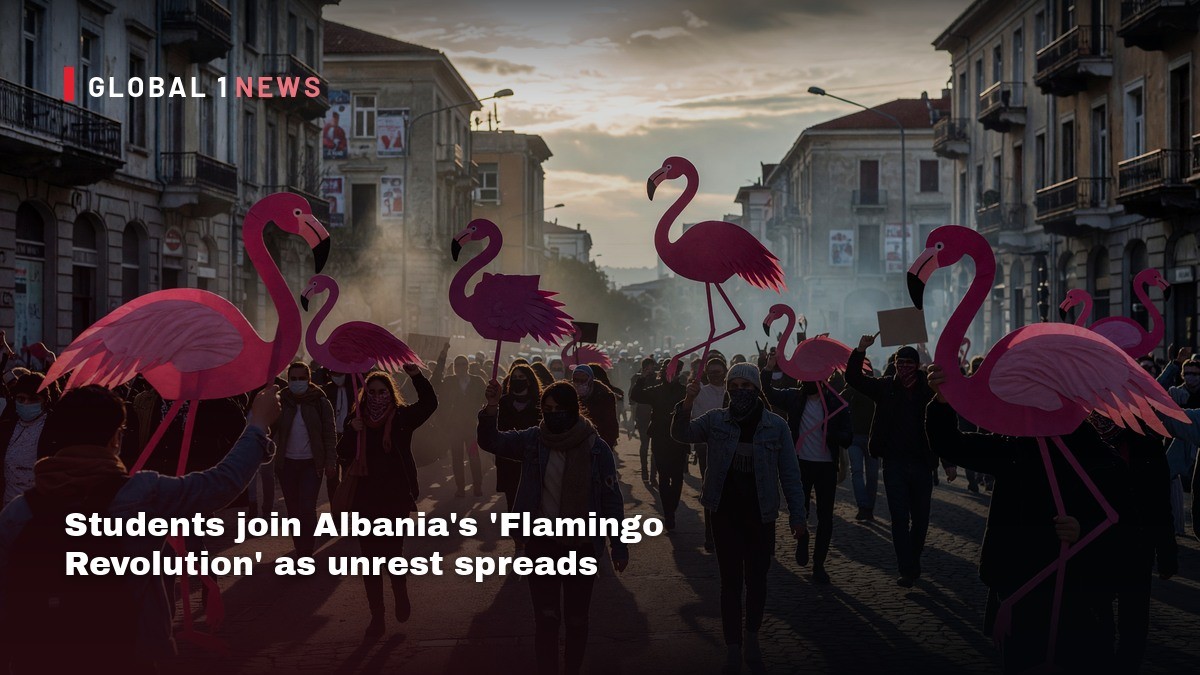
Albania’s capital has become a flashpoint in a broader wave of unrest that began as an environmental protest and has now morphed into a nationwide challenge to Prime Minister Edi Rama’s Socialist government. The demonstrations, dubbed the “Flamingo Revolution,” reflect a confluence of grievances – from the perceived threat to protected wetlands on the Adriatic coast to deep‑seated frustrations over corruption, economic hardship and a deteriorating education system. As the protests spread to cities such as Durrës, Shkodër and Gjirokastër, the government’s response and the narrative of foreign interference have added new layers to an already volatile situation.
From coastal wetlands to a national uprising
The origins of the Flamingo Revolution can be traced to a controversial coastal tourism project linked to Affinity Partners, an investment firm associated with Jared Kushner. The development, planned for Albania’s southern Adriatic coast near Sazan Island and the Vjosa‑Narta wetlands, sparked environmental objections because of its potential impact on habitats that support flamingos and other wildlife. Protesters adopted the flamingo as a symbol, framing the campaign as a defence of Albania’s natural heritage.
What began in May as a focused environmental protest quickly broadened. Demonstrators expanded their demands to include political accountability, an end to perceived corruption, and improvements in public services. The movement’s evolution illustrates how a single policy dispute can act as a catalyst for latent societal discontent, especially in a country where corruption and economic stagnation have long been sources of frustration.
Students become the new front line
Mid‑October marked a turning point when high‑school and university students poured onto the streets in unprecedented numbers. Their grievances centred on rising education costs, inadequate university facilities, limited financial assistance and bleak employment prospects after graduation. The cost‑of‑living crisis, already felt across the Balkans, amplified these concerns, driving students to join the broader protests.
Student mobilisation shifted the focus of the demonstrations toward the Education Ministry, though the protests soon spilled over into violent confrontations. Protesters smashed windows, set fire to trash bins and kiosks, and targeted a Raiffeisen bank branch. The use of rocks, fireworks, flares and Molotov cocktails signalled a heightened intensity, while riot police responded with tear gas, water cannons, baton charges and, by mid‑October, rubber‑bullet fire.
Geographic spread and targets of dissent
While the capital, Tirana, remained the epicentre of the unrest, the protests rapidly extended to other urban centres, including Durrës, Shkodër, Lezhë, Vlora, Elbasan, Korçë and Gjirokastër. In Tirana, demonstrators targeted key state institutions – the Education Ministry, Interior Ministry, Supreme Court and the headquarters of the governing Socialist Party. Clashes also erupted near a police station and the vicinity of the prime minister’s office, underscoring the protesters’ willingness to confront symbols of state authority.
The dispersion of unrest beyond the capital suggests a diffusion of dissent that could strain the government’s capacity to contain the protests. The decentralized nature of the movement, with loosely coordinated networks rather than a single leadership, complicates any attempt by political actors to negotiate or co‑opt the protestors.
Human cost and the scale of the crackdown
Official figures released during the height of the clashes reported roughly 295 injured individuals, of which about 186 were police officers. The high number of police casualties highlights the intensity of the confrontations and the willingness of security forces to engage directly with demonstrators. In parallel, authorities carried out mass arrests, with reports indicating more than 1,000 detentions and nearly 400 criminal prosecutions. Many detainees were later released, but the scale of the crackdown has raised concerns about due process and the potential for further radicalisation.
In addition to the arrests, several police officers were suspended amid allegations of excessive force. Prime Minister Rama defended the police response, promising bonuses and prospective pay increases for officers, while simultaneously offering dialogue on the students’ concerns about education costs.
Political narratives and accusations of foreign meddling
Prime Minister Rama, who secured a fourth term in the 2025 parliamentary elections, has framed the unrest as a threat to Albania’s democratic stability and its EU accession ambitions, which aim for membership by the end of the decade. He has repeatedly warned of “dark forces” and alleged foreign actors – naming Russia, Iran and unspecified others – as exploiting or radicalising the protests. However, independent evidence to substantiate these claims remains limited.
The invocation of foreign interference serves a dual purpose: it delegitimises the protests by casting them as externally driven, and it rallies nationalist sentiment around the government. Yet the lack of concrete proof may undermine the credibility of these accusations, especially as the protests are largely driven by domestic grievances.
Institutional fallout and the prospect of political reform
The unrest has disrupted parliamentary proceedings, with sessions cancelled or hampered by security concerns around government buildings. This paralysis underscores the broader institutional crisis, as both the ruling Socialists and the opposition Democratic Party, led by Sali Berisha, face public distrust. Protesters have rejected the two dominant political camps, chanting for Rama’s resignation and calling for a caretaker government to address systemic issues.
University professors and civil‑society figures have also voiced criticism of the police response, calling for accountability and reforms. Their involvement signals a widening coalition that transcends the student body, encompassing broader segments of Albanian society dissatisfied with the status quo.
Implications for Albania’s EU trajectory and regional stability
Albania’s EU accession path hinges on meeting criteria related to the rule of law, democratic governance and human rights. The escalation of street violence and the government’s heavy‑handed response risk tarnishing the country’s image in Brussels, potentially delaying membership negotiations. Moreover, the protests highlight the fragility of Albania’s political system, where economic hardship and perceived corruption can rapidly ignite mass mobilisation.
Regionally, the unrest may reverberate across the Balkans, where several states grapple with similar challenges of corruption, youth unemployment and environmental concerns. The Flamingo Revolution, while rooted in local issues, could inspire parallel movements or, conversely, prompt neighbouring governments to tighten security measures. As the situation evolves, the balance between dialogue and repression will be pivotal in determining whether Albania can navigate this crisis without jeopardising its European aspirations.
This article was produced with AI-assisted research and editorial support. Reporting is based on the source material cited below. Sources: Daily Sabah Middle East; dailysabah.com; Global1.News (25 October 2026).
By Malik Hassan, Staff Writer
What's Your Reaction?
 Like
0
 Dislike
0
 Love
0
 Funny
0
 Wow
0
 Sad
0
 Angry
0

Middle East Correspondent at Global1.News. Based in Beirut, covering politics, conflict, energy, and society across the Middle East. Brings context and depth to a region often reduced to headlines.











Comments (0)