
Russia Launches Heavy Ballistic Missile and Drone Barrage on Kyiv Killing Nine
Russia unleashed a barrage of 35 missiles including 27 ballistic ones and 185 drones on Kyiv overnight, killing nine and wounding 28-33. Only one interception occurred amid interceptor shortages for Patriot systems, marking the second major attack that week with widespread damage and outages.
Scale of the Overnight Assault
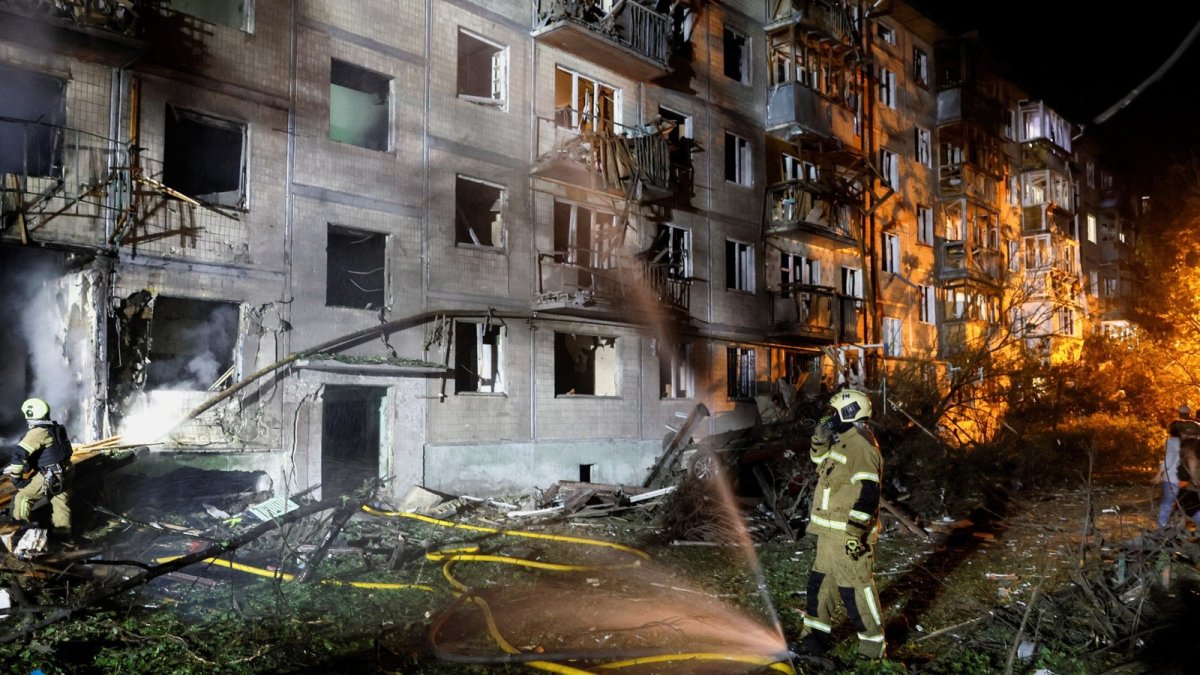
Russia launched a major attack on Ukraine's capital overnight into Saturday August 1 2026 using ballistic missiles and drones. Kyiv Mayor Vitali Klitschko reported at least nine people killed and between 28 and 33 wounded including four children. President Volodymyr Zelenskyy stated that Russia fired 35 missiles of which 27 were ballistic along with 185 attack drones.
Only one ballistic missile was intercepted during the assault. Zelenskyy attributed the low interception rate to a lack of available interceptors for the Patriot system. More than a dozen explosions shook the city across several waves of strikes according to witnesses cited by Reuters.
Fires erupted in multiple areas of Kyiv and some neighborhoods experienced power outages. The attack marked the second major strike on the capital within the same week. Damage was confirmed across seven districts in the city of roughly three million residents.
The scale of 35 missiles including 27 ballistic types paired with 185 drones and just one interception underscores a deliberate Russian escalation aimed at overwhelming Ukrainian air defenses through sheer volume. This barrage follows the pattern of repeated strikes this week and signals Moscow's intent to exploit any gaps in interceptor availability during sustained operations.
Casualties Mount in Multiple Districts
In the Solomianskyi district falling debris struck a five-storey residential building and triggered a fire. Thirty-five people were evacuated from upper floors while two died and eight suffered injuries including two children. The Darnytskyi district saw seven deaths and 14 injuries from fires that damaged homes vehicles and an administrative building.
Klitschko noted that a residential building in the Shevchenkivskyi district was partially destroyed trapping residents inside. The Prosecutor General's Office confirmed damage records across seven districts. Zelenskyy added that 18 residential buildings a school the Lithuanian Embassy and infrastructure facilities were hit.
These figures reflect the concentrated impact on civilian areas during the night. Rescue operations continued into the morning hours as authorities assessed the full extent of injuries and structural harm.
Zelenskyy Highlights Critical Shortage of Defenses
Zelenskyy warned that Ukraine has exhausted its supply of interceptor missiles for US-made Patriot air defence systems. He stated that every package of ballistic missile interceptors saves lives and that nights without them lead to additional casualties. The president has been negotiating with the United States for a licence to manufacture these interceptors domestically.
On Friday US President Donald Trump indicated that talks were ongoing but no agreement had reached. Trump noted the need for careful consideration before transferring such technology. Ukrainian Foreign Minister Andrii Sybiha called for urgent air defence supplies emphasizing that stronger air protection would bring peace closer.
The shortage stems in part from diversions of interceptors to other regions amid the Iran conflict. This development has left Ukrainian defences stretched during repeated Russian strikes.
Militarily the exhaustion of Patriot interceptors leaves Kyiv and other cities exposed to ballistic threats that cannot be countered effectively forcing reliance on limited alternative systems with lower success rates against high-speed incoming projectiles. The diversion of these interceptors to US military and Gulf allies amid the Iran war has directly reduced availability for Ukraine creating a critical bottleneck during intensified Russian campaigns.
The stakes of the production-licence negotiation are high as a successful agreement would allow domestic manufacturing to replenish stocks independently reducing dependence on fluctuating foreign supplies and enabling sustained defense against future barrages. Without resolution Ukrainian forces risk further degradation of air cover that could shift battlefield momentum toward Russian advances.
Damage Extends to Diplomatic Sites
Two missiles landed near the Lithuanian Embassy in Kyiv causing windows to break and solar collectors to sustain damage. Debris scattered across the embassy yard though no injuries to staff were reported. The incident highlighted risks to diplomatic facilities during the barrage.
Zelenskyy confirmed the embassy among the damaged sites alongside residential buildings and a school. Lithuanian officials have not issued further public statements on the event at this stage. The strike occurred as part of broader infrastructure targeting in the capital.
Embassy personnel evacuated safely following the explosions. The event adds to concerns over the safety of foreign missions in the ongoing conflict.
Ukraine Responds with Strikes on Russian Territory
Ukrainian forces struck infrastructure at three Russian oil refineries in the Bashkortostan region nearly 1,600 kilometres from the border. Zelenskyy confirmed the operation on Saturday as a direct response to the Kyiv assault. Ukrainian troops also sank the sanctioned Russian container ship Yanina in the Black Sea.
Additional targets were hit in the Sea of Azov. Zelenskyy described the chosen sites as facilities that sustain the Russian war effort. These actions form part of Ukraine's strategy to disrupt logistics and energy infrastructure deep inside Russia.
The counterstrikes occurred amid continued fighting along the 1,200 kilometre front line. Ukrainian operations have increasingly focused on Russian oil facilities and weapons production sites this year.
The strategic logic behind long-range strikes reaching Bashkortostan at approximately 1,600 km demonstrates Ukraine's capacity to project power far beyond immediate border areas targeting energy infrastructure that funds Russian military operations. The sinking of the Yanina further disrupts sanctioned maritime logistics in the Black Sea complementing hits in the Sea of Azov to constrain Russian supply lines.
These operations align with Ukraine's broader 2026 campaign objectives of degrading Russian economic and logistical resilience through precision deep strikes that complement defensive efforts on the ground and in the air.
Russian Ground Advances Continue
Russian forces captured two additional villages in recent days according to the Interfax news agency citing the Russian Defence Ministry. Olgivka in northern Kharkiv and Lyubytske in southeastern Zaporizhia fell under Russian control. These gains come as Russian advances have slowed by more than half compared to earlier periods this year.
The front line remains active across multiple regions. Ukrainian forces continue to launch strikes inside Russia targeting oil facilities and logistics hubs. Both sides maintain that they do not target civilians in the conflict that began with Russia's full-scale invasion in February 2022.
Ground operations persist alongside the aerial exchanges. The capture of these villages represents incremental territorial shifts in the fifth year of fighting.
Eyewitnesses Describe Chaos in the Capital
Sixty-eight-year-old Nadiia Komarova a concierge at an apartment building in Kyiv recounted the moment sirens sounded at 1:30 a.m. She described getting up immediately as explosions began and ceilings started to crumble. Her window was smashed with debris falling inside.
Residents across affected districts reported similar scenes of sudden destruction. Emergency services worked through the night to evacuate buildings and extinguish fires. The attack left many in the capital assessing damage to homes and vehicles.
Local authorities urged residents to remain vigilant as further strikes remain possible. The human impact includes both immediate casualties and longer-term displacement for those whose buildings were damaged.
Context of Ongoing Conflict and Supply Negotiations
The assault came two days after a suspected Russian cruise missile landed in Poland during another large-scale strike that killed at least 10 people nationwide. Six members of one family died near Kryvyi Rih in that earlier attack. Zelenskyy continues to press for additional air defence resources from Western partners.
Negotiations with the United States over Patriot interceptor production licences remain active but unresolved. Trump has stressed the need for judicious handling of sensitive technology transfers. Ukrainian officials argue that enhanced air defences would alter the trajectory of the war.
The events underscore the sustained intensity of the conflict five years after the initial invasion. Both military and civilian infrastructure continue to face repeated threats.
The regional picture includes the Poland cruise missile incident that heightened NATO concerns and placed immediate pressure on Western allies to accelerate air defense deliveries amid fears of spillover. This pressure intensifies as the war enters its fifth year with a 1,200 km front line where Russian advances have already slowed by more than half compared to earlier periods.
The trajectory suggests that sustained Ukrainian long-range responses and allied support decisions will determine whether the conflict stabilizes or escalates further into 2027.
What the Kyiv Barrage Signals for the War's Next Phase
The air-defense crunch exposed by the Kyiv barrage reveals a systemic vulnerability where exhausted Patriot interceptor stocks leave major population centers susceptible to repeated ballistic strikes forcing Ukrainian commanders to prioritize limited resources across an expanding threat envelope. This crunch directly constrains operational flexibility and raises the human and infrastructure costs of each Russian wave.
The diversion caused by the Iran war has compounded the problem by redirecting critical interceptors to US military and Gulf allies leaving Ukraine with minimal reserves during a period of heightened Russian activity. Such reallocations illustrate the global ripple effects of concurrent conflicts on Ukrainian defensive capacity.
Implications for Western allies include mounting urgency to resolve production-licence talks and increase direct supplies as failure to do so risks ceding air superiority advantages to Russia and prolonging the war through diminished Ukrainian resilience. Allies must weigh technology transfer risks against the strategic cost of a faltering Ukrainian defense posture. By Jessica Ali, Staff Writer
This article was produced with AI-assisted research and editorial support. Reporting is based on sources cited in the article.
What's Your Reaction?
 Like
0
Like
0
 Dislike
0
Dislike
0
 Love
0
Love
0
 Funny
0
Funny
0
 Wow
0
Wow
0
 Sad
0
Sad
0
 Angry
0
Angry
0

Editor-in-Chief at Global1.News. Atlanta-based journalist who cuts through the BS and tells it like it is. Lead anchor, host, and the voice you hear when the spin stops and the truth starts.












Comments (0)