
ROKS Daejeon Wins 'Top Gun of the Sea' at RIMPAC 2026
ROKS Daejeon Claims 'Top Gun of the Sea' at RIMPAC 2026 The Republic of Korea Navy frigate ROKS Daejeon secured the "Top Gun of the Sea" award at RIMPAC 2026, marking the service's first gunnery victory in the multinational exercise since the destroyer ROKS Sejong the Great prevailed in 2010. This achievement highlights Seoul's growing capacity to operate alongside U.S. forces across the Indo-Pacific while demonstrating the technical maturity of domestically built surface com
The Republic of Korea Navy frigate ROKS Daejeon secured the "Top Gun of the Sea" award at RIMPAC 2026, marking the service's first gunnery victory in the multinational exercise since the destroyer ROKS Sejong the Great prevailed in 2010. This achievement highlights Seoul's growing capacity to operate alongside U.S. forces across the Indo-Pacific while demonstrating the technical maturity of domestically built surface combatants. The result arrives at a moment when alliance planners are reassessing burden-sharing arrangements amid persistent North Korean missile activity and China's accelerating naval expansion.
ROKS Daejeon Wins Top Gun of the Sea at RIMPAC 2026
Seoul, South Korea – August 4, 2026 — The 3,100-ton Daegu-class frigate ROKS Daejeon earned the Best Gunnery Warship distinction during the 30th iteration of the Rim of the Pacific exercise, the world's largest multinational maritime drill hosted by the U.S. Navy. The award, presented at the July 31 closing ceremony on Ford Island, underscores South Korea's evolution from a coastal-defense navy into a blue-water force capable of sustained operations far from the peninsula. It also reinforces the credibility of Korean shipbuilding at a time when defense exports have become a strategic priority for Seoul.
ROK Navy Secures Rare Gunnery Honor After 16 Years
The victory represents only the second occasion a Republic of Korea Navy vessel has claimed the Top Gun of the Sea title since the exercise began in 1971. ROKS Sejong the Great's 2010 success established an early benchmark for Korean gunnery proficiency under multinational scrutiny. Analysts note that the sixteen-year interval reflects both the demanding nature of the competition and the deliberate pace of South Korea's naval modernization program, which has prioritized indigenous design and crew training over rapid numerical expansion.
The 2010 achievement by ROKS Sejong the Great occurred when the Republic of Korea Navy was still consolidating its transition from primarily coastal operations to sustained blue-water deployments. That earlier win signaled the service's readiness to integrate with U.S. Navy task groups during extended exercises. Sixteen years later, the ROKS Daejeon result confirms that the same trajectory has continued through systematic investment in domestically produced platforms and standardized training regimens calibrated to multinational standards.
Competition Execution and Technical Precision
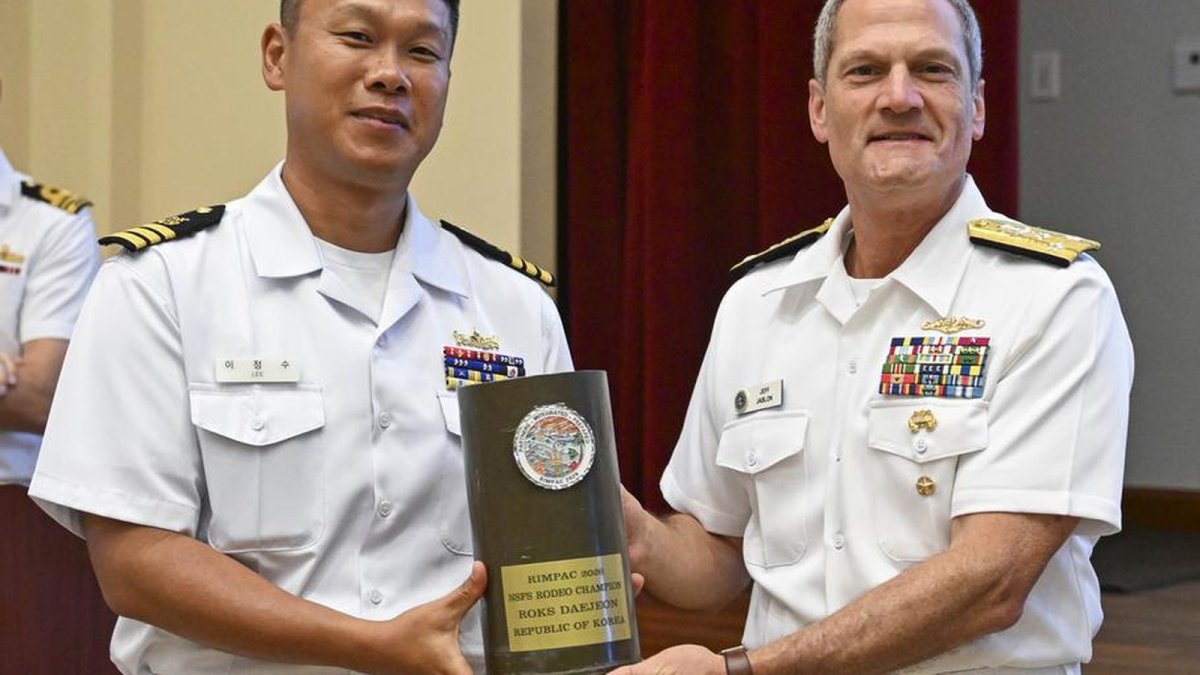
Thirteen warships from ten nations participated in the Naval Surface Fire Support event on July 12, each firing five 5-inch rounds at a target 7.2 kilometers distant. The vessel achieving the smallest aggregate deviation from the aim point was declared the winner, with results withheld until the closing ceremony. Commander Lee Jung-soo accepted the award from Combined Task Force Commander U.S. Navy Vice Adm. Jeffrey T. Jablon, while Senior Chief Petty Officer Joo Hyo-jin credited rigorous pre-exercise drills for the crew's ability to deliver accurate fire under variable Pacific conditions.
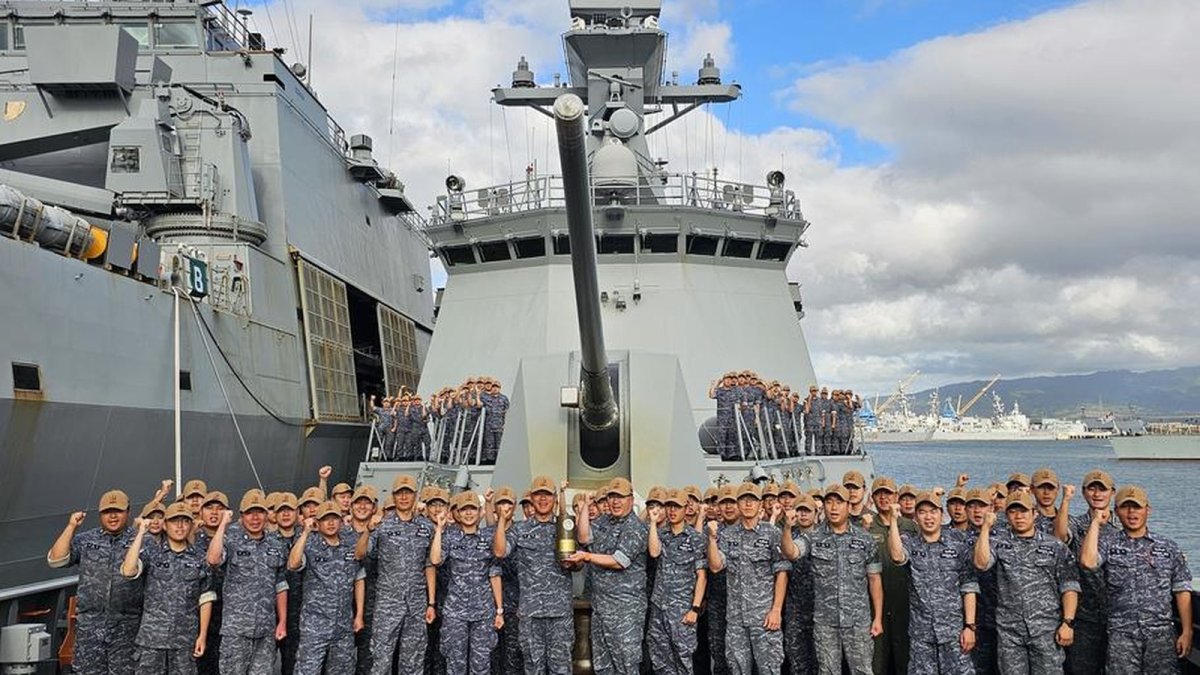
Crew members conducted tactical discussions and simulated firing sequences prior to the competition in order to master firing procedures under Pacific environmental conditions. Such preparation underscores why gunnery accuracy remains a core metric of combat effectiveness even in an era dominated by precision-guided munitions and networked sensors. The confidentiality protocol, which delayed public disclosure until the July 31 ceremony at the Ford Island Conference Center, further illustrates the exercise's emphasis on objective evaluation free from premature national or media influence.
Interoperability Gains Within the US-ROK Alliance
ROKS Daejeon mounts the Mk 45 Mod 4 5-inch gun, the same system installed on numerous U.S. Navy Arleigh Burke-class destroyers and Ticonderoga-class cruisers. Shared equipment enabled Korean gunners to synchronize procedures directly with American counterparts during pre-competition tactical exchanges. This technical alignment strengthens combined deterrence on the Korean Peninsula by ensuring that allied surface units can integrate fire support without procedural friction, a capability that gains added relevance amid North Korea's expanding missile and artillery threats.
Because the gun system is identical to those on U.S. vessels, Korean crews could draw directly on established U.S. Navy firing tables and maintenance protocols during joint training. This interoperability has been cultivated through decades of combined exercises that predate RIMPAC 2026 and continues to serve as a practical expression of extended deterrence commitments. The resulting procedural familiarity reduces response times when allied forces must coordinate naval gunfire support in potential contingency scenarios on or around the peninsula.
Indigenous Naval Modernization and Export Credibility
The Daegu-class program constitutes the core of the FFX Batch II initiative, which replaces older coastal vessels with multi-mission frigates designed and built in South Korea. Launched in 2021, ROKS Daejeon integrates the Mk 45 gun with anti-ship missiles, tactical surface-to-surface missiles, and close-in weapon systems. Commander Lee observed that the award reflects "South Korea's advanced defense industry and the navy's outstanding operational capabilities," while Senior Chief Petty Officer Joo emphasized that practical training allows accurate engagement "in any situation." These statements carry immediate weight for Hyundai Heavy Industries and other Korean yards competing for international contracts.
The FFX Batch II effort forms part of a broader national strategy to field domestically designed surface combatants capable of operating across diverse threat environments. By demonstrating that a Korean-built frigate can outperform peer vessels in a standardized gunnery trial, the ROKS Daejeon result enhances the reputation of Korean shipyards among potential export customers seeking reliable, interoperable platforms. Qualitative assessments of Korean naval engineering have long emphasized cost-effective integration of proven Western subsystems with indigenous combat management systems, a combination now validated under multinational scrutiny.
Regional Security Context and North Korean Reactions
South Korea became the first Asian nation to command the exercise's combined maritime component during RIMPAC 2026. North Korea has repeatedly threatened countermeasures against U.S.-led naval drills, and the public announcement of the award on August 2 occurs against the backdrop of China's ongoing fleet expansion. The demonstrated gunnery proficiency therefore serves both operational and deterrent functions, signaling to Pyongyang and Beijing that allied forces maintain high standards of tactical readiness in the waters surrounding the Korean Peninsula.
North Korea's pattern of issuing statements threatening countermeasures in response to U.S.-ROK naval activity reflects Pyongyang's long-standing sensitivity to combined exercises that improve allied coordination. At the same time, China's steady naval buildup has prompted Seoul to accelerate its own surface fleet modernization. The ROKS Daejeon award arrives as a tangible indicator that South Korean units can contribute meaningfully to collective maritime presence without relying exclusively on U.S. platforms for critical gunnery tasks.
Strategic Significance for Indo-Pacific Architecture
The combination of ROK command responsibilities and the Top Gun victory illustrates Seoul's expanding role within the Indo-Pacific maritime security framework. Historical precedent from the 2010 Sejong the Great win shows that such achievements strengthen diplomatic leverage when alliance partners discuss burden-sharing. For Korean policymakers, the outcome validates sustained investment in crew training and indigenous systems precisely when regional powers are modernizing their fleets at an accelerated pace.
Seoul's first-time command of the combined maritime component during RIMPAC 2026 further positions the Republic of Korea as a constructive participant in broader Indo-Pacific arrangements. These arrangements encompass both security dialogues adjacent to the Quad framework and economic initiatives comparable to CPTPP accession efforts. The gunnery award supplies concrete evidence that Korean naval contributions can meet alliance expectations for operational competence, thereby supporting arguments for more equitable burden-sharing within the U.S.-ROK relationship.
Looking Ahead: Implications for Alliance Burden-Sharing and Exports
Future RIMPAC iterations will likely feature additional Korean platforms equipped with the Mk 45 gun, potentially increasing opportunities for joint gunnery training with U.S. and allied navies. Defense planners in Seoul view the award as further evidence that Korean-built frigates can operate seamlessly within U.S.-led task forces, a selling point for prospective buyers in Southeast Asia and the Middle East. Continued success in such exercises may also influence ongoing debates over cost-sharing within the U.S.-ROK alliance by demonstrating tangible Korean contributions to collective maritime security.
Looking forward, the ROK Navy's emphasis on standardized Western weapon systems alongside indigenous hull and sensor designs positions Korean shipbuilders to compete in export markets that value interoperability with U.S. forces. As alliance discussions on burden-sharing evolve, demonstrated performance in exercises such as RIMPAC supplies Korean negotiators with empirical examples of operational value. This trajectory suggests that subsequent RIMPAC cycles may see expanded Korean participation across both surface combatants and command roles, reinforcing Seoul's profile as a reliable Indo-Pacific security partner.
By Prof. David Park, Staff Writer
This article was produced with AI-assisted research and editorial support. Reporting is based on sources cited in the article.
What's Your Reaction?
 Like
0
Like
0
 Dislike
0
Dislike
0
 Love
0
Love
0
 Funny
0
Funny
0
 Wow
0
Wow
0
 Sad
0
Sad
0
 Angry
0
Angry
0

East Asia/Technology Correspondent at Global1.News. Seoul-based voice covering Korean politics, technology, business, and culture. Analyzes how technology and geopolitics intersect across East Asia.















Comments (0)