
Robotics Rebuilds China's Northeast Industrial Heartland
Heilongjiang, China's rust-belt heartland, is betting on robotics to forge a new industrial era. Harbin's universities and startups are turning decades of heavy-industry expertise into dexterous machines, targeting 10 billion yuan in sector value by 2028.
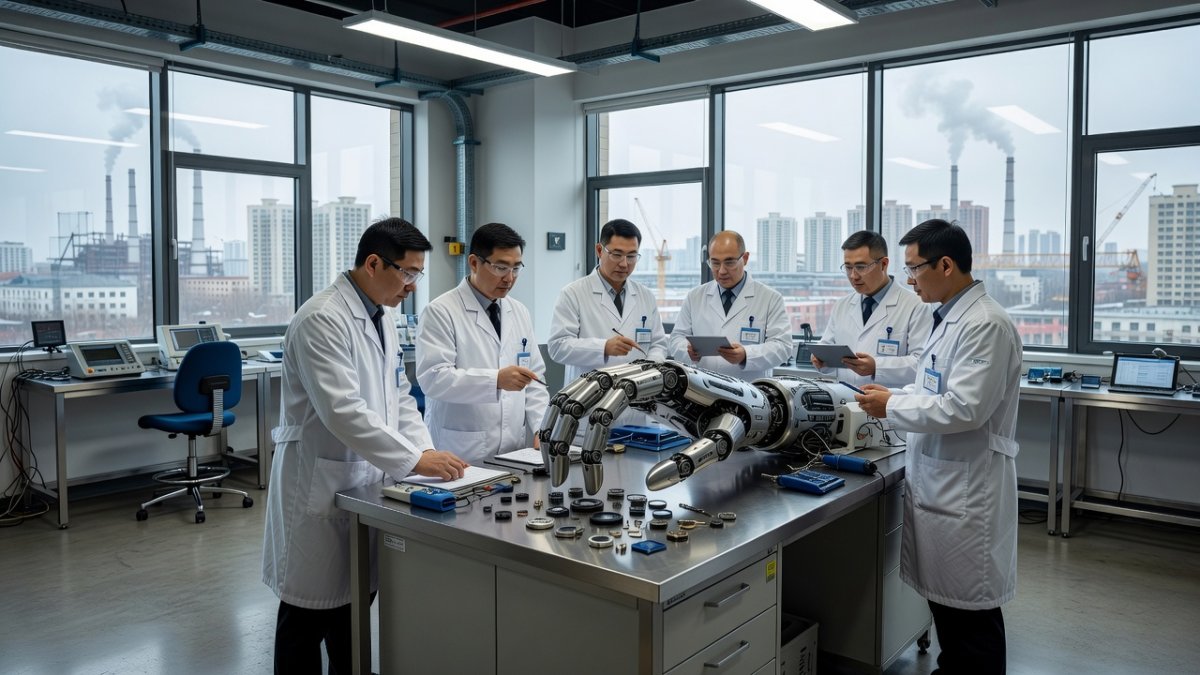
Harbin Exhibition Signals Shift in Northeast China's Economic Ambitions
At the Harbin Institute of Technology Institute of Advanced Technology, an exhibition in early August 2026 displayed robotic systems that underscore Heilongjiang Province's pivot from its traditional base in steel, machinery and oil toward advanced manufacturing. Inside the exhibition halls, visitors moved between demonstration stations where engineers fine-tuned parameters in real time, adjusting sensor thresholds and grip forces while observers noted cycle times and repeatability metrics. A lightweight robotic hand rotated and gripped objects with fluid precision, demonstrating coordinated multi-joint motion that allowed it to handle both fragile glassware and heavier metal parts without recalibration. Nearby, a surgical robot performed retinal procedures at micron-level accuracy finer than a human hair, its end-effector tracing paths guided by high-resolution imaging that compensated for subtle tissue movement. These demonstrations occurred against the backdrop of China's ongoing manufacturing upgrade and its push into artificial intelligence applications. The setting in Harbin, with its long industrial heritage, highlighted how the province is repositioning decades of accumulated expertise in equipment manufacturing and aerospace as foundations for robotics innovation rather than relics of a heavy-industry past. Outside the venue, the city's distinctive blend of Russian-influenced architecture and modern research facilities reminded attendees that Heilongjiang's economic story has always combined inherited industrial capacity with new technological layers.
Heilongjiang, long regarded as a core industrial region, now seeks fresh growth drivers. The province's equipment manufacturing and aerospace sectors provide immediate testing grounds for new prototypes, allowing companies to iterate rapidly without relying solely on distant supply chains. This local advantage shortens development cycles and enables engineers to validate designs under real operating conditions before scaling production. Feedback loops between laboratory teams and on-site operators help refine control algorithms and mechanical tolerances in environments that replicate actual deployment stresses.
Robotics Research Spins Out into Commercial Ventures
HIT vice president Liu Hong, who also directs the State Key Laboratory of Robotics and Systems, noted that over the past two years the institute has launched startups focused on medical robotics, agricultural equipment, special-purpose inspection tools, ice construction and precision manufacturing. These ventures draw directly from decades of laboratory work at the university. The pattern reflects a deliberate effort to move research outputs into the marketplace while preserving the academic environment that generated the underlying technologies. Under the spin-off model, laboratory teams identify promising prototypes during applied research phases, then establish separate legal entities that license core patents from the university. Faculty members may take entrepreneurial leave or maintain part-time roles, ensuring continued access to specialized equipment and graduate talent pipelines while the new companies secure independent funding and manufacturing space. This structure keeps foundational research within the institute even as commercial activities scale elsewhere.
Harbin Dexbot Robotics Co., Ltd., founded in 2024, exemplifies this transition. The company's team, averaging under 30 years old, has developed competitive technology in dexterous manipulation, robotic arms and coordinated arm-hand control. General manager Qi Le stated that the firm was incubated at HIT's Institute of Advanced Technology before expanding into larger R&D and manufacturing facilities. Provincial programs supporting key technologies, combined with local venture capital, financed the early stages. The young workforce brings fresh perspectives while benefiting from the laboratory's accumulated knowledge in manipulation and control systems. As operations moved off campus, the company retained formal collaboration agreements that grant continued use of testing rigs and simulation software, allowing it to validate new gripper designs against the same benchmarks used in academic studies.
Policy Framework Targets Industry Scale-Up
China's 15th Five-Year Plan period, running from 2026 to 2030, designates "new quality productive forces" as a central priority. The plan encourages policies that permit researchers to take entrepreneurial leave or hold multiple paid positions, facilitating the movement of talent into enterprises and promoting joint industry-university research projects. These measures aim to reduce barriers between academic discovery and commercial application across the country.
In April 2026, Heilongjiang introduced a policy package aimed at the intelligent robotics sector. The measures target an industry value exceeding 10 billion yuan, equivalent to approximately 1.5 billion USD, by 2028 while fostering three to five nationally competitive leading companies. Construction has begun on "Robot Island," a Harbin technology park designed to integrate research, manufacturing, international cooperation and talent services, with several university spin-offs already committed to the site. The policy package also aligns with national goals of building self-reinforcing industrial clusters.
Supply Chain Access and National Market Integration
China's unified national market gives firms in Heilongjiang efficient access to precision machining, electronic components and specialized suppliers in the Yangtze River Delta and Pearl River Delta. This connectivity shortens development cycles for complex robotic systems by allowing rapid sourcing of high-quality parts without building every subsystem locally. Trade fairs, technology exhibitions and robotics conferences further help local companies identify market demand and connect with customers across multiple provinces.
The combination of regional manufacturing strengths and nationwide supply networks reduces dependence on any single location and supports faster iteration. Heilongjiang enterprises can therefore focus engineering resources on core functions such as manipulation algorithms and system integration while drawing on established external capabilities for supporting components.
Specialized Robots Address Regional Conditions
Heilongjiang's robotics developments reflect local geography and climate. The province contains more than 20 million hectares of forest, including roughly 10 million hectares of birch, alongside extensive farmlands and heavy winter snowfall. HIT collaborated with Northeast Forestry University and a local manufacturer to create an intelligent tracked transport vehicle capable of climbing slopes up to 30 degrees. The vehicle navigates narrow mountain trails using terrain-mapping sensors that adjust track tension and motor torque in real time, maintaining stability while carrying harvested birch sap containers. Operators monitor progress through a remote interface that displays slope angle, payload weight and battery status, enabling single-person oversight of multiple units. The system reduces loading work from three workers per hour to roughly 10 minutes and can adapt for irrigation or soil cultivation tasks, according to project expert Yang Chunmei. Such adaptations directly address the short seasonal window for harvesting birch sap in mountainous terrain, where rapid deployment before freeze-up determines annual yields.
At Harbin Ice and Snow World, an automated robot constructs large ice sculptures with millimeter precision even in extreme cold. The machine uses a multi-axis gantry system fitted with heated cutting tools and real-time thickness sensors that compensate for ice expansion and contraction. It completes work equivalent to approximately 30 skilled workers at once and shortens overall construction time by about 30 percent. Potential extensions include polar research stations and cold-region infrastructure projects where human labor faces severe environmental constraints. The same platform has been tested for building temporary shelters and equipment enclosures in sub-zero conditions, where consistent material deposition rates remain critical despite ambient temperature fluctuations.
Oilfield and Aerospace Applications Extend Reach
Daqing Oilfield, China's largest onshore oilfield, has incorporated HIT aerospace and robotics technologies into intelligent systems for deep resource extraction and hazardous operations such as oil tank inspection and cleaning. These adaptations demonstrate how provincial strengths in energy can intersect with emerging automation capabilities. The same sensor and control architectures developed for aerospace environments transfer effectively to the demanding conditions of oilfield maintenance.
Professor Zhang He, chief scientist of a national key R&D project at HIT, spent nine years developing a retinal microsurgery robotic system before founding a company last year. Core patents were licensed to the enterprise, and access to mature precision manufacturing supply chains for medical materials and components has reduced both R&D timelines and production costs. This licensing model preserves academic ownership while accelerating commercial deployment.
What This Means
The developments in Heilongjiang illustrate Beijing's strategy of leveraging regional industrial legacies to meet national targets in advanced manufacturing. China's robotics industrial policy under the "new quality productive forces" agenda channels resources toward self-reliant clusters that combine university research with provincial manufacturing bases. China has remained the world's largest market for industrial robots for 13 consecutive years and accounts for more than half of global installations, while shipping an estimated 80-90 percent of the world's humanoid robots. By channeling research talent into commercial entities and aligning provincial policies with the 15th Five-Year Plan, authorities aim to create self-reinforcing clusters that address both domestic needs and export opportunities.
Global ripple effects are already visible. Unitree is preparing a potential 7 billion USD valuation IPO on the Shanghai STAR market in 2026, while Agibot targets a 6 billion USD listing in Hong Kong. At the same time, the United States has imposed FCC restrictions on imports of Chinese humanoid and quadruped robots, highlighting export friction that could accelerate China's focus on internal supply chains and non-Western markets. The unified national market provides Heilongjiang firms access to precision machining and electronic components from the Yangtze River Delta and Pearl River Delta, reducing vulnerability to external disruptions. This combination of scale, policy support and supply-chain resilience positions Chinese robotics firms to maintain leadership even as geopolitical barriers rise.
Liu Hong emphasized that robotics development in the province is not about chasing trends but about building on local strengths to solve concrete problems. This approach may limit headline-grabbing breakthroughs yet could produce durable competitive advantages in specialized niches where environmental or operational demands match Heilongjiang's accumulated expertise.
Forward Trajectory for Heilongjiang's Robotics Sector
Trade fairs, technology exhibitions and robotics conferences continue to help local firms identify demand and connect with customers across China and beyond. The combination of university research pipelines, provincial financing mechanisms and established manufacturing bases positions Heilongjiang to expand its role within the national robotics ecosystem through 2030. Continued implementation of the 15th Five-Year Plan's talent mobility provisions will determine how quickly additional researchers can transition into enterprise roles, while "Robot Island" infrastructure supports the physical co-location of design, testing and pilot production lines.
Whether these efforts translate into sustained leadership will depend on execution of the 15th Five-Year Plan's talent mobility measures and the ability of new enterprises to scale beyond initial incubation. The coming years will test how effectively the province converts its industrial inheritance into technologies that meet both regional requirements and broader strategic objectives, particularly as national policy continues to prioritize robotics as a pillar of advanced manufacturing competitiveness.
By Kenji Tanaka, China Correspondent
This article was produced with AI-assisted research and editorial support. Reporting is based on sources cited in the article.
What's Your Reaction?
 Like
0
Like
0
 Dislike
0
Dislike
0
 Love
0
Love
0
 Funny
0
Funny
0
 Wow
0
Wow
0
 Sad
0
Sad
0
 Angry
0
Angry
0

Japan Correspondent at Global1.News. Tokyo-based voice covering Japanese politics, technology, economy, and culture. Tracks the intersection of tradition and innovation in one of the world's most dynamic societies.















Comments (0)