
Reviving SAARC: Smaller South Asian States Renew Efforts for Regional Cooperation
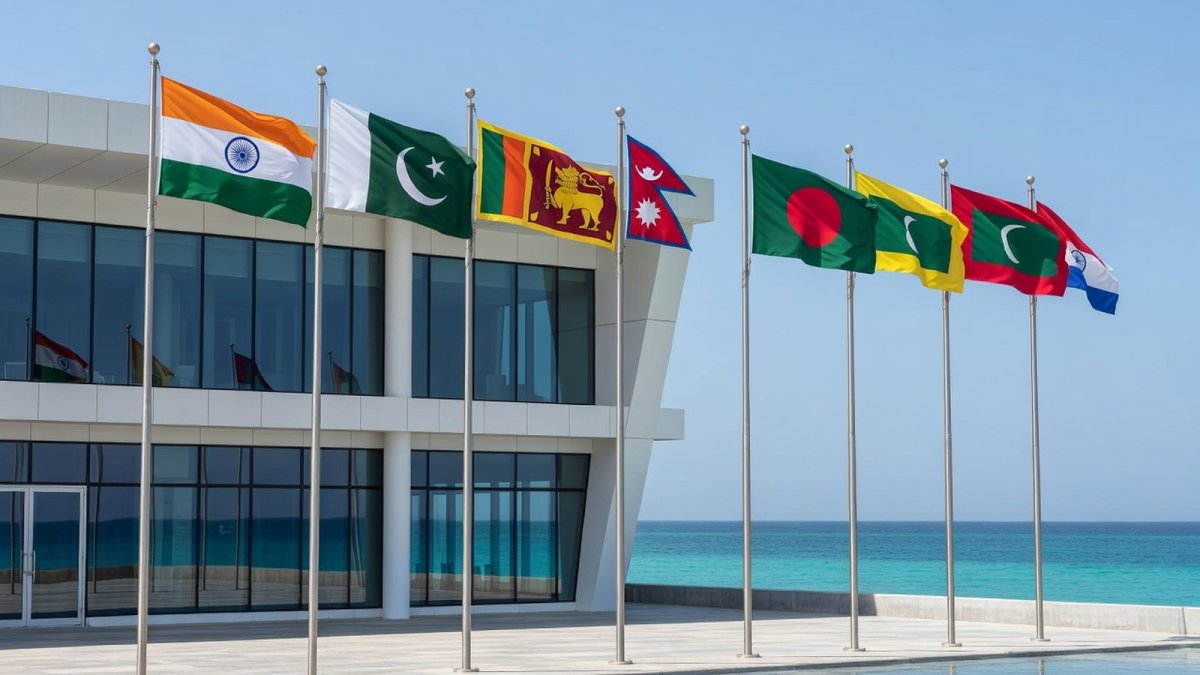
Smaller Nations Lead Fresh Appeals for SAARC Revitalization Maldivian President Mohamed Muizzu used the Maldives’ 61st Independence Day ceremony on July 26, 2026, to urge SAARC members to resume summits and return to negotiations. He offered the Maldives as a mediator and convenor to help initiate discussions among member states. This marks Muizzu’s second public call for revival within seven months, following a similar statement at the organization’s 40th Charter Day event in December 2025. B
Smaller Nations Lead Fresh Appeals for SAARC Revitalization
Maldivian President Mohamed Muizzu used the Maldives’ 61st Independence Day ceremony on July 26, 2026, to urge SAARC members to resume summits and return to negotiations. He offered the Maldives as a mediator and convenor to help initiate discussions among member states. This marks Muizzu’s second public call for revival within seven months, following a similar statement at the organization’s 40th Charter Day event in December 2025.
Bangladesh’s Foreign Minister Khalilur Rahman reinforced the push during the same Maldivian ceremony, where he attended as a special guest. In February 2026, Rahman informed SAARC Secretary-General Golam Sarwar that Bangladesh remains committed to the organization and listed trade, connectivity, poverty reduction, energy, climate change, food security, education, and health as priority areas for cooperation. By April 2026, Rahman had elevated SAARC revival to a formal foreign-policy objective of Prime Minister Tarique Rahman’s government.
Historical Parallels in Bangladesh’s Regional Diplomacy
The current Bangladeshi emphasis on SAARC echoes the circumstances surrounding the organization’s founding. Former President Ziaur Rahman formally proposed the body in May 1980, shortly after assuming power following the 1975 coup that ended the government of Sheikh Mujibur Rahman. The present administration, led by Ziaur Rahman’s son, came to power after the 2024 ouster of Sheikh Hasina, Mujibur Rahman’s daughter. In both eras, a Bangladeshi government seeking to recalibrate ties with India placed South Asian regional cooperation at the center of its foreign policy.
Additional pressures in the late 1970s and early 1980s, including balance-of-payments crises across South Asia, rising protectionism in developed economies, and the Soviet military operations in Afghanistan that began in December 1979, created urgency for cooperation. Nepal and Sri Lanka quickly endorsed the proposal, while India and Pakistan expressed initial suspicion that the framework might allow smaller neighbors to raise bilateral disputes or alter regional power balances.
The pursuit of South Asian regionalism traces back to earlier initiatives, including the 1947 Asian Relations Conference convened in New Delhi, where leaders explored possibilities for broader cooperation across the continent. Yet prospects remained constrained by emerging bilateral tensions. A more favorable environment emerged in the late 1970s amid leadership transitions in both India and Pakistan, alongside the establishment of ASEAN and shifting global economic and security dynamics. These developments coincided with the collapse of North-South dialogues and heightened protectionism from industrialized nations, which disadvantaged developing economies. Additionally, the inability of countries like Sri Lanka to secure ASEAN membership underscored the need for an indigenous South Asian framework. The Soviet military intervention in Afghanistan beginning in December 1979 further destabilized the regional security landscape, heightening the imperative for collective responses to shared vulnerabilities. Such contextual factors collectively amplified the appeal of institutionalized cooperation among smaller states seeking to navigate these multifaceted challenges.
India-Pakistan Dynamics and the Limits of Bilateral Hostility
India has responded to the latest revival calls with a lukewarm stance and has instead emphasized engagement through BIMSTEC and the BBIN sub-regional initiative. Pakistan has expressed general support for SAARC but has not publicly addressed Muizzu’s specific mediation offer. This pattern of reluctance from the two largest members mirrors the organization’s early years, when both states joined only after concluding that exclusion carried greater costs than participation.
No SAARC heads-of-state summit has occurred since the 18th summit in Kathmandu in November 2014. The 19th summit, planned for Islamabad in November 2016, was cancelled following the Uri attack. The resulting stalemate has left the grouping largely inactive for more than a decade, despite its formal membership of eight states after Afghanistan’s accession in 2007.
India and Pakistan's mutual antagonism, often characterized as a "hostility consensus," has persistently eroded the potential for cohesive regional action within SAARC. From the outset, Indian policymakers expressed apprehension that any multilateral structure might enable smaller neighbors to elevate contentious bilateral matters or even coordinate against New Delhi's interests. Pakistani authorities, conversely, harbored concerns that deeper integration could inadvertently bolster India's dominant regional stature. Despite these reservations, both capitals ultimately acceded to the organization, motivated primarily by the recognition that non-participation might entail greater strategic disadvantages than engagement. This pattern of reluctant involvement highlights how bilateral frictions have shaped institutional design and operational scope, limiting the body's capacity to transcend the core rivalry that defines South Asian geopolitics and underscoring the enduring influence of exclusion anxieties on membership decisions.
Inter-Korean Parallels and South Korea’s Multilateral Experience
The India-Pakistan relationship within SAARC presents structural similarities to the inter-Korean dynamic, where bilateral tensions have repeatedly constrained broader Northeast Asian cooperation mechanisms. In both cases, the two principal actors’ mutual distrust limits the scope of regional institutions, prompting smaller or middle powers to advocate for frameworks that can operate despite, rather than because of, progress in the core bilateral relationship.
South Korea’s own diplomatic record offers instructive comparisons. Through its New Southern Policy, Seoul has pursued diversified economic and security partnerships with ASEAN member states, deliberately building multilateral channels that do not require simultaneous resolution of peninsula issues. Korea’s sustained engagement with ASEAN-led forums demonstrates how a middle power can advance regional cooperation by focusing on functional areas such as trade facilitation, disaster response, and connectivity, even when major-power rivalries persist. This approach has allowed incremental progress without waiting for comprehensive bilateral breakthroughs.
Structural Constraints Inherited from SAARC’s Design
The SAARC Charter, signed in Dhaka in December 1985, incorporated deliberate limitations to accommodate the concerns of India and Pakistan. Provisions requiring consensus for most decisions and excluding bilateral disputes from the agenda were intended to prevent the organization from becoming a venue for airing grievances. These safeguards, however, have also prevented the body from addressing the very issues that most affect regional stability and economic integration.
South Asia remains one of the world’s least economically integrated regions, with intra-regional trade constituting only a small fraction of members’ total trade. The absence of regular summits has further eroded institutional momentum, leaving technical cooperation mechanisms underutilized in areas such as energy grids, transport corridors, and public health coordination.
Beyond formal safeguards, the charter's emphasis on consensus-based decision-making and the deliberate exclusion of bilateral disputes from deliberations created structural barriers that insulated the organization from tackling pressing stability concerns. Consequently, South Asia exhibits markedly lower levels of economic integration compared to ASEAN, with intra-regional trade volumes representing a minimal share relative to global benchmarks. The prolonged suspension of high-level meetings has compounded these deficiencies by diminishing the impetus for collaborative projects in critical domains such as interconnected energy networks, multimodal transport linkages, and coordinated responses to public health threats. These gaps perpetuate fragmentation and hinder the realization of potential synergies across the subcontinent, leaving technical mechanisms dormant and underscoring how design choices intended to preserve harmony have instead entrenched underdevelopment in functional cooperation areas.
Prospects for Functional Cooperation and Institutional Lessons
Smaller SAARC members continue to identify concrete sectors where cooperation could yield immediate benefits without requiring political breakthroughs between India and Pakistan. Climate resilience, cross-border energy trade, and pandemic preparedness represent areas where technical working groups could resume activity even if heads-of-state meetings remain stalled. The Maldives’ offer to serve as convenor provides a potential neutral platform for such limited initiatives.
South Korea’s experience suggests that sustained, issue-specific cooperation can gradually build habits of consultation that later support more ambitious agendas. By maintaining regular ASEAN-plus mechanisms regardless of fluctuations in inter-Korean relations, Seoul has preserved institutional infrastructure that can be activated when political conditions improve. Whether SAARC’s smaller members can replicate this patient, functional approach will determine if the current revival effort produces lasting mechanisms or merely repeats earlier cycles of aspiration and disappointment.
The smaller South Asian nations demonstrate greater enthusiasm for SAARC precisely owing to their limited array of alternative bilateral avenues compared to the larger powers. India's measured response, coupled with its emphasis on alternative platforms such as BIMSTEC, does not preclude future progress, as the founding era similarly witnessed initial reservations from the principal actors without ultimately derailing the enterprise. Historical precedents illustrate that once established, institutional mechanisms retain latent capacity for reactivation during periods of improved political alignment, offering a pathway for incremental advancement even amid persistent rivalries. This dynamic suggests that patient focus on issue-specific collaboration could gradually cultivate consultative habits capable of supporting broader agendas when conditions permit, mirroring approaches that have sustained other middle-power initiatives despite major-power frictions.
The recurring pattern of SAARC revival initiatives aligns closely with periodic shifts in Bangladesh's political leadership and the strategic priorities articulated by smaller regional actors. Much like the original 1980 initiative, the present campaign emanates from a Bangladeshi administration intent on recalibrating its engagement with India through multilateral channels. The Maldives' recent proposal to facilitate dialogue, alongside Dhaka's reaffirmed dedication, introduces fresh momentum into efforts to overcome the extended hiatus in summit-level interactions. Success in this regard hinges upon whether the two dominant powers perceive the drawbacks associated with sustained non-engagement as surpassing the potential hazards inherent in renewed participation. Such calculations will ultimately determine if these initiatives can transcend cyclical aspirations and foster durable cooperative structures capable of addressing shared regional imperatives over time.
By Prof. David Park, Staff WriterThis article was produced with AI-assisted research and editorial support. Reporting is based on sources cited in the article.
What's Your Reaction?
 Like
0
Like
0
 Dislike
0
Dislike
0
 Love
0
Love
0
 Funny
0
Funny
0
 Wow
0
Wow
0
 Sad
0
Sad
0
 Angry
0
Angry
0

East Asia/Technology Correspondent at Global1.News. Seoul-based voice covering Korean politics, technology, business, and culture. Analyzes how technology and geopolitics intersect across East Asia.














Comments (0)