
Record Sargassum Bloom Chokes Mexico's Caribbean Coast as Tourism Pays the Price
Record sargassum is choking Mexico's Caribbean coast — 9,000 tons daily, 27 times the average. As Tulum tourism collapses, Mexico deploys a US$115 million Navy-led response.
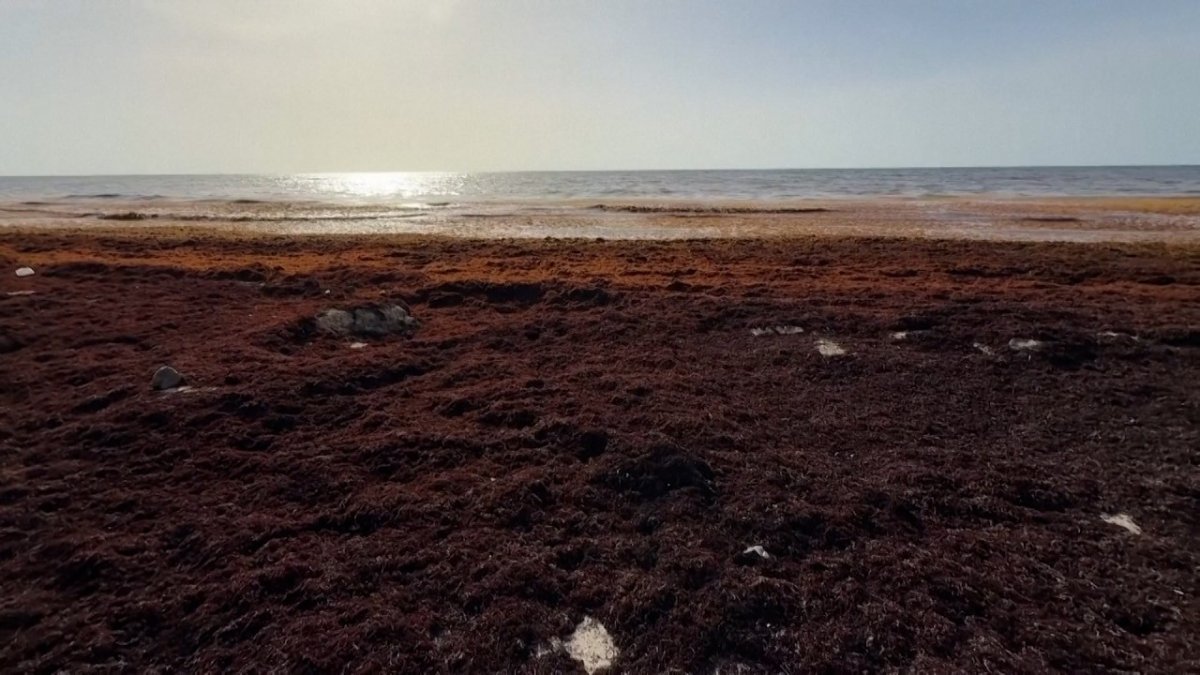
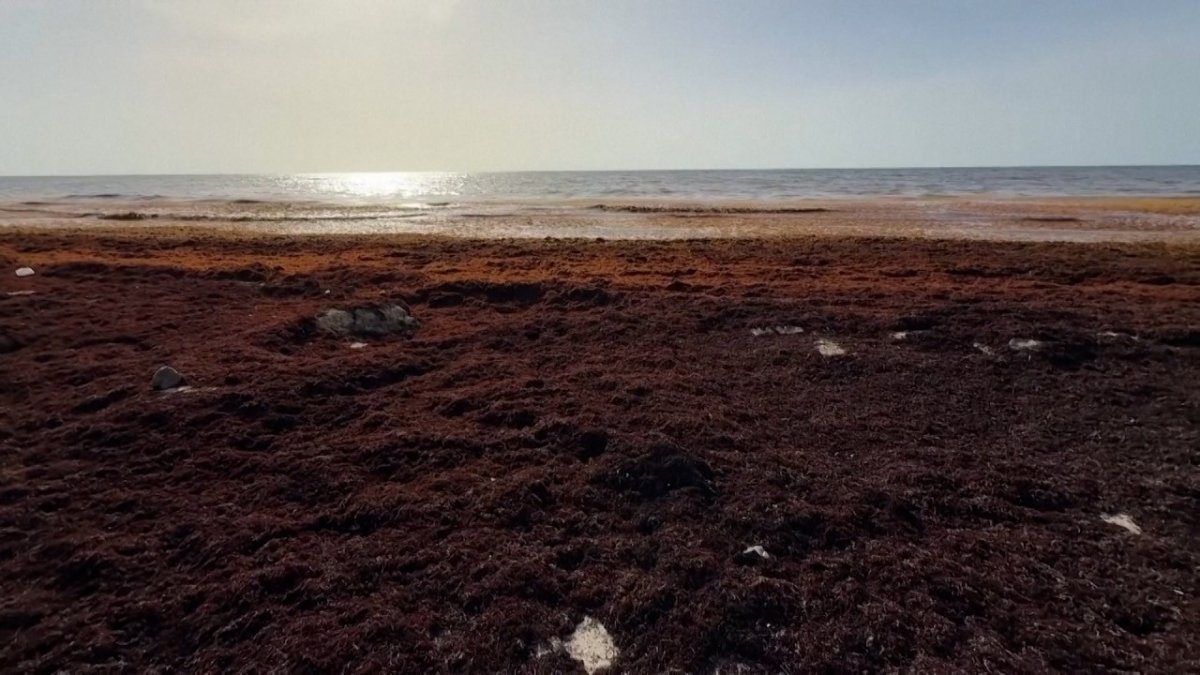
On a Tuesday morning in late July, workers on the beaches of Tulum were doing something that has become as routine as sunrise in Mexico's Caribbean: shoveling mountains of brown, rotting seaweed off the sand before the tourists woke up. By the time they finished one stretch, the tide had already delivered more. This is the reality of the 2026 sargassum crisis — a record bloom of the Great Atlantic Sargassum Belt that is dumping up to 9,000 tons of seaweed a day onto the shores of Quintana Roo, threatening the tourism engine that powers one of Latin America's most important coastal economies.
A Brown Tide Over Paradise: Sargassum's Record Invasion of Mexico's Caribbean
Cancún, Quintana Roo – Mexico, July 31, 2026 — The numbers read like a disaster report: roughly four times the sargassum of 2025, 27 times the historical daily average, and a projected 119,000 tons for the year — already eclipsing last year's record 96,000 tons. From Cancún's Hotel Zone to the bohemian beaches of Tulum, from Playa del Carmen to Mahahual, the brown tide is testing Mexico's ability to defend its most valuable coastline. And the fight is no longer just about raking beaches — it has become a national strategy involving the Mexican Navy, a billion-peso budget, and a race to turn a menace into an industry.
The Record Bloom Choking Quintana Roo
Sargassum arrivals on Quintana Roo's coast have reached levels that officials say have never been seen before. Up to 9,000 tons of the brown macroalgae wash ashore every single day, according to environmental officials — four times the daily volume of 2025 and 27 times the historic daily average, as SEMARNAT Secretary Alicia Bárcena reported in late July. The state's beaches, which stretch from Isla Mujeres and Cancún down through Puerto Morelos, Playa del Carmen, Cozumel, Akumal, Tulum and Xcalak, have become the front line of an ocean-scale event.
The Mexican Navy's SEMAR reported collecting 88,998 tons by late July, on top of more than 28,000 tons gathered earlier in the year through joint operations with SEMARNAT and state authorities. Yet the seaweed keeps coming. The crowd-sourced Sargassum Monitoring network showed nearly 9,000 "red pins" of active sightings across the region as of July 31, 2026 — a visual representation of just how widespread the invasion has become. In Tulum, the hardest-hit destination, beaches have been forced to close at times, sargassum has doubled in accumulation in several areas, and the fallout is being measured in lost sales of up to 60 percent at beachfront businesses.
The Science Behind the Sargassum Surge
This is not a local problem with a local cause. The seaweed blanketing Mexican beaches comes from the Great Atlantic Sargassum Belt, a floating ribbon of algae that stretches more than 5,000 miles — over 8,800 kilometers — from the coast of West Africa across the tropical Atlantic, through the Caribbean Sea and into the Gulf of Mexico. The belt coalesced around 2011 and has since become a self-sustaining, year-round feature of the ocean rather than a seasonal curiosity.
Scientists at the University of South Florida's Optical Oceanography Laboratory, led by researcher Chuanmin Hu, have tracked the belt for years through the Sargassum Watch System, using MODIS instruments on NASA's Terra and Aqua satellites and, more recently, NASA's PACE satellite with its OCI sensor for near-daily, high-resolution coastal mapping. Their data show the belt reached an all-time high of approximately 37.5 million to 38 million metric tons in May 2025 — far beyond the previous June peak of about 22 million tons. In June 2026, NASA's Earth Observatory reported near-record overall levels, with the Caribbean Sea and the Gulf of Mexico both hitting all-time highs for sargassum biomass.
The explosive growth is driven by a combination of excess nutrients — nitrogen and phosphorus — and warmer sea surface temperatures. The Amazon River, carrying agricultural fertilizer, sewage and runoff linked to deforestation, is a major contributor, along with the Orinoco and Congo rivers, ocean upwelling and even Saharan dust delivering iron and phosphorus. As climate change warms the Atlantic and alters currents, the belt has begun acting as its own "seed stock," making the phenomenon harder to disrupt with each passing year.
Tourism Under Siege on the Mexican Caribbean
The Mexican Caribbean is not just a vacation destination — it is a cornerstone of the national economy and one of Latin America's most important sources of tourism revenue and employment. When the seaweed hits, it hits people: hotel workers, restaurant staff, dive instructors, fisherfolk, and the thousands of families whose livelihoods depend on the beach. In Tulum, dozens of restaurants and shops along the coastal road have shut down or are struggling to survive, with some beachfront businesses reporting sales drops of up to 60 percent.
Cancún's Hotel Zone has seen sargassum pile up on many stretches, though the larger resorts with heavier machinery have managed to keep their private beaches relatively usable. Playa del Carmen, Puerto Morelos and the Riviera Maya are highly variable day to day — one beach can be clear in the morning and buried by evening, depending on winds and currents. Meanwhile, Cozumel's west coast has remained comparatively clear, offering a glimpse of what the region looks like when the seaweed stays offshore. The unpredictability itself is the problem for tourism: travelers planning summer vacations in peak season cannot be certain what they will find when they arrive.
Public Health and Ecosystems at Risk
The danger of sargassum goes beyond ruined photographs and canceled beach days. When the seaweed piles up on shore and decomposes in oxygen-poor conditions, it releases hydrogen sulfide gas — the source of the rotten-egg smell that now hangs over many coastal neighborhoods. Exposure can cause eye, nose and throat irritation, headaches, dizziness, coughing and respiratory distress. For beach cleaners, tourism workers and residents who live near the accumulation zones, prolonged exposure raises the risk of more serious pulmonary problems.
The ecological toll is equally severe. Thick mats of sargassum smother corals, seagrass beds and mangroves — the very ecosystems that protect coastlines and support fisheries across the Caribbean. Sea turtle nesting beaches in Quintana Roo, some of the most important in the hemisphere, face a double threat as the algae blocks mothers from nesting and suffocates hatchlings beneath the rotting mass. Scientists also warn of heavy metal and arsenic uptake in the seaweed, complicating efforts to recycle it into fertilizer or construction materials and underscoring how a single ocean phenomenon can cascade through human health, biodiversity and the economy at once.
Mexico's Billion-Peso Response
President Claudia Sheinbaum unveiled a reinforced national strategy on July 30, 2026, during her morning press conference, mobilizing more than 2 billion pesos — over US$115 million — to fight the bloom. The "Estrategia Integral de Atención y Manejo del Sargazo" is led operationally by the Mexican Navy's SEMAR, with SEMARNAT handling environmental policy, SECTUR managing the tourism dimension, Fonatur supporting coastal infrastructure, and Quintana Roo Governor Mara Lezama coordinating with hoteliers and the private sector.
The plan's centerpiece is infrastructure and muscle: nearly 50 kilometers of offshore containment barriers, satellite monitoring of more than 140 beaches using imagery from 10 satellites, and collection capacity of up to 1,227 tons per day at sea and 950 tons per day on beaches. Navy vessels, including the sargassum-collecting ocean ship ARM "Natans," are deployed under what the government calls Operación Sargazo, while SEMAR's Instituto Oceanográfico del Golfo y Mar Caribe runs daily forecasts and an early warning system. On the innovation front, SEMARNAT is pushing a circular economy agenda with 198 initiatives, 39 companies developing products from biofertilizers and biogas to construction materials, and 11 projects with industrial scaling potential — anchored by the Polo de Economía Circular in Puerto Morelos.
What This Means for Latin America
Mexico is not alone in this fight — it is simply on the sharpest edge of a regional phenomenon. The same sargassum belt that smothers Quintana Roo pounds the coasts of the Dominican Republic, Cuba, Jamaica, Belize, Honduras and the rest of the Caribbean, and periodically reaches Brazil's northeastern beaches after crossing the Atlantic. The Amazon connection is the region's uncomfortable truth: the very deforestation and agricultural expansion reshaping South America's largest biome are pouring nutrients into the ocean that feed a seaweed bloom thousands of kilometers away.
That is why Cancún will host an international sargassum summit on October 1-2, 2026, bringing together Caribbean nations, Brazil, Japan, the European Union, businesses and financing organizations to share technology and coordinate regional solutions. Latin American governments are also watching Mexico's circular economy experiment closely — if sargassum can be turned into fertilizer, fuel and building materials at scale, the region may transform a chronic environmental disaster into a source of rural employment and industrial innovation. The stakes are existential for coastal communities across the hemisphere that depend on the same turquoise water that is now turning brown.
The Bottom Line — What Comes Next
The 2026 season is not over. Sargassum typically peaks through the summer and into the fall, and with the Caribbean Sea and Gulf of Mexico at all-time highs in biomass, Mexican authorities expect the pressure to continue for weeks. The billion-peso response buys time, but it does not address the root cause: a warming ocean and a nutrient-loaded Atlantic fed by rivers from three continents, including Latin America's own Amazon and Orinoco.
For Elena's readers across the region, the lesson is clear — the sargassum crisis is a climate crisis wearing seaweed camouflage. It is a warning that the health of the ocean, the health of the rainforest, and the health of coastal communities are one single story. Mexico's response — combining navy-scale cleanup, satellite science and an audacious bet on turning waste into industry — is a template the entire Caribbean may need to copy. The beach shovels are still moving in Tulum, but the real work lies in the rivers, the forests and the emissions that feed the brown tide before it ever reaches the shore.
By Elena Vasquez, Staff Writer
This article was produced with AI-assisted research and editorial support. Reporting is based on sources cited in the article.
What's Your Reaction?
 Like
0
Like
0
 Dislike
0
Dislike
0
 Love
0
Love
0
 Funny
0
Funny
0
 Wow
0
Wow
0
 Sad
0
Sad
0
 Angry
0
Angry
0

Latin America Correspondent at Global1.News. Based in Mexico City, covering politics, economics, energy, and culture across the region. Brings an on-the-ground perspective to stories spanning from the Rio Grande to Patagonia.












Comments (0)