
Ombudsman Remulla calls Davao City 'epicenter' of flood control corruption; Paolo Duterte fires back
Ombudsman Remulla calls Davao City 'epicenter' of flood control corruption; Rep. Paolo Duterte challenges him to show complete records. Probe may expand to other provinces amid wider DPWH crackdown.
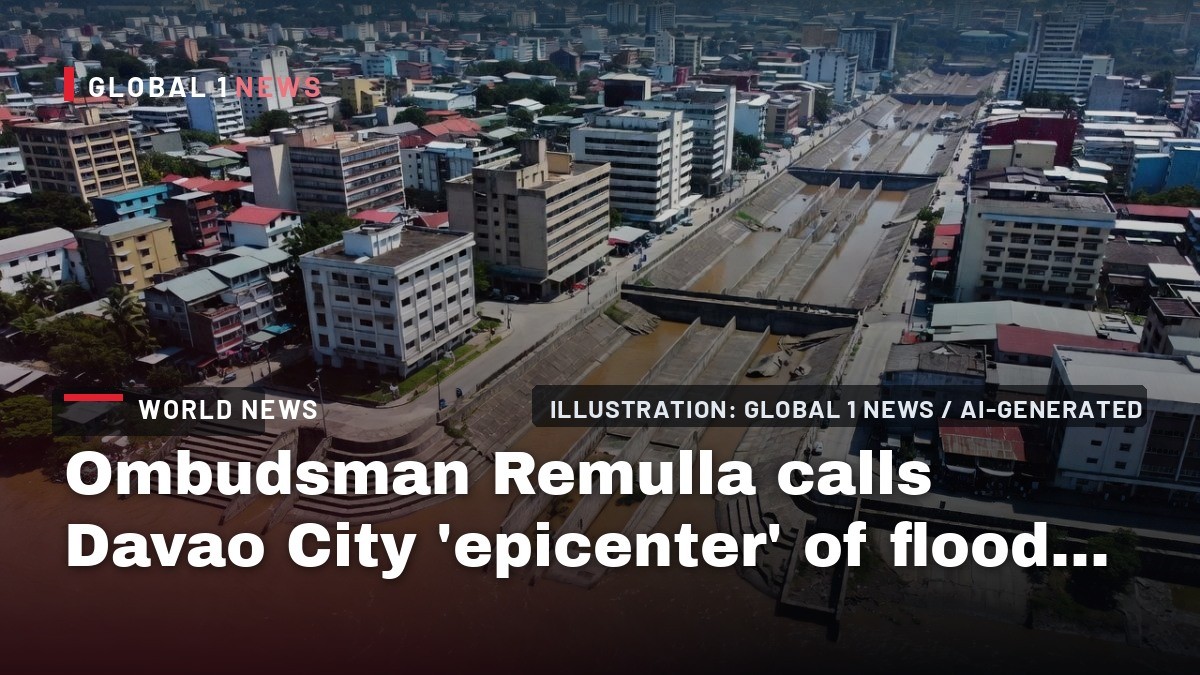
The war of words between the Office of the Ombudsman and the Duterte family escalated this week after Ombudsman Jesus Crispin Remulla described Davao City as the "epicenter" of flood control corruption before the Marcos administration, prompting Davao City 1st District Rep. Paolo Duterte to challenge him to present complete records. The heated exchange unfolded during the House Committee on Appropriations budget briefing for the Office of the Ombudsman's fiscal year 2027 allocation on Tuesday, August 25, exposing a deep rift over how the anti-graft body is pursuing its investigation into public works projects in the Duterte family's political stronghold.
What Remulla Said
During the budget hearing, Remulla told lawmakers that investigating flood control projects in Davao City has been particularly difficult due to what he called an "ecosystem of corruption" that has made information-gathering a slow and painstaking process. The Ombudsman was responding to a query from ACT Teachers Partylist Representative Antonio Tinio, who asked about investigations conducted by the agency before the administration of President Ferdinand Marcos Jr.
"Hindi lang madali talaga sapagkat sabihin natin ang epicenter po ng flood control bago ho dumating ang Marcos administration ay Davao City," Remulla said. (It really isn't easy because, let's say, the epicenter of flood control before the Marcos administration came in was Davao City.)
"Davao po 'yung ecosystem na aming tinutukoy. Kasi doon maraming pondo na pumasok daw sa flood control," Remulla added. (Davao is the ecosystem we are referring to because that is where a lot of funds allegedly went into flood control.)
The Ombudsman elaborated on the challenges his office faces, saying, "Ang ecosystem of corruption po mabigat. Mahirap pong pasukin. Mahirap pong kumuha ng impormasyon. Marami hong taong hindi nagsasalita pero hindi ho kami tumitigil." (Corruption operates as a heavy, hard-to-penetrate system. Information is difficult to secure, and many choose to remain silent, but our work continues uninterrupted.)
Remulla also said the Office of the Ombudsman plans to expand its probe to other provinces. He offered no proof during the briefing — no contractor, project, amount, or district — and said he would not reach a firm conclusion without validating the situation on the ground.
Paolo Duterte Fires Back
Rep. Paolo Duterte, eldest son of former President Rodrigo Duterte, took to Facebook to condemn the claim and urge caution.
"Boying Remulla, bago ninyo ideklara na Davao City ang 'epicenter' ng flood control corruption noong Duterte administration, baka puwedeng silipin muna ninyo ang mismong records ng DPWH," Duterte said. (Boying Remulla, before you declare Davao City as the 'epicenter' of flood control corruption during the Duterte administration, maybe you could first take a look at the actual records of the DPWH.)
The congressman, who was first elected in 2019 and is now serving his last term until 2028, challenged the Ombudsman to present complete documentation. "And if you are referring to Davao as the 'epicenter', then show us the complete records. Lahat ng taon. Lahat ng proyekto. Lahat ng pangalan. Walang pili. Walang exempted," he said. (All the years. All the projects. All the names. Not selective. No exemptions.)
Duterte also pointed out that his tenure as congressman only began in 2019, and that the 1st District of Davao City was previously represented by the Nograles family for 18 consecutive years. "At kung imbestigahan niyo ang Davao dapat hindi lang during my term po ha, 2019 lang po ako naupo na congressman sa aming lugar. Long before I became congressman, Nograles po ang congressman sa aming distrito," he added. (And if you investigate Davao, it shouldn't just be during my term. I only took office as congressman in our area in 2019. Long before I became congressman, a Nograles was the congressman in our district.)
Karlo Alexei Nograles served the district from 2010 to 2019, while his father, Prospero Nograles, held the seat from 2001 to 2010 and served as Speaker of the House from 2008 to 2010. Duterte said he still trusts that many officials and employees of the Ombudsman's office have "malasakit, integridad, at konsensya para sa bayan" (compassion, integrity, and conscience for the country).
The Red Flags Behind the Claim
Remulla's remarks did not emerge from a vacuum. In November 2025, Rep. Antonio Tinio of ACT Teachers Partylist raised red flags over 80 projects in Davao City's first district, calling for a congressional investigation to check for irregularities. Tinio was quoted in an Inquirer report on November 5, 2025, as saying there were projects under Duterte's first district that had irregularities, based on documents from the Department of Public Works and Highways (DPWH), the National Expenditures Program, and the General Appropriations Act from 2019 to 2022.
Duterte said that when he assumed office in 2019, the DPWH regional office in Davao (DPWH XI) furnished him a list of completed projects covering 2020 to 2022. "I have my copy," he said, adding he would send one to Remulla.
The congressman also emphasized that any investigation should not be selective. "Kung may anomalya, imbestigahan. Kung may ebidensya, ilabas. Pero huwag gawing shortcut ang political narrative para makabuo ng konklusyon," he said. (If there are anomalies, investigate. If there is evidence, release it. But do not make a shortcut out of the political narrative to come up with a conclusion.)
Remulla maintained that the difficulty of penetrating what he called a closed system should not be mistaken for inaction.
A Wider Crackdown on Flood Control Funds
The Davao probe is part of a larger national effort against alleged DPWH corruption. On August 22, DPWH Secretary Vince Dizon inspected alleged "ghost" flood control projects in Paombong and Hagonoy, Bulacan, according to the Daily Tribune — part of a crackdown on contractors paid for projects never completed or never built.
President Marcos Jr. has also moved to form an independent body to probe DPWH corruption, while the Sandiganbayan anti-graft court has said it aims to resolve flood control cases within six to eight months.
Flood control projects are among the most expensive infrastructure items in the national budget, and ghost-project allegations have recurred across administrations. The Ombudsman's plan to expand the probe means other regions could face similar scrutiny.
What This Means for Ordinary Filipinos
For ordinary Filipinos, the fight over flood control corruption is not just a political squabble between powerful figures — it is a matter of life and safety. Every rainy season, communities across the country — from Metro Manila's crowded streets to rural barangays in Mindanao — brace for flooding that destroys homes, displaces families, and damages livelihoods. When public funds meant for dikes, drainage systems, and flood mitigation projects are allegedly siphoned off or wasted, it is the sari-sari store owner, the tricycle driver, and the farmer who pay the price.
In flood-prone areas, a well-built drainage system can mean the difference between a manageable rainy day and a disaster that washes away a family's savings. The bayanihan spirit that Filipinos are known for often kicks in during floods — neighbors helping neighbors, volunteers distributing relief goods — but that spirit cannot replace the basic infrastructure that should have been built with public money.
The case is significant because Davao City has long been held up as a model of efficient governance under the Duterte family. Proven corruption would damage that reputation; unproven claims would raise questions about why the Ombudsman singled out the city without concrete evidence. Either way, Filipinos want to know their taxes are being used properly.
Flooding affects ordinary families directly, and public money for dikes and drainage protects entire barangays. The challenge is ensuring the investigation is thorough, transparent, and fair — not driven by vendettas or selective memory.
What Happens Next
The Ombudsman's investigation continues, with Remulla saying the office will not stop despite the difficulty of gathering information. The plan to expand the probe means more areas may come under scrutiny.
Duterte has challenged the Ombudsman to present complete records — all years, all projects, all names — and offered to share his own copy of the DPWH list as a starting point for a more transparent exchange.
With the Bulacan inspections, the proposed independent investigative body, and the Sandiganbayan's six-to-eight-month target for flood control cases, there is a clear push for accountability at the highest levels.
For now, the ball is in the Ombudsman's court: back up the "epicenter" claim with hard evidence or risk being seen as engaging in political theater. Filipinos hope the truth comes out so that public funds for flood control actually protect communities, not line pockets.
This article was produced with AI-assisted research and editorial support. Sources: Philstar.com, MindaNews, Inquirer.net, Daily Tribune.
By Bella Reyes, Staff Writer
What's Your Reaction?
 Like
0
Like
0
 Dislike
0
Dislike
0
 Love
0
Love
0
 Funny
0
Funny
0
 Wow
0
Wow
0
 Sad
0
Sad
0
 Angry
0
Angry
0

Philippines/Southeast Asia Correspondent at Global1.News. Manila-based journalist covering Philippine politics, environment, maritime security, and social issues. Passionate about marine conservation and the communities protecting the Philippines' natural heritage.











Comments (0)