
North Korea Warns of 'Nuclear Dominoes' as Seoul Advances Nuclear Submarine Plan
Seoul, South Korea – August 26, 2026 — North Korea has issued its first official condemnation of South Korea's nuclear-powered submarine program, warning that Seoul's pursuit of the vessel will trigger a "nuclear dominoes" effect across the Asia-Pacific region. The statement, delivered through state-run KCNA on August 12, marks a significant escalation in the rhetorical war over maritime military capabilities on the Korean Peninsula.
Seoul, South Korea – August 26, 2026 — North Korea has issued its first official condemnation of South Korea's nuclear-powered submarine program, warning that Seoul's pursuit of the vessel will trigger a "nuclear dominoes" effect across the Asia-Pacific region. The statement, delivered through state-run KCNA on August 12, marks a significant escalation in the rhetorical war over maritime military capabilities on the Korean Peninsula.
The warning came as South Korea presses forward with the Jangbogo-N program, a domestically designed and built nuclear-powered attack submarine slated for launch in the mid-2030s. The exchange underscores a rapidly accelerating underwater arms race between the two Koreas, with implications that extend far beyond the peninsula to the broader strategic competition between Washington and Beijing.
Pyongyang's 'Nuclear Dominoes' Warning
North Korea's Foreign Ministry issued the statement under the name of First Vice Foreign Minister Jang Kum-chol, who also serves as director of the Workers' Party of Korea Central Committee's 10th Bureau handling South Korean affairs. Jang's warning was unambiguous: "The ROK's possession of nuclear submarine[s] will inevitably result in nuclear dominoes in the Asia-Pacific region."
The North Korean official argued that Seoul's submarine plan "has entered its execution phase" and was deepening regional instability. He further claimed that South Korea had secretly pursued nuclear submarine ambitions since 2003, asserting the program was not a "reflective measure" responding to the DPRK's nuclear weapons. Pyongyang has long cast its own arsenal as a defensive necessity; it now characterizes Seoul's conventional submarine program as an offensive provocation.
Jang's statement also contained a veiled threat regarding North Korea's own strategic posture. He said possessing "the unparalleled power capable of" delivering a "retaliatory attack" that is "impossible to survive [or recover from]" would be "the most responsible option for deterring a war." This language signals that Pyongyang intends to press ahead with its nuclear and missile development programs regardless of international condemnation.
Notably, Jang accused the United States of openly "conniving and encouraging" its allies to pursue nuclear capabilities, warning that US-ROK-Japan military cooperation could become "a second AUKUS." The reference to the Australia-UK-US pact suggests Pyongyang views Washington's deepening Indo-Pacific alliance network as a direct threat.
Seoul's Defensive Rebuttal
South Korea's Ministry of Foreign Affairs rejected the North Korean warning on August 13. Spokesperson Park Doo-soon told a regular briefing that the planned submarines will carry only conventional weapons and sit entirely within the Nuclear Non-Proliferation Treaty (NPT) framework. Park called the program a "justified and defensive" answer to a rapidly changing security environment, citing North Korea's advancing nuclear and missile capability and its construction of a nuclear-powered submarine of its own.
The spokesperson emphasized Seoul's treaty compliance, stating that South Korea "has met its treaty obligations faithfully and will stay in close contact with the IAEA on the basis of transparency." He added that Seoul would present its case to every country with a stake in the matter. When asked whether Seoul had explained itself to China or Russia, and whether the subject would arise during Chinese Foreign Minister Wang Yi's visit to Seoul later in August, Park said he had nothing to offer.
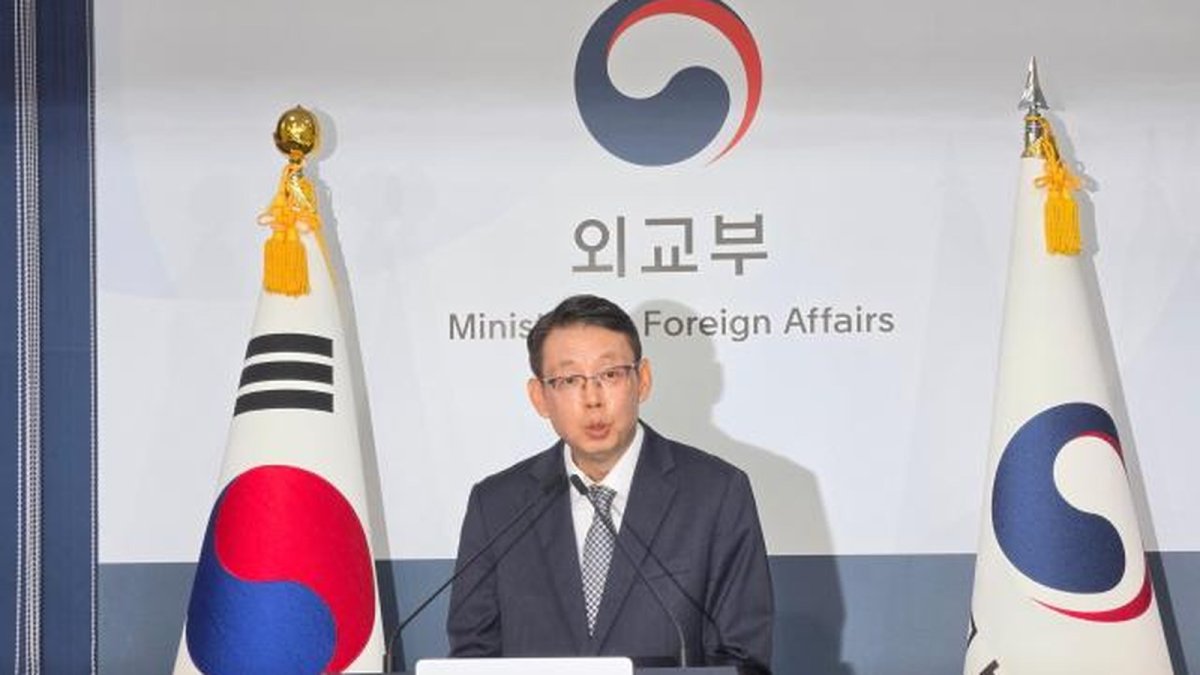
South Korean Foreign Ministry spokesperson Park Doo-soon at a regular briefing in Seoul, August 2026. (Aju Press)
According to Yonhap, the August 12 criticism was Pyongyang's first official response to Seoul's submarine plan, as confirmed by a South Korean unification ministry official. The timing — nearly three months after Seoul unveiled the program — suggests Pyongyang deliberated before responding to a capability that alters the peninsula's naval balance.
The Jangbogo-N Program
The submarine program at the center of this diplomatic storm was formally unveiled on May 26, 2026, when the Ministry of National Defense released the "Basic Plan for the Development of the Republic of Korea Nuclear-Powered Submarine." Defense Minister Ahn Gyu-back announced that Seoul aims to launch its first submarine in the mid-2030s, with the vessel designed and built entirely in South Korea.
A critical technical decision was the choice of fuel. The submarine will run on low-enriched uranium fuel (less than 20 percent uranium-235) produced domestically, following the model of France's Barracuda-class attack submarines rather than the highly enriched uranium used in US and British naval reactors. This choice is strategically significant: it allows Seoul to argue that its program is more transparent and less proliferation-sensitive than those of established nuclear submarine powers.
The plan commits Seoul to establish an IAEA safeguards system applicable to submarine reactors, a commitment welcomed by IAEA Director-General Rafael Grossi on June 8. This engagement with the international nuclear watchdog is designed to preempt criticism that the program could serve as a stepping stone to nuclear weapons development.
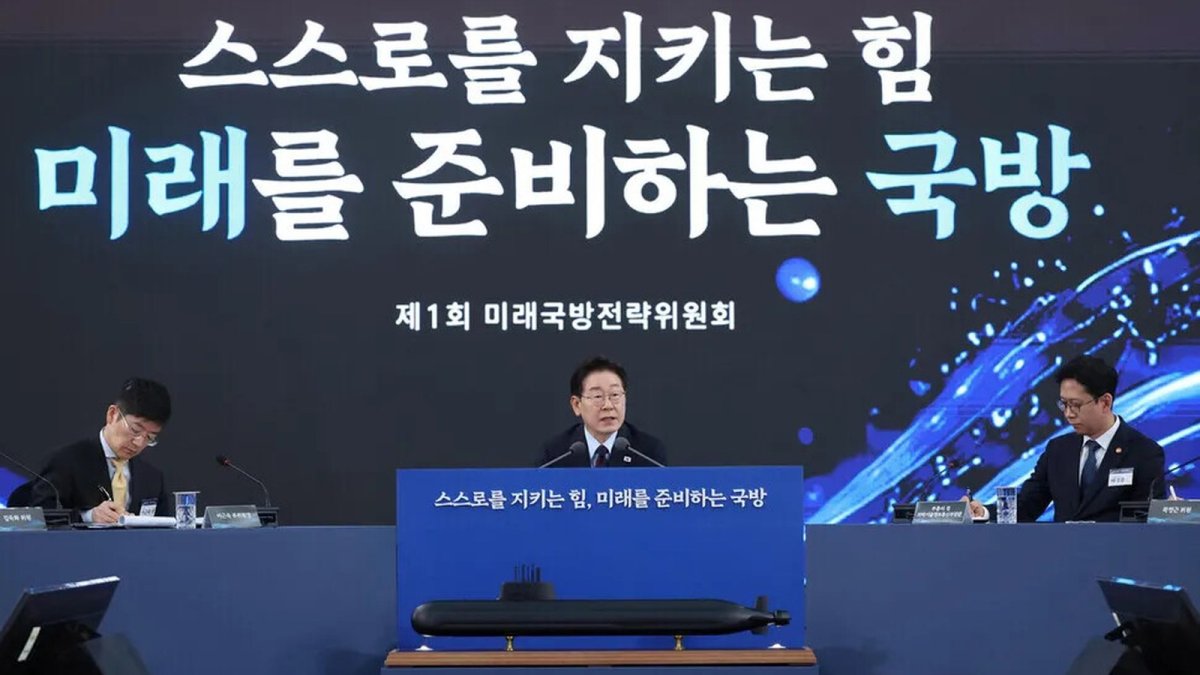
President Lee Jae Myung at a defense forum in Jinhae, May 26, 2026. (The Hankyoreh / pool photo)
President Lee Jae Myung led the first meeting of the Future Defense Strategy Committee in Jinhae on the same day the plan was released. On August 18, Lee ordered the defense ministry to accelerate Jangbogo-N development and reaffirmed plans to complete the transfer of wartime operational control (OPCON) during his term. The OPCON transfer, long delayed and politically sensitive, would mark a major milestone in South Korea's military independence from the United States.
Defense officials describe the submarine's mission as an "underwater kill chain" capability — tracking and targeting North Korea's nuclear-armed submarines before Pyongyang can launch an attack. The mission reflects a shift in South Korean naval doctrine toward a blue-water force capable of power projection.
The Underwater Arms Race
The Jangbogo-N program is, in large part, a direct response to North Korea's own submarine ambitions. Pyongyang is pursuing an 8,700-ton "nuclear-powered strategic guided missile submarine" with reported Russian technical assistance. On December 25, 2025, North Korea unveiled the completed hull of the vessel, with Kim Jong Un personally inspecting the "mounted reactor inside." In March 2026, Kim visited the construction facility and received a detailed briefing on the project.
The size of the North Korean vessel has driven significant changes in Seoul's planning. The Jangbogo-N's displacement grew from roughly 5,000 tons to an understood 7,000-8,000 tons after North Korea disclosed its own submarine — near the size of the US Virginia-class, which displaces about 7,800 tons submerged. This represents a major expansion from the Navy's current 3,000-ton Dosan Ahn Chang-ho class and newer 3,600-ton boats.
The Financial Times reported on July 28 that the submarine competition could extend beyond inter-Korean tensions to affect the wider maritime balance of power between the United States and China in Northeast Asia. This observation reflects the strategic significance of the Korean Peninsula's underwater domain, which sits astride critical sea lanes connecting the Pacific to the Yellow Sea and the Sea of Japan.
Regional and Alliance Implications
The submarine program has fundamentally altered the US-ROK alliance dynamic. The plan followed President Donald Trump's November 2025 pledge of US support for Seoul's decision to build nuclear-powered attack submarines and its ambitions to enrich uranium and separate plutonium — capabilities Washington previously sought to prevent. This reversal of long-standing US nonproliferation policy represents one of the most significant shifts in the alliance's history.
US-ROK nuclear cooperation talks were held June 2-3, with First Vice Foreign Minister Park Yoon-joo leading the South Korean team. The negotiations center on revising the US-ROK nuclear cooperation agreement, known as the 123 Agreement, to enable uranium enrichment and spent-fuel reprocessing. North Korea's Jang Kum-chol attacked this push directly, saying it is "the final goal of the ROK to secure the right to produce nuclear materials... and ultimately pave the way for making a leap forward to nuclear armament."
The program also has implications for South Korea's relations with China and Russia, both of which have historically opposed any nuclear-related capabilities on the peninsula. Seoul's apparent decision to proceed without detailed public consultation with Beijing or Moscow — the foreign ministry spokesperson declined to discuss the matter — suggests a willingness to accept diplomatic friction in pursuit of strategic autonomy.
Looking Ahead
The coming months will test whether the diplomatic framework can contain the escalating submarine competition. North Korea's warning of "nuclear dominoes" suggests Pyongyang views Seoul's program as a fundamental challenge to its security, potentially justifying further nuclear and missile development. South Korea, for its part, appears committed to the Jangbogo-N timeline, with President Lee's August 18 directive to accelerate development signaling political resolve.
The IAEA's role in safeguarding the submarine reactor will be crucial to the credibility of Seoul's nonproliferation commitments, though the agency's ability to verify naval nuclear fuel cycles remains untested.
For the broader region, the Korean submarine race adds a new dimension to the already complex security architecture of Northeast Asia. As the Financial Times noted, the competition could reshape the maritime balance between Washington and Beijing, with the Korean Peninsula serving as the fulcrum. The coming years will reveal whether Seoul's gamble on nuclear propulsion strengthens its deterrence posture or triggers a new spiral of regional militarization.
By Prof. David Park, Staff Writer
This article was produced with AI-assisted research and editorial support. Reporting is based on sources cited in the article.
What's Your Reaction?
 Like
0
Like
0
 Dislike
0
Dislike
0
 Love
0
Love
0
 Funny
0
Funny
0
 Wow
0
Wow
0
 Sad
0
Sad
0
 Angry
0
Angry
0

East Asia/Technology Correspondent at Global1.News. Seoul-based voice covering Korean politics, technology, business, and culture. Analyzes how technology and geopolitics intersect across East Asia.















Comments (0)