
New Zealand Seals Three Pacific Defence Pacts to Counter China's Reach
Wellington has sealed three Pacific security pacts in under four months — a defence pact with Papua New Guinea, a security declaration with the Cook Islands and interest in the Australia-Fiji Ocean of Peace Alliance — in a coordinated push to check China's expanding security footprint in the region.
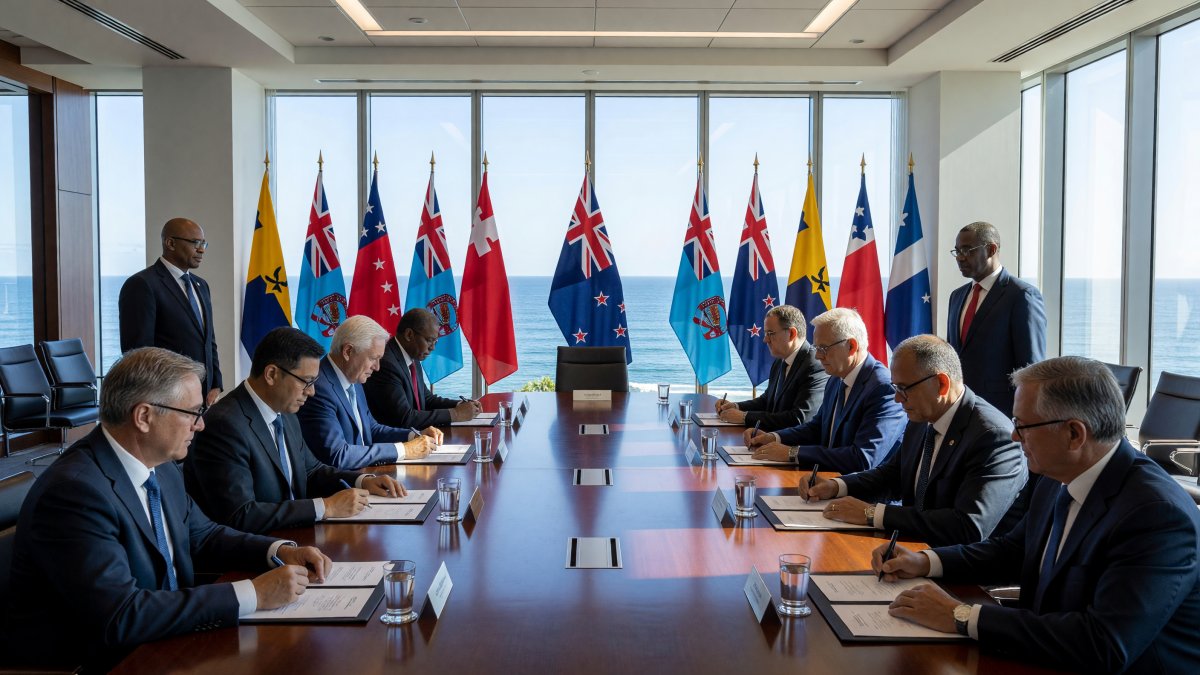
New Zealand's Pacific Pivot: Wellington Seals Three Defence Pacts to Check China's Reach
Wellington has quietly transformed its Pacific defence posture in less than four months, sealing three separate security agreements with island nations since April — a diplomatic offensive that analysts say is aimed squarely at limiting China's expanding security footprint in the region. The latest accord, signed on July 22 in Port Moresby, commits New Zealand and Papua New Guinea to expanded joint maritime surveillance, military exercises and personnel exchanges, deepening a defence pact first established in April.
New Zealand Defence Minister Chris Penk signed the agreement with his Papua New Guinean counterpart, Elias Kapavore, as Wellington also locked in a security declaration with the Cook Islands and signalled interest in joining the fledgling Australia-Fiji "Ocean of Peace Alliance." Taken together, the moves represent the most aggressive Pacific defence diplomacy Wellington has conducted in decades.
Tags: New Zealand, Pacific defence, China, Oceania security, Ocean of Peace Alliance, Christopher Luxon, Chris Penk, Indo-Pacific strategy, geopolitics, Australia-Fiji pact
The Trio of Accords: A Four-Month Diplomatic Blitz
New Zealand's defence diplomacy has shifted into overdrive this year, with Wellington sealing three major Pacific security agreements in less than four months. Since April, the country has signed a defence pact with Papua New Guinea, locked in a security declaration with the Cook Islands and floated the idea of joining a fledgling Australia-Fiji defence alliance. Analysts say the common thread is China and concerns about its expanding security and policing links in the Pacific.
The Cook Islands arrangement, agreed in April, made Wellington the islands' first port of call on defence matters — ahead of any other partner, China included. That declaration came just months after the Cook Islands signed a comprehensive strategic partnership with Beijing, a move that prompted Wellington to suspend part of its annual aid package to the islands on the grounds that it had not been adequately consulted.
"Security agreements and treaties in the Pacific are attempts to ensure that China is unable to establish security agreements with Pacific states," said Estelle Denton-Townshend, a teaching fellow in international security at the University of Waikato. In her assessment, Beijing building defence influence among New Zealand's neighbours risked leaving Wellington "more vulnerable to coercion," and the recent agreements amount to a coordinated campaign to formalise regional security ties, mirroring Australia's own push.
What the PNG Agreement Adds to the Regional Picture
The July 22 signing in Port Moresby was the most operationally concrete of the three accords. The expanded agreement with Papua New Guinea covers joint maritime surveillance — a capability directly relevant to the monitoring of foreign vessels and fishing activity in the region — along with combined military exercises and personnel exchanges between the two defence forces.
"In an increasingly volatile world, Pacific nations like ours are stronger when we work closely together," Penk said in a statement after the signing. The minister's language reflected a broader theme that has come to define New Zealand's approach: the framing of Pacific security as a shared responsibility among the region's own states, rather than an agenda imposed by outside powers.
For decades, Australia maintained formal treaty alliances exclusively with the United States and New Zealand. But after a flurry of deals in recent months, Canberra now holds mutual defence pacts with both Fiji and PNG as well, alongside its climate-focused Falepili Union with Tuvalu, which allows Tuvaluan citizens to resettle in Australia amid rising sea levels. Wellington's new agreements mirror that architecture almost point for point.
The Ocean of Peace Alliance: A New Zealand Seat at the Table?
The most consequential of Wellington's moves is its expressed interest in joining the Australia-Fiji "Ocean of Peace Alliance," a mutual defence treaty whose core clause recognises that "an armed attack on any of the parties within the Pacific would be dangerous to each other's peace and security as well as the security of the Pacific, and declares that it would act to meet the common danger."
Prime Minister Christopher Luxon announced on July 9 that New Zealand would explore joining the alliance, and he has been in conversations with Australian and Fijian leaders about it for months. "We've always said we want Pacific solutions to Pacific challenges," Luxon said. "With respect to security concerns that exist within the Pacific, this is a really good move."
Should Wellington sign on, Fiji would become New Zealand's second formal defence ally alongside Australia. Foreign Affairs Minister Winston Peters framed the prospect in terms of regional cohesion: "Elevating our long-standing relationship with Australia and Fiji – and other Pacific nations – to the next level through an alliance would mean we become even closer partners." Defence Minister Penk added that the move would build on 75 years of the New Zealand-Australia alliance, which the two countries marked this year.
The final decision rests with Cabinet followed by the standard parliamentary treaty process, and officials have indicated a decision is months away — likely after New Zealand's general election, meaning a new Cabinet will probably make the call. "It will take as long as it takes ... I think we can move through it hopefully very quickly," Luxon said. Victoria University international relations expert David Capie told the New Zealand Herald it was too early to say whether New Zealand would join, but acknowledged Luxon had shown a "real enthusiasm" to do so.
The China Factor: Missile Tests and Security Outreach
The diplomatic blitz comes against a backdrop of heightened Chinese military activity in the Pacific. On July 6, a People's Liberation Army Navy submarine test-fired a nuclear-capable long-range intercontinental ballistic missile carrying a dummy warhead. The missile flew through the exclusive economic zones of the Philippines, the US territories of Guam and the Northern Mariana Islands, eventually landing south-east of Nauru — inside a region that New Zealand and others have long designated as a nuclear-free zone.
The test drew condemnation from the United States, Japan, Taiwan, Australia and New Zealand. Even Solomon Islands Prime Minister Matthew Wale — who chairs the Pacific Islands Forum and has remained open to Chinese investment — said the launch was "not something a friend does" and announced he would lodge a "strong protest." Wale also argued the episode underscored the need for a regional security platform. "Not all the countries in the Pacific are on the same level of strength and may not want to speak up when things like this happen, but a regional platform will allow cover and allow for much greater sharing of intelligence and information."
Luxon denied that New Zealand's interest in the Ocean of Peace Alliance was a direct response to the missile test, noting that conversations with Canberra and Suva had been under way for months. But the sequence has sharpened the regional debate over how to respond to Beijing's dual-track engagement — economic investment on one hand, military signalling on the other.
China's Pacific Presence and Beijing's Rebuttal
China's security footprint in the Pacific has grown steadily since its landmark 2022 security pact with the Solomon Islands, which allows for police and military deployments. Beijing has also deepened Pacific trade and investment ties and has trained police forces in nations without standing militaries, such as Vanuatu and Kiribati.
Beijing has rejected suggestions that its engagement with Pacific nations is aimed at building a sphere of influence, saying its cooperation is based on mutual respect, development needs and the sovereignty of Pacific states. Chinese officials have further said that every country retains the right to choose its own partners, free from outside interference.
Robert Patman, an international relations professor at the University of Otago, expects Beijing to criticise New Zealand's new arrangements. "It could accuse Wellington of embracing a 'Cold War mentality' or compromising its independent foreign policy to please the US administration," Patman said. He also pointed to a second dynamic: growing doubts among Pacific states about the reliability of the United States as an ally. Washington has retreated from multilateral commitments and enacted erratic tariff policies under President Donald Trump, which analysts say has created an opening for Beijing to present itself as the more dependable long-term partner.
"While the Trump administration likes to lecture the world on the 'China threat,' it has inadvertently boosted Beijing's position in global affairs and New Zealand clearly feels it has little choice but to step up its own efforts," Patman said.
Beyond the Pacific: A Broader Diplomatic Recalibration
New Zealand's diplomatic reach is not confined to the Pacific. Jason Young, an associate professor of international relations at Victoria University of Wellington, places the country's recent moves in a wider geopolitical context. "New Zealand, like many countries in the region, is strengthening relations with countries from the Pacific to Europe as well as deepening existing partnerships by developing new areas of cooperation such as defence cooperation," he said.
In May, New Zealand and the European Union held their first formal high-level security and defence exchanges in Wellington, adding another layer to a foreign policy increasingly defined by its breadth as much as its focus. The United States, for its part, has publicly endorsed the trend. In a statement to the New Zealand Herald, a US Embassy spokesperson said defence arrangements were "sovereign matters" for each nation, adding: "The United States is committed to a free and open Pacific; we welcome and support efforts by Pacific nations to strengthen regional cooperation."
For Beijing, the calculus is more complex. New Zealand is a significant trading partner, and China remains one of its largest export markets. The question now is whether the hardening of Wellington's security posture will bleed into the economic relationship — a dynamic that Pacific analysts will be watching closely in the coming months.
What to Watch For
The immediate question is whether Wellington converts its stated interest in the Ocean of Peace Alliance into a formal accession. The answer will depend on the outcome of New Zealand's general election, the composition of the next Cabinet, and the pace of the treaty process — Luxon has promised speed, but parliamentary procedure and coalition dynamics could slow the timetable.
Also worth watching is how Beijing calibrates its response. If China follows Patman's predicted script and frames Wellington's moves as "Cold War mentality," it risks alienating Pacific states that have grown accustomed to Chinese investment. If it responds with economic pressure on New Zealand's key exports, it would confirm the very security-driven narrative that prompted Wellington's pivot in the first place.
For the wider region, the significance extends beyond New Zealand. The emerging architecture — Australian and New Zealand defence pacts with Fiji, PNG, and the Cook Islands, the Falepili Union with Tuvalu, and the proposed Ocean of Peace Alliance — is steadily filling the security vacuum that many Pacific states perceive in an era of great-power competition. How China chooses to respond to that architecture will shape the Pacific's strategic landscape for years to come.
By Kenji Tanaka, China Correspondent
This article was produced with AI-assisted research and editorial support. Reporting is based on sources cited in the article.
What's Your Reaction?
 Like
0
Like
0
 Dislike
0
Dislike
0
 Love
0
Love
0
 Funny
0
Funny
0
 Wow
0
Wow
0
 Sad
0
Sad
0
 Angry
0
Angry
0

Japan Correspondent at Global1.News. Tokyo-based voice covering Japanese politics, technology, economy, and culture. Tracks the intersection of tradition and innovation in one of the world's most dynamic societies.












Comments (0)