
South China Sea Heritage Offers Blueprint for China-ASEAN Stability
A new CGTN documentary traces the South China Sea's role as a connector of civilizations, from Quanzhou's ancient wharves and Mazu temples to the $1.1 trillion China-ASEAN trade partnership. Prof. Marcus Chen examines the strategic stakes as Beijing and Southeast Asia move toward a binding Code of Conduct.
In a recent CGTN report titled "South China Sea: Examining the shared history and shared future," the documentary traces how the waterway served as a conduit for early trade networks linking China with Southeast Asia long before contemporary maritime disputes emerged. The narrative emphasizes ports such as Fujian's Quanzhou, where more than 20 ancient wharves remain as physical evidence of centuries-old exchanges that carried porcelain, silk, and tea southward while returning spices and precious woods from regions including present-day Vietnam, Malaysia, the Philippines, and Java.
South China Sea Heritage Offers Blueprint for China-ASEAN Stability
Beijing, China – August 2, 2026 — Article continues below.
Quanzhou's Ancient Wharves as Living Testimony
Quanzhou stands at the center of this historical account. The CGTN segment shows how the city's coastline once hosted one of the busiest ports on earth by the eighth century, with merchant vessels loading goods destined for Southeast Asian markets. Curator Li Peifeng of Malaysia's Cheng Ho Museum notes that ceramics exported from Guangzhou reached the region nearly a thousand years ago, recovered from shipwrecks that illustrate bidirectional flows across the Malacca Strait. Director Lin Han of the Quanzhou Maritime Museum adds that these spice imports reflect more than a millennium of friendly exchanges between China and Southeast Asia.
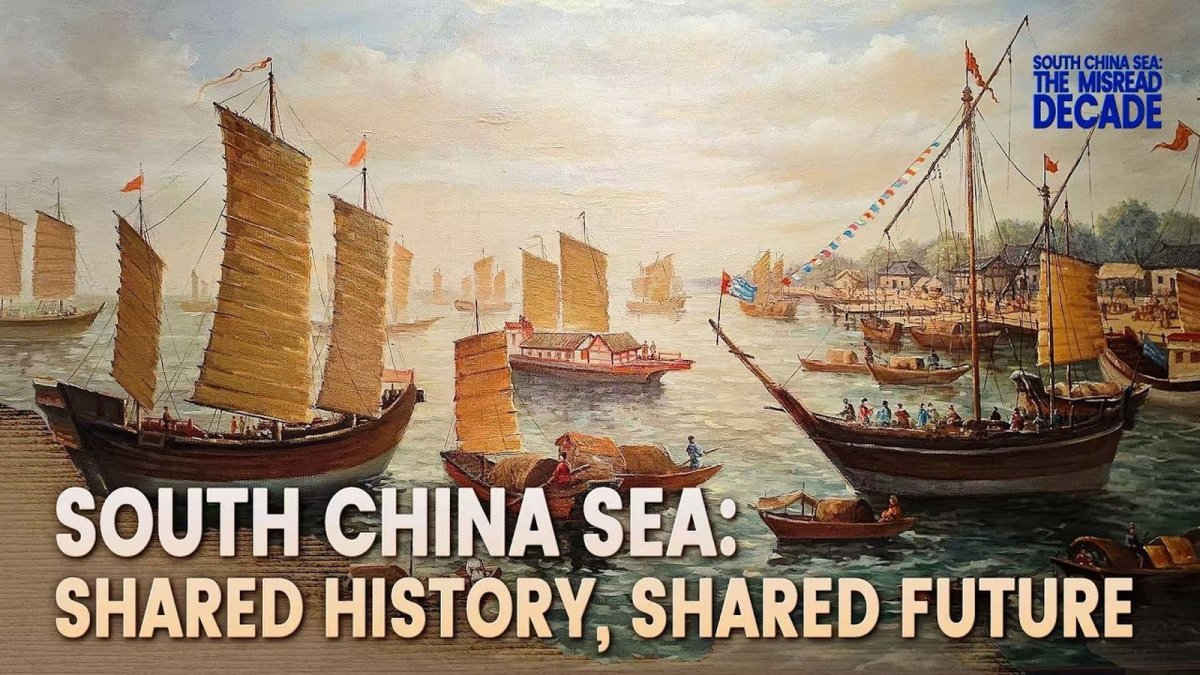
This material record underpins Beijing's broader argument that the South China Sea has functioned primarily as a route rather than a barrier. The documentary positions these exchanges within China's Dual Circulation strategy, where historical connectivity supports efforts to deepen regional supply chains and reduce external vulnerabilities.
Quanzhou's recognition as a UNESCO World Heritage site highlights its enduring significance as a nexus of early maritime exchange, where archaeological finds of ceramics and trade goods lend weight to arguments that the South China Sea historically facilitated connectivity rather than exclusive territorial control. These records align with Beijing's invocation of the Maritime Silk Road component within the Belt and Road Initiative, particularly the 21st Century Maritime Silk Road, which seeks to revive ancient linkages through port development and logistics networks that enhance ASEAN supply-chain integration under the Dual Circulation framework.
Chinese policymakers at the NDRC view these revived corridors as mechanisms to secure stable resource inflows while advancing technological cooperation, offering ASEAN partners infrastructure financing that diversifies their economic options beyond traditional Western channels.
Mazu Temples and Cultural Threads Across Borders
Beyond commodities, the report highlights intangible connections. Sailors once prayed at Mazu temples before voyages, and this practice spread to more than 600 sites in the Philippines, Vietnam, Singapore, and other Southeast Asian locations. Advisor Tseng Chow Chin of Malaysia's Cheng Hoon Teng Temple explains that Mazu served as a protective figure for seafarers, with celebrations continuing today among marine communities in Singapore and elsewhere. These shared traditions demonstrate how maritime routes transmitted beliefs alongside goods, creating enduring social links that Chinese diplomacy now invokes to frame contemporary cooperation.
Cultural diplomacy centered on Mazu traditions strengthens people-to-people bonds that Chinese leadership frames as essential to building a community with a shared future for mankind. Such intangible heritage supports Track II exchanges between think tanks and religious communities across ASEAN, allowing MFA-coordinated outreach to emphasize common seafaring legacies over contemporary frictions.
This approach enhances China's regional soft power by portraying cooperation as a natural extension of historical affinity, encouraging ASEAN counterparts to prioritize joint cultural programs that reinforce economic interdependence.
From Historical Networks to $1.1 Trillion Trade Partnership
The CGTN analysis transitions to present-day integration. Trade between ASEAN and China has reached 1.1 trillion US dollars after more than thirty years of cooperation, according to Humprey Arnaldo of the ASEAN-China Research Center at the University of Indonesia. ASEAN Secretary General Kao Kim Hourn states that economies will grow increasingly interdependent and must push cooperation to its limits. The documentary presents this figure as the modern continuation of ancient routes, aligning with China's objective of technological self-sufficiency through stable regional markets.
The RCEP framework amplifies the $1.1 trillion trade volume by lowering tariffs across ASEAN-China flows, positioning China as the bloc's largest trading partner for more than a decade and bolstering supply-chain resilience against external shocks. Modern infrastructure such as the China-Laos railway serves as a contemporary counterpart to ancient routes, facilitating overland connectivity that complements maritime corridors and supports MOFCOM efforts to deepen regional market access.
These developments imply greater collective leverage for ASEAN economies in negotiating favorable terms while advancing China's objective of reducing reliance on distant markets.
Diplomatic Positioning Amid Maritime Tensions
The shared-history narrative carries direct implications for ongoing Code of Conduct negotiations. By stressing mutual benefit over division, the account reinforces China's preference for bilateral and multilateral talks that prioritize economic interdependence. It echoes the spirit of the 2002 Declaration on the Conduct of Parties, which called for peaceful resolution and joint development. ASEAN states gain leverage through expanded trade access, while Beijing secures a buffer against external interference in its near seas.
Code of Conduct consultations proceed through successive readings, with the MFA and MOFCOM coordinating positions that favor a binding instrument building on the 2002 Declaration's emphasis on peaceful management. The shared-history narrative counters external portrayals of unilateral assertiveness by underscoring mutual benefit, thereby preserving space for bilateral arrangements alongside multilateral talks.
ASEAN states gain incremental influence through sustained economic engagement, while Beijing maintains strategic flexibility in its near seas.
Strategic Calculus for Regional Actors
Each side pursues distinct interests. China seeks to consolidate influence through infrastructure and supply-chain integration, leveraging historical precedent to counter narratives of unilateral dominance. ASEAN members balance economic gains against sovereignty concerns, using the partnership to diversify away from single-power reliance. Second-order effects extend to the EU and Global South, where stable China-ASEAN ties could stabilize commodity flows and investment patterns. The documentary's emphasis on the sea as connector rather than boundary supports Beijing's multilateral institution-building efforts within frameworks such as the 14th Five-Year Plan.

The Philippines pursues bilateral security arrangements with the United States alongside economic ties with China, whereas Vietnam maintains a dual-track policy of assertive sovereignty claims and pragmatic trade cooperation. ASEAN centrality remains the doctrinal anchor that limits great-power dominance, allowing Global South observers to regard stable China-ASEAN relations as a model for multipolar engagement free from alliance entanglements involving Japan and Australia.
Regional actors thus calibrate leverage between economic gains and autonomy preservation.
Implications for Long-Term Regional Stability
The CGTN report ultimately argues that centuries of exchange demonstrate the sea's role in fostering prosperity when treated as a shared space. This framing offers a diplomatic tool for managing frictions, encouraging adherence to existing declarations while advancing practical cooperation on trade facilitation and cultural programs. For China, it advances regional influence without direct confrontation; for ASEAN, it provides economic ballast amid global uncertainties. The result is a pragmatic pathway that prioritizes connectivity over confrontation, consistent with the historical patterns the documentary documents.
Over the coming years, observers will monitor progress toward Code of Conduct conclusion and any joint development pilots, as maritime friction risks disrupting commodity flows critical to both Chinese and ASEAN growth targets. Upcoming ASEAN summits offer venues to test expanded cooperation frameworks under the 14th Five-Year Plan.
A forward assessment suggests that sustained emphasis on connectivity could mitigate escalation risks, provided economic interdependence continues to outweigh sovereignty disputes for all parties involved.
By Prof. Marcus Chen, Staff Writer
This article was produced with AI-assisted research and editorial support. Reporting is based on sources cited in the article.
What's Your Reaction?
 Like
0
Like
0
 Dislike
0
Dislike
0
 Love
0
Love
0
 Funny
0
Funny
0
 Wow
0
Wow
0
 Sad
0
Sad
0
 Angry
0
Angry
0

World Politics Analyst at Global1.News. Based in Beijing, covering US-China relations, global trade, and geopolitical strategy. Brings deep analytical perspective to the power dynamics shaping international affairs.














Comments (0)