
Myanmar Leader Rejects ASEAN Consensus While Outlining Military-Led Transition
Min Aung Hlaing addressed a joint session of parliament in Naypyidaw on July 31, 2026, marking his first 100 days as president with a speech that dismissed ASEAN's Five-Point Consensus and accused unnamed member states of discriminating against his administration.
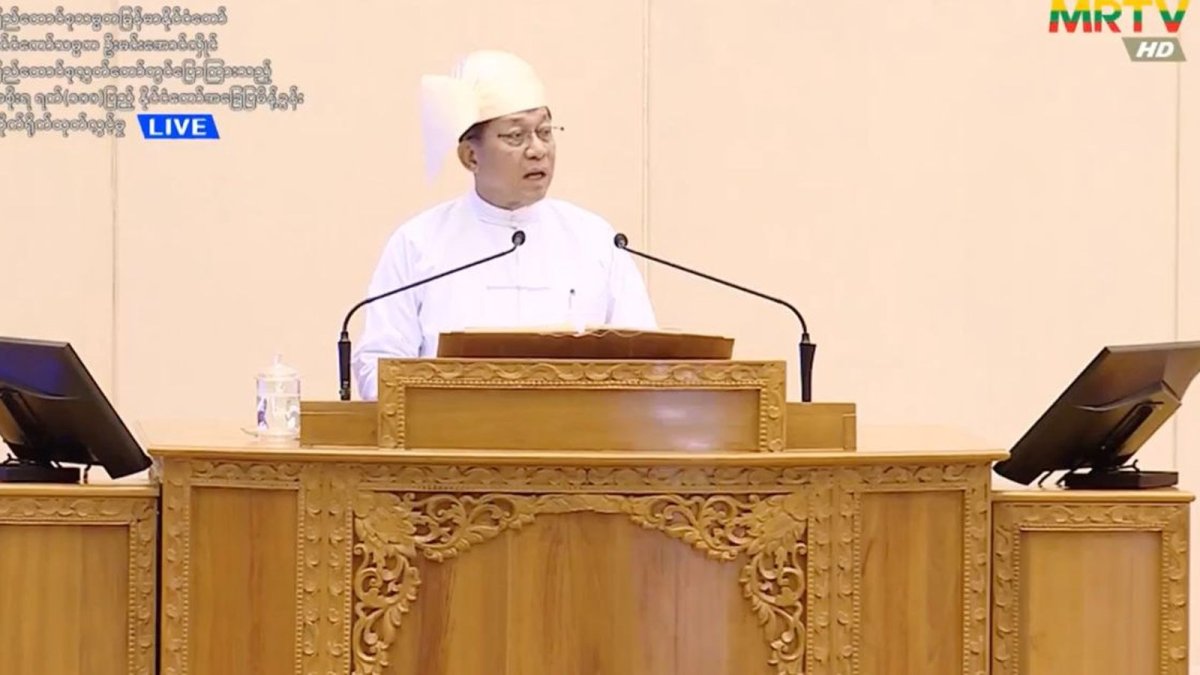
Min Aung Hlaing addressed a joint session of parliament in Naypyidaw on July 31, 2026, marking his first 100 days as president with a speech that dismissed ASEAN's Five-Point Consensus and accused unnamed member states of discriminating against his administration. The former commander-in-chief, who seized power in the February 2021 coup, used the occasion to present a five-year road map for a transition that critics say was engineered to preserve military dominance.
The 100-Day Address in Naypyidaw
The joint session convened with more than 900 lawmakers, officials and military representatives in attendance, according to AP reporting. Min Aung Hlaing, who was inaugurated as president on April 10, 2026, after an election held late last year that critics said was designed to entrench the military's grip on power, said his government had laid "important foundations" by pursuing two priorities: restoring peace and stability, and promoting national development.
The address came against the background of a civil conflict that has killed an estimated 100,000 people and displaced millions since the military ousted the elected government of Aung San Suu Kyi in February 2021. Myanmar was plunged into turmoil when the coup sparked protests that expanded into a protracted civil war. Academic analysis situates the current phase within the category of managed transitions that preserve military power, in which electoral processes and civilian titles are introduced without dismantling the armed forces' entrenched political and security prerogatives.
Rejection of the Five-Point Consensus
Min Aung Hlaing directly challenged the Five-Point Consensus agreed at a special ASEAN leaders' summit in Jakarta on April 24, 2021, less than three months after the coup. He stated that the agreement "is not the consensus of all ASEAN member states" and represented only the position of the then ASEAN chair, Brunei — even though he himself attended the Jakarta meeting. The plan had called for an immediate end to violence, dialogue among all parties, humanitarian assistance, the appointment of a special envoy, and meetings in Myanmar between the envoy and all parties.
He accused unnamed ASEAN members of discrimination, saying his administration had exercised tolerance: "We have exercised tolerance towards the discriminatory attitude of some ASEAN member states," he said, without identifying the countries, adding that "we have been patient" and would respond to non-constructive actions on a case-by-case basis. This marked a continuation of junta claims dating to April 2021, when state media asserted that the Jakarta outcome had been announced without Min Aung Hlaing's consent and amounted merely to a chair's statement.
The rejection carries implications for ASEAN's credibility as a conflict mediator. The original framework relied on consensus procedures that one key participant now disavows, illustrating how initial participation does not guarantee subsequent adherence when enforcement mechanisms remain absent.
The Five-Year Roadmap and Electoral Plans
Min Aung Hlaing outlined a five-year sequence: two years focused on accelerating the construction of a modern nation based on democracy and a federal system, followed by three years of full-speed implementation. He announced that special elections would be held in 2027 in 102 townships encompassing 172 constituencies that could not participate in the three-phase vote conducted late last year due to armed conflict.
The address confirmed continued enforcement of the military conscription law alongside efforts to strengthen the armed forces and police. Talks with 13 ethnic armed organizations were cited as evidence of outreach, while measures against money laundering, arms smuggling, drug trafficking, and online scam centers were highlighted — including the repatriation of more than 72,000 foreigners linked to scam operations to 58 countries.
These electoral preparations occur within a managed framework that limits participation and security conditions. Observers note that the combination of selective voting districts, conscription-driven emigration and selective enforcement actions prioritizes procedural milestones over inclusive representation, shaping the legitimacy the transition can claim.
Infrastructure Ambitions and Demographic Pressures
Energy and infrastructure plans included ten power generation projects, among them revival of the long-suspended Myitsone hydropower project, and continued work toward a nuclear power plant. The Myitsone dam, suspended more than a decade ago after protests over its environmental impact, remains a flashpoint between development ambitions and ecological and community concerns.
Min Aung Hlaing acknowledged that large-scale emigration of young people was impeding economic progress, though he did not link the outflow to the conscription policy that is widely cited as a key driver of the exodus. Myanmar Now's review of the first 100 days found that political repression — including media restrictions, surveillance, overnight household inspections, forced recruitment, and the continued detention of thousands of political prisoners — remains the norm, restricting the civic space and human capital required for large-scale projects.
Regional Diplomacy and ASEAN-Korea Ties
The dismissal of the Five-Point Consensus carries direct implications for South Korea's regional strategy. ASEAN occupies a central position in Seoul's Indo-Pacific framework through the Korea-ASEAN Solidarity Initiative, and Myanmar's trajectory shapes calculations about engagement versus accountability. South Korea maintains diplomatic relations and economic interests in Myanmar while supporting international calls for restraint, creating a persistent policy tension.
Korea's own democratic transition after decades of military rule offers a comparative lens. Unlike Myanmar's managed shift that preserves military influence, Korea's process ultimately subordinated the armed forces to civilian authority. The contrast highlights how external partners weigh economic engagement against normative expectations, and why ASEAN mechanisms remain the primary channel for Korean diplomacy in Southeast Asia.
Seoul's stake in Myanmar is neither trivial nor purely commercial. South Korean firms have maintained a presence across manufacturing and development sectors, while successive governments have balanced business continuity with support for international accountability measures. The difficulty of that balance is compounded by ASEAN's own divisions: because the bloc has struggled to present a unified position on Myanmar since 2021, member states — including those with closer ties to Naypyidaw — have pursued divergent approaches, leaving partners like South Korea without a single clear regional signal to align behind.
Comparative Lessons from Consensus Mechanisms
The erosion of the Five-Point Consensus parallels the earlier breakdown of the Six-Party Talks on North Korea's nuclear program. Both cases illustrate how regional frameworks falter when one participant withholds consent and external actors lack enforcement leverage — a pattern visible across both Southeast and Northeast Asian cases, where formal agreements can serve as diplomatic markers rather than operational roadmaps.
Observers in Myanmar, including Nan Lin of the General Strike Coordination Body, have warned that the conscription law will intensify fear among young people and deepen the conflict. A Myanmar Now analysis concluded that if Min Aung Hlaing is unwilling to uphold commitments made to ASEAN heads of government, resistance groups would have little confidence that pledges made to them would be honored. For South Korea, the Myanmar experience reinforces the limits of consensus-based diplomacy in the absence of binding commitments or credible follow-through mechanisms.
The deeper lesson extends beyond any single agreement. When a regional framework is built on voluntary adherence, its durability depends on the weakest link — and on the willingness of outside powers to bear the cost of enforcement. In both the Southeast Asian and Northeast Asian contexts, that cost has consistently proven higher than members were prepared to pay. For scholars and policymakers alike, the Five-Point Consensus now stands alongside the Six-Party Talks as a case study in how consensus can be declared without ever being consolidated.
By Prof. David Park, Staff WriterThis article was produced with AI-assisted research and editorial support. Reporting is based on sources cited in the article.
What's Your Reaction?
 Like
0
Like
0
 Dislike
0
Dislike
0
 Love
0
Love
0
 Funny
0
Funny
0
 Wow
0
Wow
0
 Sad
0
Sad
0
 Angry
0
Angry
0

East Asia/Technology Correspondent at Global1.News. Seoul-based voice covering Korean politics, technology, business, and culture. Analyzes how technology and geopolitics intersect across East Asia.










Comments (0)