
Mawlid al-Nabawi in Cairo: Sufi Processions Turn Faith Into Festival
Hundreds of Sufi Muslims took to the streets of Cairo this week, chanting praises and carrying banners through the historic Al-Azhar quarter to mark Mawlid al-Nabawi, the birthday of the Prophet Mohammed. For Egypt's Sufi orders, the annual commemoration is a living renewal of faith rooted in a thousand years of history.
Hundreds of Sufi Muslims took to the streets of Cairo this week, chanting praises and carrying banners through the historic Al-Azhar quarter to mark Mawlid al-Nabawi, the birthday of the Prophet Mohammed. For Egypt's Sufi orders, the annual commemoration is far more than a date on the calendar — it is a living renewal of faith, a procession of devotion that threads through the heart of the Arab world's most populous nation.
Mawlid al-Nabawi in Cairo: Sufi Processions Turn Faith Into Festival
Cairo, Egypt — The streets of Old Cairo turned into rivers of chant and colour on Tuesday as hundreds of Egyptian Muslims gathered in the historic Al-Azhar quarter to mark the birth of the Prophet Mohammed. For the Sufi orders who lead these processions, the occasion is a moment of collective spiritual renewal — and a vivid reminder that Islam's devotional traditions remain very much alive across Africa and the Middle East.
A City Transformed: Cairo's Mawlid Awakens
By mid-morning on Tuesday, August 25, 2026 — the 12th of Rabi al-Awwal in the Islamic year 1448 AH — the atmosphere across Cairo had shifted into something altogether different from an ordinary working day. Mawlid al-Nabawi is an official public holiday across Egypt, and the city embraced the pause with characteristic warmth. Shops that would normally be shuttered for a public holiday instead flung open their doors, their windows stacked high with honeyed sweets and brightly wrapped treats meant for visiting relatives and neighbours.
Lanterns of every colour swayed from balconies and shopfronts in the older quarters, their light spilling onto streets already thick with pedestrians. In the Al-Azhar district, the heart of Old Islamic Cairo, the crowds began gathering before the afternoon prayer. Families arrived from across the city — from the working-class neighbourhoods of Shubra and Imbaba, from the newer suburbs of New Cairo and 6th of October City, and from the Nile Delta towns of Tanta and Zagazig, where the train stations had been busy since dawn.
Egypt holds some of the largest and most elaborate Mawlid celebrations in the Middle East, a distinction that carries centuries of history. Where other nations mark the occasion with quiet sermons and family gatherings, Egypt transforms entire districts into open-air theatres of devotion. The scale is staggering: in the days leading up to the holiday, the streets around Al-Hussein Mosque and the Khan El-Khalili bazaar become almost impassable, so dense is the press of pilgrims and well-wishers.
The official holiday status matters deeply here. It means that students, civil servants and private-sector workers alike can participate fully in the processions and the communal prayers that stretch late into the night. For many Egyptians, the Mawlid is a rare moment when the rhythms of modern urban life slow down enough to honour something older and deeper — a connection to the Prophet that is felt as much in the body as in the mind.
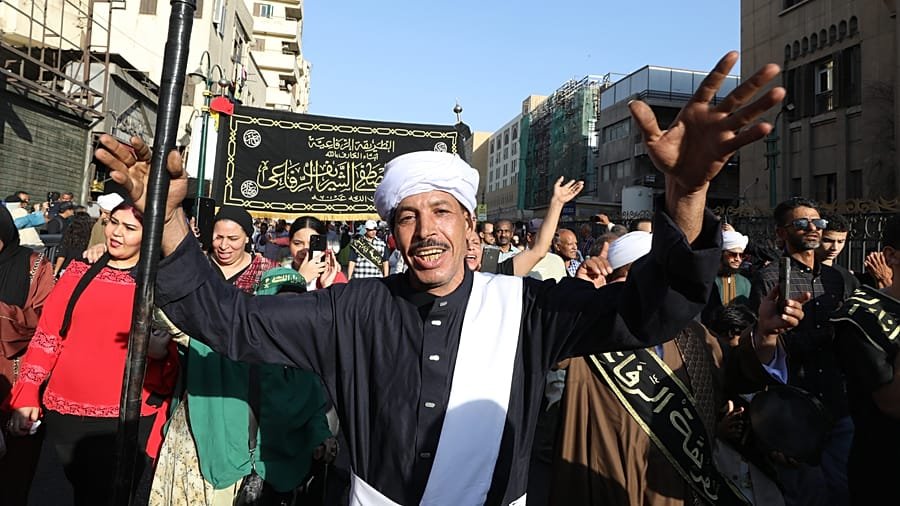
Voices of the Procession: Faith Renewed in Al-Azhar's Streets
The procession that wound through the Al-Azhar quarter on Tuesday afternoon was a study in organised devotion. Hundreds of Sufi Muslims, many dressed in the distinctive robes and head coverings of their orders, moved in a slow, deliberate column through the narrow streets. Banners embroidered with the name of the Prophet and verses of praise were held high, their fabric catching the late summer sun. The air filled with the rhythmic repetition of salawat — blessings upon the Prophet — recited in a call-and-response pattern that seemed to carry the crowd forward on a wave of sound.
Sheikh Saber Abd El Raouf, a sheikh of a Sufi order who walked at the head of one of the processions, paused to explain the meaning of the moment. "We are celebrating the Prophet, peace and blessings be upon him. It is like renewing the faith within our hearts," he said. "The Messenger of Allah does not need a commemoration, but rather our own hearts come alive by the commemoration of the birth of the Messenger of Allah." His words, captured on video by AP footage and broadcast by africanews, speak to a theology of celebration that is central to the Sufi understanding of the Mawlid.
Hassan Abd El Nazeem, another member of a Sufi order walking in the procession, described the route and the ritual with precision. "We are walking in a procession from the Sidi Saleh Al-Jaafari Mosque to the shrine of Al-Hussein," he said. "We keep chanting praises for the Messenger of Allah, peace and blessings be upon him, and we recite supplications for the birthday of the Prophet." The route he described is one of the most sacred walks in Islamic Cairo, connecting two sites of profound spiritual significance.
A Tradition Rooted in a Millennium of History
The Mawlid is not a recent invention in Egypt, nor is it a marginal practice. According to Britannica, the Fatimid dynasty in Egypt observed the Mawlid festival by the end of the 11th century, making Cairo one of the earliest centres of this celebration in the Islamic world. The Fatimids, who ruled Egypt from their new capital of Cairo, were known for their elaborate court ceremonies, and the Mawlid was among the most spectacular of their public observances.
The festival was not popularly celebrated across the Islamic world until the 13th century, when it spread quickly alongside Sufism under the Ayyubids. The Ayyubid dynasty, founded by Salah al-Din (Saladin), initially had a complicated relationship with the celebration, but the popular devotion of the Sufi orders proved irresistible. By the Mamluk period that followed, the Mawlid had become a fixture of Egyptian religious life, with grand processions that drew crowds from every corner of the realm.
The grand processions of the Fatimid caliphs are the historical ancestors of today's Sufi marches. In those earlier centuries, the caliph himself would ride through the streets of Cairo at the head of a vast entourage, accompanied by scholars, judges, and the leaders of the Sufi orders. The route would be lined with spectators, and the celebrations would continue for days. Today's processions are more modest in scale, but they carry the same spiritual DNA — the same conviction that the birth of the Prophet is an occasion for public, collective joy.
Egypt became the heartland of the Mawlid celebration in large part because of the density of its Sufi culture. The Sufi orders, known as tariqas, organised themselves into a complex network of spiritual brotherhoods, each with its own lineage of teachers, its own devotional practices, and its own following among the Egyptian people. Today, Egypt's Sufi orders are organized under the Supreme Sufi Council, and the Jafariyya, Rifa'iyya and Qadiriyya are among the best-known tariqas. Each order brings its own flavour to the Mawlid, but all share the same fundamental devotion.
The historical depth of the celebration gives it a weight that is difficult to overstate. When a Sufi sheikh leads his followers through the streets of Al-Azhar on Mawlid day, he is walking in the footsteps of centuries of predecessors. The prayers he recites, the chants he leads, the route he follows — all of it has been shaped by a millennium of Egyptian Muslim devotion. This is not a tradition that has been invented or revived; it is one that has never stopped.
Sacred Cairo: The Mosques and Shrines at the Heart of the Mawlid
Al-Hussein Mosque stands at the beating heart of Cairo's Mawlid, its golden minarets visible from blocks away. During the Mawlid week, pilgrims from across Egypt fill the courtyard with rhythmic chants, Quran recitations and dhikr circles led by Sufi orders. The dhikr — the remembrance of God through repeated phrases and names — is the core devotional practice of Sufism, and on Mawlid nights it reaches a pitch of intensity that can be felt in the chest as much as heard in the ears.
Spiritual songs echo through the alleyways of Khan El-Khalili during Mawlid nights, the famous bazaar transforming from a tourist destination into a sacred precinct. The shopkeepers who sell perfumes, textiles and gold jewellery during the day close their shutters and join the crowds, or keep their doors open and offer tea and sweets to the pilgrims passing by. The boundary between commerce and devotion, always porous in Cairo, dissolves almost entirely during the Mawlid.
Al-Azhar Mosque, the seat of Islamic scholarship, offers a more reflective experience during the Mawlid. Founded in the 10th century (970-972 AD), it is one of the oldest universities in the world, and its scholars deliver sermons on the Prophet's life throughout the holiday. The atmosphere here is calmer than at Al-Hussein, more contemplative — a space for those who prefer to mark the occasion through study and reflection rather than ecstatic chant. Yet the two approaches are not opposed; they are complementary expressions of the same devotion.
Sayyida Zaynab Mosque, named after the Prophet's granddaughter, sees pilgrims chant, pray and share food as a gesture of charity during the Mawlid. The sharing of food is a deeply embedded Egyptian tradition, and during the Mawlid it takes on particular significance. Families prepare large pots of rice and meat, trays of sweets, and baskets of fruit, distributing them to neighbours, the poor, and the pilgrims who have travelled from afar. The mosque's courtyard becomes a vast communal table, a physical manifestation of the generosity that the Prophet's life exemplified.
Sidi Salih al-Jafari Mosque near Al-Azhar hosts followers of the Jafari Sufi order for nights of devotional poetry, Quran recitations and heartfelt supplications. This mosque, smaller and less famous than Al-Hussein or Al-Azhar, is nonetheless a vital node in the spiritual geography of Islamic Cairo. The Jafariyya order, one of the oldest and most respected tariqas in Egypt, has made this mosque its spiritual home, and during the Mawlid its walls resonate with the poetry of praise composed over centuries.
Sugar Dolls and Honeyed Sweets: The Sweet Side of a Spiritual Feast
No account of the Egyptian Mawlid would be complete without mention of the sweets. Halawet al-Mawlid — honeyed sweets — are a defining feature of the season, their sticky sweetness as essential to the celebration as the chants and prayers. The confectioners of Cairo begin preparing weeks in advance, their workshops filling with the aroma of sesame, honey, nuts and rosewater as they produce the vast quantities of sweets that the holiday demands.
The most iconic of these treats is the sugar doll, known as Arouset El-Moulid — the Bride of the Mawlid. This tradition dates back nearly 1,000 years to the Fatimid period, when the caliphs would distribute sugar figurines to the populace during the festival. The dolls, crafted from moulded sugar and decorated with bright colours and paper frills, are given to children as gifts. In recent decades, the tradition has expanded to include sugar horses, sugar swords, and other figures, but the bride remains the most beloved.
Confectioners in the Bab el-Bahr area of Cairo are famous for crafting mawlid sweets, and their shops become pilgrimage sites in their own right during the holiday. The craft has been passed down through generations, with families of sweet-makers guarding their recipes and techniques as closely as any trade secret. The sugar dolls are made by pouring hot sugar syrup into carved wooden moulds, allowing it to cool and harden, then painting the resulting figure with food colouring. It is a painstaking process, and the finest examples are works of folk art.
The cultural and commercial importance of the season is considerable. For the sweet-makers of Cairo, the Mawlid is the busiest time of the year, a period of intense labour that can account for a significant portion of their annual income. The shops of Bab el-Bahr and the stalls of Khan El-Khalili do a roaring trade in the days leading up to the holiday, with customers buying sweets not only for their own families but as gifts for relatives, neighbours, and colleagues.
Family traditions of sharing sweets and visiting relatives are central to the Egyptian Mawlid. On the day itself, households receive a steady stream of visitors, each bearing a plate of halawet al-Mawlid or a sugar doll for the children. The exchange of sweets is a gesture of goodwill and shared joy, a way of extending the blessings of the occasion to the wider community. In a culture where hospitality is paramount, the Mawlid sweets are both a symbol and a substance of that hospitality.
Beyond Egypt: Mawlid's Pan-African Resonance
The Mawlid is not an Egyptian phenomenon alone. Across the Muslim world and Africa, the birthday of the Prophet is observed with a rich variety of local traditions. In Senegal, the same occasion is celebrated as the Gamou, with the Tijaniyya order's spiritual heartland of Tivaouane drawing hundreds of thousands of pilgrims each year. The Gamou of Tivaouane is one of the largest religious gatherings in West Africa, a massive convergence of faith, commerce and culture that transforms the small town into a city of tents and lights.
Senegal's Sufi tradition is closely linked to Egypt's — the Tijaniyya order, which dominates Senegalese religious life, traces its spiritual lineage through North African Sufi chains. The founder of the order, Sheikh Ahmed al-Tijani, was born in Algeria and spent time in Egypt, and his spiritual descendants in Senegal maintain strong ties to the broader Sufi world. When a Senegalese pilgrim visits Cairo for the Mawlid, or when an Egyptian sheikh travels to Tivaouane for the Gamou, they are participating in a shared spiritual culture that transcends national borders.
Mawlid is observed across the continent, from Nigeria and Sudan to Morocco and East Africa, with each culture adding its own musical and culinary traditions. In Sudan, the celebration is marked by large processions and the recitation of the Dala'il al-Khayrat, a famous collection of prayers upon the Prophet. In Morocco, the Mawlid is a national holiday celebrated with family gatherings and the distribution of sweets. In Nigeria, the Tijaniyya and Qadiriyya orders organise processions in cities like Kano and Ibadan that rival those of Cairo in their fervour.
These traditions matter for African cultural heritage because they represent a living continuity with the past. The chants sung in Cairo on Mawlid day are recognisably related to those sung in Tivaouane, in Kano, in Khartoum and in Zanzibar. The sweets, the processions, the dhikr circles, the family gatherings — all of these are threads in a single fabric of devotion that stretches across the continent. To participate in the Mawlid is to join a community that spans not only space but time.
What to Watch For
The Mawlid's place in Egyptian public life shows no signs of diminishing. Despite the pressures of modernisation, secularisation and, in some quarters, a more literalist interpretation of Islam that frowns upon the celebration, the Mawlid remains one of the most widely observed religious holidays in the country. The official public holiday status, the participation of the Supreme Sufi Council, and the sheer popular enthusiasm for the occasion all suggest that the tradition will endure.
Upcoming Islamic calendar events will offer further occasions for communal celebration. The Islamic year 1448 AH continues with the observance of the Prophet's night journey and ascension (Isra and Mi'raj), the arrival of the holy month of Ramadan, and the two Eids. Each of these occasions has its own Egyptian traditions, and together they form a rhythm of devotion that structures the religious year. For those who participate in the Mawlid, these subsequent celebrations are already anticipated with the same warmth and enthusiasm.
The enduring power of faith-based festivals to bring communities together is perhaps the most important lesson of the Mawlid. In a world that is often divided by politics, economics and identity, the Mawlid offers a moment of unity — a shared celebration of a figure whose life and teachings continue to inspire devotion across the Islamic world. For the hundreds who gathered in Cairo this week, and for the millions more who mark the occasion across Africa and the wider Muslim world, the Mawlid is a reminder that faith, at its best, is a force for joy, generosity and connection.
This article was produced with AI-assisted research and editorial support. Sources: africanews, AP, Cairo 360, Encyclopaedia Britannica.
By Amara Diop, Staff Writer
What's Your Reaction?
 Like
0
Like
0
 Dislike
0
Dislike
0
 Love
0
Love
0
 Funny
0
Funny
0
 Wow
0
Wow
0
 Sad
0
Sad
0
 Angry
0
Angry
0

West Africa/Sahel Correspondent at Global1.News. Dakar-based journalist covering politics, security, climate, and development across Francophone and Anglophone West Africa. Tells the stories of a region undergoing profound transformation.














Comments (0)