
Matlatzinca's Last Village Rises: A New Generation Speaks the Ancestral Tongue
In the misty highlands of central Mexico, children in San Francisco Oxtotilpan are reclaiming words their grandparents once hid from outsiders, filling classrooms with the sounds of Matlatzinca as elders guide their tongues. This revival unfolds against UNESCO's stark warning that a language vanishes every two weeks worldwide, with 43 percent of roughly 6,000 languages now in danger and half potentially lost by century's end, most of them Indigenous.
In the misty highlands of central Mexico, children in San Francisco Oxtotilpan are reclaiming words their grandparents once hid from outsiders, filling classrooms with the sounds of Matlatzinca as elders guide their tongues. This revival unfolds against UNESCO's stark warning that a language vanishes every two weeks worldwide, with 43 percent of roughly 6,000 languages now in danger and half potentially lost by century's end, most of them Indigenous. Across Latin America, such efforts echo the continent's long struggle to preserve identity amid centuries of erasure.
Matlatzinca's Last Village Rises: A New Generation Speaks the Ancestral Tongue
San Francisco Oxtotilpan, State of Mexico – August 1, 2026 — In the highlands of Temascaltepec, a community of roughly 1,500 people is proving that a language with only a few hundred speakers can still be rescued, one classroom at a time. Elders who once hid Matlatzinca from outsiders now sit beside children, guiding young tongues through words that have echoed across the Toluca Valley for centuries.
A Language on the Edge: The Matlatzinca Story
San Francisco Oxtotilpan sits in the municipality of Temascaltepec in the State of Mexico, a village of roughly 1,500 inhabitants where about 500 people still speak Matlatzinca. This community is described by Mexican media including La Jornada as the last remaining Matlatzinca-speaking settlement. The language belongs to the Oto-Manguean family and was spoken for centuries across the Toluca Valley west of the Valley of Mexico. It divides into two mutually unintelligible subgroups: Matlatzinca proper and Ocuiltec or Tlahuica. Mexico officially recognizes Matlatzinca as a national language alongside Spanish and dozens of other native tongues, yet it remains classified as endangered and moribund. Geographic isolation, the predominance of adult speakers, and the historical abandonment of intergenerational transmission have pushed it to the brink. Many residents split their time between the village and Mexico City, where roughly half the population lives at any given moment, further straining daily use. Despite these pressures, the community refuses to let the language fade into silence, treating each spoken phrase as an act of continuity with ancestors who navigated the same valleys long before colonial arrival.
UNESCO's Warning: Half the World's Languages at Risk
UNESCO data reveals that languages disappear at the rate of one every two weeks, placing 43 percent of the world's approximately 6,000 languages in danger of extinction, with the majority belonging to Indigenous communities. Half could vanish by the end of this century if current trends hold. In Mexico the 2020 census recorded 19.41 percent of the population identifying as Indigenous, yet only 7,364,645 people, or 6.1 percent of the total 126,014,024 inhabitants, spoke an Indigenous language. Twenty-four Indigenous languages were spoken by fewer than 1,600 individuals, and six by fewer than 100. INALI's 2008 Catálogo documented 68 language groups and 364 linguistic variants across the country. These figures underscore a pattern repeated throughout Latin America, where colonial policies and economic migration have accelerated language shift. The loss is not abstract; each vanishing tongue carries unique ways of understanding the land, seasons, and social bonds that have sustained communities for millennia. Matlatzinca's precarious status mirrors dozens of others in Mexico and beyond, where official recognition has yet to translate into sufficient resources for daily transmission.
What Latin America Stands to Lose: Knowledge in Every Word
Linguist K. David Harrison, co-leader of National Geographic's Enduring Voices Project, notes that each Mexican Indigenous language contains millennia of human experience, wisdom, and practical knowledge about the natural environment. Matlatzinca and its relatives encode details about local plants, weather patterns, and healing practices that Spanish alone cannot capture. Comparable cases illustrate the stakes: Ayapaneco in Tabasco dwindled to two elderly speakers, Kiliwa in Baja California counted about 36, and Ku'ahl was declared extinct by 2010. Across Latin America, Quechua, Aymara, Nahuatl, Maya, and Guarani similarly hold repositories of ecological insight refined over generations. When a language dies, communities lose precise terminology for medicinal herbs, soil types, and seasonal cycles that support sustainable living. The erosion also severs links to oral histories and spiritual frameworks that shape collective identity. In the Toluca Valley, Matlatzinca speakers have preserved knowledge of highland ecosystems that modern science is only beginning to appreciate. Allowing such languages to disappear means discarding irreplaceable tools for understanding climate resilience and biodiversity in a region already facing environmental pressures.
A New Generation Answers: Classrooms, Elders, and Community
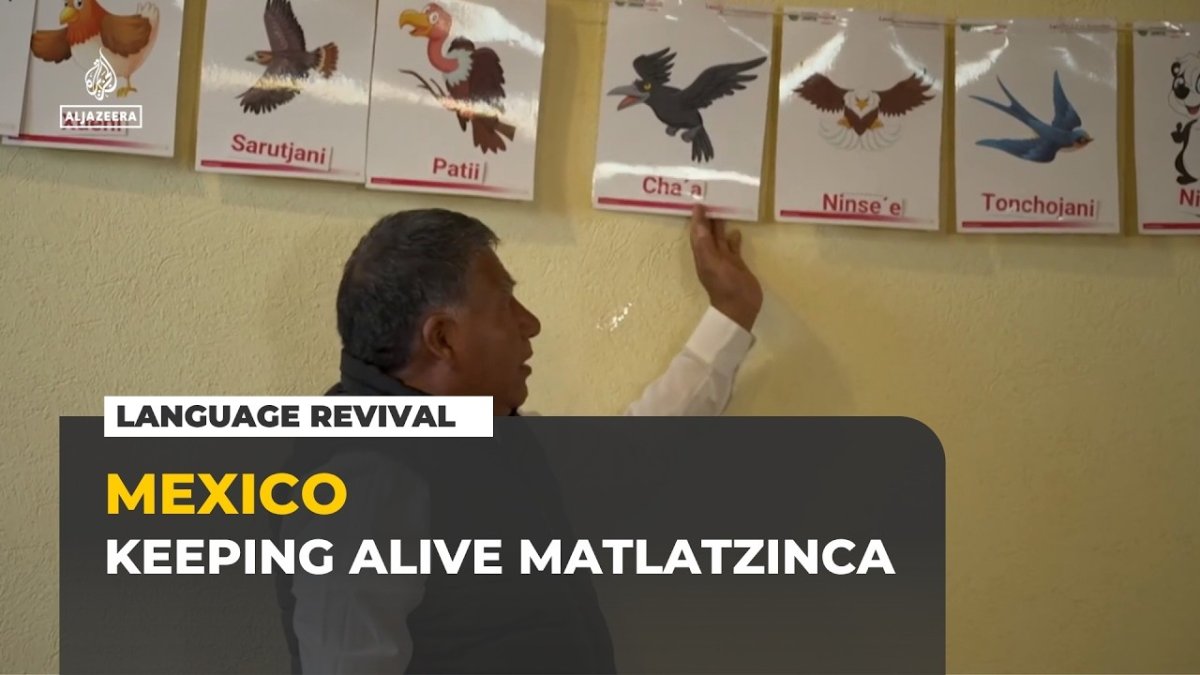
The Al Jazeera English report captures community-led classes in San Francisco Oxtotilpan where children practice Matlatzinca under the guidance of elders and young educators. Lic. Maithe Cortez Áviles, a graduate of the Universidad Intercultural del Estado de México from Oxtotilpan, teaches the language to students and pushes for its mandatory inclusion in school curricula from basic through upper secondary levels. Elder doña Filogonia Torres, known as Doña Gil, shares testimony of daily struggle and dignity, framing the act of speaking Matlatzinca as quiet resistance. UIEM has produced educational videos introducing basic vocabulary to children, reinforcing lessons beyond the classroom. Intergenerational exchanges are rebuilding transmission that faltered for decades. Young learners respond with curiosity, repeating phrases that once seemed distant and reconnecting with grandparents who feared the language would mark them as outsiders. These sessions transform the village into a living archive, where each new speaker adds momentum to revival. The report shows how such grassroots work counters the isolation that once threatened Matlatzinca, proving that consistent practice can reverse decline even in a community of only 500 speakers.
Mexican linguists have tracked this fragility for years. A 2014 National Geographic feature warned that of the country's 143 native languages, 60 were at risk of being silenced forever, while the Centro de Investigaciones y Estudios Superiores en Antropología Social (CIESAS) reported that 21 were critically endangered, kept alive only by a handful of elderly speakers. The same pattern of demographic pressure, rural-to-urban migration, and the economic pull of Spanish has hollowed out Indigenous tongues from the Sierra Tarahumara to the Yucatán Peninsula. Linguists such as Harrison argue that the stakes go far beyond vocabulary: each endangered language is a primary conduit for human culture, carrying distinct ways of naming plants, reading weather, and passing down ethics of land stewardship.
Policy and the Legal Framework: From 2003 to Today
Mexico's 2003 federal law recognized the linguistic rights of Indigenous peoples and led to the creation of INALI on March 13, 2003. The 2006 Education Law reform granted speakers of Indigenous languages the right to instruction in both their mother tongue and Spanish. INPI reported in 2016 that 23 Indigenous languages, including Matlatzinca and Tlahuica, were endangered, all spoken by fewer than 2,000 people. February 21 marks International Mother Language Day, established by UNESCO to spotlight linguistic diversity. Despite these milestones, gaps persist between legal recognition and funding for teacher training or curriculum development. Many communities still lack sufficient materials or certified instructors, leaving enforcement uneven. The diaspora to Mexico City further complicates consistent exposure for children. Matlatzinca's official status as a national language has opened doors for advocacy, yet sustained investment remains essential to move beyond symbolic gestures. Community leaders continue pressing authorities to match laws with concrete support, drawing on the same determination that has kept the language alive through earlier periods of suppression.
There are signs that digital tools can widen the corridor between recognition and practice. INALI has promoted cultural content in Matlatzinca, including the animated short film "El día en que todo se detuvo," produced in collaboration with the Pixelatl festival, which uses the language to carry a story about memory and pause. Such materials give children a bridge between the classroom and the screen, normalizing the tongue outside the home. Yet advocates caution that technology complements rather than replaces the essential work of elders sitting with grandchildren, repeating the words of their ancestors. The balance between innovation and tradition will determine whether the next decade records a revival or another obituary.
What This Means for Latin America
Matlatzinca's fight resonates across the continent where Quechua in the Andes, Aymara on the altiplano, Nahuatl in central Mexico, Maya in the Yucatán, and Guarani in the south face parallel pressures from colonial language hierarchies and urban migration. The pattern of shift toward dominant national tongues has repeated since the sixteenth century, eroding the linguistic diversity that once defined Latin American societies. Oxtotilpan's model of elder-led classes and university-supported materials offers a template other nations can adapt. It demonstrates that revival succeeds when communities control the process rather than waiting for distant ministries. Identity and memory remain intertwined with language; losing Matlatzinca would sever threads connecting present generations to pre-colonial knowledge systems. Regional organizations and governments can learn from Mexico's legal framework while addressing the funding shortfalls that undermine it. By prioritizing Indigenous languages, Latin America can reclaim narratives of resilience and strengthen cultural sovereignty in an era of globalization.
The Bottom Line — What Comes Next
The Oxtotilpan experience proves that grassroots revival works when elders, teachers, and children collaborate daily. Scaling this success requires more certified instructors, stable funding streams, full enforcement of existing language rights laws, and expanded digital tools such as the UIEM videos already in circulation. Every language preserved safeguards unique worldviews and practical knowledge that benefit entire societies. Matlatzinca's trajectory shows that decline is not inevitable; consistent community action can turn the tide. Latin America stands at a crossroads where supporting such efforts preserves not only words but entire ways of relating to land and history.
By Elena Vasquez, Staff Writer
This article was produced with AI-assisted research and editorial support. Reporting is based on sources cited in the article.
What's Your Reaction?
 Like
0
Like
0
 Dislike
0
Dislike
0
 Love
0
Love
0
 Funny
0
Funny
0
 Wow
0
Wow
0
 Sad
0
Sad
0
 Angry
0
Angry
0

Latin America Correspondent at Global1.News. Based in Mexico City, covering politics, economics, energy, and culture across the region. Brings an on-the-ground perspective to stories spanning from the Rio Grande to Patagonia.













Comments (0)