
Magnitude 6.0 Earthquake Strikes Off Hokkaido, Japan
Folks, it is 11:15 p.m. in Tokyo, and the ground has just reminded an entire nation who is in charge. A magnitude 6.0 earthquake has ripped through the Pacific waters off the coast of Hokkaido, Japan’s northernmost main island, and the entire country is holding its breath. This is not a drill, this is not a test—this is the earth moving beneath one of the most seismically prepared nations on the planet, and we are tracking every single second of it for you right now.
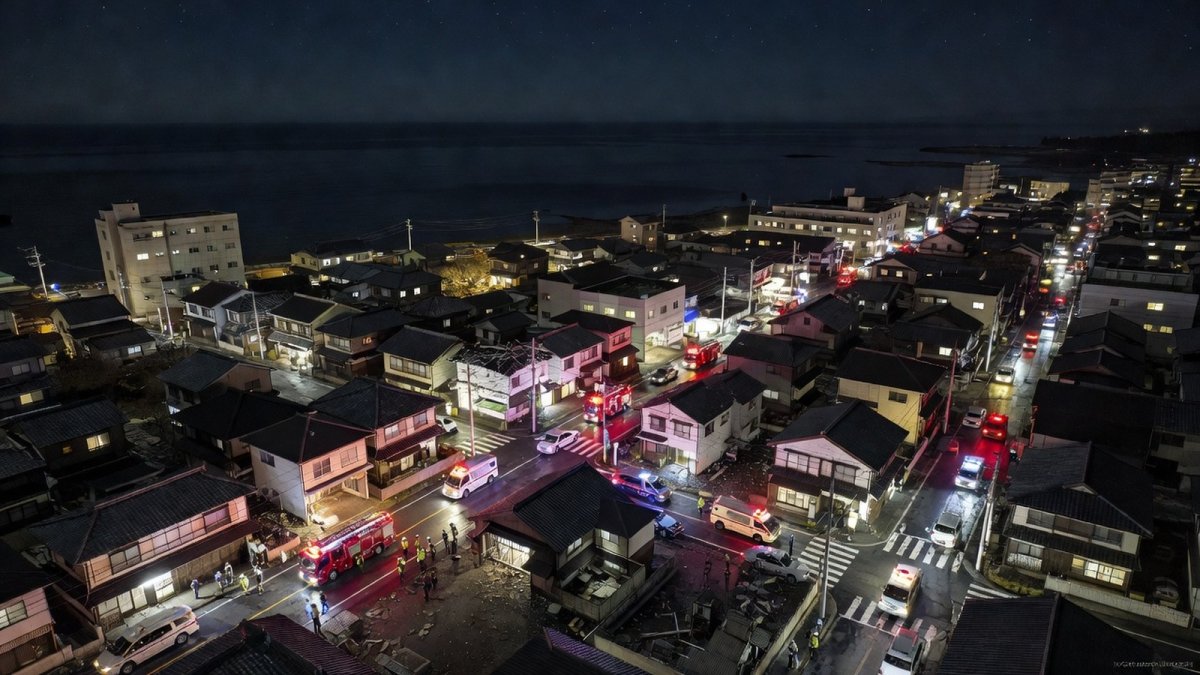
Folks, it is 11:15 p.m. in Tokyo, and the ground has just reminded an entire nation who is in charge. A magnitude 6.0 earthquake has ripped through the Pacific waters off the coast of Hokkaido, Japan’s northernmost main island, and the entire country is holding its breath. This is not a drill, this is not a test—this is the earth moving beneath one of the most seismically prepared nations on the planet, and we are tracking every single second of it for you right now.
Magnitude 6.0 Quake Strikes Off Hokkaido, Japan
Tokyo, Japan — A powerful earthquake with a preliminary magnitude of 6.0 struck off the coast of Urakawa in Japan’s northern prefecture of Hokkaido on Sunday night, August 23, 2026, according to the Japan Meteorological Agency (JMA). The temblor, which occurred at approximately 10:45 p.m. local time at a depth of about 40 kilometers, registered a 4 on Japan’s 0-to-7 seismic-intensity scale in the hardest-hit areas, shaking residents awake and sending shockwaves of anxiety across a nation already on high alert.
The Quake: What We Know Right Now
Let’s get the facts on the table immediately, folks, because in a breaking news situation, clarity is king. The Japan Meteorological Agency, the gold standard for seismic reporting, has confirmed that this was a preliminary magnitude 6.0 event. The epicenter was located off Urakawa, a coastal town in the Hidaka region of Hokkaido, sitting on the island’s rugged Pacific coast. The depth of approximately 40 kilometers places this squarely in the category of a shallow-to-intermediate quake—deep enough to dissipate some energy, but shallow enough to be felt with authority.
The JMA reported that the quake measured a 4 on Japan’s seismic-intensity scale in the areas that felt it the hardest. For those of you unfamiliar with the Japanese scale, let me break it down: a 4 means most people indoors will feel it distinctly, hanging objects will swing, and dishes might rattle in the cupboards. It is not the catastrophic 7 that levels cities, but it is absolutely a wake-up call—literally, for many residents who were settling in for the night when the earth decided to dance.
Urakawa itself is a town of approximately 13,000 people, nestled between the Hidaka mountains and the Pacific Ocean. It is a region known for its horse breeding and its stunning, rugged coastline—but tonight, that coastline is the epicenter of a national news story. The town sits roughly 90 to 100 kilometers south-southeast of Sapporo, Hokkaido’s capital, meaning the shaking was felt across a wide swath of the island’s population centers.
Shaking and Intensity: What Residents Felt
Now, let’s talk about what this actually felt like on the ground, because numbers on a screen don’t capture the visceral reality of an earthquake. At 10:45 p.m. on a Sunday night, most families in Hokkaido were winding down—kids in bed, adults watching television, the quiet hum of a weekend evening. Then, without warning, the ground began to roll. At intensity 4, the shaking is not subtle. It is a persistent, unsettling motion that makes you stop mid-sentence, grip the nearest table, and wait for it to either intensify or subside.
For the residents of Urakawa and the surrounding Hidaka region, this was a moment of pure adrenaline. The JMA’s intensity map would have lit up like a Christmas tree, with the epicentral region glowing at level 4 while surrounding areas registered lower intensities. There are no immediate reports of major damage, and no casualties have been reported at this hour, but the psychological impact cannot be overstated. Every earthquake in Japan carries the weight of history—the memory of past devastation is never far from the surface.
What is perhaps most telling is the immediate reaction on social media and search engines. Within four hours of the quake, the Japanese search term "地震 北海道" (Earthquake Hokkaido) had exploded past 20,000 searches, while "札幌 地震速報 今" (Sapporo earthquake alert now) surged to over 500 searches. This is not just a regional story, folks—this is the dominant breaking news trend in Japan right now, and the entire nation is watching, waiting, and refreshing their feeds for updates.
No Tsunami: A Sigh of Relief, But Why?
Here is the headline within the headline, folks: the Japan Meteorological Agency has confirmed that NO tsunami warning was issued following this tremor. Let me repeat that for the people in the back—no tsunami warning. This is significant, and it is worth understanding why.
Tsunamis are generated by vertical displacement of the seafloor, typically associated with large, shallow earthquakes along subduction zones. A magnitude 6.0 at 40 kilometers depth, while certainly powerful, does not have the same tsunami-generating potential as a massive, shallow megathrust event. The JMA, which operates one of the most sophisticated tsunami detection systems in the world, analyzed the data in real-time and determined that the threat did not warrant a warning. That determination was communicated within minutes, allowing residents to breathe a collective sigh of relief.
But do not mistake relief for complacency, folks. The absence of a tsunami warning does not diminish the significance of this event. It is a reminder that Japan’s Pacific coast, particularly the waters off Hokkaido, sits atop one of the most volatile geological boundaries on Earth. The Japan Trench, where the Pacific Plate dives beneath the North American Plate, runs offshore—and it is a zone that has produced some of the most devastating earthquakes in human history.
Japan’s Seismic Context: A Nation on Edge
To understand why this quake is making headlines, you have to understand the context, and folks, the context is sobering. This is not an isolated event. Japan has been experiencing a period of elevated seismic activity, and the memories of recent tremors are still fresh in the national psyche.
Let’s rewind to April 20, 2026—just four months ago. At 4:53 p.m. local time, a massive MJMA 7.7 earthquake (Mw 7.4-7.5) struck off the Sanriku Coast of Honshu, along the very same Japan Trench system. That quake produced strong shaking in Iwate and Aomori prefectures, with a maximum intensity of 5-upper in Hashikami, Aomori. The JMA issued tsunami warnings for waves up to 3 meters in parts of Iwate, Aomori, and Hokkaido—warnings that were later downgraded to advisories and eventually lifted. An 80-centimeter tsunami struck Kuji, Iwate, while Miyako and Urakawa, Hokkaido, saw 40-centimeter waves. Over 175,000 people were evacuated, and remarkably, no casualties were reported, according to the IFRC.
Now, add to that the fact that this very same weekend, a separate 5.9-magnitude earthquake struck Ibaraki, eastern Japan, including the Tokyo area, early Sunday morning. That quake injured 23 people, most slightly, and caused some disruption to transport and power supply. No tsunami was generated. Two notable earthquakes in the same weekend, one off the Pacific coast of Hokkaido and one near Tokyo—this is what elevated seismic activity looks like, folks, and it is a pattern that seismologists are watching closely.
And let us not forget the historical precedent that looms over every tremor in this region. On September 6, 2018, the Hokkaido Eastern Iburi Earthquake—a magnitude 6.7 event—killed at least 41 people and triggered massive landslides in the town of Atsuma. That quake knocked out power to 5.3 million residents, plunging the entire island into darkness. It was a stark reminder that Hokkaido, despite its reputation as Japan’s rugged, sparsely populated north, is not immune to catastrophic seismic events.
Why Hokkaido’s Pacific Coast Matters: The Japan Trench and the Ring of Fire
Let’s zoom out for a moment, folks, because understanding the "why" behind this quake is essential. Japan sits on the Pacific Ring of Fire, a horseshoe-shaped zone of intense seismic and volcanic activity that encircles the Pacific Ocean. This is where several tectonic plates converge, grind against each other, and occasionally release enormous amounts of stored energy in the form of earthquakes.
Hokkaido’s Pacific coast is particularly significant because it sits adjacent to the Japan Trench, a subduction zone where the Pacific Plate is forced beneath the North American Plate. This is a megathrust boundary, capable of generating earthquakes of magnitude 8 or higher. The 2011 Tohoku earthquake and tsunami, which devastated the northeastern coast of Honshu and triggered the Fukushima nuclear disaster, occurred along this very same trench system, further south.
The town of Urakawa, where tonight’s quake was centered, is on the front lines of this geological reality. It is a community that has learned to live with the constant threat of seismic activity, but that does not make it any less vulnerable. The Hidaka region, with its steep mountains and coastal plains, is susceptible to landslides and ground liquefaction during strong shaking. The infrastructure—roads, bridges, power lines—is built to rigorous seismic codes, but nature always has the final say.
What happened tonight is a reminder that the Japan Trench is always active, always building pressure, and always capable of delivering a punch. A magnitude 6.0 is significant, but it is not the big one. The big one, the megathrust event that seismologists have been predicting for decades, could come at any time. And when it does, the entire world will feel the consequences.
Japan’s Early Warning System and Preparedness: A Global Gold Standard
Here is the part of the story that gives me hope, folks, and it is a story that the world should be paying attention to. Japan has the most advanced earthquake early warning system on the planet, and tonight, it did exactly what it was designed to do.
The JMA operates a network of over 1,000 seismic sensors across the country, capable of detecting the initial P-waves of an earthquake—the fast, less destructive waves—and issuing alerts before the more damaging S-waves arrive. This gives residents precious seconds to drop, cover, and hold on. It automatically slows bullet trains, halts elevators at the nearest floor, and triggers alerts on every smartphone in the affected area.
Japan’s building codes are equally rigorous. Structures are designed to sway with seismic energy rather than resist it, and retrofitting of older buildings has been a national priority for decades. The result is that even a magnitude 6.0 quake, like the one tonight, is unlikely to cause catastrophic structural failure. The 2018 Hokkaido Eastern Iburi earthquake, which killed 41 people, was a tragedy—but the death toll could have been far higher without these measures. The 2026 Sanriku earthquake, a magnitude 7.7 event, resulted in zero casualties despite 175,000 evacuations. That is not luck, folks. That is preparation.
But preparedness is not just about technology and building codes. It is about culture. In Japan, earthquake drills are a routine part of school life. Every household has an emergency kit with water, food, and supplies. Community evacuation routes are clearly marked and regularly practiced. The Japanese people have internalized the reality of living in a seismically active zone, and they have built a society that can absorb the shock and keep going.
The Human Angle: A Community That Knows the Drill
Behind every statistic, every magnitude reading, every intensity level, there are people. And tonight, the people of Urakawa and the surrounding Hidaka region are the heart of this story.
Urakawa is a town of about 13,000 residents, a close-knit community known for its horse breeding industry and its stunning natural beauty. The Hidaka mountains rise dramatically behind the town, and the Pacific Ocean stretches endlessly to the east. It is a place where people know their neighbors, where the local fishing fleet is the lifeblood of the economy, and where the rhythms of nature are respected and understood.
When the quake struck at 10:45 p.m., the residents of Urakawa did what they have been trained to do. They dropped, they covered, they held on. They checked on their families, their neighbors, their elderly relatives. They turned on their radios and televisions for information. They waited for the JMA’s assessment, and when the all-clear came—no tsunami, no major damage—they began the process of assessing and recovering.
This is the human angle that often gets lost in the coverage of earthquakes, folks. It is not just about the shaking and the numbers. It is about the resilience of communities that have learned to live with uncertainty, that have built systems of mutual support, and that refuse to be defined by the disasters that could strike at any moment. The people of Urakawa are not victims tonight. They are survivors, and they are already looking forward to tomorrow.
Analysis: Elevated Seismic Activity and What It Means
Let’s put on our analyst hats for a moment, folks, because the bigger picture here is genuinely important. The fact that a magnitude 6.0 quake struck off Hokkaido on the same weekend as a 5.9-magnitude quake near Tokyo is not a coincidence. It is a pattern, and patterns matter in seismology.
Japan has been experiencing a period of elevated seismic activity since the April 2026 Sanriku earthquake. That magnitude 7.7 event released a tremendous amount of energy along the Japan Trench, and the earth is still adjusting. Aftershocks are expected, but so are triggered earthquakes—events that occur on nearby faults as stress is redistributed through the crust. The Ibaraki quake and tonight’s Hokkaido quake could both be part of this ongoing adjustment process.
Seismologists will be studying these events in the coming days and weeks, looking for patterns and trying to understand what they mean for the future. The honest answer, folks, is that we do not know. Earthquake prediction remains an inexact science, and the best we can do is prepare for the possibility of larger events while hoping they do not come.
What we do know is that the Japan Trench is capable of generating megathrust earthquakes of magnitude 8 or higher. The 2011 Tohoku earthquake, which killed nearly 20,000 people and caused the Fukushima nuclear disaster, was a magnitude 9.0. The 2026 Sanriku earthquake was a 7.7. The pressure that builds along this boundary is immense, and it is released in fits and starts. Tonight’s quake is a reminder that the process is ongoing, and that the next big one could be just around the corner.
What Happens Next: Your Role in the Story
So, folks, where do we go from here? The immediate aftermath of tonight’s quake is clear: the JMA will continue to monitor for aftershocks, which are likely in the coming hours and days. Residents of Hokkaido should remain vigilant, check their emergency supplies, and be prepared for the possibility of additional shaking. The fact that no tsunami was generated is a relief, but it is not a license to let our guard down.
For the rest of us, watching from afar, there is a role to play. First, stay informed. Follow reliable sources like the Japan Meteorological Agency and trusted news outlets for updates. Second, understand that earthquakes are a global phenomenon, and the lessons Japan has learned are applicable everywhere. If you live in a seismically active area, take the time to prepare your own emergency kit, develop a family communication plan, and know the evacuation routes in your community.
And finally, folks, let’s take a moment to appreciate the resilience of the Japanese people. They have faced earthquakes, tsunamis, and nuclear disasters, and they have rebuilt every time. Tonight, a town of 13,000 people on the Pacific coast of Hokkaido felt the earth move, and they responded with the calm, practiced efficiency that comes from decades of preparation. That is not just a story about an earthquake. That is a story about the indomitable human spirit.
We will continue to monitor this situation and bring you updates as they become available. For now, our thoughts are with the people of Urakawa and all of Hokkaido. Stay safe, stay prepared, and stay informed. This is Jessica Ali, Global 1 News, signing off from the international desk.
By Jessica Ali, Staff Writer
This article was produced with AI-assisted research and editorial support. Sources: Xinhua (citing Japan Meteorological Agency), Dimsum Daily, India Today, IFRC, Wikipedia.
What's Your Reaction?
 Like
0
Like
0
 Dislike
0
Dislike
0
 Love
0
Love
0
 Funny
0
Funny
0
 Wow
0
Wow
0
 Sad
0
Sad
0
 Angry
0
Angry
0

Editor-in-Chief at Global1.News. Atlanta-based journalist who cuts through the BS and tells it like it is. Lead anchor, host, and the voice you hear when the spin stops and the truth starts.















Comments (0)