
Karnataka Bans HFSS Foods Near Schools as Childhood Obesity Hits 41 Million
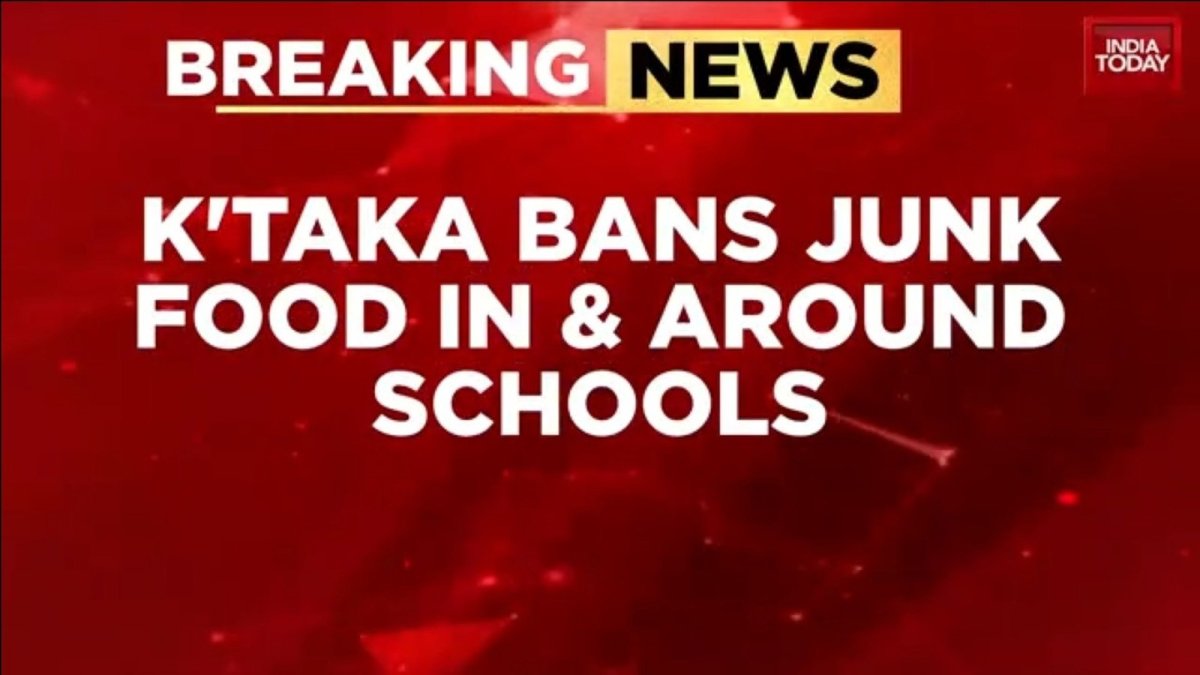
On July 31, 2026, Karnataka became the second major state to restrict high-fat, sugar and salt (HFSS) food products after Health and Family Welfare Minister U T Khader directed the Karnataka Food Safety and Drug Administration to ban their sale, free distribution, advertising and promotion on school
On July 31, 2026, Karnataka became the second major state to restrict high-fat, sugar and salt (HFSS) food products after Health and Family Welfare Minister U T Khader directed the Karnataka Food Safety and Drug Administration to ban their sale, free distribution, advertising and promotion on school and college campuses up to II PUC level and within a 50-metre radius. The move follows Maharashtra's identical order issued three days earlier and arrives days after the ICMR-National Institute of Nutrition released its "Priority Policy Actions to Promote Healthier Diets and Food Environments for Children and Adolescents in India." India already has 41 million overweight or obese children and is projected to account for more than 11 per cent of global childhood obesity cases by 2030 if current trends continue.
Karnataka Bans HFSS Foods Near Schools as Childhood Obesity Hits 41 Million
Bengaluru, Karnataka – August 1 — The Karnataka government has issued a statewide prohibition on HFSS products in and around educational institutions, citing rapid blood-sugar spikes and long-term diet-related non-communicable diseases. The order, released by the Karnataka Food Safety and Drug Administration under the Food Safety and Standards Act, 2006, applies to all schools and pre-university colleges and extends 50 metres beyond campus boundaries.
The Karnataka Order: What Exactly Is Banned
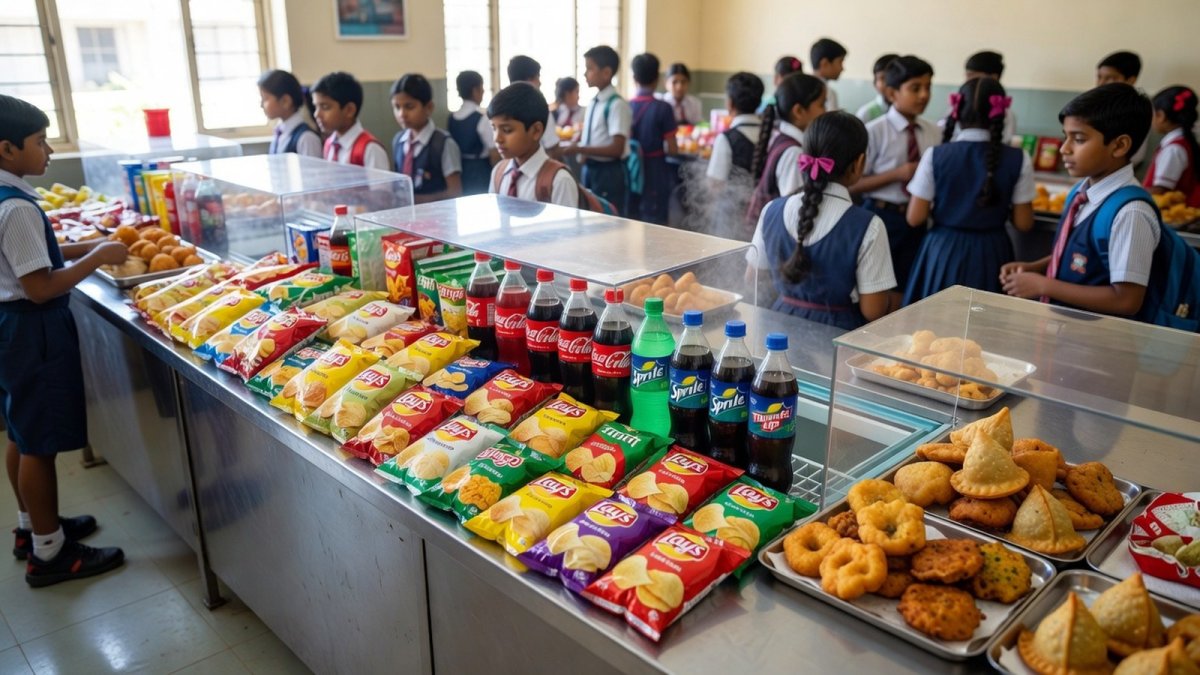
The directive prohibits sale, free distribution, advertising and promotion of HFSS items on campuses and within the 50-metre zone. Educational institutions must remove these products from canteens and meal menus, display warning signboards, ensure structured meal times and provide safe drinking water free of cost. Food vendors operating near campuses require valid licences. Violations can result in seizure of products, suspension of licences and judicial action, with regular inspections by food safety officers.
The prohibition was not abrupt. On July 19, Khader told reporters in Mangaluru that the government was working on banning burgers, pizzas and other junk food sold to schoolchildren, linking several health issues among children to unhealthy food. He had also announced upgrades to existing food testing laboratories and the establishment of new laboratories under a public-private partnership model to improve testing and monitoring capacity across the state.
The Inspection Evidence Behind the Ban
Last month the Karnataka Food Safety and Drug Administration inspected 134 schools, colleges and food business establishments across the state. Officials documented vendors selling HFSS items near educational institutions and inside canteens, collecting 53 food samples for laboratory analysis. The findings confirmed widespread availability of products linked to elevated blood-sugar levels, prompting the July 31 order.
The inspection drive's focus on high-probability violation sites tests the practical limits of Karnataka's enforcement machinery, where limited sample throughput could constrain the state's ability to impose penalties consistently across thousands of school-adjacent vendors. Analytical scrutiny suggests that without proportional increases in trained personnel and mobile testing units, the campaign risks uneven application that weakens deterrence.
The July 19 India Today report details ongoing laboratory upgrades alongside new public-private partnership facilities designed to accelerate HFSS detection. These enhancements matter directly for a penalty-backed ban because reliable, timely lab results form the evidentiary backbone required for legal action. Expanded capacity reduces turnaround times from weeks to days, enabling regulators to link specific products to violations swiftly and sustain momentum before non-compliant outlets adapt or challenge enforcement in court.
What Schools Must Now Serve
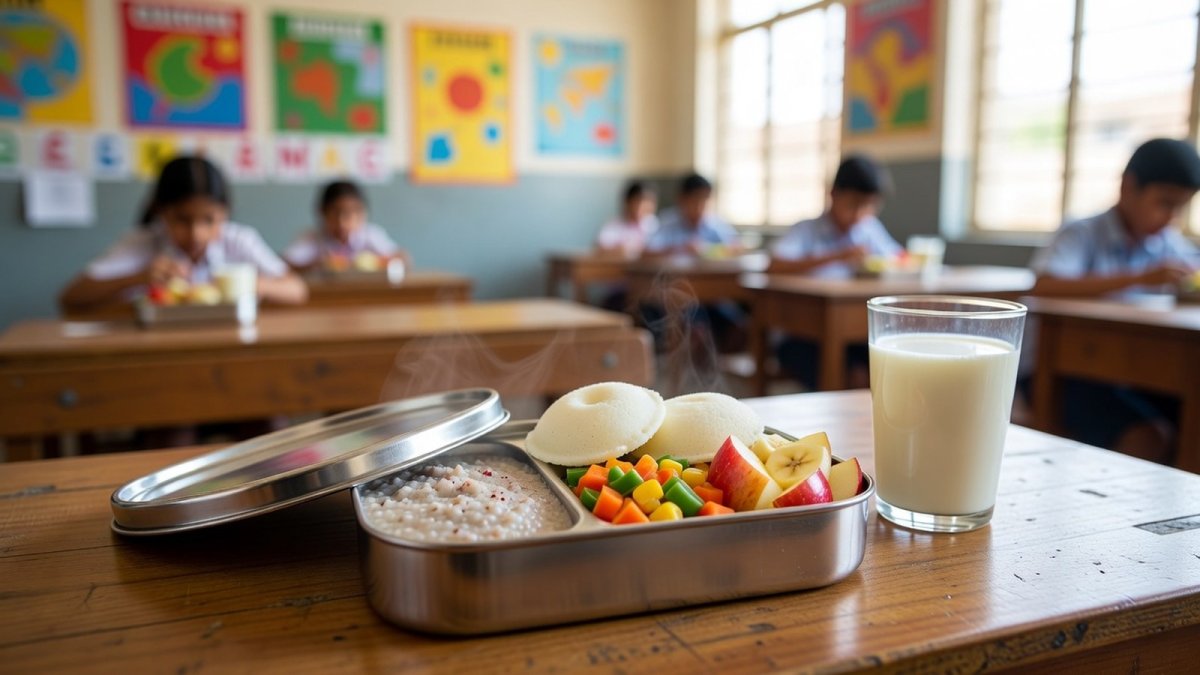
Institutions are required to ensure that 75-80 per cent of menus consist of cereals, millets and pulses such as whole wheat atta, rice, ragi, jowar, bajra, navane, sama and arka, along with legumes including tur dal, Bengal gram, horse gram and green gram. Milk and milk products, fruits, vegetables, nuts, oilseeds and freshly prepared items such as idli, upma, poha, dhokla and stir-fried vegetables are permitted. Cooking oil and ghee must be used in moderation, reheated fats avoided, and fortified wheat flour, rice, milk, edible oil and double-fortified salt preferred. Foods high in saturated fat, trans fat, added sugar or sodium are excluded.
Karnataka's millet-centric menu, built on ragi, jowar, bajra, navane, sama and arka, aligns traditional grains with updated nutritional standards for government school meals. These choices introduce higher fibre and micronutrient density compared with refined cereals, offering a culturally resonant pathway to improve dietary quality. When paired with familiar preparations such as idli, upma, poha, khandvi, dhokla and cheela, the rules encourage adoption by both cooks and children while meeting calorie and protein targets without relying on processed additives.
Fortification requirements for wheat flour, rice, milk, edible oil and double-fortified salt embed micronutrient security into every mid-day meal serving, addressing widespread deficiencies in iron, vitamin A and iodine among school-aged populations, particularly in rural districts where home diets may remain limited. Over time, consistent implementation could narrow nutrition gaps that contribute to both undernutrition and emerging overweight trends, strengthening the long-term public-health return on state meal investments.
The Definition Problem Schools Are Asking About
KAMS secretary D Shashi Kumar questioned the precise definition of junk food, asking whether a vegetable or chicken sandwich qualifies. He also raised enforcement challenges outside school premises, noting that Bengaluru malls and restaurants often sit close to educational institutions. Health Minister U T Khader stated that a more detailed list of prohibited items will be issued shortly, while the order emphasises improving children's health rather than serving solely as an enforcement exercise.
These edge cases illustrate how loosely worded product categories invite inconsistent interpretation by school authorities and vendors alike. The resulting uncertainty risks selective compliance, where some institutions adopt strict interpretations while others await clarification, diluting the ban's intended protective effect on children's daily food environments.
Minister Khader's commitment to issue a detailed list acknowledges that enforcement hinges on precise, operational definitions rather than broad intent alone. This tension between ambitious health objectives and the mechanics of daily inspection reveals a classic policy implementation gap: without granular guidance, even well-resourced monitoring teams may struggle to distinguish permissible traditional snacks from prohibited HFSS items, ultimately determining whether the ban translates into measurable dietary change.
Maharashtra's Precedent and a National Policy Push
Maharashtra Food and Drug Administration issued a parallel compliance order on July 28, 2026, covering aided, unaided and private schools under all boards and applying the same 50-metre radius. The state has approximately 108,000 schools and more than 20 million students; school canteens, tuck shops, mid-day meal centres and hostel kitchens must now hold mandatory FSSAI registration. Maharashtra FDA commissioner Tukaram Mundhe said: "The most important stakeholders—schools, children and parents—need to understand that we must give children a balanced diet, and develop a [food] culture that positively impacts their life."
By aligning licensing with existing food-safety frameworks, the two states create a scalable model that neighbouring regions may replicate, shifting the policy conversation from isolated experiments toward a coherent southern Indian approach to school food environments.
The ICMR-NIN 'Let's Fix Our Food' consortium launched on July 22 outlines evidence-based actions spanning school food standards, front-of-pack labelling, marketing restrictions, HFSS taxation and the NEAT-S toolkit. The policy document was released at the India Habitat Centre, New Delhi, by Dr M Srinivas, Member (Health) of NITI Aayog, after nearly three years of multidisciplinary research and stakeholder consultations; Dr Bharati Kulkarni, Director of ICMR-NIN, and K Srinath Reddy, Founder President of PHFI, were among those present. Partner institutions including UNICEF India, WHO, FSSAI, PHFI, Resolve to Save Lives and WFP bring technical and convening capacity that can accelerate guideline harmonisation across states. This national-level infrastructure complements state-level bans by supplying the data systems and policy templates needed for sustained, cross-jurisdictional impact.
The Bottom Line
For the 41 million children already overweight or obese in India, these state-level restrictions represent the first coordinated attempt to reshape daily food environments inside and immediately outside schools. Parents and taxpayers in Karnataka and Maharashtra will now see whether enforced menu changes and vendor licensing reduce diet-related disease burdens on the public health system. Students in Bengaluru and Mumbai stand to gain structured access to millets, pulses and fortified staples, yet successful implementation hinges on clear HFSS definitions and sustained inspection capacity. The ICMR-NIN recommendations provide a national template that other states can adopt before the projected 11 per cent share of global childhood obesity cases materialises by 2030.
Success ultimately rests on translating regulatory intent into routine practice at the school perimeter, where daily decisions by vendors and meal providers shape long-term dietary trajectories. Robust laboratory networks and unambiguous classification lists therefore function as the operational linchpins separating symbolic announcements from durable public-health gains.
— By Dr. Raj Patel, Staff Writer
This article was produced with AI-assisted research and editorial support. Reporting is based on sources cited in the article.
What's Your Reaction?
 Like
0
Like
0
 Dislike
0
Dislike
0
 Love
0
Love
0
 Funny
0
Funny
0
 Wow
0
Wow
0
 Sad
0
Sad
0
 Angry
0
Angry
0

India/South Asia Correspondent at Global1.News. Analytical voice with a background in science and health journalism. Based in New Delhi, covering Indian politics, education, healthcare, technology, and policy. Breaks down complex data into clear, actionable reporting.















Comments (0)