
Japan Deploys Fighter Jets to India for First Time as Veer Guardian 26 Signals a New Phase in Indo-Pacific Defense Cooperation
In a landmark development for Indo-Pacific security architecture, Japan's Air Self-Defense Force (ASDF) has confirmed it will deploy fighter jets to Indian territory for the first time, marking a significant escalation in bilateral defense cooperation between Tokyo and New Delhi.
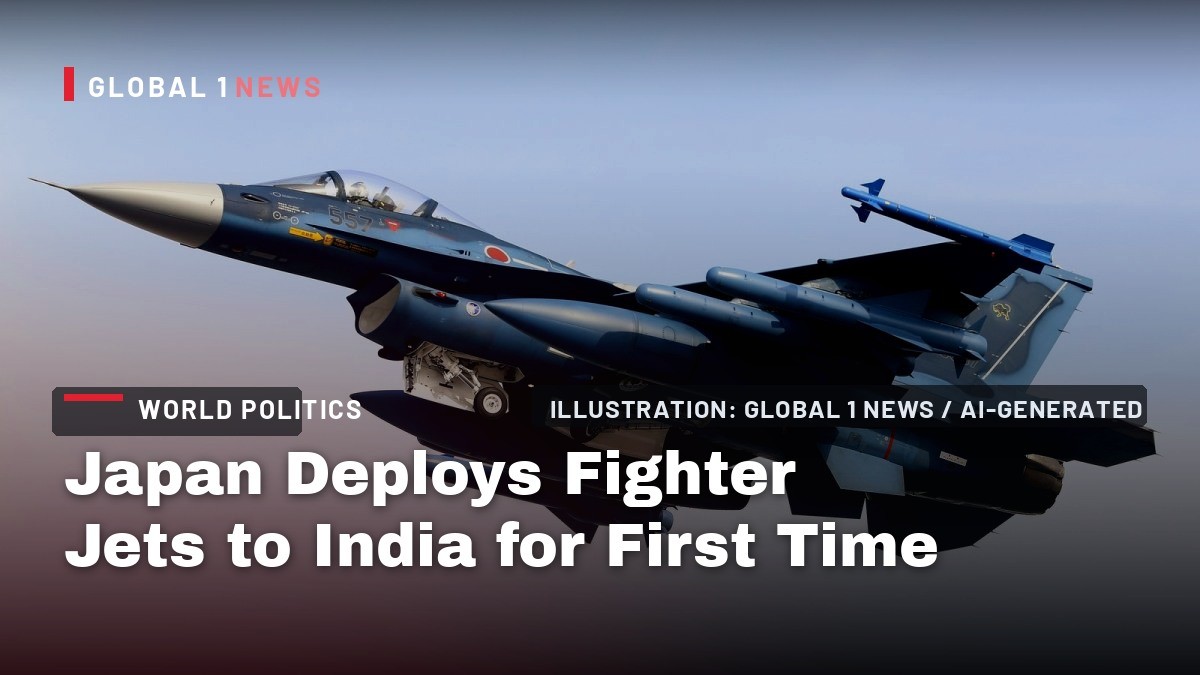
In a landmark development for Indo-Pacific security architecture, Japan's Air Self-Defense Force (ASDF) has confirmed it will deploy fighter jets to Indian territory for the first time, marking a significant escalation in bilateral defense cooperation between Tokyo and New Delhi. The deployment, which will see three Mitsubishi F-2A aircraft participate in Exercise Veer Guardian 26 at Jodhpur Airbase in Rajasthan from September 9 to 21, 2026, represents a reversal of the trajectory established when the two nations held their inaugural joint air exercise in Japan in January 2023. The move comes amid intensifying strategic competition in the region, with both nations explicitly framing their partnership as a response to China's growing military assertiveness.
A Historic Deployment with Logistical Complexity
The operational details of the deployment underscore its significance beyond mere symbolism. Approximately 110 personnel from the 8th Air Wing, stationed at Tsuiki Air Base in Fukuoka Prefecture, southwestern Japan, will accompany the three F-2A fighters to Jodhpur. According to reporting from The Diplomat, the transit route itself constitutes a major operational undertaking, with the aircraft flying via Okinawa and Thailand, supported by the United States Air Force providing aerial refueling capabilities. This logistical framework demonstrates the deepening trilateral coordination between Japan, the United States, and India, even as the formal exercise remains a bilateral affair.
ASDF Chief of Staff Takehiro Morita framed the exercise in terms of strategic trust-building, stating: "It will be a great opportunity to further deepen mutual understanding and relationship of trust." The choice of words is telling—this is not merely a training event but a political signal of alignment. The F-2A aircraft themselves carry symbolic weight: developed by Mitsubishi Heavy Industries with Lockheed Martin as a modified F-16 derivative, the platform features wings constructed of approximately 60 percent composite materials and was designed primarily for anti-ship missions. Its Mitsubishi Electric J/APG-1 radar, later upgraded to J/APG-2, was among the first active electronically scanned array (AESA) radars on a production fighter, contributing directly to Japan's subsequent aerospace electronics programs, including its role in the next-generation GCAP fighter project.
From Memorandum to Operational Framework
The air exercise does not occur in a vacuum. It follows high-level diplomatic engagement in August, when Japanese Defense Minister Shinjiro Koizumi visited New Delhi and held talks with Indian Defence Minister Rajnath Singh on August 20. The two ministers signed a Memorandum of Arrangement on Maritime Security Cooperation aimed at transforming the bilateral relationship from periodic training exercises into an operational framework. This pact, which engages the Indian Navy and the Japan Maritime Self-Defense Force (JMSDF), focuses on protecting Sea Lines of Communication across the Indo-Pacific, enhancing Maritime Domain Awareness, Search and Rescue operations, and Humanitarian Assistance and Disaster Relief across critical sea lanes.
The maritime agreement carries concrete operational implications. Indian warships could receive maintenance and repairs at Japanese shipyards, make port calls, and access logistics and defense maintenance facilities—and vice versa. This reciprocal access arrangement represents a qualitative leap in defense integration, moving beyond the symbolic gestures that often characterize such partnerships. The pact also emphasizes defense-industrial cooperation and technology transfer, with joint initiatives in naval shipbuilding and mine countermeasures, leveraging Indian manufacturing capacity under the 'Make in India' campaign.
Japan's First Defense Export to India
Perhaps the most striking element of the August agreement is Japan's commitment to export its UNICORN (NORA-50) integrated communications antenna system to the Indian Navy. This transaction marks Japan's first defense export to India since Tokyo ended its weapons export restrictions in April 2026. The significance cannot be overstated: for decades, Japan's post-war pacifist constitution and associated policy frameworks severely constrained defense exports. The UNICORN sale signals not only a policy shift but a strategic calculation that defense-industrial cooperation with India serves Japan's broader security interests in the Indo-Pacific.
Both defense ministers also agreed to expand the scope and complexity of future exercises, including the Dharma Guardian army exercise and the naval JIMEX exercise, with a specific focus on unmanned systems and joint special forces training. To oversee these initiatives, New Delhi and Tokyo have established a joint Working Group led by senior director-general-level officials, tasked with coordinating operational, intelligence, and defense-industrial initiatives under the pact. This institutional mechanism suggests both governments intend to move beyond episodic cooperation toward sustained, structured engagement.
The China Dimension and Regional Strategic Calculus
The exercise has an explicit China dimension that neither government has sought to obscure. Japanese sources reported that the planned deployment aims to enhance operational cooperation in response to China's aggressive military posture in the Indo-Pacific. China's navy is now the largest in the world by fleet size, a development that constitutes a shared concern for both Tokyo and New Delhi. For Japan, the deployment to India represents an extension of its strategic footprint beyond the First Island Chain, while for India, it offers an opportunity to balance Chinese pressure along the Himalayan border and in the Indian Ocean Region without formally aligning with any bloc.
The choice of Jodhpur Airbase is itself strategically significant. Located in northwestern Rajasthan, approximately 250 kilometers from the Pakistani border, Jodhpur is one of India's main air defense bases. It was in the spotlight during real aerial combat in May 2025, when India launched Operation Sindoor strikes into Pakistan, and Pakistani aircraft including J-10Cs responded. The selection of this base for a Japanese deployment sends multiple signals—to China, to Pakistan, and to the broader region—about India's willingness to host allied air power on its soil.
Chinese Reaction and Regional Frictions
Beijing has taken notice. The Global Times, China's state-affiliated English-language outlet, published a response the same week the deployment was confirmed. A Chinese researcher from the Shanghai Institutes for International Studies acknowledged that the partnership serves the strategic interests of both countries but warned India should be cautious about becoming a frontline player in Japan's geopolitical conflict with China. The commentary invoked Japan's wartime history, suggesting India should think carefully before building closer ties with Japan given its record of aggression in Asia during World War II. This framing—simultaneously acknowledging India's sovereign right to choose partners while warning of historical baggage—reflects Beijing's broader strategy of leveraging historical grievances to complicate Japan's security outreach.
The Chinese response also highlights a deeper tension in the Indo-Pacific: the region's security architecture is becoming increasingly layered, with minilateral arrangements proliferating alongside traditional alliances. Japan's deployment to India represents a new node in this network, one that connects the U.S.-Japan alliance, the Quad framework, and India's own network of defense partnerships. For South Korea, which maintains its own complex security relationship with both Japan and China, these developments bear close watching. The evolution of Japan-India defense cooperation could reshape the strategic calculus in Northeast Asia, particularly if it encourages further Japanese security activism beyond its traditional operational boundaries.
Beyond Veer Guardian: Tarang Shakti and the Future of Regional Exercises
The significance of Veer Guardian 26 extends beyond its immediate operational parameters. After the exercise concludes, Jodhpur will host Exercise Tarang Shakti 2026 from September 26 to October 12, with aircraft from eight nations and more than thirty observing. The schedule includes U.S. F-35 fighters, which might mark the first time America's stealth fighter joins an exercise in India. The sequential scheduling of these exercises at the same base suggests deliberate planning to maximize strategic impact, creating a continuous period of multinational air operations on Indian soil.
For Japan, the deployment represents a milestone in its evolving defense posture. The F-2A's journey to India—via Okinawa and Thailand, with U.S. aerial refueling support—demonstrates the operational reach that Tokyo has been developing since its 2022 National Security Strategy signaled a more proactive defense stance. For India, hosting Japanese fighters at a base near the Pakistani border underscores New Delhi's willingness to integrate its security partnerships in ways that would have been unthinkable a decade ago. The convergence of these trajectories suggests that the Indo-Pacific's security architecture is becoming more dense, more operational, and more consequential.
The academic literature on alliance politics has long noted that joint exercises serve multiple functions: they build interoperability, signal resolve to adversaries, and create path dependencies that make future cooperation more likely. Veer Guardian 26 accomplishes all three. The question now is whether this momentum can be sustained, and whether the operational framework established by the maritime agreement and the joint Working Group can translate into durable strategic outcomes. For scholars of Northeast Asian security, the Japan-India axis represents a critical variable in understanding how the region's balance of power is shifting—and how China will respond to the consolidation of this emerging alignment.
This article was produced with AI-assisted research and editorial support. Sources: Kyodo News via The Mainichi, Marine Insight, Tecrow, The Diplomat.
By Prof. David Park, Staff WriterWhat's Your Reaction?
 Like
0
Like
0
 Dislike
0
Dislike
0
 Love
0
Love
0
 Funny
0
Funny
0
 Wow
0
Wow
0
 Sad
0
Sad
0
 Angry
0
Angry
0

East Asia/Technology Correspondent at Global1.News. Seoul-based voice covering Korean politics, technology, business, and culture. Analyzes how technology and geopolitics intersect across East Asia.















Comments (0)