
Israeli Settlers Torch Palestinian Vehicle, Attack Home in Southern West Bank
Israeli settlers raided Surif, northwest of Hebron, overnight Friday into Saturday, torching a Palestinian vehicle, damaging another and attacking homes. Three Palestinians were slightly injured and no arrests were reported....
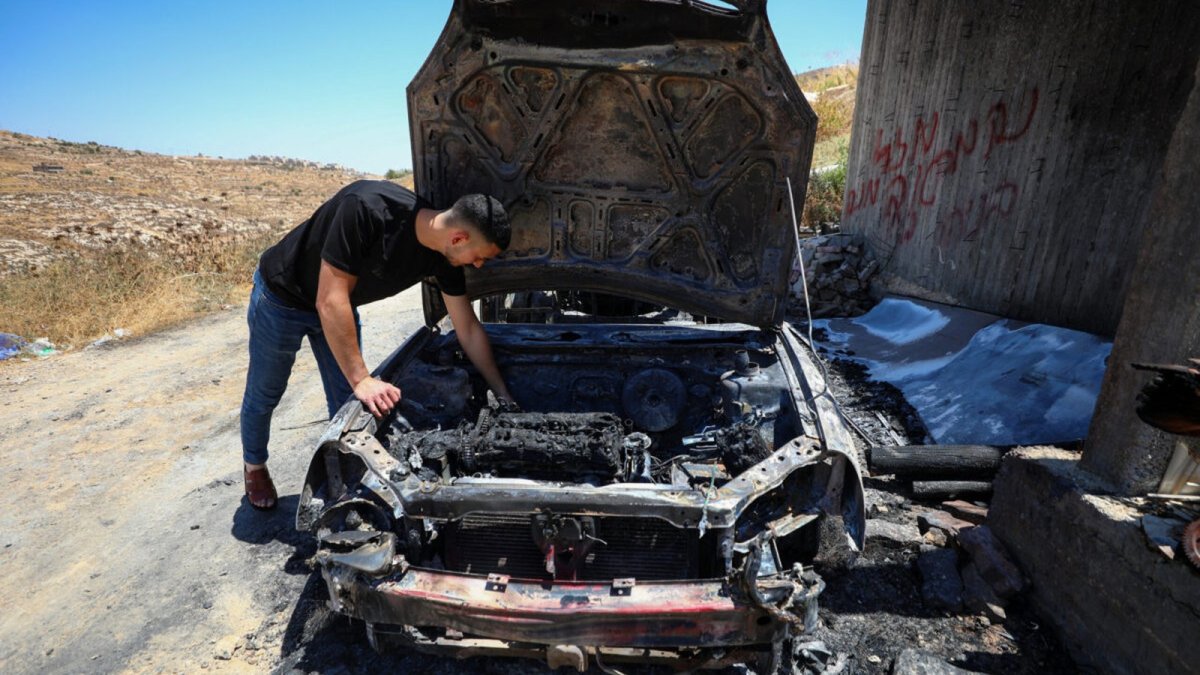
Israeli settlers raided the town of Surif, northwest of Hebron in the southern occupied West Bank, overnight Friday into Saturday, setting fire to a Palestinian-owned vehicle, damaging another and attacking residents' homes. The assault left three people slightly injured and, according to Israeli media reports, produced no arrests. Local accounts describe families woken in the dark, residents rushing into a courtyard to stop a house from burning, and a community already braced for the next raid.
Surif sits in an area of the West Bank that has become a repeated target of settler violence. The attack follows a pattern documented by the United Nations and Palestinian monitoring bodies throughout 2026, in which towns and villages around Hebron face raids that damage property, disrupt daily life and leave families living in a state of constant alert.
Settlers Torch Vehicle and Target Home in Surif Overnight
Israeli settlers raided the town of Surif, northwest of Hebron in the southern occupied West Bank, overnight Friday into Saturday, setting fire to one Palestinian-owned vehicle and attempting to burn another while also attacking a house. The assault occurred around 2:30 am local time and caused fear and panic, especially among women and children, according to local accounts.
Resident Descriptions of the Raid
Local resident Ali Ghneimat told Anadolu that the attackers approached the outskirts of Surif from the direction of the Etzion settlement. "They set fire to one vehicle and attempted to burn another," he said. The same group attacked a house and tried to set it on fire, but residents gathered in its courtyard and prevented the attempt from succeeding.
Additional Damage Reported by WAFA
WAFA, the official Palestinian news agency, quoted the Mayor of Surif, Hazem Ghneimat, as saying colonists from the Bat Ayin colony, illegally built on Palestinian lands northwest of Hebron, stormed the Deir al-Nil area of the town. They attacked residents' homes, set fire to a vehicle belonging to a local resident, damaged another vehicle, attempted to set fire to a house, and sprayed racist slogans on the walls of another house.
Injuries and Lack of Arrests
The Jerusalem Post reported that three Palestinians were slightly injured during the attack, according to an Israeli army statement. The Times of Israel covered the raid under a headline that noted no arrests were made in connection with the incident. The absence of reported arrests reflects a broader pattern in which settler attacks on Palestinian communities in the West Bank rarely result in criminal proceedings against the perpetrators.
Documented Pattern of Attacks in 2026
The UN Office for the Coordination of Humanitarian Affairs (OCHA) has documented more than 1,330 Israeli settler attacks in the occupied West Bank since the beginning of 2026 that resulted in casualties or damage to Palestinian property. OCHA recorded an average of six settler attacks per day in 2026, the highest rate on record, and Human Rights Watch reported that settler attacks in 2026 have killed 13 Palestinians as of July 15, 2026.
The pace has not let up. In a single week in May, OCHA reported more than 50 settler attacks across the West Bank resulting in casualties or property damage, including arson attacks that damaged a mosque, homes, farmland and vehicles. Earlier in the year, between late December and early January, the agency documented 44 attacks that injured 33 Palestinians, including 11 children.
These numbers illustrate a sustained pattern of violence that Palestinian communities experience as routine disruption rather than isolated events. Families in towns such as Surif must weigh the risk of leaving homes unattended against the need to maintain livelihoods, turning ordinary decisions into calculated risks. The data from OCHA and Human Rights Watch provide a measurable record of how settler activity shapes movement and security in the southern West Bank.
Scale of Settlement Activity
Around 750,000 Israeli settlers live in 156 illegal settlements and 360 outposts across the occupied West Bank, including occupied East Jerusalem, according to Palestinian figures. In the Surif area, local resident Ali Ghneimat identified attackers approaching from the direction of the Etzion settlement, while Mayor Hazem Ghneimat specified colonists from the Bat Ayin colony, which was built on Palestinian land northwest of Hebron. These distinct attributions highlight how multiple settlement sites contribute to pressure on surrounding villages.
The presence of these settlements and outposts creates overlapping zones of control that restrict Palestinian access to land and resources. The Wall and Colonization Resistance Commission recorded 11,074 attacks by Israeli occupation forces and colonists during the first half of 2026, including land and property seizures, forced displacement, field executions, vandalism, land leveling, tree uprooting and closures that directly affect agricultural and residential areas in Hebron governorate.
Impact on Daily Life in Hebron Governorate
Residents of the area remain in a constant state of anxiety due to repeated attacks. Local men have been forced to leave their jobs and avoid social occasions to stay near their homes and protect them. The Wall and Colonization Resistance Commission recorded the highest number of attacks in Hebron governorate, with 2,224 during the first half of 2026, followed by Ramallah and al-Bireh with 2,175, Nablus with 2,095 and Bethlehem with 1,137.
Such frequency forces families to reorganize daily routines around the defense of property, limiting opportunities for work, education and social participation that define normal life in Palestinian towns. In Surif, residents describe a persistent state of anxiety that extends beyond the immediate hours of an attack, with women and children experiencing heightened fear during nighttime raids and men reducing social activities to remain near their homes for protection.
A Week of Attacks Across the Southern West Bank
The raid on Surif came days after a similar incident in the village of Abu Njeim, southeast of Bethlehem, where Israeli settlers set fire to a Palestinian-owned vehicle on July 29, leaving the vehicle completely destroyed and unusable, according to Anadolu photographer Wisam Hashlamoun. The two incidents, roughly 20 kilometers apart, underscore how settler violence against Palestinian property has become a recurring feature of daily life across the southern West Bank.
Legal Context Under International Law
Settlements are illegal under international law. The International Court of Justice issued an advisory opinion in July 2024 declaring Israel's occupation and settlement enterprise unlawful. This legal framework provides context for understanding the raids in Surif, where settlers from established colonies targeted Palestinian property without reported intervention or subsequent arrests.
Palestinian communities in the southern West Bank continue to face the practical consequences of settlement expansion despite the court's opinion. The ongoing incidents documented by OCHA and local authorities demonstrate how the absence of enforcement leaves families exposed to repeated property damage and threats, reinforcing a daily reality shaped by the settlement presence in Hebron governorate. For the residents of Surif, the question is not whether another raid will come, but when.
By Fatima Al-Rashid, Staff WriterThis article was produced with AI-assisted research and editorial support. Reporting is based on sources cited in the article.
What's Your Reaction?
 Like
0
Like
0
 Dislike
0
Dislike
0
 Love
0
Love
0
 Funny
0
Funny
0
 Wow
0
Wow
0
 Sad
0
Sad
0
 Angry
0
Angry
0

Gulf/MENA Correspondent at Global1.News. Based in Doha, covering Gulf politics, energy markets, diplomacy, and development across the Middle East and North Africa. Tracks the economic transformation of the Gulf states.











Comments (0)