
Iran Drones Strike Ahmad al-Jaber Air Base as Trump's War Spins Wider
Iran's military drones struck the US Ahmad al-Jaber Air Base in Kuwait on Friday, retaliating for strikes that killed a family on Qeshm Island, as Trump convened a historic Camp David Cabinet meeting and vowed four more weeks of war. Brent crude hit $90.24 as the conflict widens.
Drones Over Kuwait: The 27th Stage of Operation Lightning
Folks, the war just walked through a brand-new door. On Friday, July 31, the Iranian army announced it had targeted strategic US military facilities at Kuwait's Ahmad al-Jaber Air Base in a drone attack. Iran's semi-official Tasnim news agency said the army hit hangars, satellite communication systems and equipment warehouses — what Tehran called "a vital hub for US aerial surveillance and operational support." ANI reported the strike was the 27th stage of Iran's Operation Lightning.
Satellite imagery analyzed by Soar Atlas and cited by Iran's Press TV showed a US storage area at al-Jaber appeared blackened. The Kuwaiti military said it destroyed multiple drones in its airspace since dawn; a US Defense Department official said there was no major impact on American bases. But here's the telling detail: the Pentagon has begun reducing its military presence in Kuwait, per the Wall Street Journal.
A Family on Qeshm Island and the Cycle of Retaliation
Early Thursday, July 30, the United States struck Iran for the first time in more than five days — a two-hour "heavy wave" of "dozens of IRGC targets," including command centers and missile and drone facilities. CENTCOM said the strikes aimed to "further diminish threats" to American forces, commercial shipping and Gulf neighbours. On the ground, the price was civilian: Iranian state media said three people were killed when a US strike hit a residential building on Qeshm Island — a family of three, including a two-year-old child.
That's the cycle, laid out in blood. On Wednesday, July 29, President Trump vowed from the White House: "We're going to be hitting them very hard because it's our turn to hit them. They know it's coming." The same day, the first coordinated US-Saudi strike on Iranian-aligned militias in Iraq killed at least 20 Popular Mobilization Forces fighters and wounded more than 30. By Friday, the IRGC promised punishment — "the aggressor will be punished today," per Fars — and Parliament Speaker Mohammad Bagher Qalibaf said the US would "pay the price" for killing civilians. Then the drones flew.
Camp David: Trump Takes the War Cabinet to the Woods
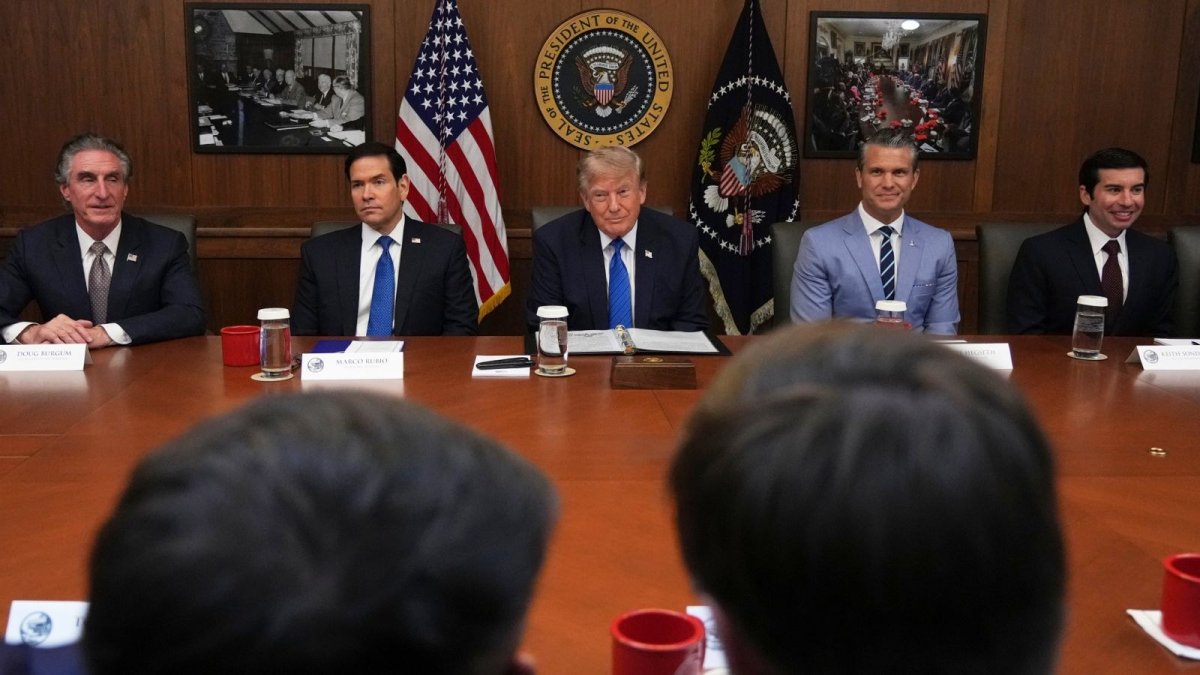
Trump convened his Cabinet at Camp David — the first live, televised Cabinet meeting there in American history, per a White House release. CNN's headline said it best: "Trump, under pressure on Iran, takes his Cabinet to the woods." Reuters: Trump convened the meeting "as he grapples with how to resolve his war against Iran." The agenda: the Iran war, gas prices, foreign policy and the 2026 midterm elections.
That agenda is the tell. This is a war in its sixth month — it began February 28, 2026, after US-Israeli airstrikes killed several Iranian officials, including Supreme Leader Ali Khamenei — a conflict widely unpopular at home and one that has jolted the world economy, per the Guardian. Trump has said the US will be attacking Iran over the next four weeks, per Al Jazeera's liveblog; to the Daily Mail, the campaign "has always been a four-week process... it'll take four weeks — or less." Strikes had been paused amid concerns munition stockpiles, especially missile-defense systems, are running low, per WSWS. When the commander in chief is talking gas prices and midterms at a televised war cabinet, he's not just running a conflict — he's running a political clock.
A Map on Fire: Jordan, Bahrain, Egypt, Iraq, the Caspian
Widen the lens. On Tuesday, July 28, Iran launched ballistic missiles toward a US base in Jordan — CENTCOM called it an "attempted surprise attack" — and all were intercepted. On Thursday, Jordanian air defenses shot down five more missiles, a second straight day of incoming fire with no reported casualties. The IRGC claimed retaliatory attacks on bases in Kuwait, Jordan and Bahrain where US equipment is located; Washington denied Iranian claims that the Jordan attack destroyed three F-35 fighter jets and damaged three more.
Iraq is a flashpoint too. CENTCOM said the targets in that strike were "terrorist logistics and weapons sites across eastern Iraq." Riyadh, which had accused Iraqi militias of firing drones at Saudi oil facilities, is now a co-belligerent. Kuwait, too, counts casualties: on Thursday, its Defence Ministry announced one worker was killed in an Iranian attack on a building belonging to a Chinese company in the country's north. Beijing said no Chinese citizens were affected and asked Kuwait to protect Chinese nationals.
Egypt got dragged in Wednesday, too. A drone strike hit the US-owned LNG storage tanker Energos Winter at Egypt's Damietta port, and the fire spread to a second, Greek-owned vessel. Egypt's Cabinet confirmed a drone caused the fire; no one claimed responsibility. No injuries were reported — but it was the first attack on Egypt since the war began. Trump called it "a little more of the same." Then there's the Caspian: Ukraine struck an Iranian commercial ship there — a first — killing one Iranian sailor, per WSWS; Iran summoned Ukraine's chargé d'affaires over the "hostile and criminal" attack. In the Red Sea, Yemen's Houthis announced a maritime blockade against Saudi Arabia on July 20; Riyadh on Thursday unveiled plans for a multinational maritime defense coalition. The map of this war now runs from the Caspian to the Red Sea.
Oil Markets: Brent at $90.24 and the Strait's One-Fifth Chokehold
Now the economic shockwaves. Brent crude rose to $90.24 per barrel on July 31, up 3.87 percent from the previous day and up 26.09 percent over the past month, per TradingEconomics. On July 26, after a pause, Brent fell 8.7 percent to $88.36 a barrel — proof of how quickly headlines repriced risk.
The reason is geographic: the Strait of Hormuz normally carries about one-fifth of the world's oil tanker traffic. When Iran strikes tankers under US "air escort" there — as the IRGC claimed Friday — every barrel of Gulf crude suddenly carries a war-risk premium. That's what shows up at the pump — and why "gas prices" was on the Camp David agenda.
Tankers Under Attack in the Strait — and Europe's Hesitation
The IRGC claimed Friday that its forces struck a pair of tankers attempting to pass through the Strait of Hormuz under the "air escort" of the US military, per ZeroHedge citing Clash Report. Iran launched these attacks despite no new US operations overnight. The message: Tehran can escalate on its own timetable.
So where are America's allies? POLITICO reported Defense Secretary Pete Hegseth has held consultations with British counterpart Wes Streeting and French Armed Forces Minister Catherine Vautrin on a US-led "defensive" patrol mission in the Strait of Hormuz. European officials, per WSWS citing Politico, have shown reluctance to join. That reluctance leaves Washington with a thinner line in the strait — exactly what Tehran wants to test.
Vertical vs. Horizontal Escalation: Tehran's Playbook
To understand where this is heading, listen to Ali Akbar Dareini, a Tehran-based researcher at the Center for Strategic Studies, who spoke to Al Jazeera. His read: Tehran believes Washington is amassing equipment in Jordan in preparation for a major attack and is trying to preempt it. "Iran is now targeting the staging grounds of future operations," he said. He described Washington as pursuing "vertical escalation" — ramping up military attacks — while Tehran pursues "horizontal escalation," expanding the conflict's geographical scope. His warning was blunt: "Iran wants a complete, permanent end to war, or it's going to be a wide-scale regional war."
Guardian-cited analysts said the flare-ups after days of relative calm pushed the region into "uncharted territory." That's the core tension: the US thinks it can bomb its way to a tolerable outcome; Iran thinks it can widen the war until the US blinks. Both cannot be right.
What to Watch Next: A Quiet Night, a Four-Week Warning, and the Midterm Clock
The headline from Saturday morning: Iran reported no new US strikes overnight into Saturday — the first night without fresh American strikes in two weeks, per Al Jazeera. Whether it's a pause before another "heavy wave" or something softer remains the question.
Three things to watch. First, the four-week clock: Trump has promised four weeks of attacks, but the Pentagon is eyeing munition stockpiles and the Kuwait drawdown suggests the US is not simply doubling down. Second, diplomacy: mediators reported cautious optimism on a draft Gaza agreement — a fragile but real channel, per Al Jazeera's liveblog. Third, politics: with midterms looming and gas prices atop the Camp David agenda, every day of war is political exposure for this White House.
Folks, this is where a tactical conflict gets walked back from the ledge — or goes over it. Iran's own threat assessment says it wants a permanent end to the war or a regional conflagration. The United States says it will hit for four more weeks. Saturday's quiet is the first honest sign we've had in a fortnight. What happens next will tell us whether that quiet was a pause — or a pivot.
By Jessica Ali, Staff WriterThis article was produced with AI-assisted research and editorial support. Reporting is based on sources cited in the article.
What's Your Reaction?
 Like
0
Like
0
 Dislike
0
Dislike
0
 Love
0
Love
0
 Funny
0
Funny
0
 Wow
0
Wow
0
 Sad
0
Sad
0
 Angry
0
Angry
0

Editor-in-Chief at Global1.News. Atlanta-based journalist who cuts through the BS and tells it like it is. Lead anchor, host, and the voice you hear when the spin stops and the truth starts.















Comments (0)