
I spent $4,000 on a robot dog from China
On a bright June morning in Washington, D.C., I took a two‑mile walk to my office with a quadruped robot dog from the Chinese firm Unitree trailing beside me.
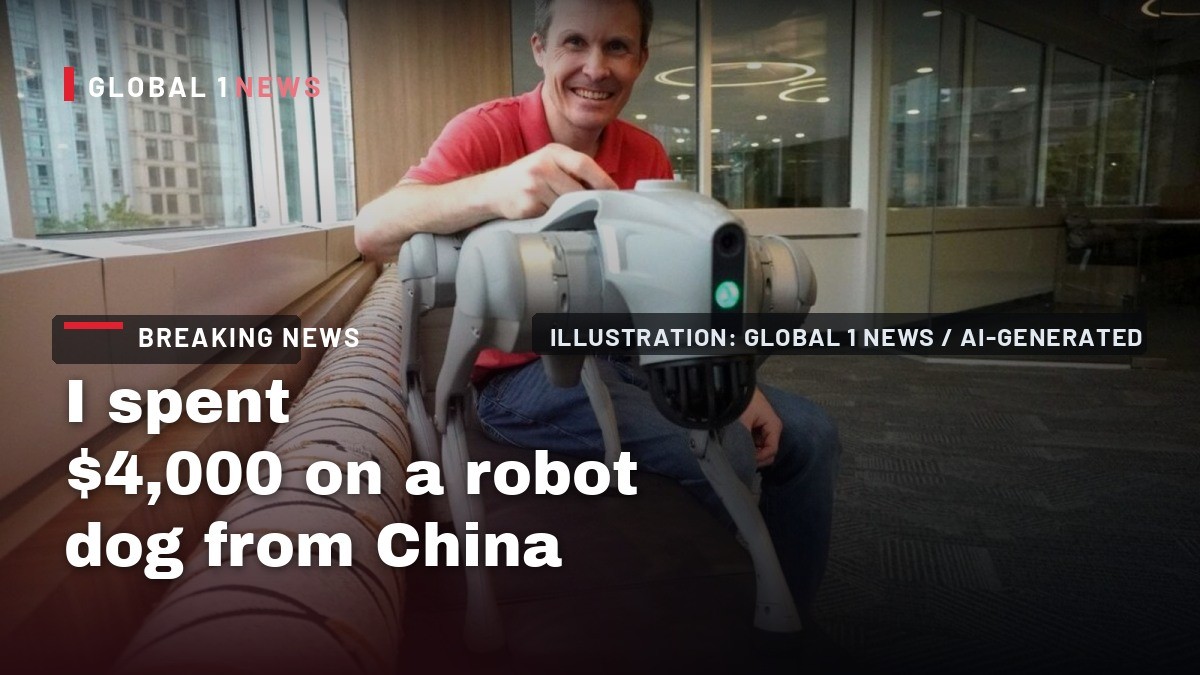
On a bright June morning in Washington, D.C., I took a two‑mile walk to my office with a quadruped robot dog from the Chinese firm Unitree trailing beside me. The sight turned heads, sparked questions, and even provoked a few growls from real dogs. It was a vivid illustration of how far affordable robotics have come, but also a stark reminder of their practical limits.
The Walk That Turned Into a Public Demonstration
My commute through the leafy Mount Pleasant neighborhood was mostly downhill, giving the robot a relatively easy start. Unitree’s Go2 Pro, the model I purchased for $4,017 after tariffs and shipping, carried enough charge to complete the trip with battery capacity to spare. As I approached the White House‑adjacent office building, strangers stopped to snap photos, ask if the robot was mine, and wonder whether it was a surveillance device. The answer was a simple “no” on all counts.
Biological dogs, however, kept a wary distance. Some barked, others simply watched the mechanical companion with curiosity. Children were fascinated; I obliged by having the robot perform a hand‑shake, a handstand, and a leaping trick. The interaction underscored a cultural moment where robots are no longer confined to labs but are becoming public curiosities, even if their utility remains limited.
Battery Limits and Overheating: The Hard Truth of Current Quadrupeds
After recharging during the workday, the return journey proved more challenging. The route turned uphill and the temperature rose to 87 °F (30 °C). The robot’s steps grew labored, and two on‑screen indicators warned of imminent trouble: a battery level at 5 percent and an internal temperature of 84 °C (183 °F). Near my front door, the robot collapsed, rolling onto its back in a graceless tumble. Whether it ran out of power or succumbed to overheating, the failure was abrupt and ungraceful.
This episode highlights a core limitation of today’s quadruped platforms: energy density and thermal management are still immature. While wheeled robots can travel farther on a single charge and drones avoid ground friction altogether, legged robots pay a steep price in power consumption, especially on inclines and in warm weather.
Affordability Versus Capability: Unitree’s Market Disruption
Unitree’s pricing strategy is the story’s most striking element. I paid just over $4,000 for a functional quadruped, a fraction of the cost of comparable models a few years ago. For context, Boston Dynamics’ Spot starts around $75,000, while Unitree’s own earlier models—such as the Laikago (2017) and AlienGo (2019)—cost tens of thousands of dollars. Even the Go2 Air, the cheapest current offering, is more than 97 percent cheaper than Spot, though the comparison is not apples‑to‑apples; Spot is larger and can carry heavier payloads.
The price drop is not merely a marketing gimmick. In June, Professor Xuesu Xiao of George Mason University showed me four Unitree quadrupeds in his lab, each priced around $15,000. He noted that before Unitree entered the market, only a handful of research groups could afford quadruped platforms. Unitree’s low‑cost models have democratized access, allowing more universities and hobbyists to experiment with legged locomotion.
From Quadrupeds to Humanoids: A Strategic Leap
Unitree’s ambition extends beyond cheap robot dogs. Leveraging the manufacturing efficiencies learned from the Go series, the company launched its first humanoid robot in 2023, pricing units as low as $13,500. While still beyond the reach of most consumers, this price point is dramatically lower than the cost of early humanoids, suggesting a potential pathway to broader adoption.
The company’s trajectory mirrors historical tech disruptions: Xerox invented the graphical user interface, but Apple, IBM, and Microsoft made it mainstream. Unitree may play a similar role for legged robots, first by saturating the quadruped market and then by using that foothold to push humanoids into more affordable territory.
Legal Hurdles in the United States
Despite the excitement, Unitree faces regulatory headwinds. The article notes that Unitree’s robots now encounter legal restrictions in the United States, though specifics are not detailed. Such constraints could stem from safety standards, import tariffs, or emerging legislation on autonomous machines. Until these hurdles are cleared, widespread commercial deployment of Unitree’s platforms in the U.S. will remain limited.
For now, the primary use cases in the U.S. appear to be research, education, and niche entertainment. The author of the source piece candidly admits that the robot “is not much useful” around the house, lacking arms or hands for manipulation. Wheeled delivery bots and aerial drones continue to outshine quadrupeds for most commercial tasks.
Technical Anatomy: Why the Go2 Pro Is So Cheap
Simplexity, a robotics teardown firm, recently dissected a Go2 robot dog, revealing that each leg houses three motors: one at the shoulder for angle control and two for the leg segments. Mechanical engineer Luis Elenes explained that this three‑motor configuration provides a “really dynamic range of motion.” By using electric motors instead of the gasoline engines and hydraulic actuators of early Boston Dynamics prototypes like BigDog, Unitree reduces both cost and complexity.
The simplicity of the design also contributes to the robot’s affordability. Fewer components, standardized parts, and mass production in China keep the bill of materials low. However, the trade‑off is evident in the robot’s limited payload capacity and the thermal issues observed during the uphill walk.
What the Future Holds for Affordable Legged Robots
The experience of walking a $4,000 robot dog through D.C. offers a microcosm of the broader robotics landscape. On one hand, the dramatic price reduction has opened doors for research labs, hobbyists, and curious citizens. On the other, the technology still grapples with fundamental engineering challenges—battery life, heat dissipation, and limited utility in everyday tasks.
As Unitree continues to push down costs and expand into humanoids, the market will likely see a surge in experimental applications: campus security patrols, interactive museum guides, and perhaps low‑speed delivery services in controlled environments. Yet, without breakthroughs in energy storage and thermal management, quadrupeds will remain niche compared to wheeled and aerial platforms.
For now, the robot dog I walked with serves as both a proof of concept and a cautionary tale. It proves that affordable legged robots are no longer science‑fiction, but it also reminds us that affordability alone does not guarantee practicality. The next few years will determine whether companies like Unitree can turn curiosity into genuine utility, or whether they will remain fascinating toys for the tech‑savvy few.
This article was produced with AI-assisted research and editorial support. Reporting is based on the source material cited below. Sources: Ars Technica; arstechnica.com; Global1.News (13 September 2026).
By Jessica Ali, Staff Writer
What's Your Reaction?
 Like
0
Like
0
 Dislike
0
Dislike
0
 Love
0
Love
0
 Funny
0
Funny
0
 Wow
0
Wow
0
 Sad
0
Sad
0
 Angry
0
Angry
0

Editor-in-Chief at Global1.News. Atlanta-based journalist who cuts through the BS and tells it like it is. Lead anchor, host, and the voice you hear when the spin stops and the truth starts.















Comments (0)