
Discover how to take your startup from prototype to production at TechCrunch Disrupt 2026
TechCrunch Disrupt 2026 is pitching the classic founder fantasy: turn your shiny prototype into a product that actually works for paying customers. That’s the easy part.
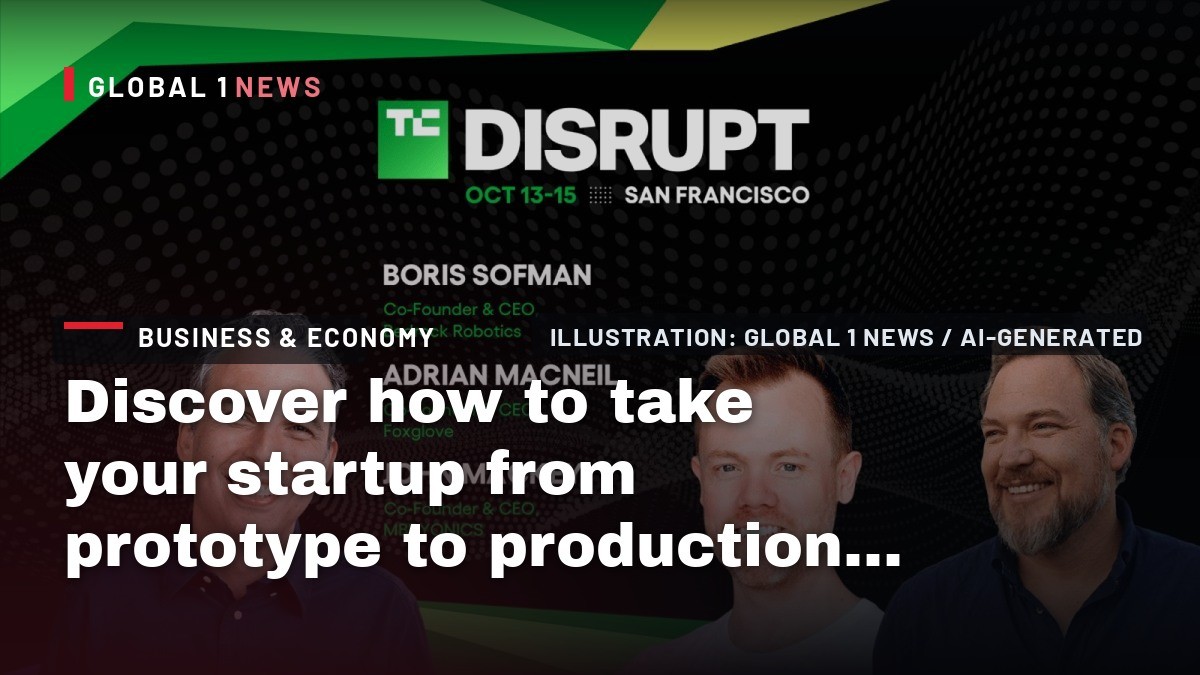
TechCrunch Disrupt 2026 is pitching the classic founder fantasy: turn your shiny prototype into a product that actually works for paying customers. The hype‑laden “Real World AI” stage promises a panel of three founders—Adrian Macneil from Foxglove, John Mackey of MBRYONICS, and Boris Sofman of Bedrock Robotics—who will supposedly spill the beans on moving from lab‑bench to production line. As someone who’s spent a decade wrestling with real servers, network gear, and the inevitable “it works on my machine” syndrome, I’m more interested in what they *won’t* say: the brutal cost of scaling, the hidden traps of hyperscaler pricing, and the reality that most “best practices” crumble the moment you try to run them at scale.
Why the prototype‑to‑production leap is the true make‑or‑break moment
The TechCrunch blurb frames the transition as a natural next step after the “Can it be done?” question is answered. That’s the easy part. The moment you move from a single‑unit proof‑of‑concept to a product that customers rely on, you’re suddenly dealing with manufacturing tolerances, supply‑chain volatility, and the need for an infrastructure that can survive the real world. The article notes that “manufacturing challenges emerge” and “infrastructure has to support growth.” Those are not just buzzwords; they are the exact pain points that turn a promising startup into a cash‑burning sinkhole.
From my own experience, the first mistake founders make is assuming the prototype’s performance will translate line‑for‑line into a production environment. The reality is that a prototype is often hand‑crafted, runs on a lab‑grade server, and is supported by a handful of engineers. When you try to mass‑produce, tolerances shift, component costs rise, and the whole system becomes fragile. The panel’s promise to “share how they’ve navigated that transition” is welcome, but the real value will be in the gritty details—how they dealt with component shortages, how they re‑engineered software to run on cheaper hardware, and how they negotiated with hyperscalers to avoid runaway costs.
The hidden cost of hyperscaler reliance
One of the biggest traps for founders is the seductive allure of cloud giants. The source material doesn’t mention hyperscalers directly, but the fact that Adrian Macneil “led infrastructure engineering at Cruise, developing the data platform that supported autonomous vehicles at scale” hints at a massive reliance on cloud services. In practice, that translates into a pricing model that can double or triple as you scale, especially when you add the data‑intensive workloads typical of autonomous systems.
What most founders don’t realize until they’re knee‑deep in production is that the “pay‑as‑you‑go” model is a myth. Once you cross the threshold of a few hundred thousand API calls or terabytes of storage, you’re negotiating with the cloud provider’s sales team, and the terms become opaque. The panel’s experience with large‑scale data platforms should serve as a cautionary tale: either build a hybrid architecture that can off‑load non‑critical workloads to cheaper on‑prem hardware, or lock in long‑term contracts that protect you from price spikes. In short, don’t let the cloud be the single point of failure for your cost model.
Manufacturing realities: from photonics spin‑out to space‑based networks
John Mackey’s story with MBRYONICS is the classic “lab spin‑out turned high‑volume manufacturer.” The article tells us he “expanded high‑volume manufacturing while helping build the infrastructure behind next‑generation space networks.” That sounds impressive, but the devil is in the details that aren’t in the press release. Scaling photonics from a handful of units to a production line means dealing with yield rates, clean‑room constraints, and the need for repeatable processes. Any variance can drive up costs dramatically.
For independent hosting providers, the lesson is clear: if your product relies on specialized hardware, you must plan for a manufacturing partner that can deliver consistent quality at scale. Otherwise, you’ll end up with a patchwork of custom builds that break under load, forcing you to spend more on support and warranty claims than on actual growth. The panel should be pressed on how they balanced the need for high‑volume output with the strict tolerances that photonics demands, and what contingency plans they had when a supplier fell short.
Autonomous systems: safety, reliability, and the nightmare of real‑world ops
Boris Sofman’s résumé includes a stint at Waymo where “fully driverless vehicles logged more than 100 million driverless miles.” That’s a staggering figure, but it also underscores the massive engineering effort required to keep a fleet safe outside a controlled test track. The source material points out that “consistency and reliability matter every day” once autonomous systems leave the lab.
The panel’s insights into how they ensured safety at scale will be directly applicable to any founder building a SaaS platform that can’t afford downtime. Expect to hear about redundant data pipelines, rigorous testing regimes, and the costly reality that you can’t ship a product until you’ve burned through enough miles or usage hours to prove reliability.
The infrastructure glue: data platforms that actually scale
Adrian Macneil’s claim that he “developed the data platform that supported autonomous vehicles at scale” is a bold one. Autonomous fleets generate petabytes of sensor data daily, and moving that data from the edge to the cloud, then back to a decision‑making engine, is a massive engineering challenge. The article hints that his talk will “underscore the systems and infrastructure that allow complex technologies to move beyond experimentation.”
For most founders, the takeaway is that you can’t treat data pipelines as an afterthought. You need a robust architecture—streaming ingestion, real‑time processing, and durable storage—built from the ground up. Cutting corners here leads to data loss, latency spikes, and ultimately a product that fails to meet SLA commitments. The panel’s experience should be dissected for concrete patterns: how they partitioned workloads, what storage tiering strategies they used, and how they kept costs in check while still delivering the performance required for autonomous decision‑making.
What “best practices” look like when the rubber meets the road
The TechCrunch piece admits that the session “doesn’t promise a single blueprint.” That’s a polite way of saying there’s no one‑size‑fits‑all playbook. In my decade of running production servers, I’ve seen countless “best practice” guides crumble when faced with real traffic spikes, hardware failures, or supply chain disruptions. The panel’s diverse backgrounds—space communications, autonomous trucking, and data platform engineering—should illustrate that the only constant is change.
What I’ll be listening for is how each founder built flexibility into their systems. Did they adopt containerization early, or stick with monolithic binaries? How did they handle version upgrades without breaking downstream services? And crucially, how did they balance the need for speed (getting a product out the door) with the need for reliability (keeping customers happy)? Those are the practical takeaways that can be applied across any vertical, from fintech to healthtech.
Actionable advice for founders staring at the production cliff
At the end of the day, the value of any Disrupt session is measured by the concrete steps you can take tomorrow. Based on the panel’s backgrounds and the themes highlighted in the source material, here’s the distilled playbook:
1. Validate at scale early. Don’t wait until you have a paying customer to stress‑test your hardware and software. Run a pilot that mimics real‑world load, even if it means spending a fraction of your runway now.
2. Decouple core logic from expensive services. If you’re leaning on hyperscalers for AI inference or storage, build a fallback path that can run on cheaper on‑prem hardware. This protects you from price shocks and vendor lock‑in.
3. Engineer for manufacturability. Work with your hardware partner from day one to ensure designs can be produced with acceptable yield. Expect to iterate on the design multiple times before you hit volume.
4. Build redundancy into safety‑critical paths. Whether it’s an autonomous vehicle or a data pipeline, design for failure. Redundant sensors, dual‑network paths, and automated fail‑over are non‑negotiable.
5. Keep infrastructure as code. Treat your deployment pipelines with the same rigor as your application code. Version control, automated testing, and canary releases save you from catastrophic rollouts.
6. Monitor cost as a first‑class metric. Set alerts not just for performance thresholds but also for cost spikes. Cloud bills can explode faster than a DDoS attack.
7. Iterate on operations. The moment you ship a product, you enter the ops phase. Invest in runbooks, on‑call rotations, and post‑mortems. The lessons from Waymo’s 100 million driverless miles are a reminder that reliability is earned, not assumed.
TechCrunch Disrupt 2026 will give founders a chance to hear these lessons straight from the people who’ve walked the path. But remember, the real work begins when you walk out of the conference hall and back into your data center or cloud console. The hype can inspire, but only disciplined engineering and ruthless cost control will keep your startup alive past the prototype stage.
— Allan Ali, Founder
This article was produced with AI-assisted research and editorial support. Reporting is based on the source material cited below. Sources: TechCrunch; techcrunch.com; Global1.News (16 September 2026).
By Allan Ali, Global1.News
What's Your Reaction?
 Like
0
Like
0
 Dislike
0
Dislike
0
 Love
0
Love
0
 Funny
0
Funny
0
 Wow
0
Wow
0
 Sad
0
Sad
0
 Angry
0
Angry
0

Publisher of Global1.News. Automation architect, systems builder, and the guy making sure the truth gets published.















Comments (0)