
China's Delivery Giants Race to Put AI Helmets on Riders
JD.com has launched an AI-integrated smart helmet for food couriers, joining rivals Meituan and Alibaba in a race to equip China's more than 10 million delivery riders with wearable AI. The helmet combines a voice assistant, a camera and route guidance; Meituan has already rolled out over one mil...
China's Delivery Giants Race to Put AI Helmets on Riders
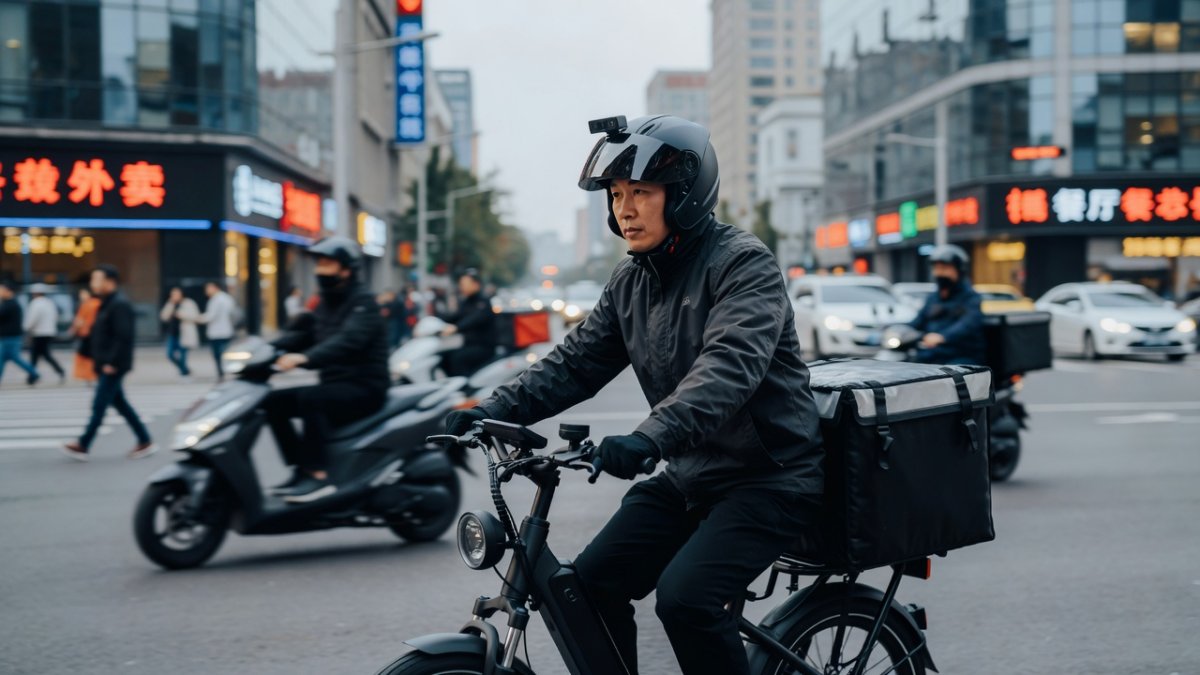
JD.com on Monday became the latest Chinese platform to launch an AI-integrated smart helmet for food delivery couriers, joining rivals Meituan and Alibaba in a race to put wearable artificial intelligence on the heads of the country's more than 10 million riders. The device combines an AI-driven voice assistant with a camera that can "see" the surrounding environment, JD.com's food delivery unit announced on August 3, 2026.
Tags: AI helmet, JD.com, Meituan, food delivery, smart helmet, China technology, Alibaba, Ele.me, delivery riders, AI wearables, gig economy, China market
JD.com's AI Helmet: What the New Hardware Does
The helmet announced by JD.com is designed to minimise distractions in poor weather, when delivery riders — who typically travel by electric bike — struggle to use smartphones with wet hands or limited visibility. Instead of pulling over to tap a screen in heavy rain, couriers can use voice commands to manage new orders, communicate with customers and complete other essential tasks while riding, the company said in a statement published on its official WeChat account.
Beyond relying on online maps, the system provides turn-by-turn voice prompts based on established routes used by experienced riders, helping newer workers navigate unfamiliar areas and avoid delays. Other AI-assisted features include automatically reading customer delivery instructions — such as contactless drop-off requests — and assisting with quality assurance checks when couriers collect orders. For instance, the helmet can automatically flag potential hygiene issues at a restaurant, the company said.
The Rollout Plan: Free First, Then Platform-Wide
The device will initially be distributed free of charge to JD.com's full-time couriers before being gradually rolled out to all food delivery personnel on the platform, according to the company's statement. The phased approach signals that JD.com is treating the hardware as a competitive instrument rather than a premium add-on, with the cost absorbed as part of its broader push into the food delivery market.
The launch highlights a broader industry trend as domestic food delivery platforms adopt AI-powered hardware to address worker safety standards and optimise routes amid intense market competition. Hardware, in this context, has become a visible front in a services war that has already reshaped pricing, subsidies and merchant commissions across China's delivery sector.
Meituan and Alibaba Already on the Road
JD.com is entering a field where its two largest rivals have established a head start. Beijing-based Meituan had rolled out more than 1 million smart helmets equipped with voice communication features, fall-detection sensors and an automated emergency-response function by June 2025. Alibaba's food delivery unit — originally operating as Ele.me, now rebranded as Taobao Shangou — introduced a smart helmet in late 2022 with similar voice-interaction features. Alibaba owns the South China Morning Post.
The different timelines are instructive. Alibaba moved first with a narrow voice-focused device, Meituan scaled aggressively once its hardware met safety and logistics requirements, and JD.com is now attempting to leapfrog both by bundling vision-based sensing with route intelligence drawn from its logistics data. Whether the camera-equipped design proves more useful in daily operations than Meituan's fall-detection approach will depend on how effectively the data is fed back into routing and safety systems.
Why the Safety Question Is Driving Adoption
China had more than 10 million food delivery riders by early 2025, according to an earlier report by state-run news agency Xinhua. With many personnel working under tight deadlines and in harsh weather, safety has become a growing concern for regulators. Electric bikes remain one of the highest-risk categories in China's urban traffic, and delivery riders account for a disproportionate share of accidents involving two-wheelers in major cities.
Platforms have responded with a mix of mandatory training, insurance programs and, now, wearable technology. The fall-detection sensors on Meituan's helmets and the emergency-response functions built into multiple devices are direct responses to regulatory pressure on platforms to demonstrate measurable safety improvements. For regulators, AI-enabled helmets offer a convenient, verifiable metric: a platform can show a declining accident rate and attribute it to specific hardware deployments.
Market Context: The Delivery War Behind the Hardware
The helmet race is a visible byproduct of a much larger competitive battle. China's food delivery industry has operated as an effective duopoly for years, but JD.com's aggressive entry in 2025 reignited the feud with Alibaba and Meituan, according to multiple industry analyses. Subsidies returned, merchant commissions were renegotiated, and rider recruitment intensified across all three platforms.
Analysts have noted that JD.com's daily active users in delivery peaked in mid-2025 before declining week-on-week, illustrating how costly customer acquisition is in this market. Hardware differentiation — a safer helmet, a smarter route, a faster pickup — is one way platforms hope to retain riders and improve unit economics without resorting to ever-deeper subsidies. It also gives each platform a talking point in the public relations battle over working conditions.
The Broader AI Backdrop: An Industry Growing Past 30 Percent
The delivery hardware race sits on top of a rapidly expanding Chinese AI industry. The National Development and Reform Commission (NDRC) reported that artificial intelligence-related industries maintained growth of over 30 percent in the first half of 2026, with a senior official citing stronger computing infrastructure, advanced model capabilities and more active data flows at a press conference on July 31.
Jiang Yi, director of the NDRC's Department of Policy Research and spokesperson for the commission, highlighted that China's first domestically produced 100,000-card AI supercluster was officially put into operation, and that the country's intelligent computing power reached 2.8 times the level of the same period last year by the end of June. Domestic companies including DeepSeek and Moonshot AI have released multiple trillion-parameter open-source large models, with total global downloads of Chinese large models exceeding 10 billion times.
What This Means for Riders, Platforms and Regulators
For the more than 10 million delivery riders in China, the spread of AI helmets carries a mixed promise. The devices can genuinely reduce the need to handle smartphones in dangerous conditions, and the free distribution of hardware lowers the cost barrier. But the same cameras and sensors that assist riders also generate data that platforms can use to monitor performance, verify service quality and, potentially, tighten the metrics that define a rider's income.
The data question is not hypothetical. A helmet camera that can flag a hygiene issue at a restaurant, or confirm a contactless drop-off, is simultaneously a quality-assurance tool and a surveillance instrument. Labour researchers who study China's gig economy have repeatedly noted that algorithmic management already sets the pace of delivery work; wearable sensors extend that visibility from the platform's app to the physical environment in which riders operate. Where the line is drawn between protection and monitoring will depend on the data rules that regulators eventually attach to these devices.
For platforms, the economics are clearer: safer riders mean fewer accidents, lower insurance payouts and less regulatory scrutiny. For regulators, wearable AI offers a new layer of real-time visibility into a workforce that has historically been difficult to monitor. The tension between worker protection and worker surveillance will likely define the next phase of this technology's deployment, and it is a debate that other markets — including Japan, where delivery platforms are also experimenting with e-bike logistics — will be watching closely.
A Regional Lens: What Japan and Asia Pacific Can Learn
The China delivery experiment matters well beyond the mainland. In Japan, food delivery platforms including Uber Eats and local operators have expanded e-bike fleets in dense urban areas such as Tokyo and Osaka, but wearable AI has so far been confined to communications headsets rather than vision-enabled devices. The Japanese market's tighter privacy rules under the Act on the Protection of Personal Information would impose stricter consent and data-minimisation requirements on any equivalent helmet-camera deployment, making China's rapid rollout a useful case study in what is technically possible — and what is legally contentious.
For Asia Pacific markets more broadly, the Chinese platforms are demonstrating that the unit economics of wearable AI can work at scale: hardware costs fall as deployment numbers rise, and the operational data generated by millions of rides improves routing models for every subsequent delivery. That feedback loop — more riders, better data, cheaper hardware — is the same dynamic that propelled China's broader AI industry to more than 30 percent growth in the first half of 2026, and it is a template competitors across the region will study closely.
What to Watch For
The next milestones to track are the scale of JD.com's rollout beyond full-time couriers, Meituan's response in terms of next-generation hardware, and any regulatory guidance on how helmet-camera data may be collected, stored and used. The NDRC has said the legislative process for an artificial intelligence law will be accelerated, which could eventually impose data-handling rules on exactly the kind of edge-AI devices now being deployed at scale.
China's delivery platforms are effectively conducting a live experiment in wearable AI, with more than 10 million workers as participants. The outcome will shape not only the competitive balance between JD.com, Meituan and Alibaba, but also the template for how AI hardware is introduced into gig-economy workforces around the world. For now, the helmets are rolling out — and the cameras are on.
By Kenji Tanaka, China Correspondent
This article was produced with AI-assisted research and editorial support. Reporting is based on sources cited in the article.
What's Your Reaction?
 Like
0
Like
0
 Dislike
0
Dislike
0
 Love
0
Love
0
 Funny
0
Funny
0
 Wow
0
Wow
0
 Sad
0
Sad
0
 Angry
0
Angry
0

Japan Correspondent at Global1.News. Tokyo-based voice covering Japanese politics, technology, economy, and culture. Tracks the intersection of tradition and innovation in one of the world's most dynamic societies.














Comments (0)