
China Urges Citizens to Leave Eswatini, Citing Security Risks Amid Taiwan Diplomatic Standoff
China’s foreign ministry has issued an urgent advisory for its nationals to depart Eswatini, the only African nation maintaining formal diplomatic ties with Taiwan, citing “rampant cyber fraud and criminal activities associated with gambling” and unspecified security risks.
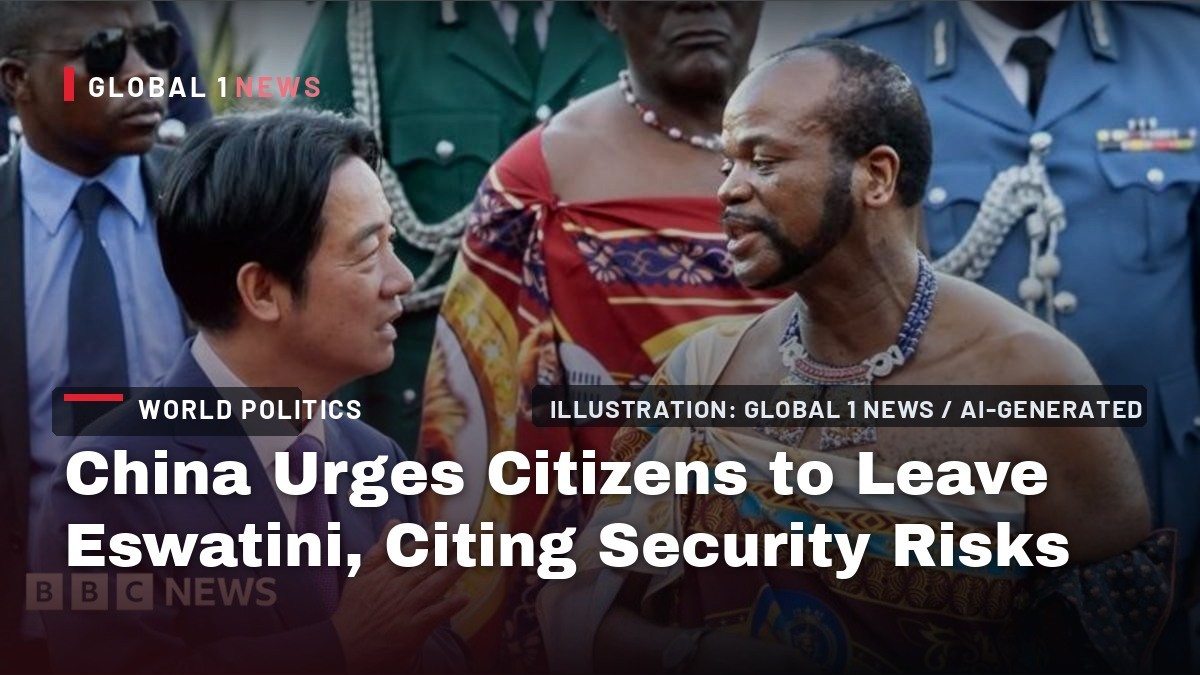
China’s foreign ministry has issued an urgent advisory for its nationals to depart Eswatini, the only African nation maintaining formal diplomatic ties with Taiwan, citing “rampant cyber fraud and criminal activities associated with gambling” and unspecified security risks. The move escalates a simmering diplomatic confrontation between Beijing and the kingdom, which has become a focal point in the cross-strait rivalry for influence across the Global South.
Beijing Issues Rare Security Warning for Citizens in Taiwan-Aligned Kingdom
Mbabane, Eswatini — The Chinese foreign ministry’s advisory, published without detailed elaboration, urges citizens to relocate “as soon as possible” to “relatively safer” countries, explicitly naming neighboring South Africa as a recommended destination. The statement warns that those who insist on remaining in Eswatini will face “extremely high security risks, and the timeliness of assistance may be affected,” a formulation that signals Beijing’s willingness to limit consular support in a country it views as diplomatically hostile.
A Rare Public Warning With Strategic Implications
The advisory marks an unusual public acknowledgment of vulnerability for Chinese nationals abroad, particularly in a nation where Beijing has limited official presence due to the absence of formal diplomatic relations. China’s foreign ministry typically avoids issuing blanket security warnings for entire countries, preferring targeted alerts for specific regions or conflict zones. The broad scope of this advisory — covering the entire kingdom — suggests either a genuine deterioration in local conditions or a calculated diplomatic signal aimed at both Eswatini’s government and the Taiwanese administration in Taipei.
The timing is significant. The advisory comes months after Taiwan’s President Lai Ching-te completed a contentious visit to Eswatini in May, a trip that Beijing had actively sought to derail. China’s foreign ministry had previously dismissed Lai as “an international laughing stock” following the visit, which was conducted without prior announcement and with undisclosed travel routes after several African nations revoked overflight permits under apparent Chinese pressure.
Detention of 40 Chinese Nationals Raises Questions
Local media reports have added urgency to the advisory. The privately owned Times of Eswatini reported on Tuesday that 40 Chinese nationals have been in detention since last month, following their arrest while attempting to leave the country. According to the news site, the individuals were initially arrested in March during coordinated raids on alleged illegal online gambling centers in Mbabane and surrounding areas, alongside dozens of other foreign nationals.
The detained group’s lawyers have reportedly written to the attorney general and the home affairs ministry, asserting that their clients had already pleaded guilty to immigration-related offenses and paid court-imposed fines. The legal representatives contend that the subsequent re-arrest of the 40 individuals, following their release on High Court orders, was unlawful. The Eswatini government has not yet issued a public response to these allegations.
The situation presents a delicate diplomatic challenge for Beijing. While China has no formal embassy in Eswatini, it maintains informal channels of communication and has historically relied on third-country representation for consular matters. The advisory’s recommendation that citizens relocate to South Africa — where China maintains a substantial diplomatic mission — underscores the practical limitations Beijing faces in protecting its nationals in a country without bilateral recognition.
Eswatini’s Lone African Stand in the Taiwan Strait
Eswatini’s diplomatic position is increasingly isolated. It is one of only 12 countries worldwide — and the sole African nation — maintaining official relations with Taiwan. This status has made the kingdom a persistent irritant in China’s broader strategy to isolate Taipei diplomatically, a campaign that has yielded significant results in recent years across Latin America, the Pacific, and Africa.
China’s pressure tactics have been multifaceted. Earlier this year, Beijing scrapped tariffs for all African countries except Eswatini, a pointed economic signal that rewards nations aligning with the One-China principle while penalizing those that do not. The tariff exemption, which covers a vast array of products from the continent’s 54 other nations, effectively excludes Eswatini from preferential trade access to the world’s second-largest economy.
The economic calculus for Eswatini is complex. While the kingdom maintains ties with Taiwan — which has provided development assistance and investment — China’s economic heft in Africa is unmatched. Beijing has become the continent’s largest trading partner, with bilateral trade exceeding $280 billion annually, according to Chinese customs data. Eswatini’s exclusion from tariff benefits represents a tangible cost, though the kingdom’s government has thus far resisted pressure to switch recognition.
Taiwan’s Strategic Calculus in Southern Africa
For Taipei, Eswatini represents more than just a diplomatic foothold; it is a symbol of Taiwan’s continued international visibility despite Beijing’s efforts to isolate it. President Lai’s May visit — his first to Africa since assuming office — was carefully choreographed to demonstrate Taiwan’s enduring partnerships, even as its diplomatic recognition shrinks globally.
The cancellation of Lai’s originally planned April trip, following the revocation of overflight permits by several African nations, exposed the logistical challenges Taiwan faces in projecting presidential travel. The eventual May visit, conducted without prior announcement and with undisclosed routing, highlighted both Taiwan’s determination and the constraints imposed by Chinese diplomatic pressure on third countries.
Taiwan’s relationship with Eswatini dates back decades, rooted in personal ties between the Taiwanese leadership and King Mswati III, one of Africa’s longest-serving monarchs. The kingdom’s strategic location in southern Africa, bordering South Africa and Mozambique, provides Taiwan with a listening post in a region where Chinese influence has grown substantially.
Beijing’s Broader Africa Strategy and the Global South
The Eswatini advisory must be understood within China’s wider Africa strategy, which has evolved from infrastructure-led engagement to a more comprehensive approach encompassing trade, security, and digital governance. Beijing’s recent tariff exemptions for African nations — part of its commitment to opening its market to the continent — reflect a deliberate effort to position China as Africa’s preferred partner, particularly as Western engagement faces scrutiny.
The mention of “cyber fraud and criminal activities associated with gambling” in the advisory is notable, as it touches on a sensitive area where Chinese nationals have been implicated in illegal operations across Africa and Southeast Asia. Beijing has increasingly cooperated with African governments to combat such activities, recognizing that they damage China’s reputation and complicate its diplomatic messaging.
However, the advisory’s framing suggests Beijing views the situation in Eswatini through a political lens as much as a security one. By publicly warning its citizens to leave, China signals to Mbabane that the absence of diplomatic relations has tangible consequences — including reduced Chinese investment, limited consular protection, and now, official discouragement of Chinese nationals residing in the kingdom.
Second-Order Effects for Regional Diplomacy
The standoff carries implications beyond the bilateral relationship. South Africa, which hosts significant Chinese investment and maintains strong ties with Beijing, has been drawn into the dispute as the recommended destination for departing Chinese nationals. This places Pretoria in a delicate position, balancing its economic relationship with China against its regional leadership role and its own diplomatic ties with Taiwan, which it severed in 1998.
For other African nations, the Eswatini case serves as a cautionary tale about the costs of maintaining Taiwan ties. The tariff exclusion and now the security advisory demonstrate Beijing’s willingness to use both economic incentives and diplomatic pressure to achieve its objectives. As China’s engagement with Africa deepens — through the Belt and Road Initiative, the Forum on China-Africa Cooperation, and expanding security cooperation — the calculus for smaller nations becomes increasingly weighted toward Beijing.
The situation also reflects broader dynamics in the Global South, where competition between China and Taiwan — and by extension, the United States — plays out in diplomatic recognition, economic partnerships, and now, citizen safety advisories. For Eswatini, the immediate challenge is managing the detention controversy while navigating pressure from both Beijing and Taipei. The kingdom’s government has remained silent on the detentions, suggesting either ongoing diplomatic negotiations or internal deliberation about how to respond.
What Comes Next for Eswatini and the Cross-Strait Rivalry
The coming weeks will be critical in determining the trajectory of this dispute. The Eswatini government’s response to the lawyers’ allegations regarding the detained Chinese nationals will signal whether Mbabane seeks to de-escalate or is prepared to weather Chinese pressure. Meanwhile, Beijing’s advisory may prompt an exodus of Chinese nationals, potentially affecting local businesses and economic activity in a kingdom already facing fiscal challenges.
For Taiwan, the episode underscores the fragility of its remaining diplomatic relationships. Each incident involving Eswatini — whether the cancelled April trip, the May visit, or now the Chinese security advisory — reinforces the narrative that Taiwan’s international space is shrinking. Taipei’s ability to maintain its African foothold will depend on its capacity to offer tangible benefits that outweigh the costs of Chinese pressure.
Beijing’s long-term objective remains clear: the complete isolation of Taiwan diplomatically, culminating in eventual reunification. The Eswatini advisory, while framed in security terms, serves that broader strategic purpose. By making it more difficult for Chinese nationals to operate in Taiwan-aligned countries, Beijing increases the cost of maintaining such relationships — for the host nations, for Taipei, and for its own citizens caught in the geopolitical crossfire.
The situation remains fluid, with the Eswatini government yet to comment on the detentions or the Chinese advisory. What is certain is that this small southern African kingdom has become an unlikely battleground in one of the world’s most consequential diplomatic confrontations — with implications that extend far beyond its borders.
By Prof. Marcus Chen, Staff Writer
This article was produced with AI-assisted research and editorial support. Sources: BBC News.
What's Your Reaction?
 Like
0
Like
0
 Dislike
0
Dislike
0
 Love
0
Love
0
 Funny
0
Funny
0
 Wow
0
Wow
0
 Sad
0
Sad
0
 Angry
0
Angry
0

World Politics Analyst at Global1.News. Based in Beijing, covering US-China relations, global trade, and geopolitical strategy. Brings deep analytical perspective to the power dynamics shaping international affairs.














Comments (0)