
China's Record 4-Million-Vehicle Recall Puts Tesla and Hidden Door Handles in the Regulatory Crosshairs
China has ordered its largest-ever car recall — more than four million vehicles, mostly Teslas — over hidden door handles that can trap occupants after a crash. The action precedes new rules taking effect 1 January 2027, making China the first country to ban concealed handles without mechanical release mechanisms.
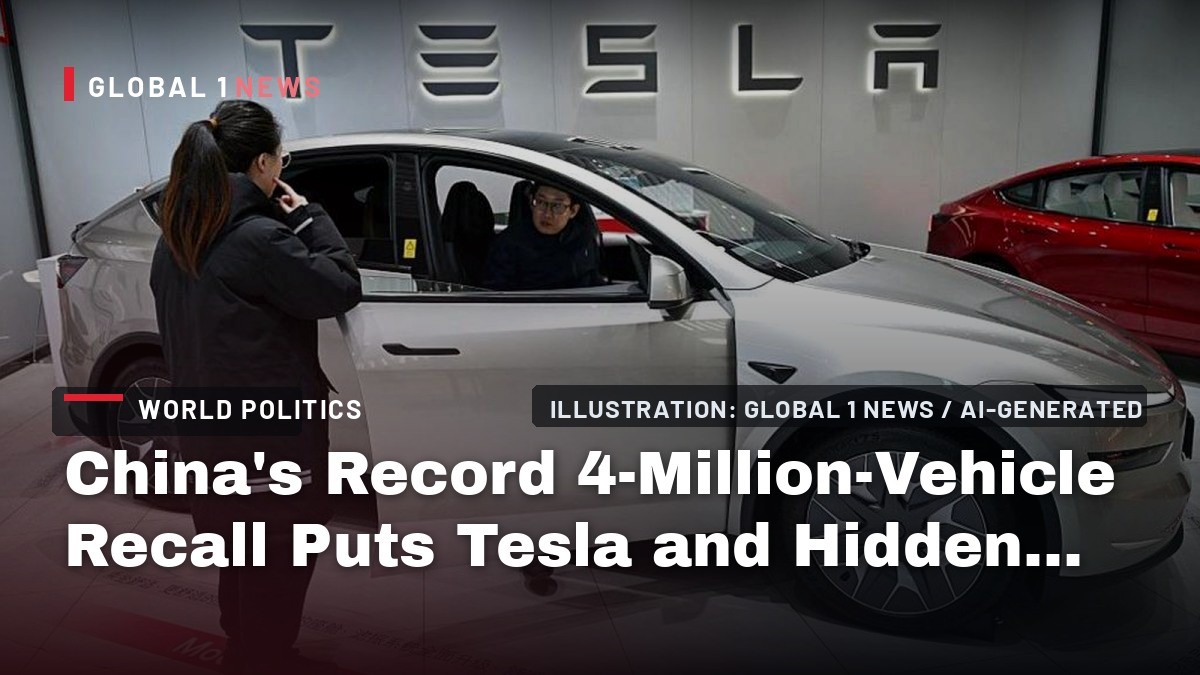
In a landmark move that signals Beijing's growing willingness to impose its own safety standards on the global automotive industry, China has announced its largest-ever car recall, affecting more than four million vehicles. The bulk of these are Teslas, with additional recalls covering domestic manufacturers Xiaomi, XPeng, and Geely. The action, announced by the State Administration for Market Regulation (SAMR) on 21 August 2026, targets the increasingly popular but controversial hidden door handle designs found on many electric vehicles (EVs). The recall is a direct precursor to new regulations taking effect on 1 January 2027, which will make China the first country in the world to ban concealed door handles that lack mechanical release mechanisms on both the inside and outside of the vehicle.
The Scope of the Unprecedented Recall
The sheer scale of the recall underscores the pervasiveness of the design flaw. According to the SAMR, Tesla is recalling nearly three million vehicles, a figure that dwarfs all previous actions. The agency stated that the recalled cars have door handles that are "difficult to identify" because their colour closely matches the vehicle's interior trim. More critically, in the event of an electrical failure, the handle design may prevent passengers from quickly opening the doors to escape or could "hinder rescue efforts" by bystanders. Beyond Tesla, Xiaomi, XPeng, and Geely will collectively recall more than 750,000 vehicles. The manufacturers have been ordered to add warning labels inside vehicle doors to instruct passengers on how to open them, and some cars will receive a software update designed to lower the windows automatically in the event of a crash.
The Rise and Risk of the Hidden Handle
Hidden door handles, popularised by Elon Musk's Tesla, have become a defining aesthetic feature of the modern EV era. Their minimalist design offers a "sleek look and reduces wind drag," as noted by Stephen Dyer, a car industry analyst at consultancy AlixPartners. However, this design choice has increasingly been scrutinised for its practical and safety implications. Dyer, who is based in Shanghai, admitted that even he often finds it difficult to locate the switch to open the door from the inside of an unfamiliar vehicle. The issue transcends mere usability, moving into the realm of life-saving technology. Nanyang Technological University associate professor Lyu Chen highlighted the "real safety concerns" that arise when electronically powered door handles fail to open promptly, delaying rescue efforts after accidents. "A door handle may seem simple, but it becomes safety-critical in the seconds after a crash," Chen said.
Fatal Incidents and the Catalyst for Change
The regulatory shift has been accelerated by a series of tragic incidents. Chinese carmaker Xiaomi faced intense public scrutiny following two fatal crashes in 2025 involving its SU7 model, where suspected electrical failures allegedly trapped occupants. One incident on a highway in Tongling city, eastern China, resulted in three deaths, according to regional news coverage cited by state-controlled media Global Times. Relatives of the victims stated that passengers were stuck in the car as the doors could not be unlocked after the collision. While Xiaomi's representatives maintained that the SU7 had mechanical emergency release handles located at the bottom of each door, the company has since updated its latest models with handles that can be opened without power. The company has not responded to BBC requests for comment on the recall.
Legal Precedents and the US Experience
The concerns are not confined to China. Tesla has faced lawsuits in the United States over its door handle designs. The company was sued by Jordan Miller, the only survivor of a 2024 crash involving a Cybertruck that killed three college students in California. Miller alleged that the Cybertruck's design trapped passengers in the burning vehicle and blocked their rescue. His lawyers from The Veen Firm argued that the car lacked door handles and that the electronic buttons meant to open the doors failed to work. "When you design a vehicle with no mechanical way to open the doors from the outside, you are betting the electronics will work in every scenario, including a high-speed crash followed by a fire," one lawyer stated. In court filings, Tesla denied any wrongdoing and asserted that the Cybertruck complies with US federal safety standards, as reported by the Guardian. There have been other US cases of passengers, including children, allegedly being trapped in Tesla cars after the doors suddenly stopped working.
China's Regulatory Leadership and Industrial Policy
China's decision to ban hidden door handles, announced in February, positions it as a global pioneer in this specific area of vehicle safety. The new rules, which take effect on 1 January 2027, stipulate that new car designs without physical release mechanisms on the inside and outside of their doors cannot be sold. The cars' interiors must also carry signs showing how to open the door. This proactive stance is notable because it places China ahead of the US and the European Union, which typically lead regulations around road safety and emissions. Analyst Stephen Dyer noted that one reason for China's swift action is likely the sheer number of EVs on its roads. With around 60% of the top 100 best-selling new energy vehicles featuring hidden handles, the potential for risk is magnified, making regulatory intervention a matter of public safety and consumer protection.
Geopolitical and Strategic Implications for Global Automakers
This regulatory move is a clear assertion of China's growing influence in setting global standards for the automotive industry. By mandating a specific safety feature, Beijing is not just protecting its domestic consumers but also shaping the design parameters for cars sold worldwide. Since cars are built to sell globally, it is highly likely that the safety requirements established in China will be adopted elsewhere, as engineering lecturer Lyu Chen suggested. This creates a significant strategic challenge for global automakers, particularly Tesla, which must now adapt its designs to comply with the world's largest EV market. The recall and subsequent ban force a recalibration of the "sleek design" ethos that has dominated EV aesthetics, prioritising functional safety over minimalist form. For US-China competition, this represents a shift from competing on technology and price to competing on regulatory leadership and safety standards, a domain where China is now taking the initiative.
Criticism and the Limits of the Current Measures
Despite the scale of the action, some engineers argue that the measures may not go far enough to resolve the underlying safety concerns. Engineering instructor Lim Hong Wee from the National University of Singapore pointed out that the measures do not address the need for a mechanical way to open the doors from the outside. Access to a car during an emergency should not depend on software, he argued. Gokul Krithivasan from risk management consultancy SecureSafe echoed this sentiment, stating that the measures mainly address the issue of people being able to get out of a vehicle but do not provide a reliable way for rescuers to get in. He dismissed warning labels as a "weak remedy," noting that "when panicked, people fall back on their instinctive responses, and don't read small print in a dark and possibly smoke-filled cabin." This criticism highlights a potential gap between regulatory intent and real-world emergency dynamics.
Global Ripple Effects and the Future of Door Design
For now, it remains unclear whether similar recalls will be initiated outside China. The BBC understands that carmakers have not yet notified authorities of any plans for a similar recall in the US. The US National Highway Traffic Safety Administration has told the BBC that it is reviewing whether it will require emergency door-exit systems in vehicles. In Europe, regulators have flagged the potential hazards related to hidden handles and have drafted new standards to ensure they still work even if a car's power is cut off. The common principle, as articulated by Lyu Chen, is clear: "emergency entry and exit should remain possible even after a loss of electrical power." As manufacturers and regulators worldwide pay increasing attention to door design, China's decisive action serves as a powerful precedent, likely accelerating a global shift towards fail-safe mechanical systems in the next generation of vehicles.
This article was produced with AI-assisted research and editorial support. Sources: BBC News.
By Prof. Marcus Chen, Staff Writer
What's Your Reaction?
 Like
0
Like
0
 Dislike
0
Dislike
0
 Love
0
Love
0
 Funny
0
Funny
0
 Wow
0
Wow
0
 Sad
0
Sad
0
 Angry
0
Angry
0

World Politics Analyst at Global1.News. Based in Beijing, covering US-China relations, global trade, and geopolitical strategy. Brings deep analytical perspective to the power dynamics shaping international affairs.















Comments (0)